
 |
Vision | Projects | Blog | Articles | Awards | Order | Reviews | |











































|
Week 39, 2014: Both Iconoclasm and Turn of Time have now reached a mature stage. The 4 player testing is completed and annotated test games have been published to the Iconoclasm and Turn of Time homepages. Some additional testing of the 2/3/5 player variants remain but I'm in no hurry to order the prototypes. Instead, I consider options for exposing the game ideas to other people first:
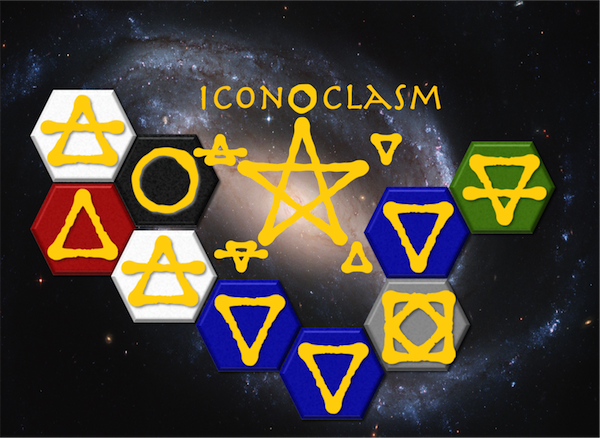
Speaking of crowdfunding, Find the Bug! unfortunately failed to fund. It was a gamble to design a game for a non-gamer community (the testing community), even if several colleagues have shown interest. Nevertheless, I find consolation in the fact that many people looked at the game at FundedByMe, The Game Crafter and my own homepage and have learnt many lessons for future crowdfunding. The most important one is to build a fanbase first, which is what I will do before I launch the campaign for Iconoclasm (if the game turns out good enough of course). There are several good sources on how to do this, for example Stonemaier Games Kickstarter Lessons. Additional advice are as always welcome! If you belong to the crowd who liked Find the Bug!, the game is available both at The Game Crafter and as a free Excel version at the game homepage. Week 38, 2014: Another intensive week is at an end. Iconoclasm had another update whereby spirits are removed at iconoclasms as well. This, in combination with a forced move rule in the end turn, created a less chaotic and more predictable (i.e. tactical) game. The rules and annotated games are available at the Iconoclasm homepage. My second game in progress, Turn of Time, also has a homepage and is also available at The Game Crafter. It still needs some testing to assess the need of a game length limit and come up with good strategic advice but the rules are very solid so far. Least but not last, Kickstarter finally opened up for Swedish submissions so perhaps Iconoclasm will launch a crowdfunding campaign sooner than expected. An alternative is to first publish the game as work in progress at Boardgamegeek to get feedback. Do you have any preferences for which game that is best suited for crowdfunding and by what means? Please let me know! Week 37, 2014: An intensive week is at an end. The testing of Iconoclasm entered a second level as I tested and rejected several variants until I was satisfied. The game components have now been created at The Game Crafter. The 5th Street Challenge contest proceeded to the semifinals but unfortunately without my games Bake the Cake! and Find the Treasure!, although they did receive more votes than my previous contest game, Mare Balticum. A new contest has already been announced, Time Challenge, and I already have an idea for a game. Initially, I thought of rewriting Iconoclasm with seasons instead of elements, but the contest cost limit is too low for that game. Instead, I continued with the idea of four seasons fighting each other by turning time back and forth and Turn of Time was born! It's going to be yet another abstract game and the initial tests are promising. Another piece of good news was that my crowdfunding campaign for Find the Bug! got its first backers. They're most likely too few and too late but it's nevertheless an improvement compared to my first crowdfunding campaign. I still think testing is too narrow for a game but perhaps Iconoclasm can attract more backers with good pre-marketing? Week 36, 2014: The focus of this week was writing strategies for my old games. In my testing methodology, I recommended using test documentation for this purpose, and after having done it myself, I've realized how powerful it is for understanding what takes place in the player's mind while playing. Even seemingly simple games like the children's games Bake the Cake! and Find the Treasure! can take advantage of strategic thinking. All the strategies can be found on the homepage and eventually on Boardgamegeek.
Three other games already participate in contests. The 5th Street Challenge has started with my games Bake the Cake! and Find the Treasure! However, there are 65 contestants in total so the competition is fierce. The 18 Card microgame contest has also started with my card game version of Vasa Regalis. Fingers crossed! 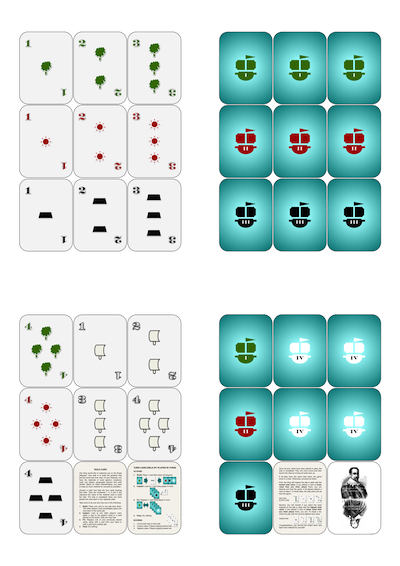
Concerning my crowdfunding campaign for Find the Bug!, it seems like the concept of a testing game appeals to a too narrow audience. On the positive side, the campaign has attracted quite a few visitors and I will build on my experience for my next (?) campaign.
After the idea was born, I took the opportunity to apply my testing methodology by first identifying the game objectives, then "unit testing" the concepts and mechanisms and finally "system testing" the entire game. It looked very promising so I proceeded with outlining the game components and rules. As always, new games give me thrills and I devote myself fully to Iconoclasm. 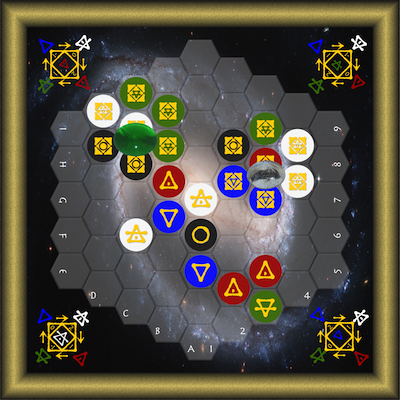
However, I also allowed time for my old games and returned to the very first: Nova Suecia. It was based on the the prisoners' dilemma mechanism, where the players as governors had to balance between paying tax to the colony and keeping gold for themselves, but it didn't work very well in the game since players could pay only for their interests and ignore the rest. A discussion about this with a friend suddenly gave me the idea of turning the taxation into a take-that mechanism, where a player's tax would have secondary effects, both positive and negative. The mechanism also removed the need of forts as a tax reward and made the game $5 cheaper. Nova Suecia may still not be my favorite among my games but it took a huge step forward and somehow, I think I owe that to my first game. Week 34, 2014: This week was devoted to game testing, starting with Find the Bug! at the office together with colleagues from the software testing team. 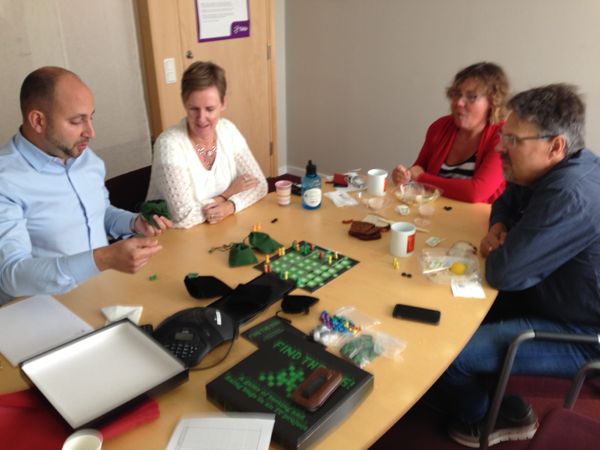
I also wrote an article on the subject for later publication on LinkedIn, Boardgamegeek and test forums. Unfortunately, the planned weekend testing had to be cancelled due to testers not being able to come. Another setback was that the crowdfunding campaign for Find the Bug!, in spite of many visits, is beyond the target. As feared, a test game may appeal to too few investors, and I have to see it more one of many steps to build a brand. Instead, I used the free time to lower the prices of Christina Regina and Vasa Regalis with $5 each. In Christina Regina, I simply removed the 0 chamber and 4th chamber tiles and in Vasa Regalis, I replaced the cardboard with a mat. In addition, I did a test of my own of "the perfect game", Tigris & Euphrates, and also wrote a review. The test passed with a good margin and serves as inspiration to all those test designers longing to create the perfect game themselves. 
Week 33, 2014: Rob Daviau (@robdaviaugamer) said that "if you don't like making your work more marketable, you're not a designer, you're an artist". Well, this week has all been about marketing. It started already the Friday before when I submitted my crowdfunding campaign for Find the Bug! to FundedByMe. This was followed by a number of activities aimed at creating awareness of the Nova Suecia Games:
In addition to the above, I published all games at Boardgamegeek, including description, images, weblinks and designer's own review. I also published an article on learning by gaming at Linkedin and submitted the same to the test community Testzonen. My intention is to continue publishing articles that connect my interest in gaming with my profession in testing during the crowdfunding campaign. Finally, I celebrated the launch of the campaign with a traditional Swedish "fika" at the office. 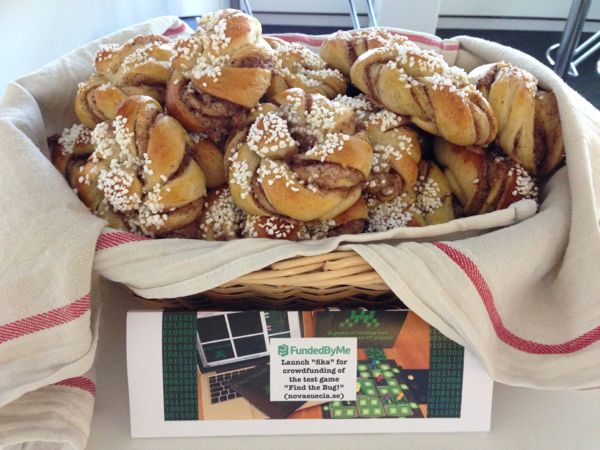
Week 32, 2014: The week started great as I unpacked my second delivery from The Game Crafter. 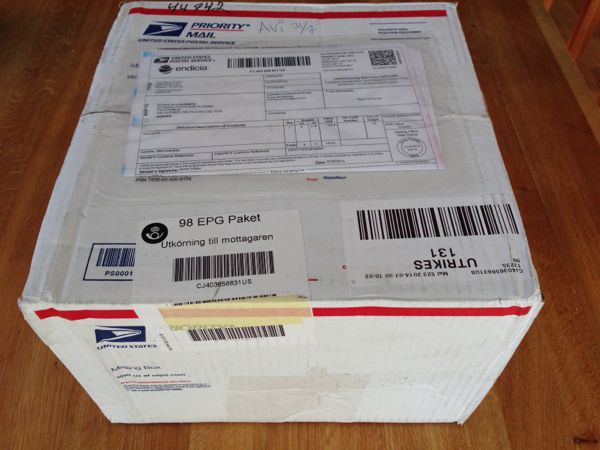
The first game to unwrap was Find the Bug!. I had been worried whether the chits would fit on the game board and in the bags but the fit turned out to be just perfect! My only concern was that the green gem was very dark and may easily be taken for a black gem. Fortunately, they will only have to be compared with yellow and red gems while the black gems aren't used until the end of the game. One thing was changed: the fix markers were removed and placed on the back of the pass markers instead. By that, I could use 1 sheet less and decrease the cost with $4. (Why didn't I think of that before?) 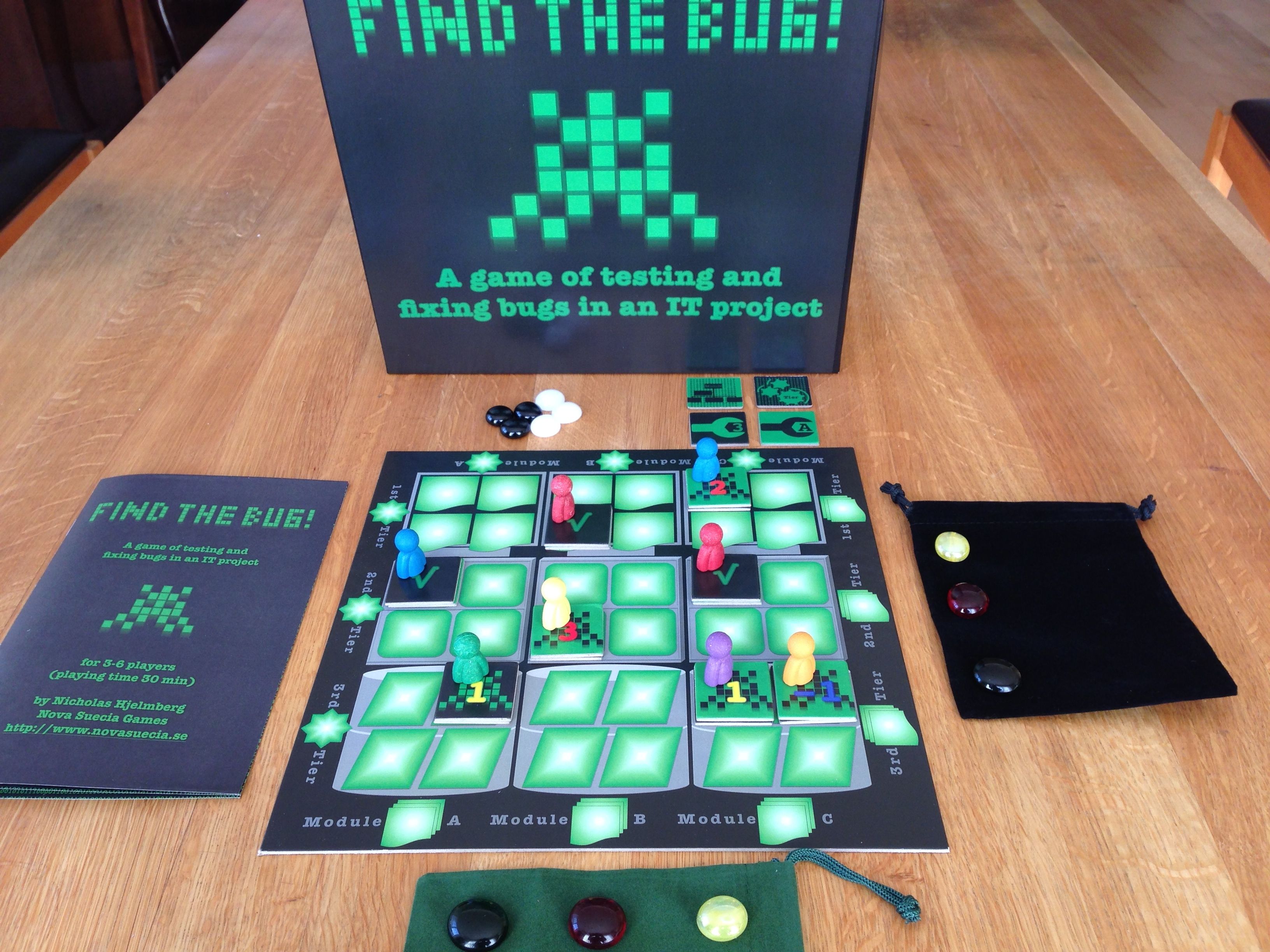
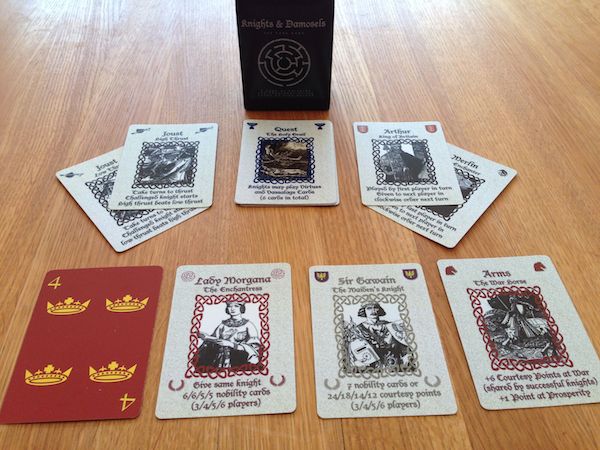
Next, I unpacked my card games Christina Regina and Knights & Damosels. Again, I was very happy with the quality and there was really nothing to complain about. I may consider changing some of the knights' names (such as Tristram instead of Tristan) and descriptions (such as "son of King Lot" instead of the Maiden's knight) but nothing else. 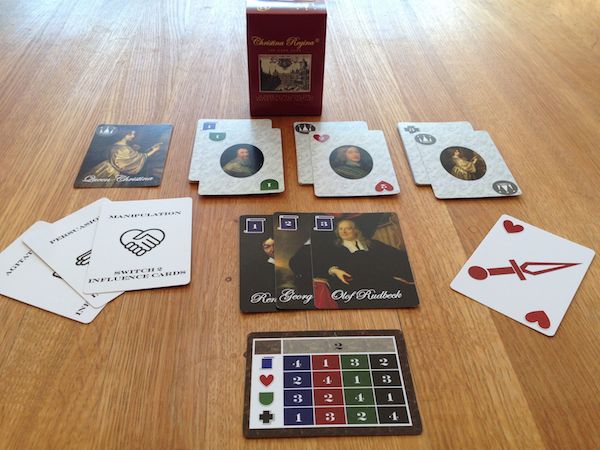
After that, it was time to unpack Bake the Cake!. It was meant to be a colorful game and the colors turned out very well. It may be easier to simply place unused ingredients in the box rather than stacking them on the table mat (the 6 player game will require stacks of 12 ingredients each!) but since it's necessary to keep them away from the players, I will keep the table for now. There is a potential to reduce both the cost and the stack by only having 1 ingredient per player but I fear that the game would be too unflexible by that. 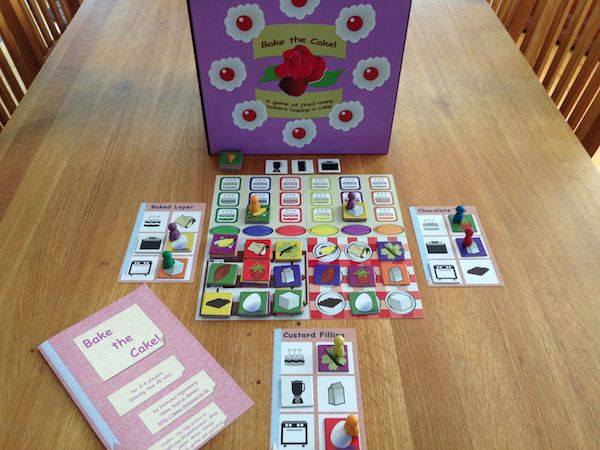
Least but not last came Find the Treasure!. It came with 154 chits and it turned out to be a lot. It took some time to build an island with the chits but the distinct colors and sturdy material made it fairly easy and I hope that the setup time will be compensated by the variation offered by a modular map. Another concern had been whether the chits would be too small and unstable but the completed both looked nice and withstood "table quakes". The chevrons used as lid markers were slightly bigger than expected but overall I think the "pirate" feeling is there. 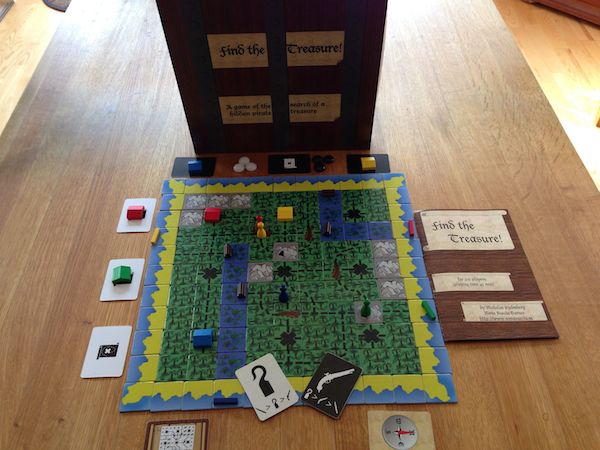
Further images were taken for the shop action shots and all games are now ready for publishing! Finally, I submitted an application to FundedByMe for Find the Bug!. If approved, I plan to market it through both game and professional networks. Week 31, 2014: Proceeding with my different marketing options, I now turned to Find the Bug!. Find the Bug! is the next game I consider for crowdfunding (aimed at test communities) and as a pledge level, I would like to offer an electronical version of the game. The result was Find the Excel Bug!.xlsm. Find the Excel Bug! replicates all the board game rules in 3 spreadsheets: 1. Game Board is where the testers assign the testers to analysis, test and retest. This is also where the game is automated through macros:
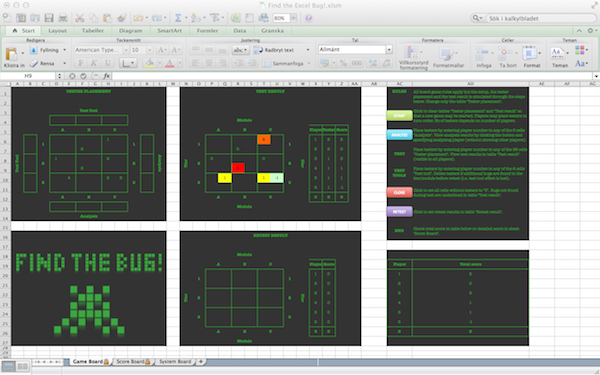
2. Score Board is where the players' detailed score is shown. It's used only for the players' reference. 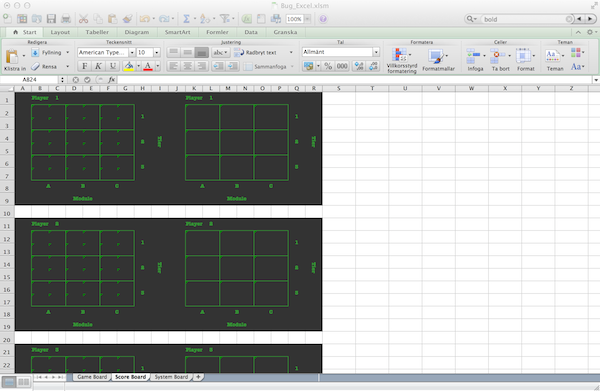
3. System Board is where the game setup is stored. It's used by the game only but if game master leads the game, he or she may refer to it. 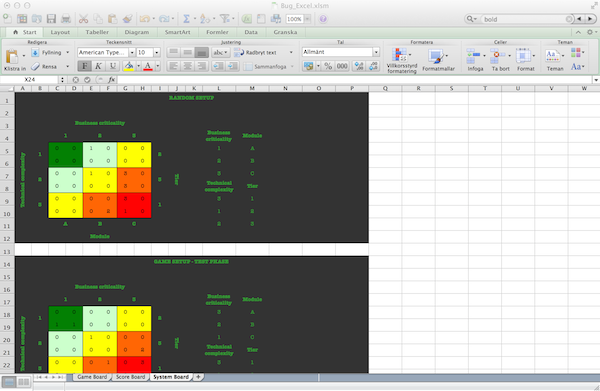
Of course, a test game needs to be tested but the draft version is available here. Week 30, 2014: After a week's vacation I returned to my games. With the design phase completed, it was time to look at the different marketing options. The first task was to create P&P versions of my two card games, Christina Regina - the Card Game and Knights & Damosels. Since they are card games only, I simply inserted all png files in word processing document with fronts at even pages and backs at odd pages. The idea is to encourage players to test the game and provide feedback. Old blog posts may be found here:
|
Please leave a comment on the games or contact me directly at nicholas.hjelmberg@gmail.com. |
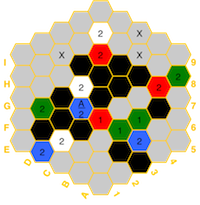 My new game also has a good progress. The rules and game components have been polished and
another test round completed. One complete annotated game is published
My new game also has a good progress. The rules and game components have been polished and
another test round completed. One complete annotated game is published
 Week 35, 2014: This week's great news is the birth of a new game idea: