
 |
Home | Game | Rules | Theme | Strategy | FAQ |  |






































|
Enter all victory paths, exit oneKnights & Damosels has three different paths to victory:
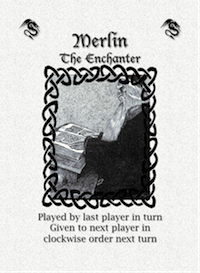
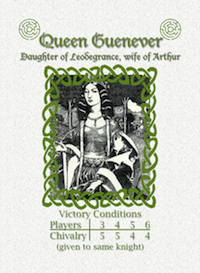
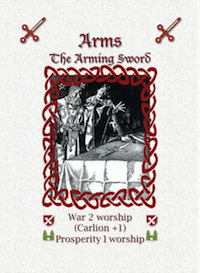
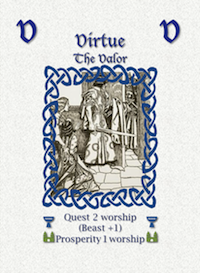
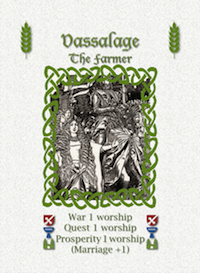
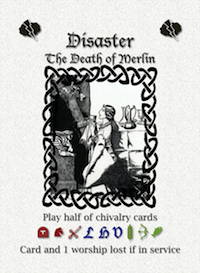
Worship victoryThe first victory path is quite difficult to attain. Unless you're very fortunate in quests and wars, it's likely that a knight or damosel victory is triggered before you reach the victory level. That said, you should still aim for that victory for two reasons. First, if you participate in a quest or war where less than three knights succeed, you will score higher and with some luck with the events drawn (many quests/wars or few disasters), the level may suddenly turn attainable. You can also use the Arthur role to your advantage. If in a turn you play the Arthur role, you can play a card similar to the card or cards that the other knight in the quest or war will play. This could be the case when another knight only has a sword. By playing sword yourself, you increase the risk (chance) that the first war round fails, after which you as Arthur can choose to remove the other knight from the war. For each knight removed, there will be less knights that share the 6 points awarded for the success. If you really want to gamble, you can play for becoming the only knight left and get all 6 points yourself. It's risky but you must take risks to win! Second and more important, if you abstain from wars and quests, you will allow other players to get more than 1 knight on them and thus score 4-6 points per player. This would most likely give the game a worship victory but it will not go to you! Knight victoryPlaying for a knight victory has several advantages. First, just like the case for worship, you make it more difficult for other players to win a knight victory. Second, the chivalry cards you acquire will enable you to acquire worship by participating in wars and quests. Third, by equipping your knight, you increase your odds of winning the Camlann battle in the end. To win a knight victory, you must either pick more than one card per turn or have the other players lose cards in disasters. The latter is risky since disasters may just as well strike you but the former can be accomplished by selecting the right chivalry card. Which is the right card then? The answer is the card that leaves other players without cards. If for example there is a sword and farmer left and the other players already have swords, you should pick the farmer first and then, when it's your turn again, the sword. Those situations will happen by themselves in the game and can be created by a good use of jousts (see further below). Remember that no matter how many cards you manage to take in a turn, you will still not take cards from more than 1 damosel and thus not increase the chance of another player's damosel to win a damosel victory. Speaking of damosel victories, you should also be cautious with the "obvious" cards. If the only arms card you lack is sword, the war event turns up and a sword is played from a damosel, it's very likely that the sword comes from the damosel whose cards you already have. It would then be wise to take another card instead and even leave the war to the other players if the worship victory is out of reach anyway. Use your Merlin role when you have the chance to see which cards that have been placed on the table. To allow another player a damosel victory will hurt your knight in the final battle of Camlann as one card is lost to the damosel player and isn't a risk worth taking. Damosel victoryPlaying for a damosel victory is difficult but almost risk-free and very beneficial if you succeed. Not only does your knight gets an extra card in the battle of Camlann but another knight will lose a card. To play for a damosel victory, you need to keep track of which knight that takes your cards and then ensure to play cards which that knight lacks but which the other knights already have. (You want to ensure that only he and nobody else takes the cards.) The only risks with playing damosel victory (but which shouldn't be neglected) are that the knight gets so powerful that he will win a worship victory or be stronger than your knight even after giving up a card to him. About joustsJousts may seem pointless, as the challenged knight has 50% chance of winning in the first round while your knight only has 50% chance of drawing. However, next round, the roles are opposite so you actually have 33% chance of winning a joust. Recalculating this into expected returns, you invest 0.67 points (67% risk of losing 1 point) but gain 0.33 times your objective. Considering that you get 1 point just by winning the joust, you should joust whenever a victory awards you a better action than your currently available action! What is a "better action" then? Clearly you shouldn't joust for the right to draw a vassalage card if there's a second vassalage card available. But if you're the only one who can draw the second vassalage card, you should joust for the first card and then draw the second card, earning 1 extra point. Another action would be to become the last knight in a war or quest, where you may gain 2 worship points or even more. Of course, you may lose the joust as well but if you don't take risks, you will end up in the middle and from there, you will never win Knights & Damosels! One more thing to remember is to do this calculation not only as a challenger but as a challenged. You should always accept the challenge (50% chance to earn 1 worship and 0% risk to lose) but if you lose the first round, you basically turn into a challenger. If there's an equivalent action available for you, you should consider declinging rather than risk losing 1 worship. The end gameOne final word about the end game - the Battle of Camlann. This is a multi-player rock-paper-scissors competition where the last man standing wins. You have two major decisions: which side to choose and which cards to select. For the side to choose, you will obviously want to be on the winning side to have a chance of winning the game but also be siding with weaker players (as measured by their worship points) to increase your own chance of winning. Since one chivalry card can defeat several, the two sides are fairly equal no matter how many knights there are on each side. Thus, you should let your own winning chances dictate your choice. If you have a high worship, you should side with the knights with the smallest worship to maximize your chance of winning the final worship draw. If, on the other hand, you have few chivalry cards, you should side against the fewest knights to minimize the risk that a card defeats your card. Which side that will be depends entirely on the other players' decisions so you need to predict that. Once the battle start, identify the cards you want to save to last and keep them on your hand. Since each card type will be defeated by two other card types (e.g. arms is defeated by both arms and virtues), you will have to expect the first cards to be lost. Which cards do you want to save then? At least one of each card type is good to give you flexibility. If the opposing players seem to be having many cards of a specific type, you should save cards of the the type that defeats that (e.g. save arms if they have vassalage). Be prepared to reevaluate your hand every turn. When the battle have lasted a few turns and the first players been eliminated, it's time to play cards that you can expect to survive (e.g. an opponent with mainly arms left will leave your virtue card alive). The key to winning the Battle of Camlann is simply to defeat cards without losing cards yourself. |
|

