
 |
Home | Game | Rules | Theme | Strategy | FAQ |  |














|
Version History
The complete rules are available in the PDF file to the right. In the following sections, I will describe how they came to be. Let's start with the essence of the game. Implemented RulesThere are many ideas that are tested in Iconoclasm©. On this page, I would like to present some of them and their outcome. Starting mattersThe game may start either with an empty board or with 1 of each element matter already on the board and disconnected. The first option gives the players more flexibility when it comes to placing their matters but also gives more external clashes before this "pangea" starts breaking up. The second option works in the opposite direction as "islands" of units are created and then slowly moves towards external clashes. The second option turned out to give the most interesting games. Neutral elementThe fifth element of spirit is a neutral element. It may still be part of a unit placing an icon but never forms its own units and never supports any side. More importantly, spirit may not act as a connecting matter between units and thus serves as a "buffer" zone. This adds another tactical element to the game as players can protect their units. Tie-breakersMajorities determine the outcome of clashes but with only seven matters in a units, ties are bound to be frequent, so how are they handled best? There are two basic philosophies regarding ties. The first is to to break all ties through various tie-breaker rule and the second is to simply leave the tie as is. The support rule is a core rule of Iconoclasm and has been used in all versions as the primary tie-breaker but for secondary tie-breakers, earlier versions hesitated between the two philosophies. One idea was to determine secondary supporting elements or opposing elements, another idea to leave large masses of tied matters until eventually a majority can be claimed somewhere. The first was complicated rule-wise (basically a flow chart would be needed to keep track of this) while the second was complex game-wise (identifying a majority in a large mass, also taking into account support, is not an easy task). I finally gave in for the simplest tie-breaker of them all: turn order. Who takes over a unit and when?The idea of replacing one winning matter with a spirit matter in an external clash is to create a dynamic game where it's not the strongest element that wins but the element that is strongest in the right time. But how can the other elements benefit from a reduced winner? A new external clash will be easier to win but how about internal clashes? I wanted to allow the strategic option of "unit reforming" or latent clashes, where the supporter eventually take over the unit but I didn't want this to happen after every external clash. The rule that a supporter takes over if stronger than the current element owner turned out to give the best balance as the table below shows.
This rule was refined through several iterations until finalized in version 1.0. End gameA game where removed pieces (after clashes) can return (in subsequent player turns) has no finite end so how to avoid infinite games? One idea would be to let pieces removed from the board be permanently removed from the game but this would make it hard to recover from early clashes (and, from a production economy perspective, require redundant components as some will be removed while others haven't even entered yet). Instead, I borrowed from my own game Lucca to remove only one piece permanently and end the game once an element is depleted (unless ended earlier through a victory condition). Annotated gamesComplete test games are presented under Annotated Games. |
Boardgame Rules (Video)
Boardgame Rules (PDF)
Cardgame Rules (Video)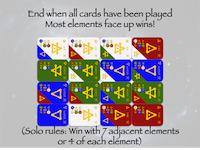
Cardgame Rules (PDF)
... and Rejected RulesThere are of course also ideas that did not make it and here I explain why. Hidden handsShould the matters on hands be open or hidden by screens? On one hand, hidden hands would add an extra memorize challenge. On the other hand, the player colors are unknown anyway and the rest of the game is open. Since I wanted a tactical game rather than a memory game, the hands remained open. Alternative take-over rule 1As an alternative to replacing winning matters after external clashes, I considered turning them into new elements. The idea would be to let 1 temple element be turned into its support element and 1 support element turned into its support element. A fire matter would be turned into an air matter and its supporting air matter into a water matter and so on. However, the temple would remain with the original element until none of that element remain in the group. This would give strong temples a greater chance to survive several external clashes while still making them weaker after each one. A temple with 3 fire and 2 air would turn into a temple with 2 fire and 2 air (1 fire turns into 1 air but 1 air turns into 1 water) and so on. To make this work in gameplay, I could simply have let every element matter have its supporting matter on the back. However, testing showed that games tended to be more static and less predictable and the rule was finally rejected. Alternative take-over rule 2Another alternative to replacing winning matters considered was to assign them a full (face-up) and reduced (face-down value) and simply flip them after external clashes. This rule worked very well and survived very long in spite of the disadvantage that the matters could only be flipped once and the temple elements thus only be weakened one step. The rule was not rejected until I came up with the better rule of replacing one matter at the time with spirit. Imbalance mattersWith inspiration from Tigris & Euphrates' catastrophe tokens, the players started with 1 imbalance matter each, that could be used to replace previously placed element matters. However, the neutral spirit matters made them a bit redundant and when tests showed kingmaker situations in the end game, they were removed completely. Last unit standingThe idea of a struggle with only one objective, the last unit standing, was considered both thematic and tense. However, many players failed to connect the early moves to the end game position and the game was not perceived fun until that moment. The solution was to introduce scoring during the game and build up the tension that way. 5 player versionWhen spirit was introduced as the 5th element, a 5 player version was introduced as well. However, in an abstract no-luck game like Iconoclasm, the caos introduced by too many players is a contradicting mechanism. 2-4 players were simply enough. |