
 |
Vision | Projects | Blog | Articles | Awards | Order | Reviews | |








































|
Week 30, 2015:
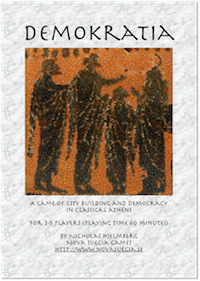
More successful was the test of Demokratia. There were many small adjustments, both in art and in rules, to get components and gameplay as clear and smooth as possible, and I also added an advanced rule of the Peloponnesian War, threatening to destroy the entire Athens, but the game is now as tense as I want it to be. More testing is still required but the draft rules are finally completed. Week 29, 2015: I tried to take a break from game design during my vacation but couldn't help myself from completing some tasks. One was to update the Peoples - Civilizations rules with an important scoring escalation the bigger the settlements become. This is important since the most valuable metropolises require 6 tribes and the players with 8 tribes are unable to put all of them into metropolises on their own. This gives players incentives to interact more by building settlements together with Culture (or sneak into each others' settlements with Religion). I also completed most of the artwork for Demokratia, including the logotype, so "all" that remains is to test the two games. 
Week 28, 2015: What started like an idea last week was turned into a game this week: Peoples is now two games in one with the original Migration version and the new Civilization version. A lot of testing remains but the updated components and the draft rules have already been added to the game, both at the homepage and the The Game Crafter. My other game in progress, Demokratia, took a great leap forward when I (after a lot of calculations and simulations) decided to let the city tiles form actual blocks and roads and to base the factions on the historical tribes of Athens instead of the imaginary political factions. The former is visually more appealing as a real city emerges in front of the players while the latter makes the game more thematic as the purpose of the tribe system was to maintain the political balance that the players try to overcome. I then proceeded to write the draft rules along the phases of Debate (player negotiations), Ekklesia (hidden votes), Athens (city building) and Boule (counting of votes and distribution of new citizens/victory points). Each city tile placed in Athens will generate 0-3 new citizens that will be modified by the votes and then distributed based on the majority in the different tribes of the Boule. The testing remains here as well but I expect the game to have tight decision between investing citizens in Athens (to improve the power of the tribe where you have the majority) and in Boule (to claim majority in tribes). 
Least but certainly not last, I had a good progress on my RPG adventure and expect to deliver a draft before going on vacation next week as planned. A good week's work! Week 27, 2015: My latest game Peoples was finally completed. The homepage is up, the Rules and the Print & Play files completed, the video created and the components uploaded to The Game Crafter. 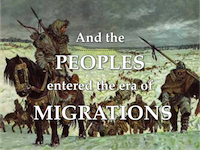
But I had hardly done so before I returned to the original "civilization light" idea behind Peoples. What if the players not only owned but also played their own colors, built their own settlements and produced their own resources? The population would grow similar to Advanced Civilization and the diplomacy markers would be replaced by physical contact between the peoples. The civilization markers could be kept but their functions slightly tweaked:
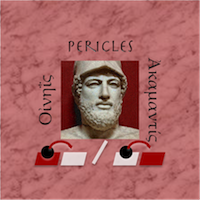
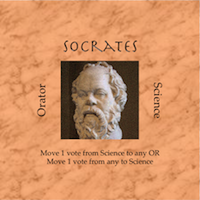
Since only a new rules set and some new marker backs are needed, I could easily turn Peoples into two versions: the original migration version and this new civilization version. Next blog post will tell whether I succeed or not. What happens next? I don't know yet. Perhaps I will test it locally, perhaps I will submit it to a contest like the annual Hippodice Contest. The future will tell. Meanwhile, I wasted no time to get my next game Demokratia started. After having considered several different approaches, I finally settled with yet another Colovini mechanism, namely the "control the controllers" mechanism of Carolus Magnus. The idea is to let the players build score engines in two dimensions: first by erecting buildings in Athens of different colors and second by controlling the factions that score for the different colors. To do both will take too long so the players will have to negotiate with each other. The offices and orators remain (how could I resist a game with strategoi and Socrates?) as additional mechanisms with special powers for the players willing to invest in them. In addition to the standard victory condition of getting all your vote markers into the game, I even squeezed in a majority and area control mechanism, as dominance in either the senate or in the city of Athens may lead to an oligarchy or a tyranny victory respectively. The test has only started but the game looks promising so far. 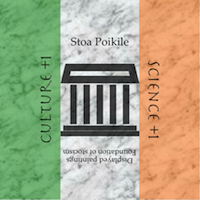
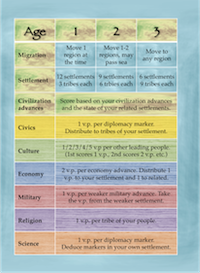
I also got another interesting offer to write a short sequel to my Morwhayle RPG adventure. The work has already started and I hope to complete before going on vacation at the end of next week. I'll definitely continue to have my hands full! Finally an update on my Twitter problem: One week after having logged a ticket about not being able to submit a phone number and unlock my account, the support returned and advised me to submit a phone number to unlock my account. As another victim commented, it's quite ironic that Twitter automatically locks accounts because of automated behavior and an automated support certainly doesn't improve its reputation! Week 26, 2015: The Kickstarter adventure is over for now as Iconoclasm failed to reach the target. I guess 60% is not bad for the first time but after all effort with sending copies to testers and reviewers, preparing online versions, and getting videos produced, I'm not really sure I can do much more. Perhaps competitions and publishers is the way forward? As a sign of fate, my Twitter account, created as a marketing channel for crowd funding campaigns, was automatically blocked the very same day for "automated behavior". Well, if nothing else I can enjoy a "free" summer where I can focus on other games instead. One of them is Peoples, where a successful game test was completed. I'm still not sure whether the complexity of the advanced game add enough depth but the game as such is solid and well-balanced. Another is Demokratia, where I've evaluated various mechanisms suitable for a voting/city-building/hidden agenda game. I've also picked up some old university books to study the Ancient Athens for inspiration and even found a good webpage with 3D images of Ancient Athens. If I can find a good game-defining mechanism, it'll be my next game! Week 25, 2015: The first of the three ages of Peoples is completely tested and the game is now full of interesting decisions. A couple of weeks ago I simplified the civilization advances by detaching them from the relations only to come to the conclusion that the relations became an uninteresting decision. With some adjustments I managed to make all the advances dependent on the relations without making the rules too complex. 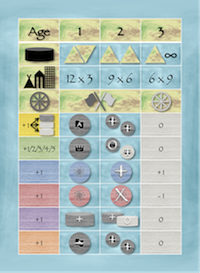
The Kickstarter campaign for Iconoclasm suffered a setback as AllUsGeeks thought the rules were too complex to review. I did follow the advice to write them more straight-forward (focusing on the step-by-step gameplay and moving the support rules to the back, thereby removing 4 of 12 pages) but the inevitable conclusion is that the game is too narrow to appeal to a wider audience. I will proceed with the campaign and unlock the second stretch goal (tokens instead of chits) but I don't expect to relaunch Iconoclasm but rather focus on other games. Mingle & Murder is one candidate if doing well in the Killer Gamer's Remorse Challenge and Mice in Maze another if doing well in the Gamehole Board Game Challenge. For the purpose of the latter, I once again tried to offer the game to playtesters at Boardgamegeek. There are also other potential project that I may dig into. One is the RPG adventure I'm writing for Morwhayle, where the first illustration has been completed. 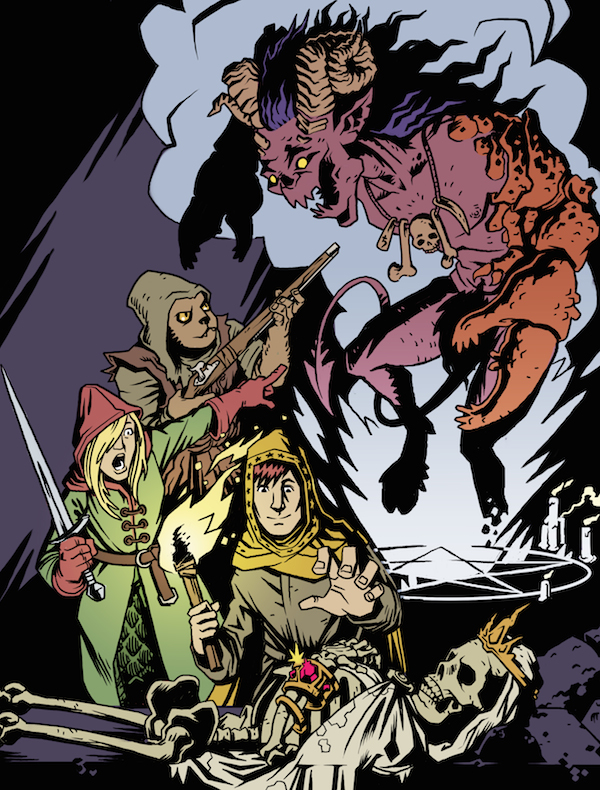
My work with Peoples and Algebra has also inspired me to design another game set in the Ancient Greece, this time with focus on the politics. The working name is "Demokratia" and the loose ideas I have is to design a game where the players together make decisions for the best of Athens while at the same time furthering their own secret interests. Finally I also have games to play as the second of my two expected game packages arrived: Clans and Alexandros! Week 24, 2015: The game testing of Peoples continued at a slow pace, not because the game is complicated but because it takes time to document the movements of 72 tokens... Nevertheless, the game is now so solid that I'm proud to introduce the Peoples webpage. The goal is to have a copy ready for order in July so that I can get a copy of both Peoples and Mice in Maze home in time for the Gamehole Board Game Challenge. 
The Kickstarter campaign for Iconoclasm is still slow, although the unlocking of the first stretch goal (a strategy booklet) and the addition of free global shipping reward helped a bit. I also tried some other ways to get out the word, such as starting a blog at Boardgamegeek and putting up the game at Megafounder. However, the most likely outcome will be that I must consider a relaunch later. As my other projects are concerned, I could finally close the design phase of the mathematical game Algebra. My partner and I will now test it the next few months before deciding if and how to proceed with it. The week ended with the opening of the first of my two expected game packages: Carolus Magnus, Through the Desert and Ra, Power Grid and El Grande are now all part of my game collection! Week 23, 2015: The work on my next game Peoples continued with further refining of the components and the rules. Two things kept me particularly occupied. First, how to ensure that the game progresses without people tokens being pushed back and forth? I finally rejected the idea of leaving blocking barren tokens (they wouldn't prevent people tokens from being moved in circles) in favor of forcing them to move to populated areas. It's less elegant and potentially too restrictive so I don't think the last word has been said yet. Second, how to make the civilization advances as fair and streamlined as possible? I had already streamlined advances like economy (instead of scoring based on connected settlements with economy, simply score the lowest of connections and economies, whether connected or not). I now went on to change religion (instead of scoring based on connected settlements without religion, simply score for each of your own color in the settlement) and military (instead of the kingmaking scenario of stealing from one player, simply steal 1 point from every connected settlement). This was as far as I could come without thorough testing and that's what I started next. So far, the players seem to have interesting decisions every turn. 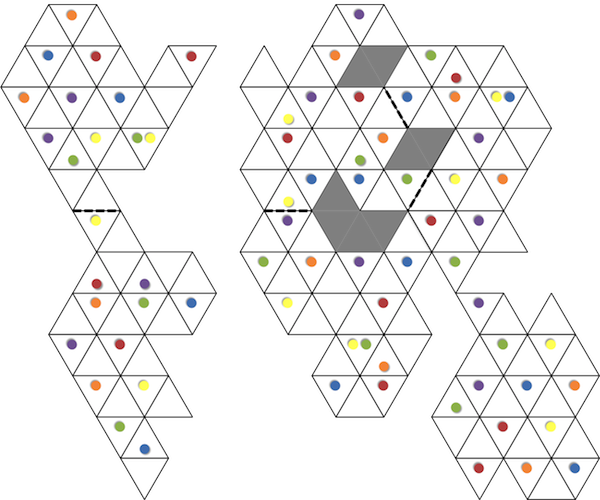
As for the components, I have now completed drafts for all of them. The challenge has been to give them a similar style while still keeping them distinct from each other. 




Meanwhile, I kept getting backers for my Kickstarter campaign for Iconoclasm but at a slower rate. Judging from many other campaigns, the market for crowd funded board games seems saturated and it's hard to get attention. Perhaps I should unlock stretch goals to make the offer more attractive? Other games were more successful. Find the Bug! was used as part of an interview process at my work and will be further pitched by a manager at an international HR meeting. Perhaps I should do move to learning games instead? Finally I decided to do an update of my game library. I placed an order for some Colovini and Knizia games that have resided on my wish list for a long time: Clans, Alexandros, Carolus Magnus, Through the Desert and Ra. In addition, I got myself two other good classics: Power Grid and El Grande. To my regret, I also put up two of my games on my trade list: Dead of Winter and Siege of Jerusalem. The first is interesting but the psychological game in the game isn't quite what I had hoped for while the latter is well designed but too long and complex and none of them can be expected to enter my game table in the near future. Week 22, 2015: What a week! It started with great news: Mingle & Murder reached the finals in the Killer Gamer's Remorse Challenge! From the jury motivation: "Whoah Nelly! Minimum of 5 players. But wow! The game play on this one. Clue meets Kill Doctor Lucky meets Murder mystery parties." The competition is tough but if the game manages to stay in top five, it will get a public review and hopefully lots of attention. From the jury, I also learnt that Mingle & Murder has a learning curve, something that I will have to continue working with. (The days of Avalon Hill's long and detailed rule paragraphs are definitely gone.) This leads me to my continuous work with my next game Peoples. I ran a number of simulations and started writing on the draft rules, not only to balance the game but also to challenge and evaluate the rules. By constantly asking myself what would be the simplest and most intuitive way of playing a certain part, I've worked hard to make the rules as streamlined as possible. The struggle to minimize the components also helps; not only does it minimize the costs but the fewer the components, the simpler the gameplay. I also completed a second draft of the game board, with geeky details like Babylonian cuneiform. 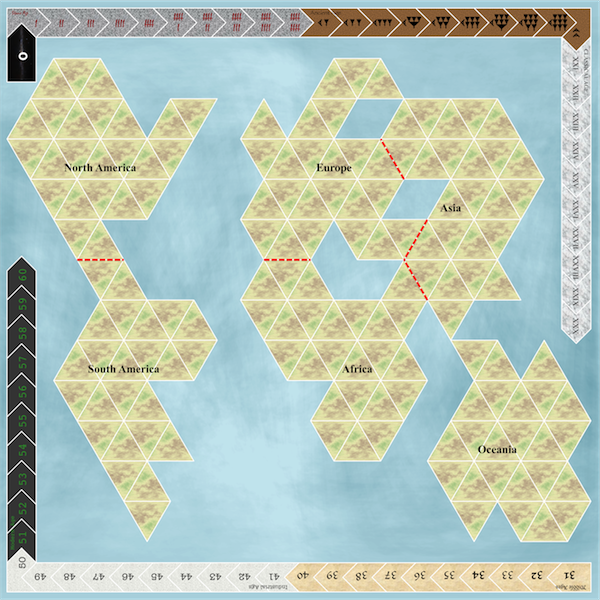
But the main news of the week was of course the launch of the Kickstarter campaign for Iconoclasm. It started surprisingly well with 2 backers for the full game and nearly 20% funding in the first few days. It has also been listed on a Top 8 Kickstarter Game List. It's still a long way to go but it's already far better than my previous attempts in crowd funding. One thing I have learnt already is that you get a lot of spam from people trying to sell crowd funding services (like the margins are not small already). Possibly more interesting is the request from a Polish reviewer. Whether it makes sense for US-based print & play actor like me to engage with reviewers is another question but attention is always good. Week 21, 2015: Here we go again... The last few weeks I had been considering (and rejecting) changes to Nova Suecia. This time, I thought of letting the players place the workers mancala style (like in one of my recent favorites Five Tribes). Again, the idea was rejected but spawned two new ideas:
As always when I get ideas, I quickly dived into them and critically reviewed the mechanisms - and rejected them as well! In the abstract game, I couldn't find enough game, and in the civilization game, I couldn't find anything novel enough. However, in parallell (where did i find the time?) I also studied more of Leo Colovini's designs and was further intrigued by Carolous Magnus with its mechanisms of "controlling the controllers". Then all of a sudden the pieces fell into place and the new game idea of Peoples was born. Peoples has the ambition of becoming a short civilization game with the unique twist of shifting leadership. Over the ages, the players take turns to move and settle peoples of different colors (similar to Clans). For each age, some settlements grow bigger and get more civilization advances (similar to Advanced Civilization) while others decline and disappear. But over the ages, the leadership of those peoples shift (similar to Carolous Magnus) and hence also the player scoring for a certain people. Each player knows which people he or she will lead each age and which other people to count as allies (this time I've borrowed from my own game Iconoclasm) and can plan the migrations and advances ahead. The result is a game that is not only mechanically elegant but also surprisingly thematic. It shows aspects of world history like migration and urbanization and even thematic benefits of the civilization advances. Trade advances are better the more other settlements that trade while religious advances are better the less other settlements that have competing religions. The first draft of the map experiments with triangular regions (inspired by another Colovini game, Alexandros, forming six continents with 24 regions each. The first draft rules are also ready, containing the two phases of migration and civilization over three ages where the settlements get fewer and bigger and where the distances get shorter. As always, the first few days of a new game idea is roller coaster where the game pends between great and worthless but Peoples have passed the first test and I look forward to work with it! 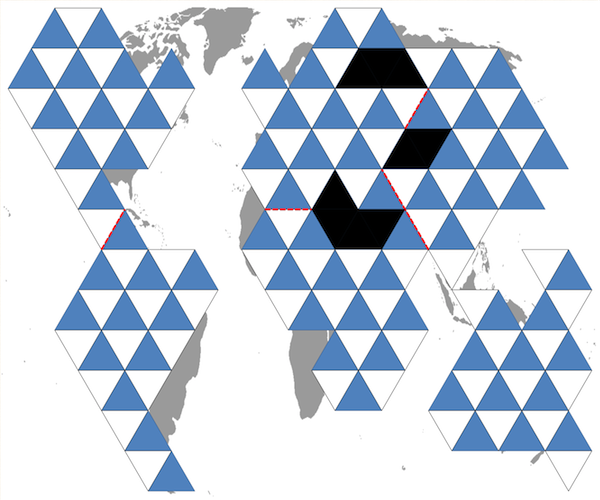
However, I did force myself to attend to my old games as well and completed yet another annotated game: Vasa Regalis. No changes here, Vasa Regalis is probably my best example of a clean game where everything unnecessary have been removed but may be too clean to be really immersive. Nevertheless, as the inspiration that led to Peoples shows, it's always good to get back to old games and take a new look at them with fresh eyes. But in spite of all this, I haven't even come to the main event of the week yet. I finally got the game video for Iconoclasm from B L Garver and what a video! I'm very pleased with mystic atmosphere conveyed by the video and that alone gives me hope for the coming Kickstarter campaign. The launch date is now set to 27 May. 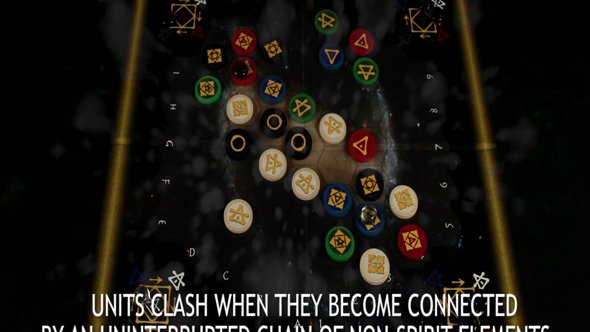
Old blog posts may be found here:
|
Please leave a comment on the games or contact me directly at nicholas.hjelmberg@gmail.com. |
 A failed test is a good test too. What looked good on paper - simple but yet interactive
civilization mechanisms - weren't enough to create the necessary tension in Peoples - Civilizations.
There is too much space on the board, a competitive player next to you will ruin your game whereas
two cooperative players next to each other will be difficult to bring down and so on.
Perhaps a more complex game with more units are necessary, perhaps a simpler card version is more
suitable, but whether the game has
a future or not, it won't be within the framework of the Peoples - Migrations components.
A failed test is a good test too. What looked good on paper - simple but yet interactive
civilization mechanisms - weren't enough to create the necessary tension in Peoples - Civilizations.
There is too much space on the board, a competitive player next to you will ruin your game whereas
two cooperative players next to each other will be difficult to bring down and so on.
Perhaps a more complex game with more units are necessary, perhaps a simpler card version is more
suitable, but whether the game has
a future or not, it won't be within the framework of the Peoples - Migrations components.