
 |
Home | Game | Rules | Theme | Strategy | FAQ |  |




























|
Last Icon StandingThe objective of Iconoclasm is to place icons. Not the first icon, not the most icons but the last icon standing. Victory by three icons or two connected icons can usually only be achieved by another player's mistake so let's focus on victory by the last icon. So you should simply deform all other groups and then form your own group? Well, that summarizes the overall strategy but it's easier said than done. Let's start by looking at some group basics.
This means that a group has one of the following destinies:
Let's continue by looking at what determines a group's destiny. No external clashThe earlier a group is formed, the likelier it is that it suffers from an external clash. The first strategic guideline is thus not to form own groups early. However, if you half-way through the game find that an area is or can be isolated by spirit tokens, you could form a group and defend it to the end. External clash with weakeningFor a group to be weakened and yet remain in your power, two conditions are required. First, the number of your tokens and supporting tokens must be higher than the challenging deity's tokens. A strong group is desirable but difficult to obtain, not only because you have few tokens of each deity to play but also because the other players hardly will allow a group to get too strong. However, bear in mind that tokens in the conflicting group also count. Thus, once a group is about to be formed in your vicinity, you can either play to increase your strength in it by playing your or your supporter's tokens in it or to decrease the overall group strength by playing tokens of deities different than the ones already played. The second strategic guideline is thus to keep other groups weak. Second, and more difficult, there must be more of your tokens than tokens of the other deities. Otherwise, you will win the external clash only to lose the group to another deity. The third strategic guideline is thus not to have too many tokens of other deities in your groups. External clash with takeoverAs discussed above, for a group to be taken over, another deity needs to become stronger than the current deity. You can take advantage of this by "hanging around" the deity you support in hope of taking over their group after an external clash. Why the deity you support? Because then your deity can support the group and you want the group to survive. However, you must still consider the destiny of the group. Can it be expected to survive an external clash before the takeover? Can it be expected to survive an external clash after the takeover? The fourth strategic guideline is thus to be a strong supporter in other groups. External clash with deformingIn an external clash, the weaker deity and all its tokens will be removed. This is a disaster to the losing side and should be avoided at all cost. If you have followed the strategic guidelines so far, you shouldn't have to be the victim of an external clash. Instead, use this powerful mechanic to deform weaker groups, starting with groups of your opposing deity, since those are of least use to you. Remember that you can and should connect groups belonging to other deities to have them weaken each other before you step in. Be cautious though so that not other stronger groups are formed in their places. The fifth strategic guideline is thus to connect and conquer other groups. Weak and strong groupsLet's conclude the discussion with an overview of what constitutes a strong group and what constitutes a weak:
A final warning
Take for example the position to the right. If water fights fire first, she will win with 4 water vs 3 fire but be weakened by having 1 water replaced by a spirit. This will make water and earth equally strong and result in earth taking over the group from water thanks to more support (ironically from water). A better tactic is to first let the fire and earth groups enter a clash (which fire will win with 5 fire vs 3 earth) and then take on the fire group. ConclusionIconoclasm is a game where every tile placed changes the conditions and demands new tactical decisions. Nevertheless, there are five strategic guidelines that will help you to attain the last icon standing:
|
Strategy (PDF)
Aristotle
15th century icon
|
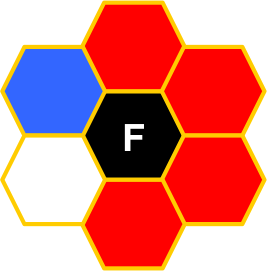 Strong predictable group. Fire has 4 tokens and, if needed, support from 1 air token. Since fire has both a primary supporter (air)
and a secondary supporter (water), the fire group can survive 4 external clashes before air takes over. This is group
that fire should try to keep to the end.
Strong predictable group. Fire has 4 tokens and, if needed, support from 1 air token. Since fire has both a primary supporter (air)
and a secondary supporter (water), the fire group can survive 4 external clashes before air takes over. This is group
that fire should try to keep to the end.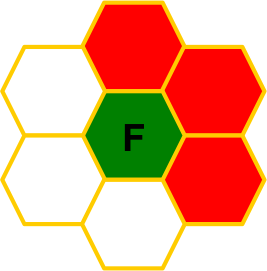 Strong semi-predictable group. Fire has 3 tokens and, if needed, support from 3 air tokens. Fire will lose the group to air after
the first external clash (after which there are only 2 fire tokens left) but take it back after the second (after which there are
only 2 air tokens left. Thanks to water's support, the air group will also be strong, so this is a group that fire
may try to keep to the end with a well-planned last turn takeover.
Strong semi-predictable group. Fire has 3 tokens and, if needed, support from 3 air tokens. Fire will lose the group to air after
the first external clash (after which there are only 2 fire tokens left) but take it back after the second (after which there are
only 2 air tokens left. Thanks to water's support, the air group will also be strong, so this is a group that fire
may try to keep to the end with a well-planned last turn takeover.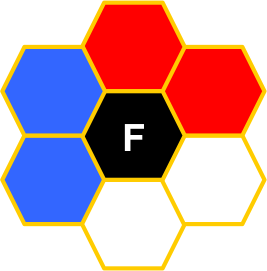 Semi-strong semi-predictable group. Fire, air and water all have 2 tokens each and, if needed, 2 supporting tokens (except water).
All three deities will take turns to take over the group after external clashes, making it difficult to predict who will end
up with it in the end.
Semi-strong semi-predictable group. Fire, air and water all have 2 tokens each and, if needed, 2 supporting tokens (except water).
All three deities will take turns to take over the group after external clashes, making it difficult to predict who will end
up with it in the end.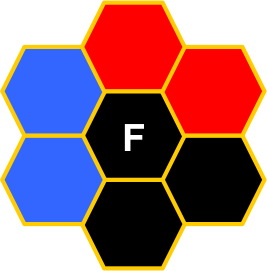 Weak group: Fire has only 2 tokens and only secondary support. Even if the group does survive its first external clash,
it will be taken over by water and not retaken again until another 2 external clashes has replaced both water tokens
(if it survives that long).
Weak group: Fire has only 2 tokens and only secondary support. Even if the group does survive its first external clash,
it will be taken over by water and not retaken again until another 2 external clashes has replaced both water tokens
(if it survives that long).
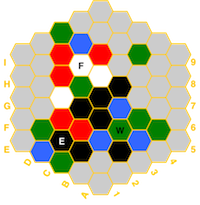 A final word of caution. The advice so far have focused on forming groups late. It may be tempting to save your tokens
in the reserve until the last turns. However, this also means that the other deities will be stronger on the board. As long as
you can have their groups deformed and the tokens removed, that's fine, but beware of the risk that a deity gets a
two group connected or a third group.
A final word of caution. The advice so far have focused on forming groups late. It may be tempting to save your tokens
in the reserve until the last turns. However, this also means that the other deities will be stronger on the board. As long as
you can have their groups deformed and the tokens removed, that's fine, but beware of the risk that a deity gets a
two group connected or a third group.