
 |
Vision | Projects | Blog | Articles | Awards | Order | Reviews | |












































|
December, 2018 The last month of the year was spent catching up with game activities. Designer's notes were added for Cosmoclasm, Fair Trade and Find the Treasure! - The Card Game. I also published a review of Sol: Last Days of a Star and recorded the first sale of Mingle & Murder. Furthermore, my collection saw the disposal of Orient Express and the addition of Vanuatu. Less good news was that the third attempt to use Meetup for game tests ended with no participants turning up and I decided not to halt further attempts. Instead, I signed up to test a new 2 player version of Britannia. Hopefully my test experience can help another designer instead.
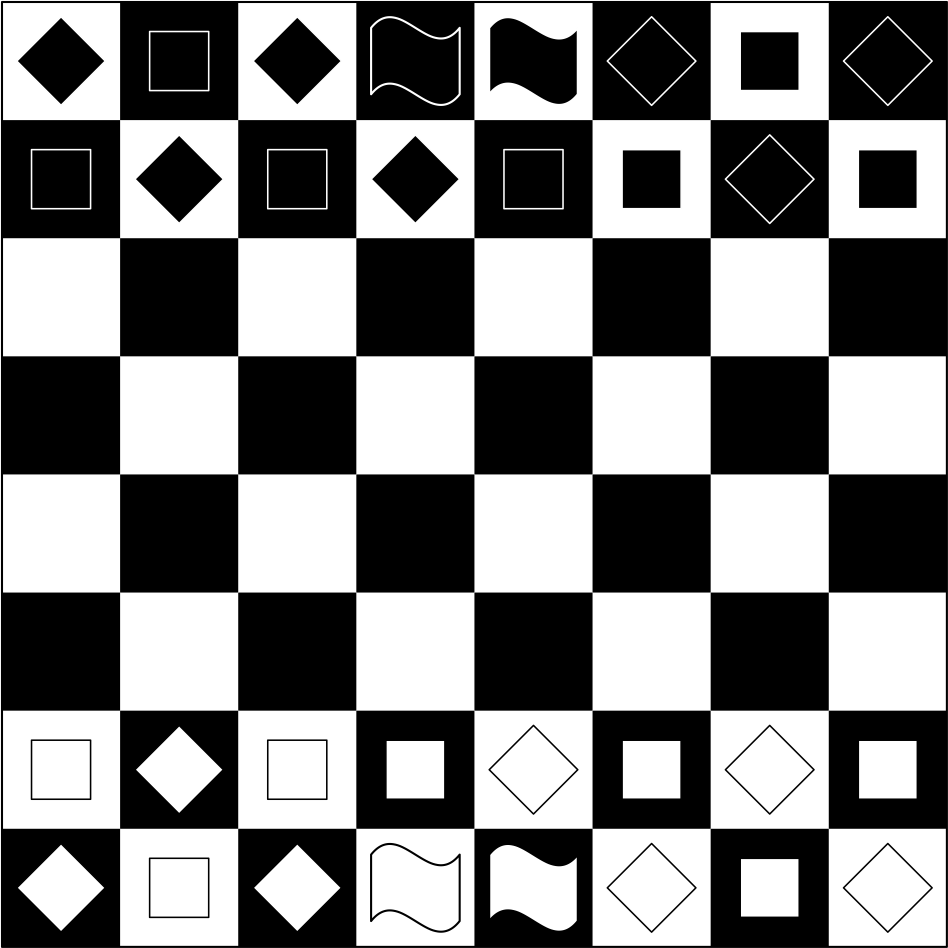
The first (and so far only) abstract game is Mount Chess, a kind of chess variant invented in response to claims that ordinary chess need more "compound pieces" (combinations of rook and knight and of rook and bishop), pieces I personally find bizarre. Mount Chess' response is to let the players start with generic pieces (moving only diagonally or only orthogonally) and allow them to compound if they wish. I found the idea so intriguing that I turned it into a game, although more testing is still needed.
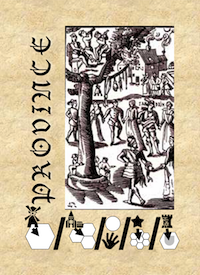
With that done, I found some time to return to Suecia. I wasn't happy with the idea of letting the players choose any action cards and decided to let them choose from a hand of action cards, similar to Brass. For this purpose, I also added city action cards and province action cards to give them more flexibility. I also completed print & play files so now "only" a game video and an annotated game remains. 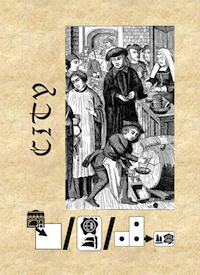
November, 2018 While last month was devoted to other games, this month became full of my own game activities. Encouraged by a successful Meetup test of Crusader Kings last month, I decided to repeat the event with other games. Again, only a few of the enrolled actually turned up but Apokalypsis was successfully tested and the players spontaneously wanted to play it a second time. Another successful test was held at the Stockholm Designer Meetup, where Find the Treasure - The Card Game won the approval of my fellow designers.
I also decided to add my latest games Peoples - Civilizations, Fair Trade and Find the Treasure - The Card Game to Boardgamegeek as well as a new video for Find the Treasure.
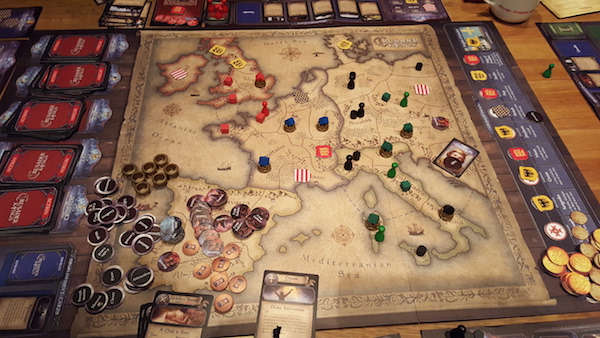
However, all this work was shadowed by the great news that Warring States made it to the World Original Design Contest of Board Game Semi-Finals and Hangzhou/Dyce all the way to the Finals! The success led to an invitation to Shanghai for the award ceremony but since only hotel is paid for, not travel, I still hesitate whether it's worth going. October, 2018 This month was completely devoted to a game other than my own. I was asked by Fria Ligan to test Crusader Kings and I managed to set up no less than eight test sessions with different players. The result was a 30+ pages test report with various observations and recommendations and one of the largest revenues for Nova Suecia Games. Perhaps I should consult other boardgames instead of designing my own?
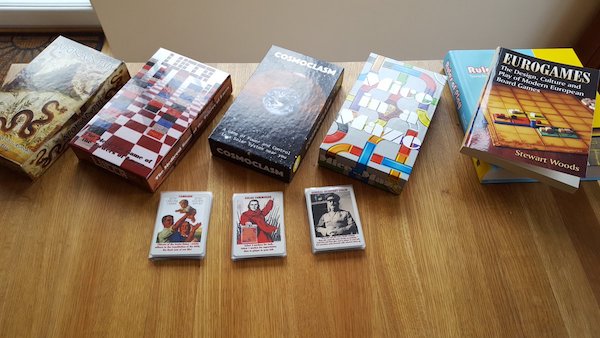
Unfortunately, this meant that I didn't have time to complete any review or video this month. Hopefully I'll get more time next month. However, I did record two additional sales, one for Find the Bug! Agile to Germany and one for Find the Bug! to the UK. At least the latter buyer had seen the game at one of my test speeches. Unfortunately I also learned that the wooden bugs that I recently added to Find the Bug! are being phased out from The Game Crafter. Acrylic bugs will replace them but, which at least match the acrylic tester pawns, but there is no estimate yet. I also received the last of the many kick-started games: Endeavor: Age of Sail and Stephenson's Rocket. This meant that yet another game had to leave my collection, the good but not outstanding Rialto. In addition, I invested in yet another book about boardgames, Eurogames by Stewart Woods. So far it's interesting reading about the history and mechanics of eurogames. September, 2018 The summer contact about publishing the Comrade series was resumed. Apparently, an artist and an investor have been approached and testing sessions in Gothenburg have been planned. I tried to set up testing sessions in Stockholm as well but the high player count of 5-10 players make it hard. 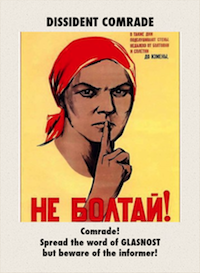

That didn't prevent yet another sale of the Comrade series, making the games my new bestsellers after Find the Bug! and Apokalypsis!. In addition, I could record my first sale of Lucca. Returning to my newer games I've struggled a lot to find a good balance between general concepts and specific rules in Suecia. Writing too specific rules for all actions would be repetitive while too many concepts wouldn't make sense for the reader until learning the specific rules. The solution was to add a schematic overview of how building are used for resources to flow into and out of the city and then immediately move on to the specific rules. The rules need more work but a draft rules were finally completed. I also managed to complete a review (Ponzi Scheme - All you need to make Money and video (Mice in a Maze) this month as well. Finally, my collection was extended with several interesting games:Tinners' Trail with its interesting time mechanics, Confucius with its interesting gift mechanic, the Tigris & Euphrates sibling Yellow & Yangtzee, a reprint of the classic imperialism game Endeavor and finally the Thundergryph finalist prize for Apokalypsis, . To make room for them, I decided to dispose of Tammany Hall, simply because the mechanics weren't interesting enough. It looks like I'll be occupied for yet some time... August, 2018 I've reached a stage where my old games consumes all my time, leaving no time for new games. I decided to submit Apokalypsis to Fastaval's Designer Contest but although I was happy with the new Gods' Variant, I felt that the one meeple movement was too slow for managing two colors. The simple solution was a new perspective: one tile movement, whereby all meeples evacuate from or rally to a tile. It also adds to the panic theme. The game test was successful and the game submitted. Another game change was triggered by the new video for Explorers & Exploiters. I was never really happy with the plastic sprue figures and the unnecessarily big box. But since the game was designed, The Game Crafter has added several new wooden components that could serve as settlements. In addition, wooden components would fit in a medium pro box, so Explorers & Exploiters have finally found a new and better home!
Finally, I started counting down to the 5th birthday of Nova Suecia Games by offering the remaining Game Crafter coupons to homepage visitors. Hopefully some of them will use them for our games. 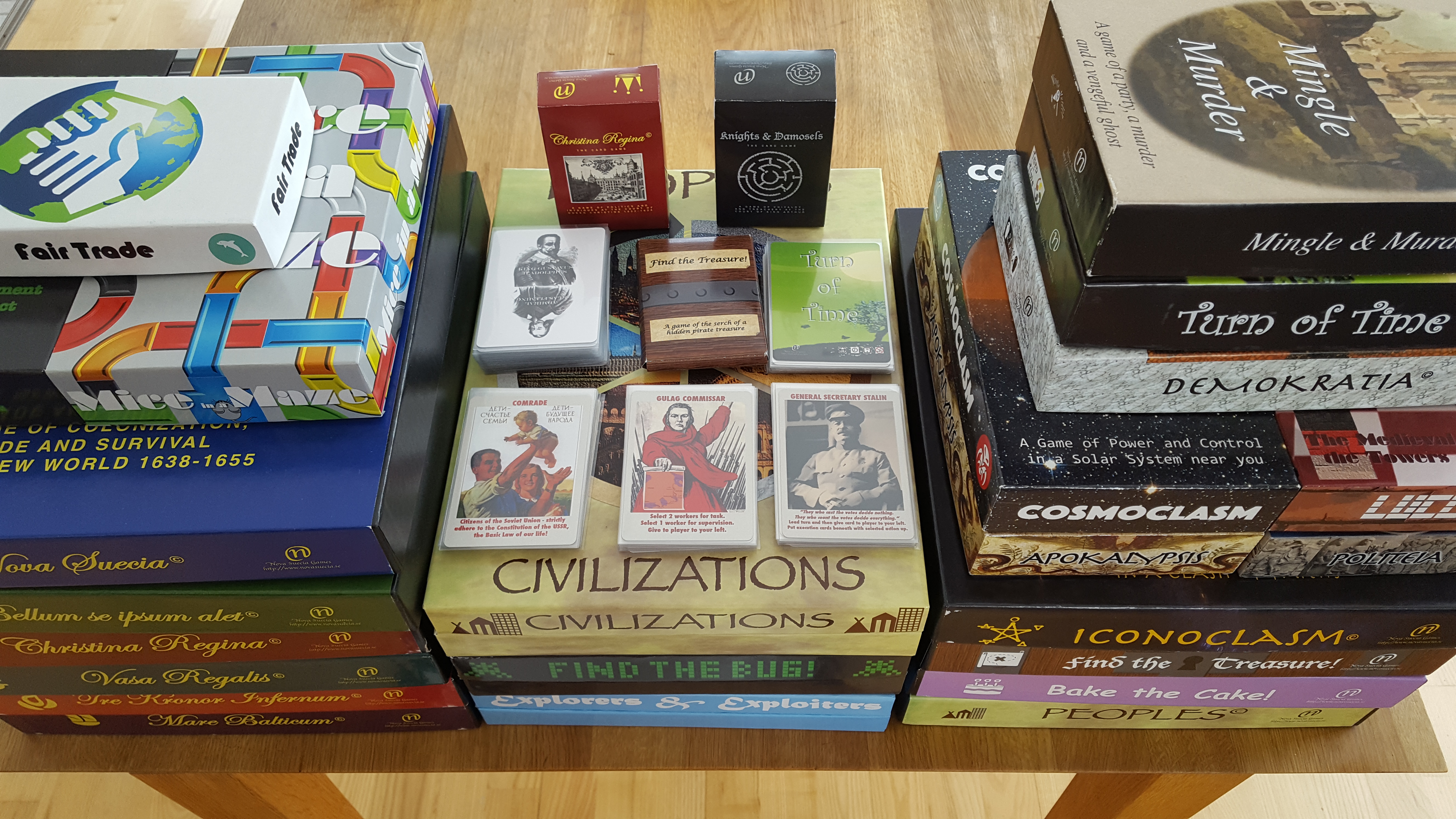
July, 2018 July was a vacation month with much time for game design but also a very hot month with little energy for it. I continued the Peoples - Civilizations game test with never ending adjustments, mainly of the six civilization traits, until I finally got them balanced. With a third of a full game annotated it's still very open so the time spent has paid off but it's still a lot of work left. To take a break, I finally started working on my next game Suecia. I had hesitated for some time but a hostile take-over rule inspired by Indonesia. In fact, I was so inspired that I decided to add not only Indonesia but also the classic merger game Acquire and the well reputed economy game Arkwright to my collection. Most of the Suecia components were created and hopefully the draft rules will be ready to publish next month. The work with the additional home pages has already started, not only for Suecia but also for a collection of my card games (5 Ages and Jelly Mind) and Warring States. 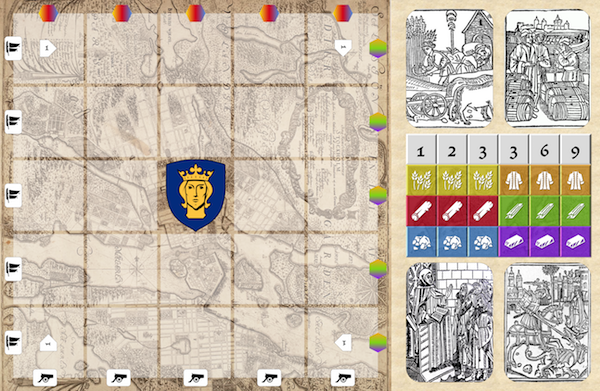
Speaking of Warring States, the month may have started slowly but ended in a rush. To get something done, I rushed the writing of a review for Settlers (Catan) and the creation of a video for Turn of Time. I also solved the issue with Lucca, whereby the weaker tower's top color earned nothing in a struggle, by simply letting the removed top color take the prisoner.
Then it became official that Automobile will get a new edition and that I am part of the development team. Exciting but a lot of work. Finally I was approached by a publisher who expressed interest in my Comrade games Comrade, Gulag and Politburo.
Perhaps I shouldn't have ordered those new games... June, 2018 The focus of this month was the long awaited start of the Peoples - Civilizations game test. As expected, many tweaks and tunings remained and two distinct categories emerged:
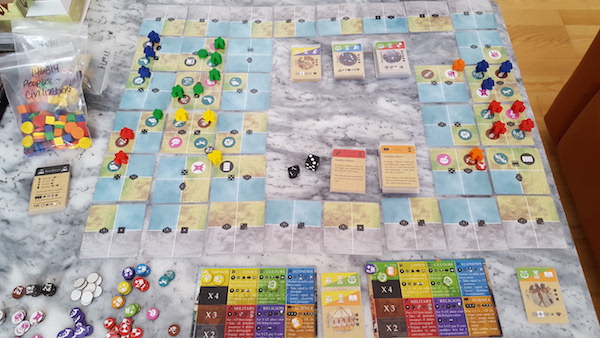
The game test left little time for other games but I did complete yet another video, this time for Mingle & Murder .I also had time to complete reviews for Crusader Kings and Reef Encounter. Finally I completed and submitted a simple game for the Jellybean Contest, namely Jelly Mind. It's partially a parody on The Mind, where players are supposed to cooperatively guess the order of the cards they hold. Jelly Mind simply make this competitive by letting the players gamble to either play early (and earn a lot of points if they have the highest card) or late (and earn less points but win ties). It turned out to be quite fun but I'll probably just publish it as a game that can be played with an ordinary deck of cards in the future, similar to 5 Ages. May, 2018 Last month's video frenzy continued with Bellum se ipsum alet and Mare Balticum. The latter was "reengineered" years ago while the former finally got its long overdue updates. More streamlined phases (less phases with influence only checked once), a historically more accurate economic system (supply from cities -> supply from land -> strength to the army) and more divergent end game conditions (besiege all opponents or survive the war) turned this my second game into a less fiddly and more thematic experience. The game test demonstrated a much more dynamic game with shifting tides of the war, just like Bellum se ipsum alet was supposed to be! A smaller update was given to Politeia, where only eliminated citizens count for victory. This balanced the take that effect that long troubled me, whereby the aggressor gets higher production in the long run while the victim gets more victory point in the short run. Regarding last month's tested games, I decided to put them into another test by submitting them to World Original Design Contest of Board Game. Dyce was rethemed to its original: dye trading in a medieval (Chinese) city while Cosmoclasm got new and interesting rules whereby not only symbols provide benefits (tactical army placements) but also suits (strategic army manipulation). This idea was actually inspired by the retheme to the Warring States Period and Sun Tzu's strategic ideas. I expect to give at least the latter retheme a game of its own after the contest. Besides designing, I spent a lot of time learning new games at various online gaming sites and even felt prepared to review one of the best of them, The Great Zimbabwe. April, 2018 April became a great video month. It started with a game video for the old but newly ordered game Turn of Time the Card Game and the similar game Iconoclasm the Card Game. Having completed them, and given last week's sale of Politburo, I decided spend the Easter updating the videos for all Comrade games as well. It was probably the right decision, because another "Deal of the Day" resulted in sales not only of the featured Gulag but also the other games in the Comrade series. With that, Gulag has suddenly risen to my third most sold game! While the Easter holiday made room in the calendar for my own design work, it made less room for the regular design meetups. However, I did get a successful test of the recent changes to Cosmoclasm. The game was considered ready and I have to decide on the next step for it. 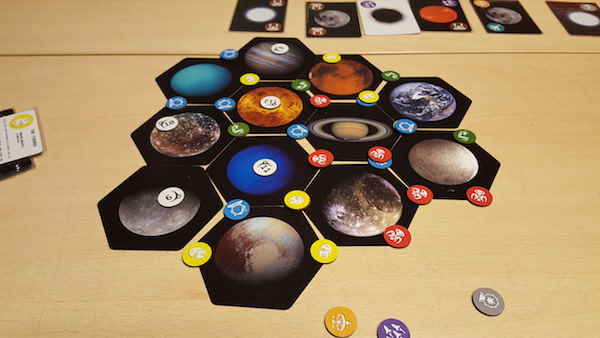
April also saw the completion of Lucca's game test. The tested rule where all players engage in tower struggles made the game more engaging and a strength limit based on the block size made the game more dynamic. I'm still not sure which audience a game like Lucca has but this is another game that can be considered ready. Moving from old to new games, I developed the ideas from Dyce further and came up with a draft idea for Suecia. Suecia returns to the early Nova Suecia Series games set in the 17th century Sweden. In this game, the players produce basic domestic goods that are first sold to foreign merchants to be refined but later refined in own shops. Using the refined goods, the players finance foreign expeditions to produce refined goods directly, which will be further refined and used for military conquests. In essence, the game tells the story of how Sweden grew from a poor farming country, via trading with the Hansaetic League and establishing own trade routes across the Baltic Sea, to become a major European power engaged in the Thirty Years' War. What is particularly interesting about Suecia is that all resource transactions and conversions take place on a city grid where all players are present so the players may both engage in mutually beneficial trades (or piggy-backing if you want) as well as beating each others to the best deals. But although the idea felt good enough to start testing, I decided to let it mature further first and start on another project idea instead, that of Bellum se ipsum alet instead. One idea is to allow the armies to reach 0 supply to trigger the end and award the victory to the army with the greatest supply. This will force the players to fight not only each other but also starvation. Another idea is the double contribution system, where gold from the cities is used to buy food from the countryside, which recover slowly (or permanently if plundered). This will force the players to constantly move to feed their armies. More realism but still in a euro format! Hopefully, this will give even more ideas to Suecia. Another source of ideas for Suecia may become the online gaming site Boardgamecore. Here I finally got to play not only the elegant The Great Zimbabwe but also the interesting Food Chain Magnate - two excellent Splotter games. Both of those games explore trading and networks in a very instructive way. I expect Food Chain Magnate to become my second Splotter game in my collection in the near future. Unfortunately, all this meant another month with less time for reviews but I did find time for a study in another good game design, namely that of Hansa Teutonica. March, 2018
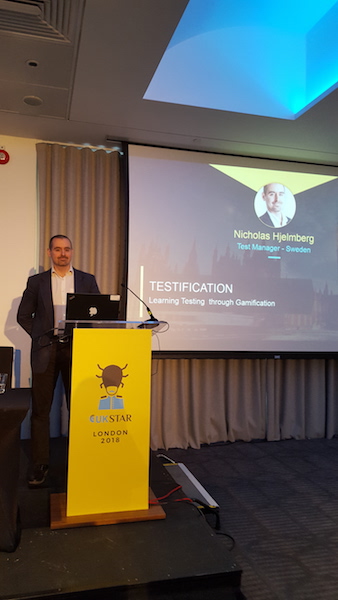
Overall it was a fun experience, although it only generated nibbles and no sales. This was expected, as many in the audience pointed out the high shipping costs from the USA. Perhaps Find the Bug! is ripe for a Kickstarter campaign soon? The same can be said for Cosmoclasm, which was well received at Stockholm Board. The only update to the rules was a drafting in the setup, where the players start with 8 cards, choose 6 and leave 2 for the drawing row. 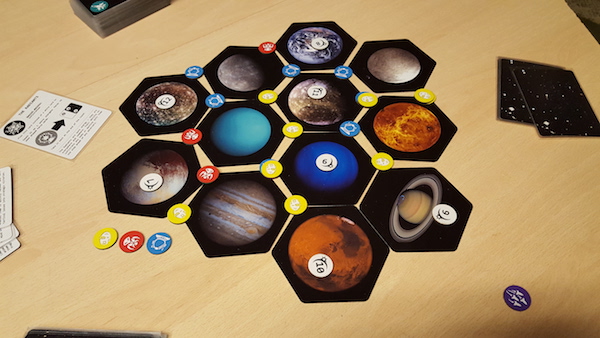
Another game well received both at the meetup and at Boardgamegeek was the this month's focus game: Dyce. The rules went through several iterations but has now become the tense and strategic game I wanted it to be. Let's just hope that the Game Pieces Only Challenge jury thinks the same. With Dyce completed, I could finally start opening the other games shipped from The Game Crafter together with Find the Bug! and the discount coupons. Explorers & Exploiters, Lucca, Turn of Time the Card Game and Find the Treasure the Card Game are all games that I want to run further test games of the next few months, not to mention Peoples - Civilizations, where the test has only started. For all those games, I also ordered more sleeves for the cards, and then took the opportunity to add two more games to my collection: Patrician, because it reminded me about Lucca, and Res Publica, because I found the "silent" trading mechanic interesting. 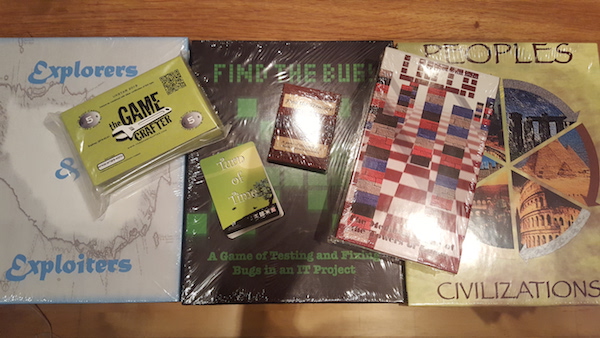
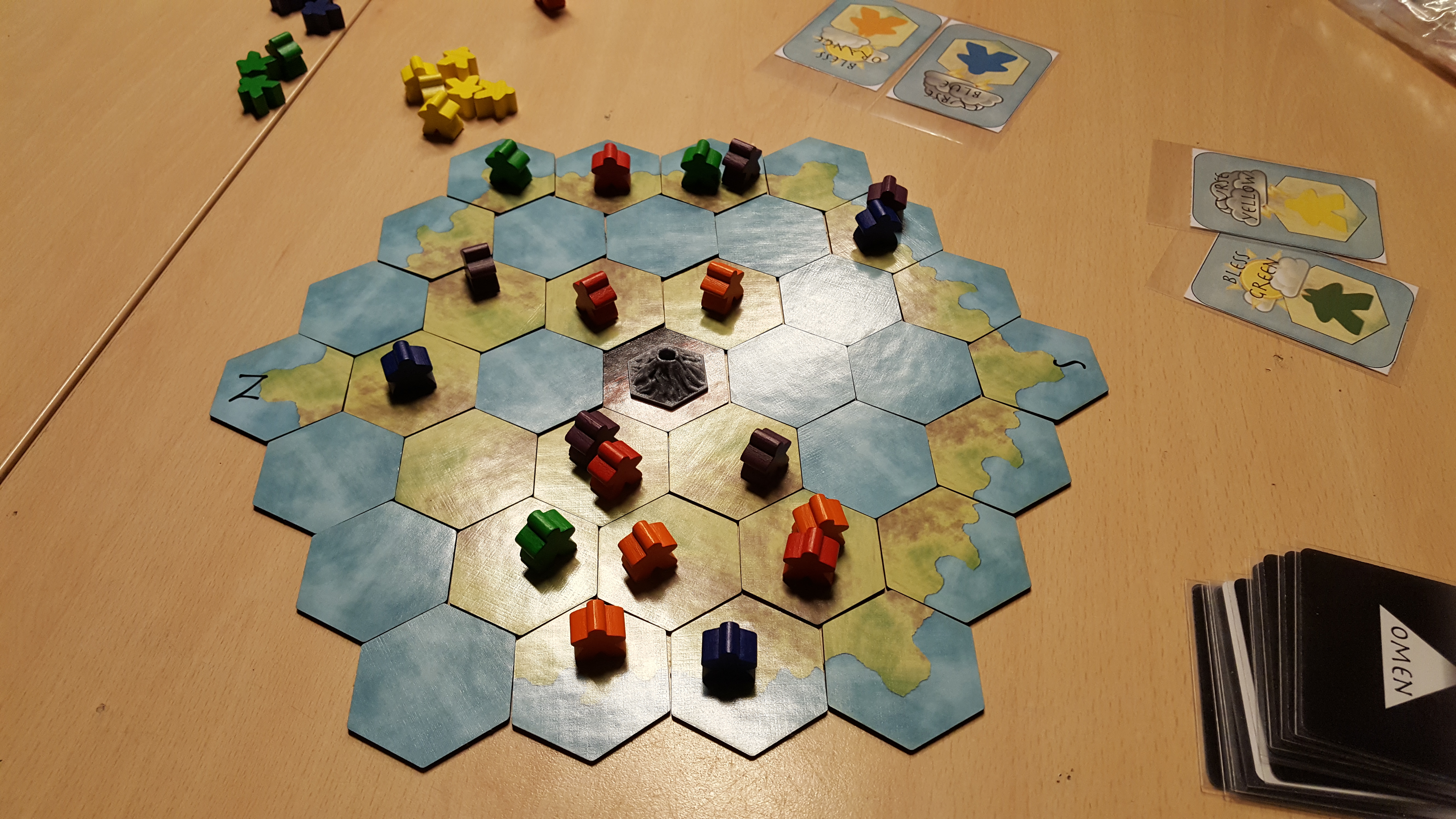
I also signed up some of my games for the new The Game Crafter feature "Deal of the Day", which features games at a discounted price. It resulted in one more sale: Politburo! All this left less time for reviews but I did get to complete One Night Ultimate Werewolf and Battle Line. February, 2018 The Stockholm Board Game Design Meetups started again and I took the opportunity to bring Apokalypsis to get fresh ideas. The result was a new "Gods Variant", where they player have two secret colors each, one that they want to save and one that they want drown. The result was a success (although I lost miserably) and the variant included in the updated rules. 

Meanwhile, my review journey continued with Tao Long, Samurai, Through the Desert and Sheepland.
Lisboa also reminded me of my loose idea to create a city building game set in 17th century Stockholm, where the city planning would "evolve" due to game events in the Swedish Empire (the need for certain goods, the tendency of similar shops to group together etc.). Hence, the city building would only be one mechanic in the context of the greater empire building game, but it struck me that this mechanic could be used in the Game Pieces Only Challenge, a contest for non-printed material only. Using colored dice to represent both goods and prices, I could let the players build shops on an imaginary grid to attract merchants buying and selling those goods. The natural setting was dye merchants in a medieval city with the fictive game of Dyce (Dyes + Dice) but when I realized that there is such a city in Scotland, the setting was changed to whisky blending. It's too early to tell if the idea will work but the initial game tests looked promising and the game of Dyce was born! Finally I was happy to record yet another sale of Gulag. My Comrade games will soon compete for the title of my best selling games! January, 2018 A new year and new ambitions! I decided to publish regular board game reviews, and completed reviews for Advanced Civilizations, Dominant Species, Automobile, China and Keyflower in addition to nine previously written reviews. My first reviews started as a way to reflect upon new games so why not resume that ambition? My ambition to focus on old game failed quickly, however, as I got a stroke of inspiration and designed a game for the Game Crafter contest Hook Box Challenge: Find the Treasure - The Card Game!. The idea is that the players get to lay the map themselves first and then compete to find the most treasures on it. It was so simple and yet unique that I couldn't resist designing the game. Speaking of Turn of Time and last month's updated Comrade series, I could record additional sales of those games, which of course further boasted my energy. I had already decided to order more copies of Find the Bug! for my presentation at UKSTAR 2018 in March and took the opportunity to replace the bug gems with real bugs. 

In addition, I rushed to complete a prototype of Peoples - Civilizations to test more effectively. The work was further prolonged when I finally found a good mechanism for the events: a book of events inspired by Africana. Another updated game was Apokalypsis, where I shortened the game slightly by letting it end when the last meeple of any color is removed. This was a learning from a game during last month's game convention, where a game proceeded until the very last tiles were removed. All this work didn't prevent me from adding new games to my collection: Ships and Biblios Old blog posts may be found here:
|
Please leave a comment on the games or contact me directly at nicholas.hjelmberg@gmail.com. |
 Finally I added long overdue homepage entries for
 In addition, I published yet another review, this time for my old favorite
 Other game activities included yet another review, this time for
 The main event of March was of course
  Speaking of reviews, I finally got my promised copy of