
 |
Vision | Projects | Blog | Articles | Awards | Order | Reviews | |



































|
Week 10, 2015: It's funny how I keep finding new things to occupy myself with regarding my games. This time, I explored the Vassal Engine, a game engine where you can build online versions of board games. The interface required some IT experience but simple enough to build a module for Iconoclasm in less than a week! I picked Iconoclasm since this is my candidate for Kickstarter but if it turns out well, I may let more games go online. More good news: the six old games I ordered in week 4 to a buyer finally arrived and the new games and updates I ordered to myself can be expected to arrive early next week. That means more reviews and more pictures to work with (if I don't find other things to do). Week 9, 2015: The week started with two good news. First, my latest game Explorers & Exploiters reached the semi-finals in the Sprue Challenge and caught the interest of a buyer in the USA! Perhaps that game will be my next candidate for Kickstarter? Speaking of Kickstarter, I continued to act on feedback on Iconoclasm by updating the Kickstarter page. The previous one had a lot of text and the simple advice was similar to the one I give others when it comes to presentations: highlight key messages in the headers and use text limited text only to support that message. (Why is it so difficult to follow your own advice?) The new page uses images for all headlines and I've also used images to illustrate the component list and the gameplay. I still haven't decided whether the game is good enough to launch but at least the campaign itself looks better. 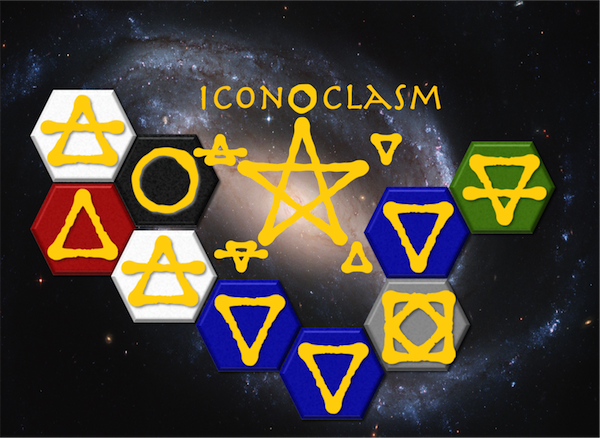
The rest of the week was spent on working the mathematical game I'm co-designing. After a slow start, a game begins to emerge where the classical hexagonal wargame is spiced not only with the mathematical mechanisms proposed by my co-designer Michael Paxinos but also several hidden simultaneous actions that add tension and reduce downtime. A simple one is the use of movement tokens, not unlike the programming cards of Robo Rally. A more inventive one is the production and trade mechanism, where territories produce goods to the owner (or your lord, if you've been forced to become a vassall, or an enemy, if your territory is plundered), which are sold on a market at a given demand curve (the more players that happen to sell, the less do they get per resource). This may become a very interesting game. Nevertheless, my main focus was on my non-boardgame work with Morwhayle, where I've now reached the second adventure in the trilogy I'm preparing. Even without any new boardgames of my own, Nova Suecia Games will keep me occupied this year too... Week 8, 2015: The tester feedback on Iconoclasm highlighted two main issues with the game:
Taking in this feedback, I simplified the rules even more by removing the ordered scoring (1 point per unit or 1/2 point for the spirit player - period). After some hesitation, I also removed the 2 unit victory, since the benefit of a tactical victory path was outweighed by the risk of accidental kingmakers as players form opponent units by mistake. I then proceeded with replacing the diagrams with more realistic images and replacing text with diagrams where possible to make the rules easier to read. Last but certainly not least, I added a sample game throughout the rules to further illustrate the rules and put them into a strategic context. The result is version 1.2. Iconoclasm may still not appeal to all players but at lest it has been given a fair chance to present itself! My next task will be to update my Kickstarter page and send the game to an external reviewer to get a professional opinion. Week 7, 2015: This week I finally managed to take a break from game design and limited my effort to completing my submission of Explorers & Exploiters to the Sprue Challenge and (finally) completing my game test of Mare Balticum. The latter is growing again after some "resource optimizing" turns were followed by devastating battle turns and it is a good candidate for my next game to promote. Unfortunately, I haven't received the tester feedback I had hoped for from my currently promoted game Iconoclasm yet. Perhaps it's too abstract and tactical, in which case a more thematic game like Mare Balticum may be a better option. I also suffered from a setback as something went wrong with my order at the The Game Crafter so that I had to replace it. This means another 3 weeks' waiting time so I will have to wait with the actions shots for my new and updated games. With less time for own games, I dug deeper into others' games with a review of the inventive card mechanisms of Deus and a solo version of another inventive game, namely Five Tribes. Nevertheless, this year may be devoted to roleplaying games instead, as my first drafts for an adventure to Morwhayle received good feedback not only from the game designers but from the author to Morwhayle himself, Peter Bergting. So many exciting game opportunities, so little time... Week 6, 2015: A strange week is at an end. It started with a thorough rule feedback on one of my Christman Give-Away games, namely Bellum se ipsum alet. Overall, the game was appreciated and besides rule clarifications I softened one of the victory conditions by letting ruins reduce the number of required cities for victory. More rule feedback was received for Iconoclasm regarding an error in an example and the misunderstanding that support is counted by the end game score values (ranging from -1 to 2) rather than simply 1 per token. You can never be too clear! But as this wasn't enough, I was asked by a consulting company to offer a game evening featuring Find the Bug! and my game design articles. As this wasn't enough, I was asked by a teacher in mathematics to partner in designing a game based on mathematical mechanisms. I already have an idea on how to use precalculus in sieges, by letting spies find out unknown variables to let the besieger know how much strength that is required, and look forward to come up with other mathematical game mechanisms. It seems like my poor game test of Mare Balticum will have to wait yet another week. Perhaps it's just as well that my shipment from The Game Crafter is delayed. Week 5, 2015: After the previous hectic week, I took a break from the game design. This still meant work with finalizing the shop pages for my next games to be published; Comrade, Gulag, Politburo and Explorers & Exploiters; including making videos. As a player, I'm personally not a fan of learning games through videos but since this is considered important to many others, I made one for Find the Bug! for the crowdfunding campaign and decided to do the same for my latest games. (My videos are very simple compilations of my shop page action shots, where I give an overview of the rules, but a simple video is probably better than no video at all.) In addition to this, my ongoing projects of documenting annotating games (currently working on Mare Balticum) and creating Print & Play versions (finally completed Find the Treasure!) proceeded. Even if I don't design new games, my old games will keep me busy! But a break from game design doesn't mean a break from games. I have received the games Five Tribes and Dead of Winter and look forward to learn new things and, of course, have fun! Week 4, 2015: A hectic week is at an end. It all started with some good advice at The Game Crafter on how to improve the art, theme and components of Iconoclasm. This resulted in a gas cloud rather than a moon as the board background, the removal of the somewhat far-fetched deity-cult-temple dimension in favor of a strict element-units-icons dimension and the use of tokens with sticker instead of cardboard chits. 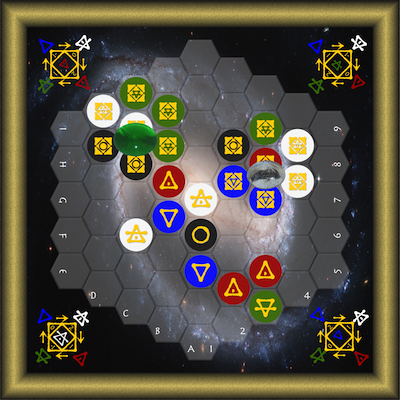
However, I was not even done when some of my games got attention at Boardgamegeek, among them Iconoclasm, after which gamers found their way to my advertisement for testers. Suddenly I had several testers providing valuable but time-consuming advice. After having received their their blessing for my ongoing changes, I ordered copies for them to test. At the same time, I ordered copies of my remaining games (Explorers & Exploiters, Comrade, Gulag, Politburo and Explorers & Exploiters as well as new copies of the previously given away Nova Suecia and Bellum se ipsum alet and new components for Mare Balticum and Iconoclasm. However, I had hardly submitted the order before a Swedish collector asked to buy all 6 games in the Nova Suecia series! I quickly cancelled my order and added the games in a new order that by far is my biggest order with The Game Crafter. Nevertheless, I plan to let it be my last order this year. I know it's only January but with 18 games designed so far, I really need to revisit them, refine them and decide whether I want to market them as well or just leave them as "hobby games". The outcome of my Iconoclasm initiative will tell. Week 3, 2015: Two more games were polished this week. First, Tre Kronor Infernum got a new end condition by letting the game end when it runs out of fire or ash markers (symbolizing the fire being out of control or the castle being burnt down). This is similar how to the exhaustion of sand tiles in Forbidden Desert symbolizes the desert winning over the players and is another example of how playing games inspire to designing games. Perhaps even better, this also convinced me to remove the many redundant victory conditions, such as most extinguished fires (since the fire markers are no longer kept by the players) and focus on the core conditions of saving and stealing. As a bonus, I could decrease the number of markers in the game and hence the price! The other game was Iconoclasm. To avoid unnecessary decision points, I wanted an unambiguous rule for which element that is replaced by a sprit in an external clash. "Closest to the enemy temple" is natural but may end up with two eligible elements and "closest to middle" is not enough to break ties. However, "the one right of the own temple" leaves only one element and I finally got my quick and clear decision point. I also considered two other rule simplification but rejected both. One was to remove the relative temple scoring and only have the players' own temples counted. However, I realized that the with the relative scoring, even players unable to build their own temples will have something to play for by building two opposite temples as this will lead to an all-player draw. This keeps the game interesting to all players and mitigates kingmaker situations. I also considered the rare indirect support but although the rule add a bit to the complexity, it is only used in rare situations and help avoiding complex situations with large non-temple areas. Speaking of Iconoclasm, the TGC community member "Video Garver" offered to produce a free video for the game. I also got a reply from a previously contacted reviewer, All Us Geeks, who accepted to review Iconoclasm. Given this, I set a goal date of 30 April for the Kickstarter campaign and applied for game testers at Boardgamegeek. Finally some non-boardgame news. I had previously discussed converting my old RPG adventures to Morwhayle with a friend and my initial writings got good feedback. I have now agreed to write an adventure and if approved, I expect to spend less time for my boardgames. On the other hand, the last few weeks have shown that they benefit from being left to mature with occasional revisits and I will continue to play both them and other games once in a while to continuously improve them. Week 2, 2015: Elaborating further on the resource balance mechanisms of Mare Balticum, I looked into the static vs dynamic dimension. The first edition focused on the chain mechanism, where fleets are prerequisites for armies but armies harm the fleet production and son, a context in which a static gameplay is suitable. However, with the insight that Mare Balticum is really a game about resource balance, a dynamic gameplay felt more appropriate. The two main results were specialized provinces, where it is no longer is enough to select a couple of provinces and stick to them but where the players must constantly find new markets to satisfy their changing needs, and rotating leadership, which encourages players to share fleets, armies and forts (as long as they can trust each other). I also replaced the old wooden tokens with the new cardboard chits offered by The Gamecrafter, resulting not only in a visually more appealing game but also a price reduction with $10!
Among other things, my Christmas Give-Away, concluded with Bellum se ipsum alet being the third game to be given away to Peter Hagbok. Although popular, its audience of military gamers may still be too small to motivate a marketing effort but I guess future will tell. Week 1, 2015: Playing games is a great way to get inspiration for designing games! Next week's game of Advanced Civilization (the first time in years) with its brilliant balance mechanism between units and gold probably inspired the update of Mare Balticum, where both goods and gold now are required for investments. Two other inspiring games were Istanbul and Amun-Re. I had long been concerned about the lack of tension in the end game of Nova Suecia as players start accumulating gold. The previous version 1.0 had the solution of investing in forts but this way of buying victory points felt like a pointless transaction. The answer was a return of the fort but with an increasing cost. Now the players need to choose between investing in districts for future gold or investing in the fort before it gets too expensive. At last the tension I had looked for so long! Among the other news was the final score in the 18 Card Microgame Contest. My best placed game was Comrade as the 12th best game and the 3rd best theme, followed by Vasa Regalis as the 22nd best game and Gulag with the 11th best art. It remains to see if any of them gets selected for production. Old blog posts may be found here:
|
Please leave a comment on the games or contact me directly at nicholas.hjelmberg@gmail.com. |