
 |
Vision | Projects | Blog | Articles | Awards | Order | Reviews | |













































|
Week 40, 2015 A busy but productive week is at an end. It started off with leading the Find the Bug! game event at my latest customer AddQ. Unfortunately, the package from The Game Crafter didn't arrive until a couple of days later. Instead, I had to borrow games for the evening and deliver the real games, with the custom printed logotype, later - a logistic challenge. Nevertheless, the game was popular, although I really would like to find a smoother game mechanism for the retest phase. I also consider relaxing the test automation rule - instead of losing a tester if a later bug is detected, the player could lose a point instead. However, there is a risk that all player will place testers on test automation from turn 1, since they usually pay off at least 1 point, so more testing is required first. A game that did get some rules revisions was Apokalypsis thanks to the feedback from The Game Crafter user Atomic Dragon, although they were mainly clarifications. The rules are now solid and I announced the game at Boardgamegeek. Another game that finally made it to the Boardgamegeek was the card game version of Iconoclasm. Although the game, the rules draft, the art template and the proof of concept was completed within hours, the rest took the entire week. Rules revisions, detailed art, print & play files (color and black and white), game description, shop page and rules video - even a simple 18 card game takes time. A lot of testing remains, as does designer notes and strategy articles for the homepage, but at least the game got ready in time for the formal start of the 18 Card Microgame Contest. When the package from The Game Crafter finally arrived, I was also happy to receive Apokalypsis. It looks very good and I look forward to bring it to the next boardgame café for external testing! 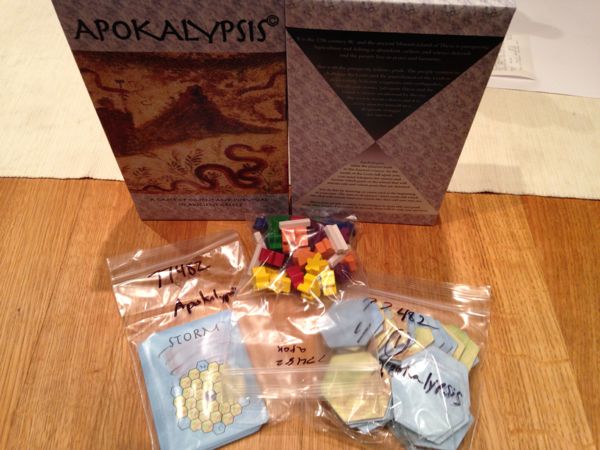
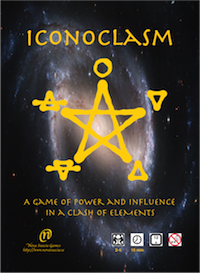
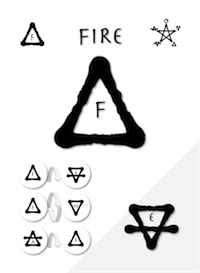
Week 39, 2015 This week I focused mainly on completing the illustrated rules for Nova Suecia. There are many dependencies in this my very first game and with 16 rule pages it is my most complex as well. Still, no rules can be removed without changing the core of the game. Nova Suecia may not have the highest ratio between depth and complexity of my games but at least the illustrated rules help players understand what happens in this dynamic game. In contrast, my latest game Apokalypsis manages with only 4 pages of rules and testing shows that the game is solid. Hopefully I will have time to annotate the test game next week. The small box version of the game for the The Survival Challenge was completed at The Game Crafter, as was the rules video. As soon as the game has been delivered and I've taken some photos, it's ready for submission! As if one contest wasn't enough, I found about the 18 Card Microgame Contest 2015. Following the success with Vasa Regalis, Comrade and Gulag, I decided to participate again and somehow, my mind wandered back to Iconoclasm. At one point, I considered letting elements flip into other elements instead of units deforming and reforming. I abandoned the idea since this would be too chaotic for a boardgame with elements in units but perhaps it would work in a cardgame with only elements? Some initial testing confirmed my idea and within hours, I had draft rules and components ready! The objective is to have both color and black & white print & play files ready for the entry date of 3 October. 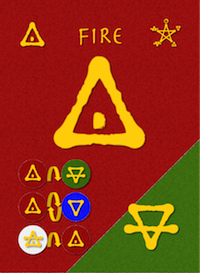
Finally I demonstrated Find the Bug! for my customers at AddQ. Unfortunately their games won't be delivered until next week but I managed to borrow games and will also help leading the game session next week. It may be a lot of work to sell some games but it's always fun to see your own games being played! Week 38, 2015: Unfortunately, neither Mice in a Maze nor Demokratia made it to the semi-finals in the Gamehole Board Game Challenge 2015. It was close but the many submitted games and the fact that voting was free (allowing many games that didn't fulfill the contest criteria to raise votes) put an end to the contest for my games. However, both games can look forward to a video review by Matt Games, who took an interest in them, and that's almost as good! More exposure was given to Iconoclasm, which was a surprise hit at this month's boardgame cafe. The players spontaneously asked to play it again, giving it a top 5 on the Q4T Score! With that, I decided to announce the relaunch of the Kickstarter campaign, although the date isn't set yet. 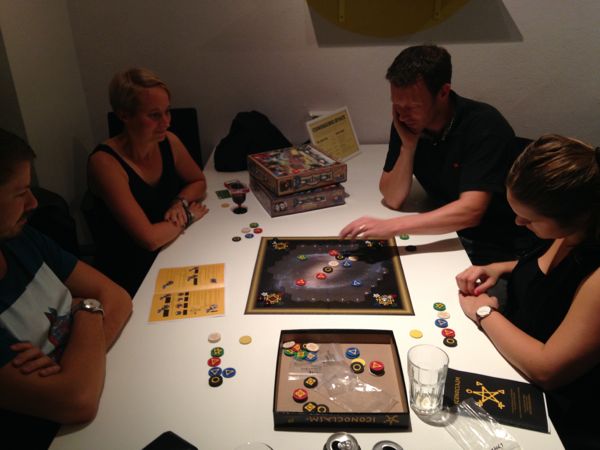
Besides that I worked on updating the Apokalypsis homepage with game, rules, strategy and theme sections. Now, only the rules video and the annotated game remain. Hopefully, I can then request feedback on the rules after that. Speaking of which, some old games have started to catch attention and with courtesy of BGG user BozoDel, I've received valuable feedback on Christina Regina and Nova Suecia. I've already considered updating old rules with more illustrated examples one day and now I've got the trigger I needed (as if I didn't have enough to do already). At least it should keep me from starting new game project. Or...? Week 37, 2015: My plans for the week were interrupted in a positive way: Seven more games sold! First, five copies of Find the Bug! were ordered by AddQ for a consulting event. Only a couple of days later, Mice in a Maze and Comrade found their way to a buyer in California. 
The first sales triggered frantic activities, not only to update Find the Bug! with the AddQ logotype but also to complete a prototype of my next game Apokalypsis to include in the shipping. Perhaps it was a sixth sense but although I was in no hurry to complete the game, I had completed most of it already (tiles, draft game at The Game Crafter and several test iterations) so I only had to complete the cards and the box. The Survival Challenge requires a small box but for my personal copy, I decided to go for a medium box to fit meeples and bridges and make it more similar to Demokratia, my first game in what may become a series of games set in Ancient Greece. 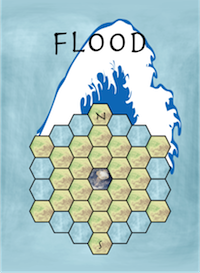
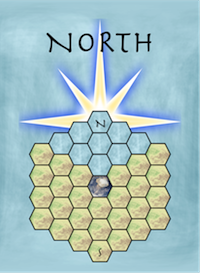
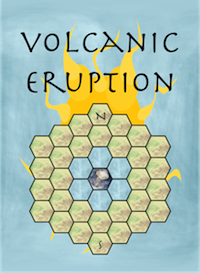
The test iterations continued anyway and fortunately, the game is now fairly stable. The latest iterations use twice as many meeples and allows two per tile. Not only does this give more flexibility to move around but it also opens for an intriguing mechanism: the ability to "push" to get your meeples to safe tiles and others to dangerous tiles! The idea of defying Gods, however, worked less well but instead I gave the players the freedom to draw two omen cards each turn and choose one. In that way, they get to choose both which tiles that they want to sink soon and which tiles that they want to sink later. I know that I say this about all my games but I'm really beginning to like this little gem. While I was at it, I uploaded the draft homepage, complete with rules and print & play files. The rules can also be previewed and commented at Google Docs, an idea I'm trying for the first time to - the more critical eyes, the better! How about my planned activities then? Well, I had to postpone the Iconoclasm strategy a couple of days. Nevertheless, I kept iterating it in my mind and, inspired by some other games I've studied during the week Genesis, Reef Encounter among others), even considered alternative rules, such as units of unlimited sizes. However, in the end I felt that the restrictions of seven tokens per unit makes the game more manageable and unique. Also, the idea of "last unit standing" is much better implemented by many small and short-lived units that few large and long-lived once. One small change survived the thought process: the modification of the two-unit victory to require two connected units to prevent "accidental king-making". I was also glad to learn that my Iconoclasm microbadge at Boardgamegeek was approved. I haven't yet decided if and when to relaunch the Kickstarter campaign but Iconoclasm is very much alive still! Finally a word about Gamehole Board Game Challenge 2015. The contest opened on Monday but with 90 submitted games (!), the competition will be fierce. Perhaps Survival will stand a better chance, given its constraints of fitting in a small box. Week 36, 2015: Is it a game or a variant? I designed, tested and submitted 5 Ages to the Playing Card Challenge in no time. I even added a military dimension to the game with the jokers, allowing a player to steal a card from another player's civilization. Perhaps it can be turned into a real game one day, but that will probably require good art to stand out. I also changed the game mechanism of Apokalypsis from escaping the island to simply surviving on the sinking tiles to get more variation in the movement. I also gave the players the freedom to choose when to trigger tiles to sink by defying the Gods. The idea is to move your meeples in safety first and then cause others to lose more than you do. The abstract coordinate system was also replaced with a more thematic area system, where area cards in combination with lava (inner rings) or tsunami (outer rings) determine which tiles that are affected. However, I don't spend much time on the game yet but let the idea mature first. The work with my Iconoclasm strategy booklet also progressed well. I have now discussed strong and weak units and hope complete everything in a week or two. Week 35, 2015: "Real" job prevented game job this week but I did have time for one fun event: a boardgame evening at a Café & Co. 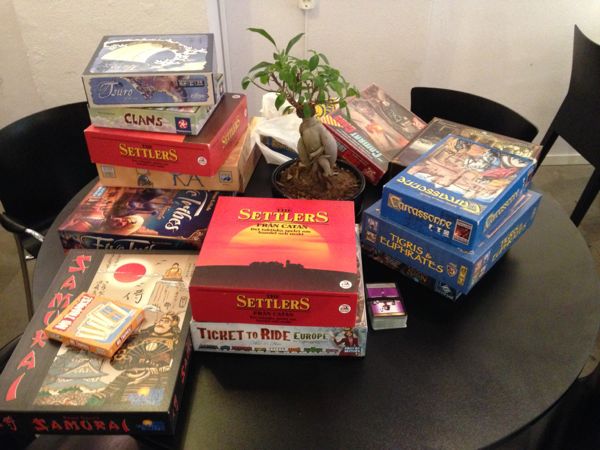
My help consisted of announcing the event at various forums and bringing games and buns. I also enjoyed learning new games like Ticket to Ride: Europe, Tsuro of the Seas, 6 Nimmt! and No Thanks!. Hopefully it can be recurring event. 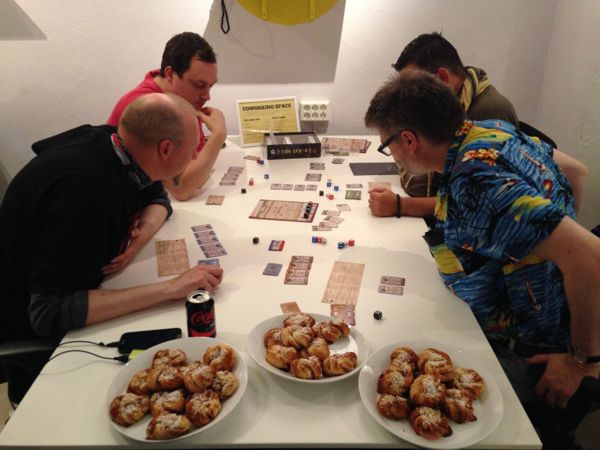
Another game activity was my resumption of my ambition to understand the ancient game of Go. With four of the five books studied in a series on Go strategy. by Janice Kim, I have now started to summarize my insights on my private homepage. I have also started to test my strength against the free and excellent app of Little Go. Hopefully my studies will serve as inspiration for my own strategy writing for Iconoclasm. I have completed the first chapter, where I characterize the elements in terms of "Master", "Betrayer" and "Opponent". Although not as deep as Go, it feels good to discover the depths of one of my own games. How about new games then? Well, the contests keep coming and so do the ideas. Although I don't have time to add more games to my portfolio, I may submit one or two simple ones just for fun. One is The Survival Challenge, which inspired me to Apokalypsis. The game is simply about moving meeples from a central city tile to a coastal edge tile, where a ship can be used to sail to safety. The challenge will come from a Tre Kronor Infernum mechanism, where drawn coordinates will make tiles disappear. Players may cooperate to help each other up from disappearing tiles or even build bridges to cross them but eventually, the cooperation will be replaced by competition to survive. Another contest is Playing Card Challenge, where you only have an ordinary set of cards at your disposal. Here the idea is to simulate a civilization building, where the players simultaneously draw cards and choose which ones to build with and which ones to trade away, not unlike 7 Wonders. The winning "civilization" will simply be the best poker hand after 5 rounds. Since both games can be crafted with limited work and without additional components, I may give them a chance! Week 34, 2015: This week started with great news as the Mingle & Murder became my first game to receive a video review! Gameplay, style and replayability scored high while (as expected) art scored less high. I may also have to think about my rules. As a designer, I'm biased and don't regard my rules as more complex than in other similar games so it's hard to tell whether I need to improve the writing or the rules themselves. Is Mingle & Murder the next game to focus on then? I'm not sure. Art can be acquired if necessary but it may still be a challenging game to market considering the number of players - 5-10 players will usually go for a simpler party game like Avalon or a hardcore game like Advanced Civilization so I'm not sure where Mingle & Murder will fit. I also published my recent games Mice in a Maze, Demokratia and Peoples, of which the two first were also submitted to the Gamehole Board Game Challenge 2015. Mice in a Maze had a couple of last minute changes that removed some parts that had disturbed me.
With those changes, I believe Mice in a Maze may appeal to a wider audience than my own favorite Demokratia, which may be considered too complex. The same can be said about Peoples but without a take that mechanism, it was never a candidate for the contest anyway. I also realized that it was difficult to resize images into microbadges but after a complete rework of the Iconoclasm symbol with clear instead of fuzzy lines, I could finally submit an OK image. Whether it gets approved remains to see. The week ended with a small jubileum: On 22 August it was exactly 18 months since I started Nova Suecia Games. I can look back on 20 games - all with a unique story. It started with Nova Suecia, a game that was supposed to be my only one but which resulted in an entire game series, The Nova Suecia Series. It then proceeded with the educational Find the Bug!, some attempts with children's games (Bake the Cake! and Find the Treasure!), card games like card versions of old games and Knights & Damosels and the abstract games of Turn of Time and Iconoclasm. After taking on the challenge of microgames (Comrade, Gulag and Politburo), I ventured into more innovative games such as the "all play all" 4X game of Explorers & Exploiters and the deductive murder mystery game Mingle & Murder. All my games have been fun to design and I've learnt a lot on the way. Nevertheless, I've now decided not to design any more games for a while and instead focus on improving and marketing the ones I have. After all, I gave birth to them all and I should now help them grow to their full potential. Week 33, 2015: The strategy sections for Peoples and Demokratia were completed. As always, it's one of many good game tests to verify the depth (and given the long and detailed strategies, both of them passed!). I was also happy to review my shipment from The Game Crafter. Some colors in Peoples could have been more distinct but besides that, they all looked good and I also took the opportunity to take some action shots of sequences from the annotated games. 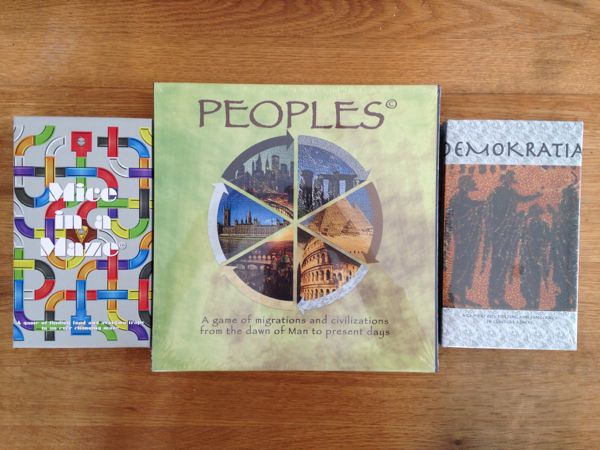
With my new games completed, I returned to old Iconoclasm and its strategy booklet. There's definitely a lot to write about so that will be my next project. I also started working on a microbadge for Boardgamegeek to see how well that works from a marketing perspective. Week 32, 2015: The order of Demokratia, Peoples and Mice in a Maze was not only placed but also shipped from The Game Crafter after an impressively short production time. I thought I would have more time to complete non-component game stuff while waiting, such as updating the homepages for the games and even canceling and reordering if discovering an error in the last minute. (I did so; some missing shadows and a decision to change the concept of tribe satisfaction to tribe power so that the Oligarch victory makes more sense; but fortunately nothing critical.) Anyhow, Demokratia now has a Game section, Rules section and a Theme section documenting the design work behind the game. The only thing that remain are the strategy sections for both Demokratia and Peoples, and of course the photos and boardgamegeek pages for the games to arrive in my package. Speaking of strategy, I also consider producing the strategy booklet promised in the Kickstarter campaign. It may have failed but if I decide to relaunch, a strategy booklet may help showing the strategic depth of the game. Week 31, 2015: The testing of Demokratia is finally completed! The most important changes during the test were the clear distinction between tribe satisfaction (which generates new citizens) and tribe influence (which determines your share of new citizens) and the addition of "black buildings", which subtract rather than add influence. They were introduced to make tile placements more challenging and to reduce the endgame "inflation" in satisfaction. They also add a new dimension to the game, as the players now have more options to modify the satisfaction and they are elegant from a numerological perspective as well: the total number of influence received from the 49 tiles is crossroad 10 + street 20 + turn 20 + alley 15 - black crossroad 2 - black street 4 - black turn 4 - black alley 6 = 49! All the work around new games is completed too: the Print & Play files, the Rules Video and the The Game Crafter Shop Page. The only thing that remains is to place the order (together with Mice in a Maze and Peoples. As always, I tend to like my latest game best - Demokratia is a very tense and interactive game that is open to the very end. But is it good enough to immerse the casual player? That remains to see but for the moment the accomplishment is enough for me. I still need to decide if to market a game if so, which game to market. Old blog posts may be found here:
|
Please leave a comment on the games or contact me directly at nicholas.hjelmberg@gmail.com. |