 |
Vision | Projects | Blog | Articles | Awards | Order | Reviews | |










































|
19 July 2014: Prototypes of Christina Regina - the Card Game, Find the Bug!, Bake the Cake!, Find the Treasure! and Knights & Damosels ordered! The last changes before the order was the addition of the rule in Knights & Damosels that no event card is drawn the 1st turn (I discovered that I had missed to write this rule down when updating the homepage with the reason for this rule) and that the smaller side in the Battle of Camlann gets 1 extra card instead of 1 extra player (I realized that this an even better option when updating the homepage with the calculations behind this rule). That shows the importance of not only testing a game but also stepping back and reflecting over the game to ensure that all the lessons learnt are included! With this blog post, the design phase of Nova Suecia Games is over for now with 11 games designed in the 5 months since all started on 22 February. I will now go on vacation and think about how to proceed next. New games or marketing of old games? The future will tell. 18 July 2014: Action shots for Knights & Damosels completed and uploaded to The Game Crafter. A final review remains before the next batch of prototypes may be ordered. 17 July 2014: Homepage finally updated and uploaded with my most recent games. I hope you find the information interesting. 16 July 2014: With Knights & Damosels completed, I finally took some time to start updating the homepage. Although I had designed another 4 games since the Nova Suecia series (Find the Bug!, Bake the Cake!, Find the Treasure! and Knights & Damosels, not counting the card version of Christina Regina), none of them had reached my homepage yet. I also like to document them for my own sake as it helps me to reflect on decisions made during the design. 15 July 2014: Perhaps it was good that I decided to write the rules on cards instead of in a booklet since this really forced me to write clear and concise rules. It was not easy but by sticking to the general rules and use game cards for the details, I hope that I made the rules not only more digestable but also easier to refer to during the game. The final result was 3 rule cards: 1 card description to help the player understand and sort the 9 different card types, 1 turn description to give the players an overview of what happens in the 6 phases of a turn and how the cards flow through the game (with an example on the back) and 1 advanced rule card for the Battle of Camlann (again with an example on the back). I hope I succeeded, the game is really not complicated but my initial rule attempts certainly gave the opposite impression! Today's test returned to the 4 player version and this time it was a rather straight-forward game with few blocks and jousts. However, the end game got interesting as both Morgana (Lancelot's damosel) and Guinevere (Gawain's damosel) managed to influence knights. Gawain won with most nobility cards but was challenged by Percival and Lancelot, who both had more courtesy points. Kay, having few courtesy points, preferred Gawain's side and the Battle of Camlann began. It was an even battle until turn 6, when Lancelot's valor prevailed and made the battle even in terms of nobility cards. Lancelot, Gawain and Kay all survived the battle and with 19 courtesy points against Kay's 10 and Gawain's 9, Lancelot claimed the victory! Fair? Maybe, his damosel did succeed. Exciting? Yes! 14 July 2014: Another successful test of Knights & Damosels, this time with 3 and 6 players. I was a bit worried that the 3 player game would leave the players with few options - when the first player has taken a nobility card, the second and third will have no options as they cannot take their own colors. However, the game turned out to be even more tense as the player got even more opportunities to block each other from taking or placing cards and taking them themselves. In the mid-game, there were several jousts to accomplish and the most successful knight was Gawain, who was able to place 3 cards compared to Lancelot's and Kay's 1 each. However, Lancelot (playing King Arthur that turn), had a revenge when the war failed and he could select Gawain as the knight to lose a nobility card. Lancelot then seemed to ride towards victory as he claimed his 7th nobility card. However, little did he know that Guinevere was behind 6 of them and so lost the victory to her knight, who turned out to be Gawain. To make things worse, Lancelot lost his 7th card in the last quest of the game (which unfortunately was the only card NOT from Guinevere) and with that the 2nd place as well. In the final battle of Camlann, he sided with Kay and with 11 cards against Gawain's 6, the field was prepared for an even fight. The victory seemed to slip out of Gawain's hands as Kays horse survived the 3rd round but he replied quickly when his horse killed both Lancelot's fisher and Kay's hunter. The rest was simple and Gawain won another exciting game of Knights & Damosels! The 6 player game started with early quests and wars, giving a mid-player advantage. Kay (starting 3), rode off to what looked like a secure victory with 10 courtesy points after 3 turns, only 2 below the victory condition. Other knights jousted fiercely to catch up, increasing the spread between the knights and helping Percival and Tristan to get closer. However, two disasters in a row threw them back and instead Galahad passed them all as his damosel Elaine managed to influence Lancelot (which was ironic considering what really happened). Nevertheless, Lancelot sided with Galahad against the 4 other knights in the Battle of Camlann and I was to witness a test with 4 knights (18 nobility cards) against 2 knights (12 nobility cards). With 6 cards played at a time, there were few opportunities for break-throughs and with most rounds ending with all cards lost, no knight could match Galahad's 7 cards. Just like the 3 player game, this game lasted 8 turns and I feel like I have found a good balance in the game at all number of players! 13 July 2014: After a weekend's work, all 108 cards are completed (except the 3 rule cards) and all rules reviewed and updated with illustrated examples. I also got rid of the last random game mechanism and made the disaster rule more consistent with the war/quest rule. Just like the knights have to choose arms/virtues cards to succeed in a war/quest, they may now choose a vassalage card to avoid losing a card to a disaster (which they will do if they choose the same as King Arthur picks). This also gives more value to the King Arthur role and makes it at par with the Merlin role. More test and shop design work still remain but I can finally see Avalon in the distant! 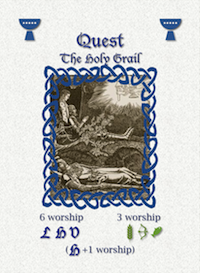
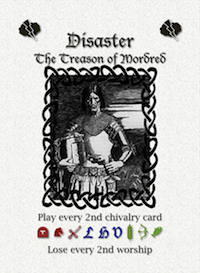
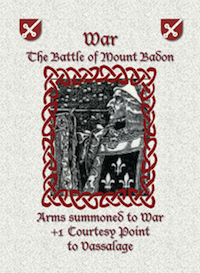
12 July 2014: With all the design components ready, I started to assemble all the cards in Knights & Damosels. Of the 108 cards in the game, 46 are unique if I counted correctly. How do designer with hundreds of cards manage? Anyway, at the end of the day I was happy to welcome Sir Gawain, Sir Lancelot, Sir Galahad, Sir Percival, Sir Pellias and Sir Tristan to the game together with Lady Guinevere, Lady Morgana, Lady Nimue, Lady Viviane, Lady Elaine and Lady Isolde. 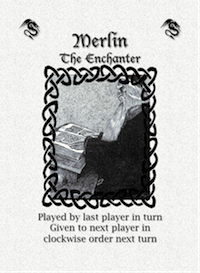
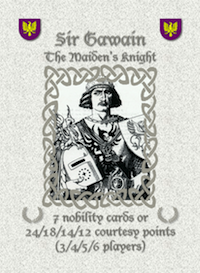
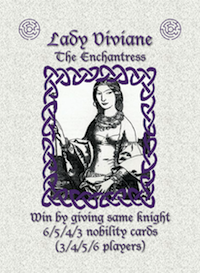
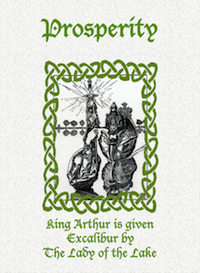
11 July 2014: After some days of designing, I returned to the testing of Knights & Damosels and the long awaited odd player testing. My main concern was whether the Battle of Camlann would be balanced with an odd number of players. Initially, I thought of simply adding cards until the two sides are equal but would this really make things better? Wouldn't the fact that more players on a side also lose more cards every turn even things out anyway? There was only one way to find out: to go back to probability calculations. For the probability calculations, I set up table of all possible outcomes in battles with 2 to 1, 3 to 1, 4 to 1 and 3 to 2 players. The conclusion was a bit surprising. With the assumption that the players will have 5 cards each in the battle, 1-2 cards to the weaker side is enough to even out the odds. Considering that the leading player is likely to have more cards to start with, 1 extra card to his knight should thus be enough even if all other knights turn against him! So how did the odd player test go? 5 knights and 5 damosels met and the clashes started immediately as Lancelot jousted Tristan for Loyalty and lost. War, prosperity and quest followed, benefitting Gawain, Kay and Percival most. Percival took a gamble and jousted Gawain for Fisher and his victory seemed to secure the victory for him. However, in a following war, Percival lost his sword and instead, it was the damosels that came to determine the outcome. Guinevere (Gawain's damosel) had influenced Kay while Vivien (Percival's damosel) had influenced Gawain. Courtesey points had to be used to break the tie and this was in Percival's favor but thanks to his damosel, Gawain was the strongest knight and challenged Percival for the victory. Again, the game had to be settled through the Battle of Camlann. Kay and Lancelot sided with Gawain, mustering a total of 20 cards, while Tristan supported Percival, giving their side 14 cards. According to my calculations, this should be an even fight so what happened? Well, with 3 against 2 cards played, most rounds killed off all 5 cards but in the 3rd round, Lancelot's card managed to stay alive and things looked dark for Percival's side. However, in the 2nd to last round, Percival's fisher managed to kill off Gawain's honor, leaving Percival's last horse to meet Lancelot's last horse and Gawain's last farmer. In the ensuing King's Vote, the knights had 8, 12 and 14 courtesy points, which were reduced to 1, 5 and 7, and with the odds on his side, Percival was declared new King and winner of the game! The test game was very exciting and in spite of the absence of disasters, the path to victory was far from short and straight-forward. Even Lancelot, who hade the poorest score from the first phase of the game, had a chance to win in the end. The newly adjusted rule that the winner of the first phase gets 1 nobility card (gave Percival 8 cards, just as many as Gawain) and 2 courtesey points (gave him the 2 points needed to get better odds) seems fair and well-balanced and currently I don't see any need for further adjustments. I have a good feeling about this game...10 July 2014: The thing about designing a card game is that you have to design a lot of - cards! Even though the groups of cards in Knights & Damosels are limited (knights, damosels, events, arms, virtues, vassalage, joust, service and courtesy points), almost every card within each group is unique and had to be designed separately. A lot of time was spent in finding suitable illustrations for each individual knight, damosel, event and so on. Fortunately, everything I needed was available. In addition, the cards had to be designed so that it's easy to too see on a card both what kind of card it is and what group it belongs to, otherwise it will be a nightmare to sort them and play with them. For the back, I used a neutrally colored silver/black background with a symbol on the back to identify the group and still have a consistent theme. For the front, I used a small colored symbol in the corners where the symbol identifies the kind of card and (for event and nobility cards) the color tells which cards that are related to each other (green for prosperity/vassalage, red for arms/war and blue for quests/virtues). Least but certainly not last, the cards must work for the game purpose. This was certainly true for the nobility cards, handed out by the damosels. They must have information both for the knight using them and about the damosel behind them. Naturally, I put the damosel information on the back but kept the neutral background and only marked the damosel by coloring the damosel symbol and adding the damosel's name. By that, I maintained the consistent theme for the back and also minimized the risk of players seeing the color when handling the cards. The "usability" test will be very important for this game... 9 July 2014: Returning to yesterday's game test, I analyzed the final phase of the battle of Camlann further and was not happy with the forced end game. The battle was all about getting a unique card to the field to kill similar cards in the enemy's reserve. Since this typically happened in the first battle round, the cards left would not have any more enemy cards to kill and only be exchanged against each other. The first solution I considered was to simply play one battle round only and let that decide the outcome. One advantage would be that it doesn't matter if the sides are unequal as the smaller side can compensate the fewer cards played with a greater impact against a bigger enemy. However, one round only would be an anticlimax after a game full of tactics. Instead, I returned to the simple rock-paper-scissors mechanism. By having virtues beat arms, arms beat vassalage and vassalage beat virtues (knights care about virtues but peasants don't...), I created more opportunities for a battle with shifting luck. I added a rule that the winning side could add or remove nobility cards until the sides were equal and another rule that gave damosel winners the right add nobility cards and courtesy points up to the level of the knight influenced and got started. This made Lancelot (whose damosel Morgana had influenced Gawain) stronger so Gawain sided with Percival instead of the weaker Kay. The battle started with a successful use of valor by Percival, shifting the balance to his side. However, half-way into the battle, Lancelot managed to strike with his sword against Percival's fishermen and in the end, his valor stroke both Gawain's valor and Percival's armor in one blow. With Kay already fallen, the King's election was not necessary (which was fortunate to Lancelot, since he had so few courtey points). This battle was just as tactical and exciting as the first phase of the game. Perfect!8 July 2014: Draft rules for Knights & Damosels completed and tested! As often is the case in my games, the design was an iterative process where the different paths are simulated (to find out if the mechanisms are balanced), the rules drafted (to find out if all scenarios are covered) and the turns simulated (to find out if the game "flows" well). As an example, I had to ensure that the decision to pick a nobility card (used in risky quests) is equivalent to picking a vasall card (used in safe production). After some tuning, I concluded that both options provide an average return of 0,75 courtesy points per turn used (nobility cards return 2 in quests, 1 in prosperity and 0 in wars and disasters; vasall cards return 1 in quests, prosperities and wars and 0 in disasters) and an average loss of 0,67 per game (1 of 3 players is expected to lose a card in quest 2-3; disaster 1 is expected to strike 1/6 cards and disaster 2 is expected to strike 3/6 cards). The detailed calculations will be published on the homepage later if anyone is interested. Some of the important changes concerned the number of courtesy points awarded per turn (decreased to increase the competition), the addition of 1 starting courtesy points (to promote early jousts), the opponent's role in wars/quests (opposition cards must be drawn randomly, otherwise they will be impossible once one knight fails) and hands-on gameplay (such as the placement of courtesy points to the left of the knight and chivalry cards to the right to keep all the different cards in order). So how did the test go? Much better than expected! The knights' luck fluctuated strongly with first Gawain and then Lancelot losing jousts and falling behind. Percival and Kay seemed to leave the others behind when suddenly a war left Gawain as the only knight standing and gaining all courtesy points while Lancelot's damosel Morgana managed to influence Gawain. As the first phase ended and the battle of Camlann commenced, Percival had 8 courtesey points Kay and Percival 7 each and Lancelot 4. Percival and Kay joined forces and won the battle and in the following King's election, Percival had the statistics on his side with more courtesy points in the lottery and also won the game. I need to see how the game works with an odd number of players as well but so far there is a lot of action hidden in this seemingly small card game! 7 July 2014: First test of Find the Treasure! completed!. The first phase (the search) played as I had expected whereas the second phase (the chase) had to be modified to prevent pirates from returning to their ships and use its speed to chase the winning player. After all, the ship crew will not take kindly to pirates returning empty-handed, will they? The game started with red and blue pirate (Captain Bloody Mary and Captain Deep Blue?) challenging each other in a swampy corner. Red won, claimed blue's map and used it to find one diamond. However, yellow then guessed where the two diamonds might be and now an epic chase began. In a dark cave, where many pirates lost direction, red first beat yellow (Captain Yellowbeard?) and claimed his two diamonds. However, she couldn't find the way out of the cave and lost in a new duel against yellow shortly afterwards, whereupon green (Captain Seasick?) emerged out of nowhere and defeated red. Red, blue and yellow now all set sail to cover the possible escape routes but green managed to slip out of the net and, after having fended off red from a high bridge position and claimed her last diamond, sailed away from the island of Coroca with three diamonds! Find the Treasure! may not have the tactical depth of my other games but judging from the test, it is full of action and "take that" scenarios, perfect for the The Game Crafter contest it has been designed for! 6 July 2014: Action shots for both Find the Treasure! and Bake the Cake! completed. By that, my two games for the next The Game Crafter contest are completed and I can finally get started on my next game: Knights & Damosels. Since there will be plenty of cards to design in the game, I started with the logo early and what could be a better logo than King Arthur's own blazon: three golden crowns on a red (or blue) background. I also thought of a symbol for the damosels of the game and finally chose a Celtic style labyrinth symbol of the damosel's colors. Finally I found the perfect source for the general art theme: oldbookart.com with exquisite (and royalty-free!) Arthurian illustrations from Howard Pyle's books. With a frame in the shape of a Celtic knot, I hope that the cards will help bringing the players back to the Age of Chivalry. That is, if I manage to turn my thoughts into art. 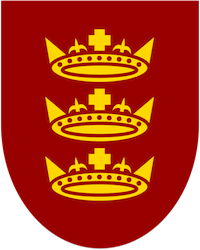

5 July 2014: Rules for Find the Treasure! finally completed and the entire game uploaded to The Game Crafter. All that remains is testing and action shots. 4 July 2014: Finally time to complete some more Find the Treasure! maps. Although the players should build their own maps, pre-built maps enable them to quickly start a game so I created 6 maps instead of the initially intended 3.
In addition, following my habit of having several parallell ideas in mind at the same time, I compiled some draft rule ideas for my next card game: Knights and Damosels. By opening several set building paths (arms, virtues and land) and connect them to services (war, quest and tax), I created a setting where the knights may have different options to earn courtesy points and the damosels may provide equipment to help them (and snare them). The random event mechanism is simple with cards drawn that may give peace, quest, war or disaster. The battle mechanism is also simple with cards being either placed on the battle field (1 per player) or held in reserve (the rest). Matching cards on the field discard each other while non-matching cards on the field discard all similar cards in the reserve or (if none are available) 1 card of any kind on the field. A quick simulation between 1 player with 6 cards and 2 players with 3 cards gave an even outcome, which was exactly what I wanted. There are several winning options: reach 12 courtesy points, have a knight building a complete set of 9, have a lady provide 3-6 equipment to the same knight depending on the number of players or fight the battle of Camlann if 3 disaster cards have been drawn without a winner. The players are free to pick side but only 1 player on the winning side will win the game through a lottery based on the number of courtesy points. This creates an incitement to pick the side where you are relatively strongest, likely resulting in equal sides. Almost best of all: the entire game experience can be accomplised by 100 cards only! I will reread Le Morte d'Arthur and go to action! 3 July 2014: New versions of the Christina Regina - the Card game uploaded and they do look much better. Hopefully I can leave this behind me now and finally return to Find the Treasure!
2 July 2014: The testing of Christina Regina - the Card Game revealed some necessary design changes. Previously the entire influence card was colored, just like the influence tiles in the board game. However, as the cards are supposed to be piled on each other, the colors of the cards beneath the top cards may be visible. Instead, I made them white with small colored symbols in the corners, just like ordinary playing cards. Continuing on this idea, I added faction leader portraits in the middle to make them more visually appealing and also give my "heroes" a chance to appear more openly. Continuing further, I even considered linking assassinations to cards scored: if the faction leader is assassinated, his or her color in his or her pile won't score at all. This would another tactical level to the game: if I assassinate a leader, which other color will score and how does that affect my score? The idea is intriguing but this also means that an assassination is not always beneficial, removing the key objective of the game to guess the other players' colors. The new card layout will still make this possible as a "house rule" but for now I will not apply it in the game. I also received my first quotation for a larger production: BangWee Games offers to produce 500 games of Find the Bug! for $7.95 each. Adding costs for artwork ($1 000?) and shipping to backers ($10 to Sweden, $20 to Europe/USA), a crowdfunding level of $30 per backer and $10.000 in total should be enough to break even. Is it attainable? I'll find out after summer when I have ordered and received a prototype.1 July 2014: Continuing with my ambition to make my games cheaper, I returned to Vasa Regalis. At TGC, components are priced by the sheet and the chits come in sheets of 77. However, Vasa Regalis uses 80 chits, requiring 2 sheets. By having 1 less of the value 1 goods (9 instead of 10), I could decreace the cost with $9! Second test of Christina Regina - the Card Game was successful. This time, I tested with 5 players and semi-assymmetric card piles (3, 5 and 7 blank in each pile), and just like in the board game, the increased difficulty in guessing colors makes the game more tense and tactical. Green succeeded in luring black into a failed assassination and took the lead. Red disclosed green in the last turn but green took advantage of red's knowledge to guess her color and immediately retaliated. Blue managed to keep her color a secret all game but had to pass on the assassination while black and purple were so far behind that it was pointless. The final score was green 9, red and blue 8, purple 3 and black 2. I think the board game is visually more appealing than the card game as the Queen moves across the board but the card game certainly has its merits! 30 June 2014: Christina Regina - the Card Game tested and so far, the game feeling is similar to the one in the board game. The players steer carefully around the colored cards, eager to have their own drawn but rather by someone else so they don't reveal their colors. Green played a bluffing game, taking red cards and being the object of a failed assassination from black. However, the failed attempt helped blue guessing red's true identity and grabbing the victory with 10 points against green's 9. Red stopped at 7 while black only got 4. A small adjustment was to limit the actions to only one per game instead of two. I also consider having the different amounts of blank influence cards in the piles rather than the current amounts of 0, 5 and 10 (either 3, 5 and 7 or 5 in all piles). Further testing will tell. 29 June 2014: A night's sleep and a morning's jogging gave me the idea I needed. Instead of designing a board game using cards, I should think differently and design a card game. Instead of letting the different chambers be set up by cards spread all over the table, I let them be set up by piles. Instead of moving a queen, the players will now choose whether to draw cards or play actions, hoping that other players will draw the cards for them. All the game mechanisms from the board game could be seamlessly applied to the card game. It was as if the card game begged to be designed. The final cost? Less than $10! Christina Regina the Card Game is now up for testing! 28 June 2014: Game development takes unexpected paths sometimes. I had expected to continue with Find the Treasure! but instead I began to think of card games. Why cards? I like boards! Well, that's actually one reason - I can't resist a challenge. Secondly, I had been thinking of a game with faction mechanisms, where players play dual roles: 1 that want to build a set and another 1 that provides the cards for the set. The more a player uses another player's set, the more does he or she falls under that player's influence. The working name is Knights and Damosels, as I consider setting the game in the Arthurian legend, an old favorite of mine, and weaving in other Nova Suecia mechanisms, such as production (rebuild the ruined country), cooperation against a common enemy (barbarians) and finally treachery (Mordred and Arthur's death). Those ideas point towards a huge game so why not starting small by testing the individual game mechanisms in a simpler game, like a card game? Thirdly, my games tend to be expensive (again, I like boards!). Perhaps a cheaper card game could serve as an introduction? Last but certainly not least, I've always been concerned that a simple game like Christina Regina is so expensive due to the tiles and the game board. Why not turn it into a card game instead? Considering all this, I started my card game adventure with Christina Regina, since it's a well-known and well-tested game. The board and all other components could easily be replaced by cards. Nevertheless, I ended up with a limited version that still only cut the cost by half, giving a selling price of $25. What to do now? 27 June 2014: Updates to Christina Regina and Mare Balticum completed! Now I can return to my next game again: Find the Treasure! 26 June 2014: First test session with unknown players completed! A colleague and his gaming sons came by for a dinner and game evening and we played Christina Regina twice and Mare Balticum once. The sessions went well (although I didn't win) and we had a good discussion on what worked and what could be improved. For Christina Regina, I will increase the number of characters per player to 3 (to allow players assassinated early to come back), limit the number of actions (by letting the players play action cards), add a 5th chamber to the board (to allow the queen to be moved around longer) and optionally have only 1 of each influence tile on the board. For Mare Balticum, I will let players place units on the build and title deck at setup (to speed up the start of the game), use similarly directed arrows on all enemy attack cards (so that they can be placed on the enemy hex to show the direction) and allow ships to generate 1 resource rather than nothing when there are enemy land units in the overseas province (to give then an incentive to stay and let an army cross the sea to attack). 25 June 2014: First island tiles for Find the Treasure! completed and so far I'm satisfied. I will likely choose this approach for the game board.
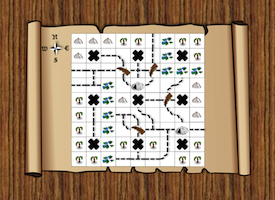
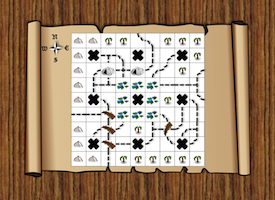
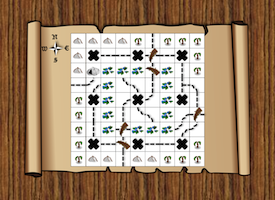
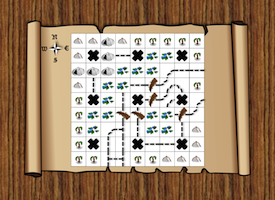
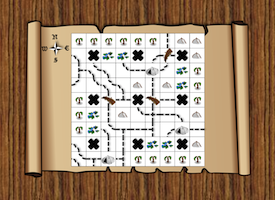
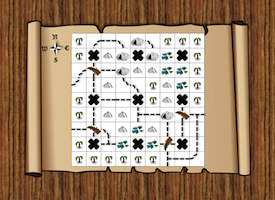
24 June 2014: After some additional thinking of the Find the Treasure! game board, I experimented with a different approach: a modular game board with a number of predefined setups. This combines the best of the two previous ideas: a clean and dynamic game board with controlled paths. Of course, the players may still create their own boards. Unfortunately, tiles instead of a board increased the price so I had to remove the 6th player to just get below the contest limit of $39.99. I guess 6 players would have made the island crowded anyaway. I also removed the dice from the movement rule (yes, still no dice in my games!) and linked the movement to the number of lids placed on the board (i.e. the number of items the pirate carries). The pirate may simply move half as many squares as he or she has lids left. This also works as a balancing mechanism as a successful pirate will be slower and easier to catch for the other. Finally I refined the board mechanisms. Instead of specifying the starting locations of the rafts, the player will get one each to place on the game board as part of the setup. Instead of rolling a dice for the cave, the player in the cave will have to play compass cards against a second player (the closest one or clockwise order). If similar directions are played, the pirate in the cave moves in that direction. If different directions are played, both player discards that directions. If all cards are discarded, the player chooses direction. If I got the statistics correctly, this gives the player 2/8 chance to move in a specific direction and 3/8 chance to choose the direction - enough to make caves interesting but not impossible. I'm beginning to like this game! 23 June 2014: 5 player test of Bake the Cake! completed! The scaling of the game, with 1 extra kitchen tool, gave the game a good flow with some (but not too many) blocks due to lack of tools. The victory was awarded to the green player, who managed to bake the winning cake and also supply 2 ingredients, giving a total score of 7. Yellow managed to get 2 of her bakers on the cake and blue to supply 5 ingredients but 6 and 5 points respectively were not enough. Red and purple were stronger on the other cake but since the winning cake takes it all, they stood no chance in the game. As in previous tests, the winning strategy requires that as many players as possible participate in the winning cake but that easier said than done. The testing is now completed and I only have to refine the artwork (paritcularly the box, which I would like to resemble a cake but my first attempts were not convincing). 22 June 2014: First draft of the game board/map for Find the Treasure! completed. The game board is asymmetric, using paths rather than squares/hexes for movement, which is something completely different from what I'm used to. The advantage is the possibility to customize an intriguing maze of challenges and also makes the board more similar to a treasury map. The disadvantage is a non-dynamic game board that gets "messy" compared to symmetric ones. An alternative would be to create a modular map, like in Drakborgen, but this may cause treasures to end up without any paths leading to them. After all, the primary mechanism of the game is the search of the treasure, not the maneuvering of the pirates, so if I can make the board less messy, I'll probaly stick to it. The draft work also inspired to some additional board specific mechanisms to make the pirate movements more interesting. One that I probably will keep is the addition of rafts, enabling the pirates to use rafts to cross lakes and rivers and prevent others from follow. This would also make the game board more dynamic as the rafts will be left on different shores during the game. Another one is the presence of caves, where the pirate will lose orientation and end up in a random direction. This would not only work to players' disadvantages but also help gettig rid of followers. 21 June 2014: Returning to Bake the Cake!, I finalized the last components: the store, the kitchen and the trays. Those constitute the game board of Bake the Cake!, where the game progresses from ingredients to completed cakes.
I also set up the shop page at The Game Crafter. Now I can focus on Find the Treasure! again before I decide which to submit to the contest. Or should I submit both? 20 June 2014: The game components for Find the Treasure! were completed, again using images from Openclipart to get a colorful look. I also found many good images that may be used for the map so hopefully it will not look too bad. Besides the map, Find the Treasure only contains two kind of cards: maps (showing which gems to expect in a longitude or a latitude) and arms (for the simple rock-paper-scissors battle system). The ships, the pirates and the markers showing where the players have dug will all use wooden tokens.
I also got an answer from WinGo Games regarding a request for proposal for Find the Bug! I need to provide some more details and then decide whether to proceed with crowdfunding directed towards the test community. So far, WinGo Games seems to be a better option than Cartamundi and Offason, that didn't even bother to reply. 19 June 2014: When discussing Find the Bug! with a colleague, I casually commented that the game could have a completely different theme, such as finding a pirate's treasure. A few days later, the idea of a new game had taken form. Find the Treasure! uses a similar analysis mechanism but instead of placing many testers, the players move around one pirate that must stay away both from cursed treasures and from the other pirates who want to steal his or her maps or treasures. The draft rules were quickly completed and the designed components are so few that the game can be completed in no time. The exception is of course the treasure island itself. Will I manage to create a map that looks good enough to attract treasure hunters? 18 June 2014: 3 player test completed! The game flowed well when scaled down (1 kitchen tool less) and became more tactical as the level of chaos decreased. Blue managed to get many ingredients on her own cake and also include yellow points in it, resulting in a victory with 10 points against yellow's 6 and green's 2. It was a close run, since yellow had 6 points on the 2nd cake as well and if that had won, the game would have gone to green with 7 points. I also did a re-simulation of the 3 and 4 players tests with a different score system, giving 3 baker points and 5 cake points to promote more cakes to be baked. Blue would still have won a tight victory in the 3 player test while yellow's baker strategy would have given a sole victory in the 4 player test. Both games required about 60 actions for 2 cakes to be completed, giving an estimated playing time of 30-45 minutes. Ideally, I would like to see all players finishing their cakes but that would take too long so 2 cakes ready seems to be a good end point. 5 player test next... 17 June 2014: The first draft of the recipe cards for Bake the Cake! created. I let the kitchen tool symbols be black and white in contrast to the more colorful ingredients and added a cake symbol to indicate which part of the cake that the recipe is used for. It may need more work but is good for a first draft.
16 June 2014: 4 player test of Bake the Cake completed! In my previous test, the game tended to stick to one track but two changes made it more dynamic. First, I introduced a cake contest in the end, where the players identifies the cake where they score the most. Then that cake only is used for the final score. This means that more cakes are baked and that a player must balance the score to win. Second, I adjusted the use of the kitchen tools so that each new ingredient must use a new tool. This means that a recipe can be blocked not only before its start but also during its use as new tools are constantly needed. The test game now became a tense affair with blue playing for ingredient score (most ingredients on a cake), yellow playing for baker score (most bakers putting the ingredients on a cake), green playing for cake score (baking the winning cake) and red playing for maximizing the score on one cake (a strategy chosen before my rule change). After the green cake was completed, green and yellow fought for the baker points of the second cake (mainly using the game's "take that" function of eating each others' ingredients but also by blocking access to kitchen tools) and instead blue completed the red cake. Nevertheless, the green cake won the cake contest and, using the eaten ingredients as tie breakers, yellow and green shared the victory with 6 points each (6 baker points for yellow, 3 ingredient and 3 cake points for green). A crazy but yet deeply tactical game, exactly what I'm looking for! The draft rules are now completed and only the artwork and the 3 and 5 player game tests remain. Particularly, I will try cards for the recipes (mimicking pages from a cook book) and assess how to scale the number of kitchen tools in the game. Still after seven games I get surprised of all the tuning that is required even for small games. The draft rules are actually only four pages - less than any other game. 15 June 2014: A mile stone was passed as Nova Suecia Games sold its first game! The honor was given to Mare Balticum, the sixth game in the Nova Suecia series and also a game that was given publicity through the recent contest at The Game Crafter. I don't expect huge volumes of sale but the knowledge that something I created will be played somewhere else in the world (in this case Oslo, Norway) is all the reward I need. Mare Balticum is now also published at Boardgamegeek.com together with images of the previous games in the Nova Suecia series. The game that followed Mare Balticum, Find the Bug!, got its shop page completed with action shots and is now ready for order. Finally, I returned to my latest game: Bake the Cake! and the writing of the rules. It's written in a cook book style, as by an old grandma with plenty of recipes up her sleeve, and I hope to have draft version ready by tomorrow. 14 June 2014: This day is a memorable day: I brought home my first delivery of my first games!
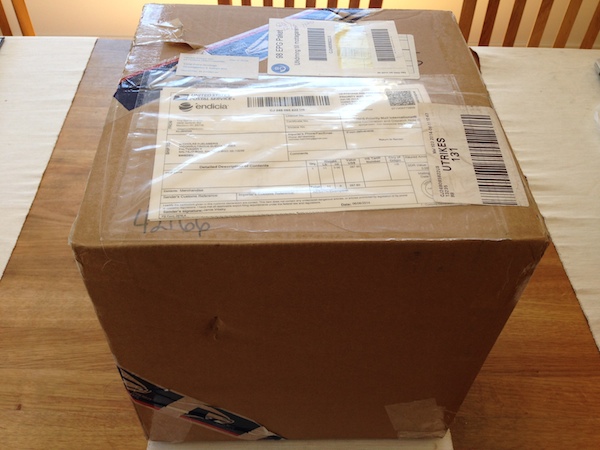
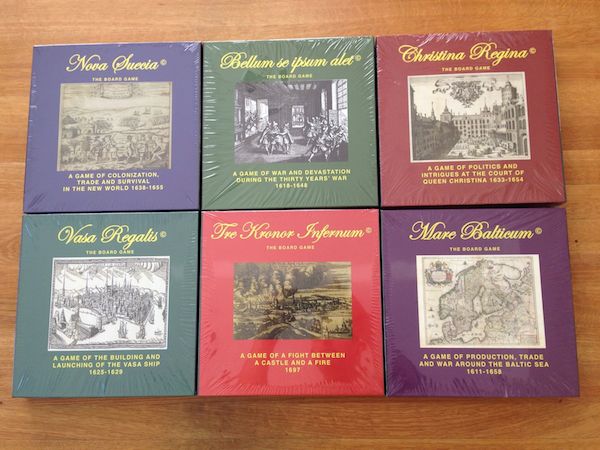
After long days and nights with hard work, my six games were finally in front of me. The quality of the games was better than I had expected/feared. The Game Crafter had packed them well and wrapped each game in plastic. The boxes were sturdy and my characteristic one-colored games with golden text and historic images wouldn't embarrass any game shelf.
The components were well packed in both plastic bags and brown paper to prevent them from bouncing around in the box. I particularly liked the thick quad-fold game boards. The glossy surface and the leather-like chipboard back gave me the same feeling as from opening a leather-bound book and made me want to play immediately. Less good were the flimsy shards and I hope that TGC listen to other customers and provide an option with stronger material for them. Nevertheless, all components were robust enough to withstand many game sessions. The printing left nothing to be desired. All my colors and patterns appeared as I wanted them to and the cutting lines were exactly where they were supposed to. I was also reliefed to see that the resizing of my A4 rules into the TGC format didn't affect the final printing at all. The issues that I did find were minor and entirely due to my own errors:
With that I documented the components, uploaded the images to both my homepage and the TGC shop pages and pressed the publish button. The future will tell if they ever get any other buyers but at least there's one proud and happy buyer over here. 13 June 2014: 3 player test of Find the Bug! completed! This time the players had a hard time to find the bugs initially but a strong end game rush prevented a loss for all players. This time, yellow had 2 testers to do analysis work but her remaining 5 testers only managed to score 4 points, an average of 0,8. Blue only had 1 analyst and still scored a higher average of 1,0 per tester or a total of 6 points for the 6 testers. Green did no analysis and scored only 3 points with her 7 testers or less than 0,5 in average. In the retest phase, yellow scored 4 points compared to the other players' 3 points each but couldn't prevent blue from winning with 9 points ahead of yellow with 8 points and green with 6 points. 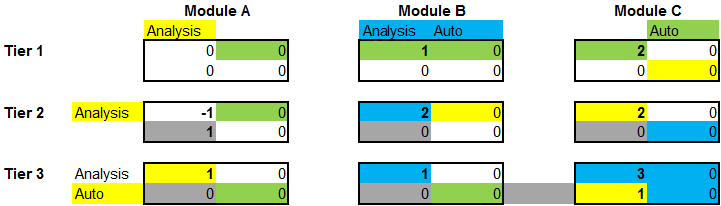
I also started a 5 player test but this time 3 components were left with bugs, causing all players to lose. 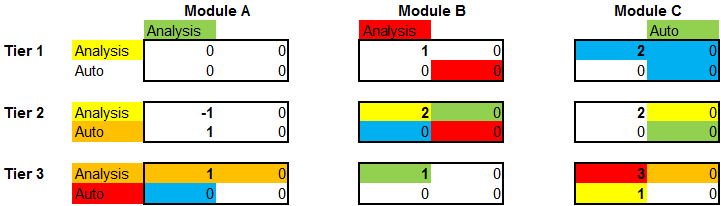
Although this should be a possible end, I felt that not only is the risk too high but it also difficult to automate a test until the very last turn, giving the turn order an unfair benefit. To solve this, I did a quick re-simulation with 1 extra tester per player and no bugs at all accepted. I also decreased the score for retest bugs to 0,5. This time, blue and green shared the victory in the 4 player game (5 points each after green caught up with 4 retest bugs in the end) while blue won the 3 player game (8 points in spite of a strong finish by yellow with 5 retest bugs). The 5 players still lost the game so that possibility remains. Find the Bug! seems to have reached a mature stage now. 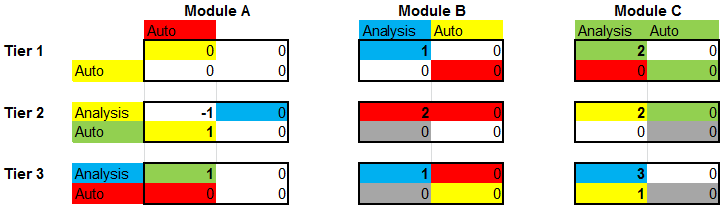 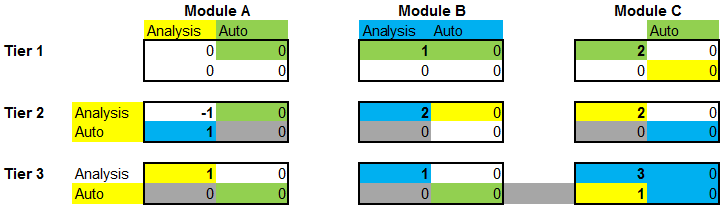 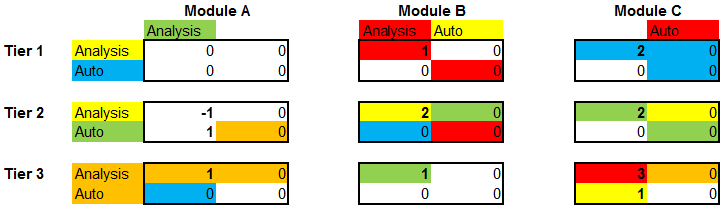
Finally I found time for some initial testing of Bake the Cake! Overall the game flow is good but the players tend to (literally) stick to the first cake to be started rather than competing with other cakes. Less kitchen utensilies may be one option to increase the competition. Further game testing will tell! I also started to create the components. The cost estimate is $35, a good margin to the contest limit of $40, and I made use of Openclipart for my first components. The theme is supposed to be comic and although my own simple symbols worked well for the Nova Suecia series, this game requires clear and colorful images. At least the symbol is my own and in line with my other symbols. The next challenge will be design a good looking store and kitchen.
12 June 2014: 4 player test of Find the Bug completed! All players tried different strategies with blue having 2 testers to analyze, yellow having 2 testers to automate tests, green having 1 each for analysis and automation and red not having any analyst at all. Blue's analysis paid off as she detected the only severity 3 bug in play and also found severity 1 bugs with her 2 other testers, scoring 5 in total. Yellow and green found bugs every second time and scored 3 each. Red only found 1 bug, scoring 2 points. So far, analysis paid off well (although blue was a bit lucky to have all testers finding bugs). However, blue's luck ended as she automated a component still containing a bug and this paved the way for yellow and green. They both found 3 bugs, giving a total of 6 each, and with yellow having less testers on test cases, she secured the victory. 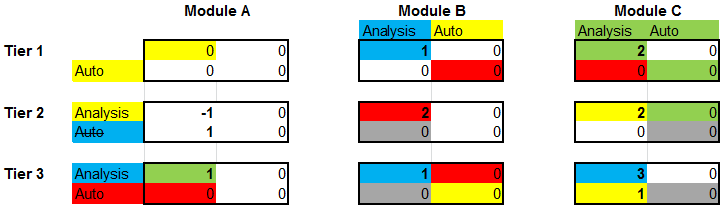
(The colors show where the players placed their testers, with gray indicating bugs after fixes, and the numbers show the severity of the bugs.) Overall, the test was successful (both the game as such and the simulated test in the game) and the only change was to allow 1 bug remain undetected. Last but certainly not least: it seems like my delivery from The Game Crafter has arrived! I look forward to the weekend when I can collect it from the post office. 11 June 2014: On second thought, I wasn't comfortable with changing my old games just to make them suitable for a contest. Instead, I got an idea for a new game with a literally more digestible theme than the Swedish 17th century: cake baking! The idea is to have the players buy ingredients, use kitchen utensilies to prepare them into cake parts and finally bake the cake. The challenge is that players may use each others' products but only the ones participating in the winning cake will score. Of course, players may also eat each others' products, thus complying with the contest requirement of a "take that" mechanism. Although the theme is completely different from the other games in the Nova Suecia series, the mechanisms are pretty similar. I will start by drafting the rules to assess the playability of such a game. 10 June 2014: All components for Find the Bug! uploaded to The Game Crafter, except the box and the rules. I have also created the draft homepage. Now it's up to the test result to determine the fate of the game. One idea is to try crowdfunding again and reach out to test communities. There is also a new contest at The Game Crafter. The company is more into cartoony games but this is not a requirement for the contest so I may consider participating again to get some publicity. Considering the price limit ($39.99), only Vasa Regalis and Tre Kronor Infernum may participate and considering the age level (8+) I may have to adjust the rules as well. One idea is to have a basic rule set where the object is simply to build most at the ship (Vasa Regalis) or extinguish most fires (Tre Kronor Infernum), with the save/steal mechanism added in advanced rules instead. But first I need to finish Find the Bug! 9 June 2014: After some consideration, I decreased the number of bugs to promote the analysis task (0-2 per tier instead of 1-3) and increased the spred of severity (between -1 and 3 instead of 0 and 2) to increase the score spread. I also completed the glossary, explaining how terms are applied both in the game and for real. I also created a game template at TGC, where I could try out different components. The estimated cost ended at $47 due to the many components, in line with my other games. 8 June 2014: First draft of Find the Bug completed! After many probability calculations, I think I have found a good balance between bugs and non-bugs that also ensures that it pays off to analyse the game board before starting to place testers. The addition of bug severity added another dimension to the game as players may choose between going for quality or quantity. A lot of review remains but hopefully I can start game testing my testing game (!) next week. 7 June 2014: Find the Bug progresses well. The game board, most of the cards and the rule book template is already completed. Just like I enjoyed linking the game mechanisms of my Nova Suecia games to historical facts, I now enjoy linking Find the Bug to IT terms. The game board depicts a 3 tier environment with 3 modules, the number of bugs in each area is determined by technical complexity and business criticality and the game phases are similar to the test phases of plan, analyze, execute, fix, retest, report and close. Least but not last, my simple art of symbols fit the theme very well as I can use existing process flow symbols instead of inventing new ones. This may become a very interesting game. 6 June 2014: My prototypes have been shipped! Also, I got some good ideas from The Game Crafter chat about my new game Find the Bug. Instead of the 8x8 square game board with bugs appearing in a line or row, I will use a 6x6 square game board where the squares are divided into 9 specific areas. In that way, I can have a random number of bugs in each area and allow more testers to search the same area. 5 June 2014: No shipping yet but the test lead game progresses well. The basic rules our outlined and basic simulations seems to confirm the game mechanisms. The working name is "Find the Bug!" 4 June 2014: 1 day left to shipping of my prototypes. Meanwhile, I've started to think of my next game but this time it's not gonna be set in the 17th century but instead related to my work as test lead. More details will come. 3 June 2014: No semi final for Mare Balticum in the Flux contest. Perhaps I should have submitted one of my simpler games instead? At least I learnt a lot and also got inspiration to a simplification of Mare Balticum. By simply only letting one kind of unit produce at the time instead of the rather complicated combinations of units, I lost a fifth of the rules without losing the heart of the game: one unit's gain is still another unit's loss. I also learnt that I don't need a back cover to my games and by removing it, I pushed the price of all games below $50. My order has now reach production stage so if all goes well, I will have the games by mid summer and then be able to publish them! 2 June 2014: Two more games voted for: The Light Speed Cup and Our Manifest Destiny, the first a racing game with high pace and the second a slower railway game where the players acquire companies and increase their values through deliveries. I also got good feedback from another contestant confirming my previous concerns: the 12 pages of rules in Mare Balticum are more than most other games and may be considered too complicated. I may have to remove the different production values for local and overseas provinces and only give production to the "highest" unit in the chain (a fort takes everything etc.). However, that would remove the incentive to cross the Baltic Sea so I need to test the changes carefully. 1 June 2014: It took only one day from the order till I realized I had missed something. I updated Vasa Regalis' logotype but forgot that it appeard on the back of the cards. Well, at least it will be a test of how late updates that will be included in the final delivery. Besides that, I prepared actions shots for the rest of the games so that they are publish ready once I get the delivery (I may not publish a game before that) and also reviewed the other contestants (my other favorites are Farmstead and Hack the Gibson). It will be interesting to see which game that makes it all the way. 31 May 2014: Games ordered from The Game Crafter! $358 for my six games, including shipping. Not bad at all. I can't wait to get to unpack my first own games! 30 May 2014: The first review of Mare Balticum received at Fancy Squid Games! This time, it was the cooperation/competition element and the replayability that was complemented. I also spent time reviewing the components used in games for consolidation opportunities. Since components are paid for by sheet, the use of many different components can drive the price quite high. This was particularly true for Bellum se ipsum alet, where the 8 circle shaped leaders cost $1 plus $8.50 for the sheet! By changing them to hexes, the price got lower. Similarly, Christina Regina's dagger and vote markers were changed to cards to get rid of an extra marker sheet. However, I did keep Vasa Regalis's robust game board instead of changing to a cheaper mat of the same size. Tomorrow I will place the order! 29 May 2014: The Nova Suecia prototype completed! The components took shorter time than expected and the rules did not require any extensive modifications. Also, I feared that the many components would result in a high price but it stayed at $45. Now only a final review remains before I will order all six games and make them available for purchase at The Game Crafter. 28 May 2014: The first vote on Mare Balticum received together with a compliment to the theme and the enemy simulation. I also learnt of the importance of the shop page. I thought that all components, including the rules, were available for viewing, but this turned out to be wrong and I had to quickly throw in a link to a downloadable version. Also, I had add more action shots giving a quick guide to the game to attract visitors' interest. Nevertheless, several submissions have stunning art, introductory videos and even a fan base so I consider my humble game as a first lesson in game marketing. 27 May 2014: Mare Balticum finally submitted to the The Game Crafter's contest and I could move over to the last game to publish at The Game Crafter: Nova Suecia. It will require some changes, since the old game board format has a shape doesn't fit into The Game Crafters' templates. Instead, I will use a modular solution, like in Mare Balticum, where the players place their individual province card in front of themselves. That also mean that the old governor cards and symbols are no longer needed. They started it all so it is a bit sad to exclude them from the publishing. Nevertheless, I have to apply the rule of removing everything unnecessary so farewell Johan Printz and thanks for everything! 26 May 2014: Further investigation on yesterday's hex issue easened my mind - the template may not be equilateral but the final cut version seems to be so. Unfortunately I wasted time creating new versions before I discovered it so I guess I learnt not to jump to conclusions too quickly. Anyway, with one day left to the game contest deadline, I finalized the 3, 4 and 5 player tests in parallell. Some last minute refinements included skipping enemy forts (to give armies less war booty in favor of ships and also increase the probability of invasions), promote specialization by requiring 2 special goods for a build (where 2 of a kind may replace a special good) and promote diversification by requiring one good of a kind for a title (where 2 of any kind may replace a special good). A new hex was created to keep track of "title builds". The game is now ready for the contest! 25 May 2014: An assembly test of Mare Balticum revealed a less pleasant surprise - The Game Crafter's hexagonal templates are not equilateral! I discovered it when I tried to assemble my map parts in the proper order and they would not fit. Initially, I wanted the map to be readable from six different directions but I guess have to settle with four sides. 24 May 2014: The Bellum se ipsum alet prototype completed, without too many problems. It is also the most expensive game at $56, du to having both a game board and many wooden components. Now, only the first game, Nova Suecia, remains. 23 May 2014: The full 5 player test of Mare Balticum progressed well with some very interesting complications. I adjusted the victory conditions so that leadership of fleets/armies/forts counted as a title rather than being victory conditions themselves. Previously when a player was about to reach a leadership victory condition, the other players lost all incitement to build the fleets/armies/forts themselves, causing the game to lose dynamics. Now, the players constantly have to balance the cooperation and competition, something that the latest test game turn showed. Player 1 was very close to victory with 2 titles and the field marshal title. At the same time, Denmark and Russia invaded Sweden, threatening to cause all players to lose. Player 3 helped player 1 to complete some armies but then deserted player 1 on the battle field and took charge of the armies herself. Player 1 managed to repair some of the damages by using the war booty to acquire a title and may still have a chance to reclaim the field marshal title. Player 2:s shipping strategy has suffered from the wars but may recover now that the Baltic Sea is cleared from enemies. Player 4 and 5 are in the middle with 2 titles each but player 5 is about to build 2 forts and may yet claim the victory. The game is very interesting - just like I want it to! 22 May 2014: The Mare Balticum prototype completed! It took longer time than expected since basically every component is unique and several of them contains details that need to be aligned to each other and placed so that they fit within the cutting lines. The interesting phenomenon that a change of a color may also change the size of the image (!) also took time but now all the components except the rule book is uploaded. As for the rules, the retest with labor cost was completed, this time with a close victory for the army strategy of player 1. The game balance got better with less "inflation" but I also observed that all strategies were too expansive with the players having so many units on the board that there are no units left for producing and saving. For the 5 player test, I will let the 5th player employ a strategy of careful growth and strong cashflow to be able to outbid the other players for titles. 21 May 2014: The full 4 player test of Mare Balticum was followed up with further fine-tuning of the rules. One important change was to add a labor cost of 1 unit for each investment. Although it does add a degree of complexity, it also removes "inflation" in the game. Previously, excess units could only be used to acquire titles or discarded but now there is a natural was of disposing them. Another change was to allow leaders to escape to a new build if the all units in a battle retreat. This was a necessary balance mechanism to prevent players from always retreating to have the leader killed and prevent a leader victory. The retest so far indicates that the changes fulfill the requirements. 20 May 2014: The full 4 player test completed! In a close end game, player 2 built her 4th fort, upon which player 4 acquired her 4th title. The tie was broken by the number of units on board and here player 2 emerged as the winner with 16 against 9. Player 1:s army strategy failed partly due to the failure to defend Karelia (costing a title) and partly due to the animosity it created (causing the other players to desert her armies) and she ended with only 2 armies. Player 3:s ad-hoc strategy gained little concrete and in spite of 2 titles, she was never near the victory. Mare Balticum is now very close to acceptance! In the parallell creation of game components at the Game Crafter, I finally decided to abandon the game board in favor of large hex tiles to be assembled. One important reason is that it would be difficult to create a game board large enough with the Game Crafter's templates but I also think that the hex tiles are more logical. They also allow for a natural inclusion of support information (building deck, production table and game phase overview) as I can place this on hex tiles rather than the edges of the game board. 19 May 2014: The Mare Balticum test game has entered an exciting stage. Russia has invaded Karelia, causing player 1 to lose her title in that province. Russia has also built a fleet in Estonia and, if succeeding with another invasion, will cause all players to lose the game. Player 4 is now ahead in the race with 3 titles, followed by player 1 and 3 with 2 titles each and player 2 with only 1 title. It is still a tense game where the players constantly looks for opportunities to stab each other, sometimes with fatal results (two battles have ended with complete elimination of the players' units) and balance between investing in fleets/armies/forts or saving to bid for titles. The limit of 20 units also works well as the players always seems to have too little units to allocate. I look forward to the completion of the test. I also came up with two interesting options for 2 player games (play with one primary and one secondary line) and 6 player games (play with a permanent Chancellor that alternate between the other players' lines). 18 May 2014: The prototype work continued with Mare Balticum. The reason for prototyping Mare Balticum before the remaining two games in the series, Nova Suecia and Bellum se ipsum alet, is that I consider letting it participate in one of The Game Crafter's contests. Obviously it depends on the test result but it's good to have the prototype ready just in case. 17 May 2014: The Kronor Infernum prototype completed. I thought it would be a quick work but my decision to choose a game board similar to Christina Regina (after all, both games are set in the same castle) and replace some markers with tokens required several updates in the rules and illustrations as well. The final cost of $42 is not bad for that amount of tokens. 16 May 2014: Five turns into the first full 4 player game test, Mare Balticum seems to be just like I want it to. Player 1 focused on armies and used his cloth for soldiers rather than sails, causing frictions with the ship building player 2. Player 3 went for the more short-sighted strategy of picking whatever seemed best for the moment and participated in both ship and army building. Player 4 focused on the farms, giving her a high initial production. One battle has been fought, where player 1 and 4 defeated Poland in Livonia, and it was also player 1 and 4 that managed to acquire the first titles. Meanwhile, Russia has gone on the offensive with fleets both in Estonia and Ingermanland. The next game turn will see the first naval battles but also a fort built by player 2. All players are still in the game! 15 May 2014: The Vasa Regalis prototype completed! The final cost at The Game Crafter summed up to only $39 thanks to the smaller game board. The next game, Tre Kronor Infernum, is likely to cost more due to the use of wooden components. I also completed the second test of Mare Balticum and now feel that the rules have reached a stable stage. Next step will be the full 3, 4 and 5 player tests where the different players try out different strategies (one will go for homeland production, one for shipping, one for warfare and one will play more randomly without a strategy). It will be a good test of the game balance. 14 May 2014: Second test of Mare Balticum started. The test revealed that game mechanisms are not easily transferred between games. The enemy actions were based on the coordinate system from Tre Kronor Infernum where players choices of crossing coordinates (A-C and 1-3) trigger events. However, the non-abstract coordinates of Mare Balticum (enemies and actions) incited the players to choose enemies far away from their interests rather than actions, thus rarely triggering any enemy actions. The new system still has 6 enemy action markers but they are now triggered if numbers next to each other are chosen (reflecting enemies combining forces). The game is still balanced between 3, 4 and 5 players:
Further testing will prove If I have calculated the statistics correctly. 13 May 2014: I couldn't keep my hands off the Christina Regina prototype but returned to adjust some graphical details. It started with the simple addition of a marble-like background to the colors to make them less strong and more vivid and ended with basically all components having their colors updated, including rule images. Yet my art is extremely simple and based on simple colors and symbols. I guess I'm too much of a perfectionist to be an artist. Nevertheless, I did manage to start on the Vasa Regalis prototype. Hopefully and given not too many changes, I will have a first draft completed tomorrow. 12 May 2014: First test of Mare Balticum started! My first lesson learnt was that the goods were too general and too evenly distributed around the map so there was never any problem with scarce resources. I thus changed the goods by dividing them into the categories of growth (food; required for increasing population) and expansion (wood, cloth, iron and stone; required for building fleets, armies and forts) and the map by concentrating food to Sweden and cloth, iron and stone to specific enemy areas, leaving wood as the only good available everywhere. With the new map, if one enemy takes control of her two overseas provinces, there will only be two production spots left for that specific expansion good. I guess this is a good example where the addition of assymmetry is needed to create a more interesting game experience. Nevertheless, the general game idea seems to work with the players are carefully watching each others' moves and fighting to get the resources that are most valuable for the time. I expect this fight to be even more tense with resource assymmetry. 11 May 2014: The Christina Regina prototype completed! All that is left is to upload the rules and box cover. I had to struggle a bit to get the two halves of the folded game board to fit, to size my pictures exactly and to keep all parts within the cutting line but overall it was a simple and stream-lined process. The final cost is $45, not bad for producing only one game! Hopefully I will have learnt enough to create the next games even faster. Next game in the queue is Vasa Regalis. 10 May 2014: When is a piece of artwork completed? For my print & play prototypes, I had to create game components in png format and specific sizes so I took the opportunity to investigate more advanced programs than the ones I've currently used (Keynote and PowerPoint). Inkscape looked promising, being a free and easy-to-use tool. In addition, it is vector-based rather than raster-based, meaning that I could move and adjust objects like I'm used to. However, after having struggled with how to place objects in relation to each other I began to miss the simple snap functions in Keynote and PowerPoint and gave up. If the games turn out to be popular, I may spend more time learning the advanced tool (or hire an artist) but for the simple print & play editions I will stick to my simple art. With the decision made, I was able to create half of the components to Christina Regina AND upload them to The Game Crafter's simple interface. With this pace, all my games will be ready for print & play before the end of the month! Of course I haven't forgotten about Mare Balticum either - the rules were updated with images from the game components. 9 May 2014: I started to evaluate two print & play producers: The Game Crafter and Print & Play Productions. The advantage of the former is that you can download individual cards and tiles while the latter requires complete sheets, leaving the responsibility to you to ensure that each card is properly positioned. On the other hand, Print & Play Productions have more size alternatives and seems more personal. I will likely produce prototypes from both sites and then decide which suits me best. The first game out will be Christina Regina, perhaps my favorite game so far which also has the least components. 8 May 2014: Draft game components completed! Mare Balticum is now ready for test. 7 May 2014: Some research gave an interesting option for actually producing the Nova Suecia series games. Print & Play Productions looks very promising and I consider sending them one or two of my simpler games. I also found a comprehensive step-by-step blog on producing board games, A Game Inventors Guide to Starting a Board Game Company. (For a more detailed guide, see Boardgamegeek). Some ideas I will bring for my production is the adding of logotype, contact details and Not for under 3 years label to the box. I'm not sure a CE label is necessary for a game and will skip both that and a bar code for now. The focus will be on getting a game that can be used as a prototype and distributed to a fairly small number of gamers until I'm confident it can be published in larger volumes. 6 May 2014: Another night of rethinking and another game board idea. This one uses large hexagons instead of squares to illustrate how the provinces are connected both geographically and logically. I feel that it has both the clean look from the first game board and the clear look from the second and will continue to work on a map along this idea. 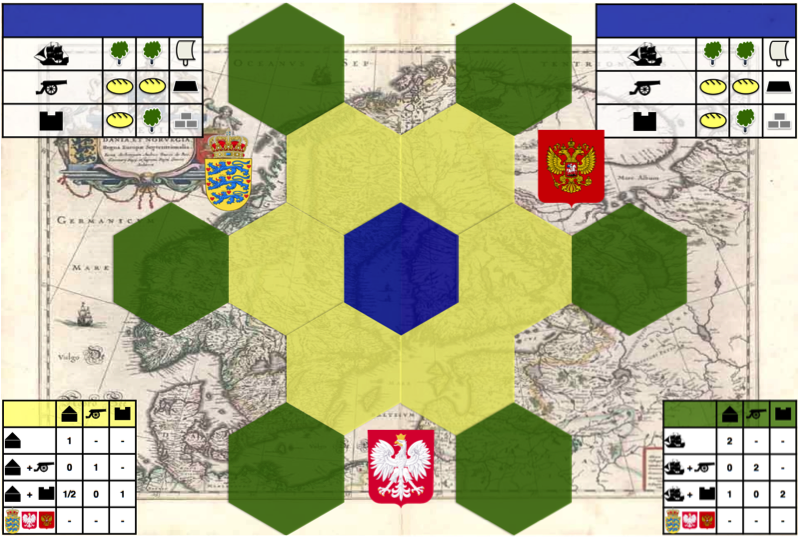
I also consider exchanging some overseas provinces with more known (?) provinces, such as Norway instead of Trondheim (not acquired until 1814) and Pomerania with Prussia (never acquired but Sweden did get control of the trade from some ports and did try to capture Danzig). 5 May 2014: One night of rethinking gave an alternativ map. The Nova Suecia style map is very clean but the land and the sea routes were not clear at all. Instead, I excluded the sea areas and put the provinces in semi-circle order to mimic the way they are related. Which is best? Judge for yourself, I'm really not sure myself. 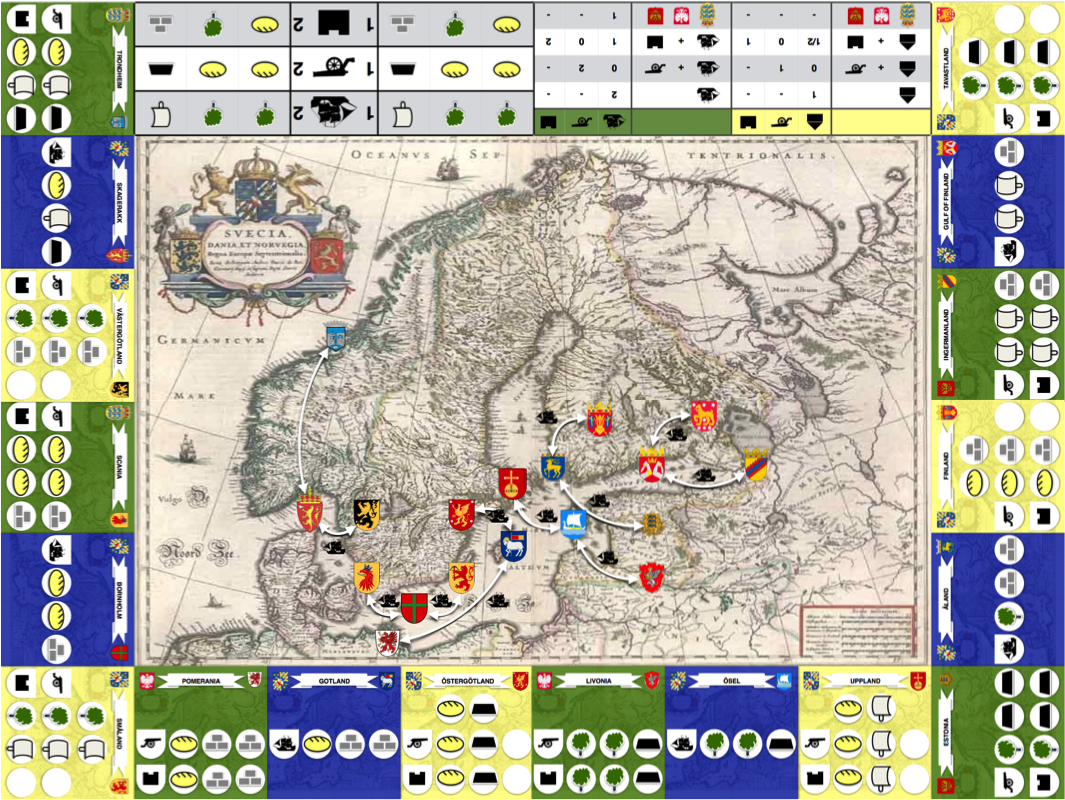
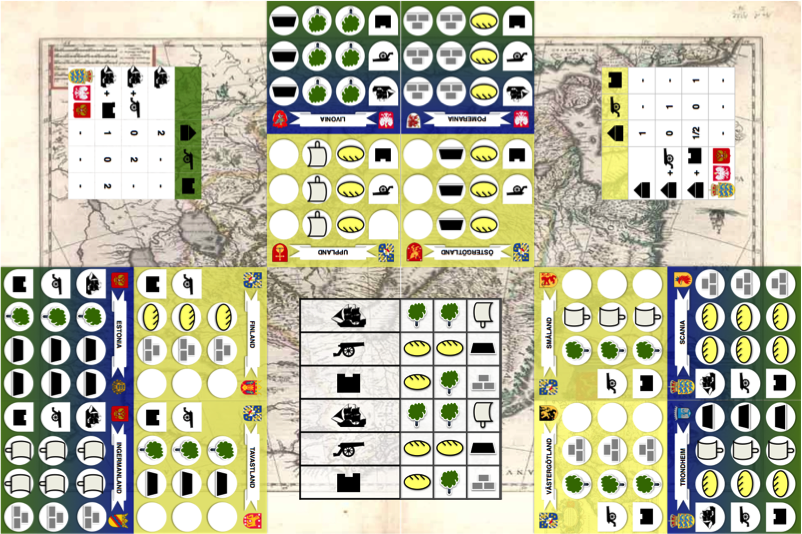
The work also reminded me of how difficult it is to create that kind of map with my simple tools (Keynote and PowerPoint). If any of all those symbols is not aligned properly, the map makes you sea sick. It is a game about the Baltic Sea but still... 4 May 2014: Draft game board almost completed. I tried first to place all provinces directly on the map but the various production circles required too much space and they ended up at the edges, just like in Nova Suecia. I was also happy to find historical examples used of the production. Even stone (used for forts) was actually an export good even in that time. The first draft will be published tomorrow. 3 May 2014: Draft rules for Mare Balticum completed! Next step will be to complete the game components and add images. 2 May 2014: The first rule draft for Mare Balticum is nearly completed but not without challenges. The basic course of the game was fairly easy: allocate resources, use them for producing, trading or waging war and invest or save the profit. So far a standard economic game. But Mare Balticum is also a military game (although the farmers and merchants would prefer not having armies ruining their business) so I needed both a cooperative battle mechanism and an enemy simulator. The enemy simulator first. I built on the mechanism from Tre Kronor Infernum, where the players draw one coordinate card each (A-B-C or 1-2-3) and where the coordinates meet, an action will take place. But how many actions will there be for 3, 4 and 5 players and will the more player actions in the 5 player game compensate for the more enemy actions. After a lot of calculating, I finally came up with the following statistics:
No wonder my favorite game designer Reiner Knizia is a mathematician. Provided that my calculations have no errors (please feel free to correct me otherwise), it looks like the enemy simulator is fairly well balanced. The battle system fortunately required less calculating. The idea was to have a system where the players' common hidden decisions affect both the overall result and their individual result. Naturally, this called for a prisoners' dilemma mechanism. The solution was as simple as the above calculation was difficult. Each player selects to attack or defend - that's it. Generally, both players benefit from attacking and lose from defending but if one player attacks and one player defends, the defender is better off. What to choose? Well, that's part of the game! I will now relax with some history studies and then publish the first draft. 1 May 2014: The development process so far for Mare Balticum reminds of the two first games in the series, Nova Suecia and Bellum se ipsum alet. Unlike Christina Regina, Vasa Regalis and Tre Kronor Infernum, there are several small game ideas rather than a few big that need to be put together. The process started with some brainstorming sessions where the ideas, big or small, were loosely documented. Then I returned to the ideas one by one and assessed them in terms of playability and balance. One example was calculating how much a unit would return when used as a farm, a fleet, an army or a fort to make the different strategies equally strong. At a certain point, the big ideas were fairly clear (as listed in yesterday's blog post) while the small ideas had grown so much that I began to lose sight of the whole. I then started with the draft rule book to accomplish two purposes: first to put all ideas into context for further assessment but also to understand how they will work in practical play. As an example of the latter, I realized that I don't need separate units for subjects, goods and gold but rather only one unit and let the placement decide its character. Finally, as my personal touch, I began to reread series of books about the wars around the Baltic Sea from The Swedish Military Book Club (SMB) to get more ideas. Old blog posts may be found here:
|
Please leave a comment on the games or contact me directly at nicholas.hjelmberg@gmail.com. |