
 |
Home | Game | Rules | Theme | Strategy | FAQ |  |













































|
Bait or BluffLet's start with some mathematics. The objective of Christina Regina is to score most points out of the three tiles drawn in the three chambers. Since each tile awards 10 points (0+1+2+3+4), the average score is 2.5 points per tile or 7.5 points in total per color. Assuming that the second best color scores 1 point more than average and the best color scores 2 points more than average, you need more than 9 points to win. This means that each tile must award you 3 or 4 points. Only if you have got, or expect to get, two tiles worth 4 points, you can afford the tile worth 2 points to be drawn. At the same time, you do not want to rush towards "your" tiles, since this would give away your color and not only lose you 2 points but give another player 2 points. Instead, you should move the Queen like participants in "Spirit in the Glass" move the glass and slowly move her towards areas where "your" colors are abundant. Given that the other players think the same, the Queen will be moved away from areas with few colored tiles and towards areas with plenty of colored tiles. Depending on whether "your" colors are present there or not, you have two basic strategic options:
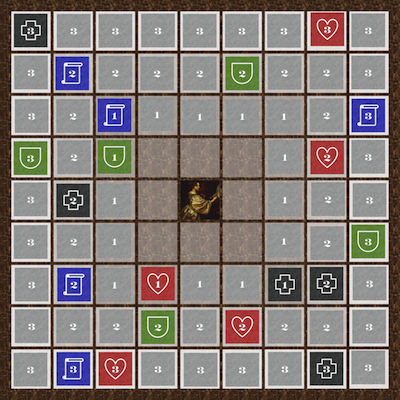
In the image above, black is concentrated to the bottom right corner and may have to consider a bluff strategy. Of course, you should also assume that the other players follow similar strategies and deduce from their moves which colors they play. A successful assassination can make or break your game. Let us continue to elaborate on the guessing work required for a successful assassination. Given the strategies above, it's hard to guess another player's color by the first tile tile drawn. Once drawn however, it's time to put yourself in the mind of each other color and ask yourself questions. First set of questions to ask is which color scored 4 points from the tile and which color scored 3? Which other tiles do those colors need to score another 3 or 4 points? Are any players moving the Queen in that direction? Then they may be playing the bait strategy and you should be able to pair two players with two colors. Continue to observe them and once the second tile is drawn, you should be able to associate the leading color with the player contributing most to get that color drawn. Second set of questions to ask is if a player moving the Queen towards one color suddenly moves the Queen towards other colors. Then that player may be playing the bluff strategy. By process of elimination (including, of course, eliminating your own color), you may identify a couple of colors that the player seems to be uninterested in and deduce that one of them really gives her or him 3 or 4 points. Just don't be too quick, a bluffing player will have a low score so you don't have to be the first player to assassinate. Instead, be very observant on the other players' assassinations. Third set of questions to ask is namely asked at each assassination. Who assassinates who? What has the latter player done to be the target and what does the first player knows? Is the assassination successful or not? By pairing your knowledge and the knowledge the assassinating player can be expected to have, you may be able to narrow down your suspects and do a successful assassination yourself. Take the example where you play red and observe how player B goes for red and blue. Player B may be blue (you are red yourself) or she may be bluffing. Suddenly player C assassinates her and fails. It must have been a bluff then but why did player C rush in to an assassination unless she thought she had narrowed down player B's color to one? Perhaps she plays blue herself and thought player B was red? Player C's next move is towards blue so perhaps she's desparate for points now that she has lost an assassination? It's time to strike! Knowing the differences between a bait strategy and a bluff strategy will help you connect players with colors, first by pairs and later one to one. Just make sure to balance carefully between those two strategies so that you don't reveal your own color. |




|