
 |
Home | Game | Rules | Theme | Strategy | FAQ |  |










































|
I came, I saw, I ran away with the MoneyAt a first glance, there are a lot of strategic options in Mare Balticum. Production, trade, wars, diplomacy and so on. However, don't let this shadow the fact that it's only one thing that counts in the end: the number of titles you manage to acquire. Thus, your strategy must revolve around this single objective. Let's move backwards from it and see how best to accomplish this. 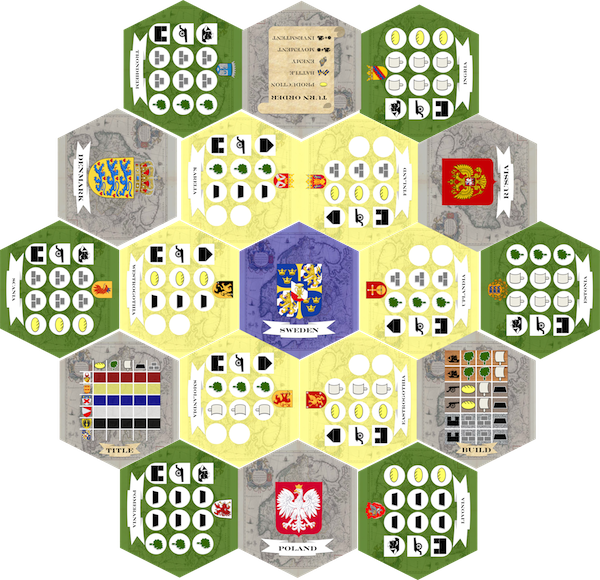
ResourcesTitles are acquired by resources and resources come in five different kinds: grain, wood, cloth, iron and stone. To acquire a title, you need to pay one of each resource or twice as much if you don't have the right resource. The latter part suggests one obvious strategy: use resources efficiently and avoid using them at half their value. So having production in all 5 resources is a winning strategy then? Not quite, you have to take into account the ones producing the goods for you: the units. UnitsYour units have several functions in Mare Balticum. They serve as producers (farmers, soldiers etc.), goods and gold. Producers give you goods, goods may goods may be invested in more producers (farmers, soldiers etc.) or titles but some must also be saved as gold to pay for investments next turn. The challenge is that you have a limited number of units. A grand army may look impressive but is of no use if you run out of units and are unable to get those precious goods. A tiny army on the other hand will not yield enough. So what's the optimal balance then? As always, it depends but you should let the following considerations guide you.
Wait a second! I had less producers in the specific production compared to the differentiated production? How does that work? The simplest option is to desert one unit but that yields nothing. A potentially better option is the battle. BattlesIn most games, you fight battles to win but not necessarily so in Mare Balticum. The purpose of wars in those days was mainly economical and that is the case in the game as well. A victory is worth nothing to you, or may even cost you, if the prize is a province with goods you're not interested in. Not only do you have to use the goods as gold to acquire your titles but you also tie units to producers instead of making them available as goods. This is perhaps the most important point in Mare Balticum: Win the battle when you need the goods but lose the battle when you don't need the goods.. The battle system of Mare Balticum is simply a choice of attacking or retreating. If all attacks, all win, but if any retreat, only the retreaters survive (but if all retreat, all lose). As long as the province yield the goods you need, you should aim at winning but once it has served its purpose, you should retreat. Whatever happens then is a win-win situation for you; either your units get returned to you or you obtain the leadership of the ship or army and can move it to better provinces. Other players may complain about your abandoning their cause but it's simply a strategic retreat. Of course, they may reason in the same way so if you must go to a battle, do it with players who want to win. How about forts then? They cannot move? That's true, and for that reason you should be cautious with forts. However, there are some cases where forts may be useful.
Nevertheless, you should refrain from having units in more than one fort since this will cost you flexibility. So far, we've talked about Mare Balticum as a game where the players act alone but there is one more part: the enemy. EnemiesThe enemies in Mare Balticum are simulated through cards played by the players. If adjacent enemy cards are played, the enemy attack along those fronts. Given the discussion above, there are several ways to take advantage of this.
The opposites apply if it's the opponents that have or don't have interest in a province. Bear this in mind, both when you select enemy cards and when you move your producers. Some examples illustrate how you may think:
Final recommendationThe final recommendation is to use all tips in this strategy to optimize the last few turns that will take you (or prevent someone else) from acquiring that last title required for victory. Try to get all three units in a fleet or an army to be in full control. Likewise, try to get at least one unit in the leading player's army or fleet to ruin her attempts by retreating so that it's defeated. Also look for (your and other players') opportunities to claim a leadership title. A well timed retreat followed by a build can cause an unexpected shift of a leader title. It doesn't matter if you end up the game with no units on board or the enemy just outside the Swedish borders - as long as you get that title, you will win Mare Balticum! |
Uplandia Westrogothia Finland Smolandia Eastrogothia Karelia |