 |
Home | Game | Rules | Theme | Strategy | FAQ |  |

































|
Game designThe influences to Knights & Damosels came from many sources. Already when I designed Christina Regina, I had an idea about creating a faction game where the factions would have to both fight and rely on each other but never managed to realize it. Later on, I happened to come across two Arthurian games, Avalon (where the players play on hidden sides, one aiming at succeeding in quests and one aiming at losing) and King Arthur's Realm (a combination of a role playing game and a board game), and although none of them were about the factions the way I wanted, they gave me the missig piece of the puzzle: the relation between a knight and a damosel. How about a game where the knight wants to build a card deck (like in a traditional deck-building game) and the damosel wants to influence a knight (by giving him as many cards as possible)? The fact that I have loved the Arthurin legends triggered my imagination further and from there on, the road to Camelot lay wide open for me. The simple faction mechanism combined with the rich Arthurian legends may serve as the foundation for an epic game where I could weave in other Nova Suecia mechanisms, such as production (rebuild the ruined country), cooperation against a common enemy (barbarians) and finally treachery (Mordred and Arthur's death). However, at the same time I had begin thinking of creating a cheaper card game to attract buyers that may otherwise refrain from my more expensive board games. My first attempt was a card game version of Christina Regina but the idea of Knights & Damosels is even more suitable for a card game. Besides, by going in the opposite direction this time and create the card game first, I would be able to test the mechanism and potentially build a small fan base before proceeding with a larger board game. How to turn this game mechanism into a game then? First I felt that I needed a motive. Why do the knights want to collect cards? Obviously to build up their knighthood. What kind of cards then? As often in my games, the number 3 felt appropriate so I came up with 3 groups or services (arms, virtues and vassalage) with 3 kind of cards (chivalries) in each group. So far, so good, but the motive needed to be more concrete and give room for more actions. How about letting them use the cards to earn worship points (which, by the way, is the name of the victory points in another old Arthurian game: Excalibur)? Arms could be used in wars and virtues in quests while vassalage could be used as a mean to earn less but safer points. Also important is that the opportunity to earn worship points would give the knights an incentive to collect specific cards in a turn, something that the damosels may use to their advantage. The idea of the event cards and their match to chivalry cards was thus born. To add more action into the taking and placing of the cards, the theme gave me the idea of letting the knights joust for their damosel or their King, that is the right to play a specific cards. Another idea from the theme was a final battle where all the players would use their cards and points earned and fight Arthur's and Mordred's last battle at Camlann. The cards could be used for the actual battle while the worship points could be used to tell the survivors apart and declare a winner. All mechanisms fit so well with the theme that the game seemed to beg to get designed! To simulate all the different ways of oppositions that the cards may engage in. I did not want the outcome to be completely random so I investigated variations on the rock-paper-scissors mechanism.
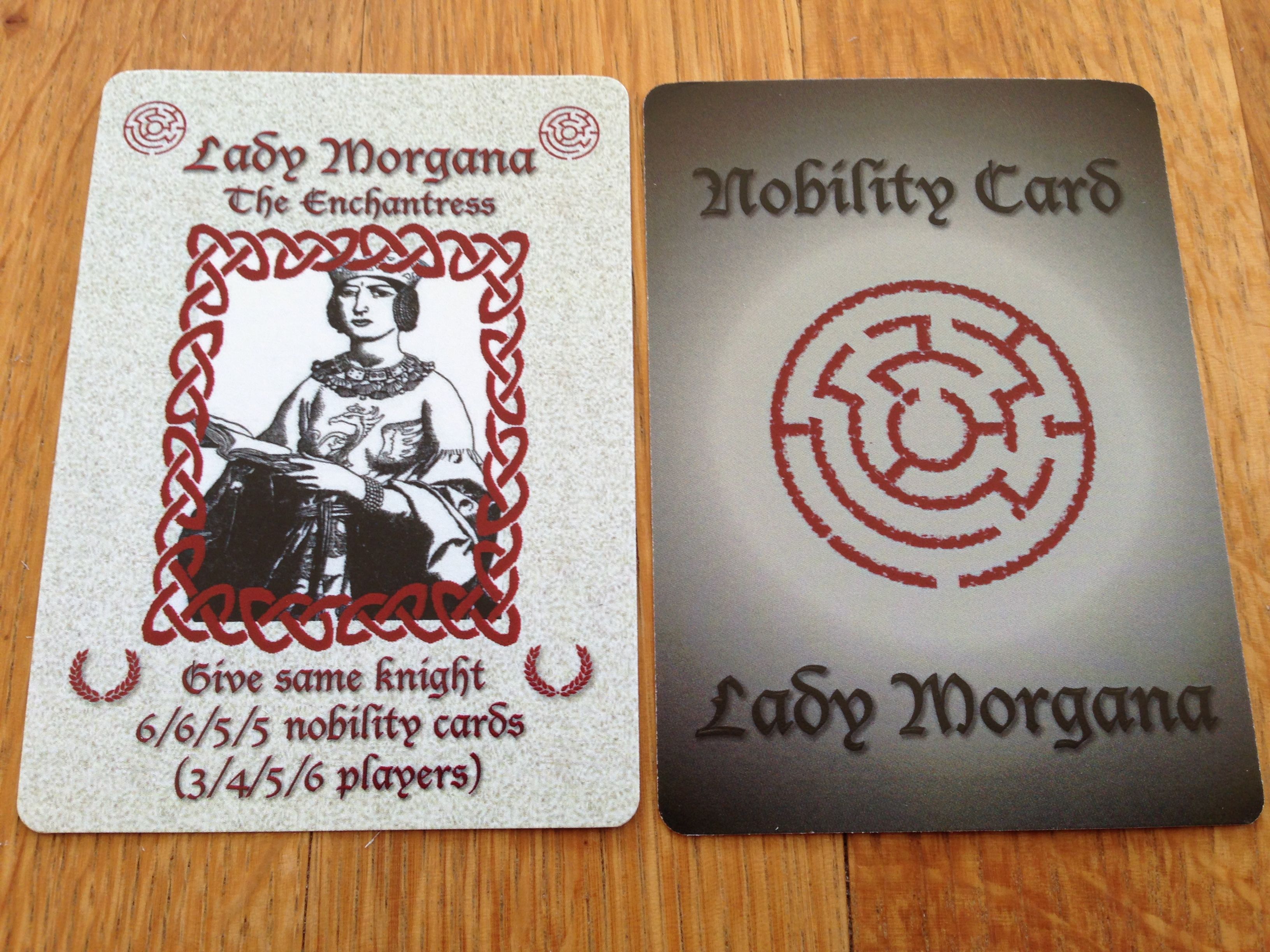
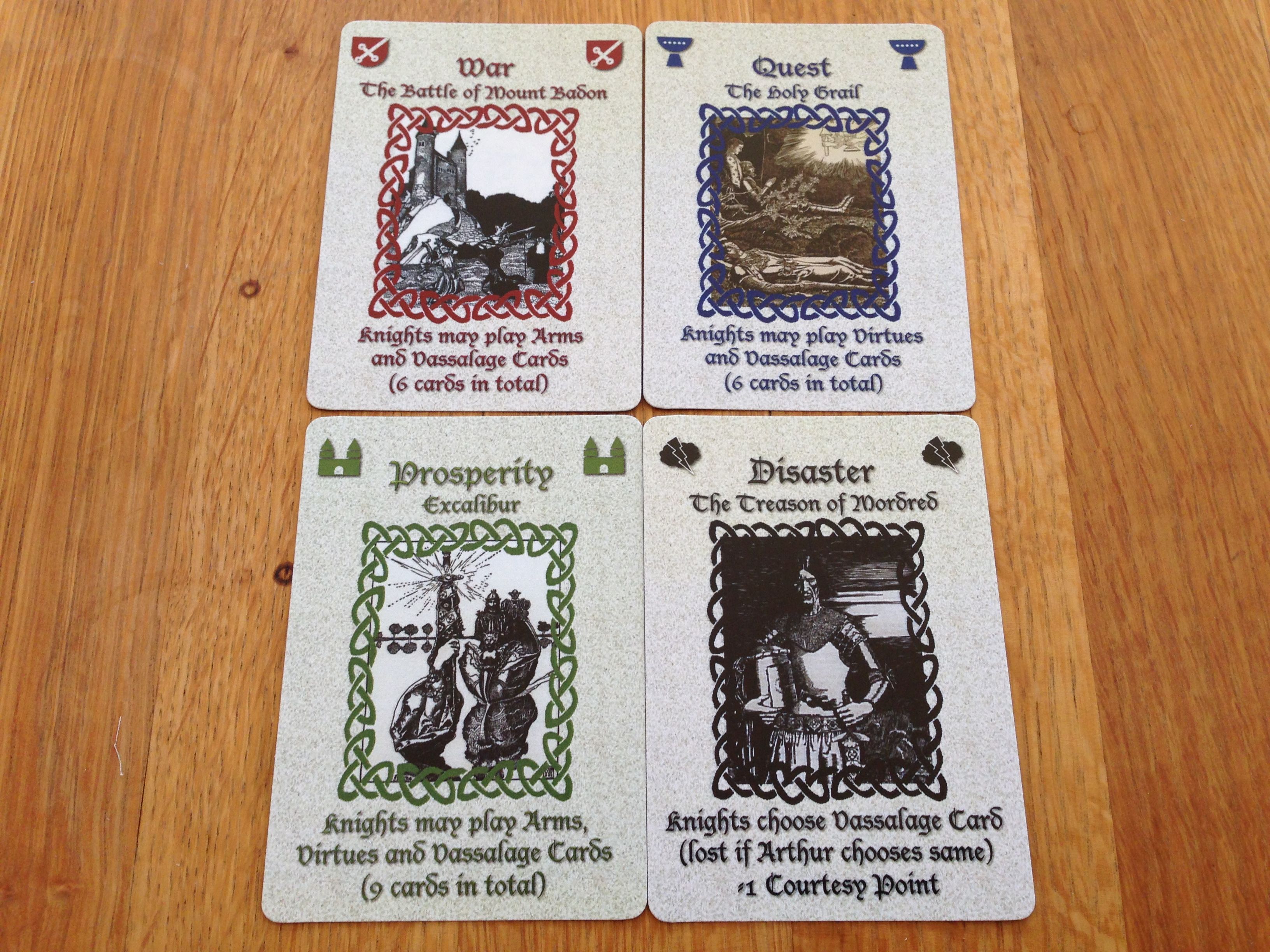
Attention also had to be given to the handling of the cards. The damosel behind each card had to be kept secret so I literally placed the damosel's name and symbol on the back of each card. However, how will practically handle the cards and find out when a damosel have given a knight enough cards to win? The solution was to introduce Merlin, a role that is the players take turn to play and that gives the wisdom to handle and see all the cards. To give Arthur a role as well, I introduced a role with power to choose which cards to be affected in critical situations (war losses etc.) and thus got rid of some random mechanisms at the same time! For a card game like this, I thought the artwork was very important to convey the Arthurian atmosphere to the players so I read literature (Le Morte d'Arthur) and watched movies (Excalibur of course but also Monty Python's Holy Grail) for ideas. At last, I fell for Howard Pyle's wonderful illustrations and since they were free even for commercial purposes at Oldbookart.com, I used them as a basis, surrounded by Celtic knots and completed with symbols in the upper corners. As far as possible, I created own symbols, using parts from Openclipart where necessary and connecting either to the game purpose (a grail for the Quest cards and so on) or to the theme (coats of arms as described in the books). Colors were another important part of the artwork. The match between for example the event of War and the Arms card to be played at wars was high-lighted by making all symbols red. The knights became silver and the disasters and the neutral cards black to connect to the game's color theme of silver against a black background. The damosels on the other hand all got bright colors as a contrast against the knights they try to influence. After all, although they have few visible actions in the game, they are literally behind most of what happens in the game. I get emotionally attached to each one of my games but with Knights & Damosels, I feel that I have managed to get a lot of game in just one deck of cards, and I hope that other players will feel the same.
Game components
|
Annotated gamesIf you like those game mechanisms, I can also recommend: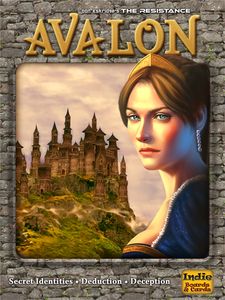
|