Home Game Rules Theme Strategy FAQ


Starve and Conquer

The objective of Bellum se ipsum alet is to influence cities. However, not only do you have to do this in competition with other players, you will also see your influenced cities decreasing in value and even slipping out of your influence. The key to victory is thus to include the time dimension in your strategy. Whenever you are about to capture a city, you should plan ahead for the next city. Ideally, you should have your two leaders capture two cities in about the same turn. This gives you six turns to capture two more cities, after which one leader may return to reoccupy the earliest cities and the other to defend the later cities. That should help you maintaining a stable base of four cities. Let us now see how to handle the different phases of the game.

The opening

Stake your territory early. Don't just go for the closest cities but try to establish a "natural" border to your closest enemies. There is no such thing as neutral cities in this game, either you take a city or someone else does. Most likely, the other powers will prefer taking empty cities to fight other powers for cities. You should also aim at a "compact" sphere of influence, where you quickly can move your leaders from one part to another, rather than an outstretched, where you can't defend all parts.

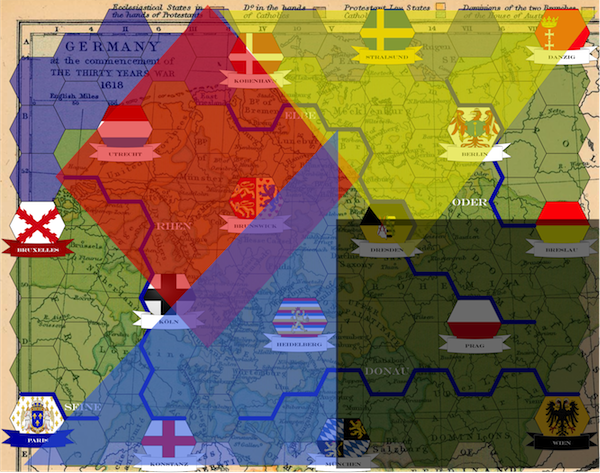
For Sweden, Copenhagen and Dresden are two good starting cities, since this would leave Berlin, Danzig and Breslau behind the lines for later conquests - enough for victory. Austria should claim Breslau early for this reason and also Munich as a border against the French. This would leave the nearby city of Prague for the second wave but since no other power is near enough, it's no hurry to capture this Bohemian stronghold.

France and Spain both have interests in Cologne but should try to avoid early battles. One bold option would be to go for Konstanz/Heidelberg and Utrecht/Brunswick instead to fend off Sweden and Austria before settling the issue.

Clashing ambitions for the opening: Sweden (yellow), Austria (black), France (blue) and Spain (red)

The mid-game

With two cities captured, it's time to look for the third and fourth. One leader can be sent back to occupy/reoccupy cities behind the lines while the second keeps an eye at the other powers and look for an opportunity to snatch a city. You don't want to be the first power to wage a battle but rather the one that grabs the spoils afterwards. If an enemy is approaching, your decision should be determined by the tactical situation. Will the enemy stretch out too far by capturing a city? Then you may want to save your army and take it back later after the enemy's inevitable retreat. Are two enemies approaching? Let them fight and look for gains behind their lines instead. But if the lost city would divide your sphere of influence, you should defend it with full force. You will be weakened but hopefully have time to recover before the other powers take advantage of it. If necessary, bring back your other leader as reinforcement and play the waiting game for a couple of turns. You must be well prepared before the end game assault.

Typically, Sweden should pick up Berlin and (if left alone) Danzig while Austria should go for Prague and look for opportunities to capture Dresden or Heidelberg. For France and Spain, an agreement about Cologne must be made (with arms if necessary), after which Munich and Copenhagen are possible targets.

The end game

By now, you should have two cities recently occupied/reoccupied and another one or two cities with reasonable time left before revolt. You will then have a couple of turns for a quick and sudden expansion to capture a headquarter and trigger the end. The other players will most likely do the same so identify the weaker of them and go in that direction. Saving the army is not important now - as long as you get those cities, it doesn't matter if your army is annihilated.

If your expansion fails, your only option is to fall back and let the other players restore the balance. Use all means to point out who is closest to victory and turn them against each other until your army has recovered. By now, some cities are likely to have been ruined, making movement slower and armies smaller and hence a quick victory more difficult. Nevertheless, there may still be opportunities for tactical tricks among the ruins. With hopefully all powers' armies weakened and no city support in the centre, you may be able to cut an enemy leader's retreat and capture him. Remember that capturing leaders also triggers the end. Another option is to purposely ruin border cities to make advancements from that direction less interesting. If you can maintain your core area established in the mid-game, you still stand a good chance to have the highest supply or strength when the game ends.

The ten commandments of a commander

  1. The cities provide supply and the countryside provides strength. Your army needs both so your strategy must secure both the cities and the countryside.
  2. The cities will eventually revolt and have to be reoccupied. Time your conquests to be able to reoccupy one city at the time.
  3. The countryside is vulnerable to enemy armies. Feed from border areas first so that you have food behind your lines if attacked and so that your enemy has less food if attacking.
  4. Balance strength and swiftness. Besieging every city you pass may give you many cities in the short run but influencing a large territory first may give you even more cities in the long run. Remember that strength grows slowly while influence tokens are placed immediately.
  5. Turn tactical advantages in your favor when waging battles. Bring both leaders if possible, avoid attacking positions across rivers and seek defensive positions close to your cities.
  6. Read your enemy before the battle. Is the enemy interested in winning a victory or preserving the army? How much strength is the enemy expected to commit? Whether you expect to win or lose, you will want to commit no more strength than absolutely necessary.
  7. If you win, follow before your enemy recovers. If you lose, retreat through land where your enemy is slower to win time for recovery.
  8. Beware of opportunities to cut enemy supply lines before attacking. Take advantage of rivers to secure your own supplies, particularly when ruins start blocking land supply lines.
  9. Beware of opportunities to launch direct attacks against enemy headquarters or leaders. It does not mater if your own headquarter is at risk as long as the enemy falls first.
  10. Use diplomacy. The war has more losers than winners so if your enemy gets the upper hand, it is in the interest of the other major powers to intervene.

Johan Banér


Louis de Bourbon


Johann Tserclaes, Count of Tilly



Cardinal-Infante Ferdinand