 |
Home | Game | Rules | Theme | Strategy | FAQ |  |













































|
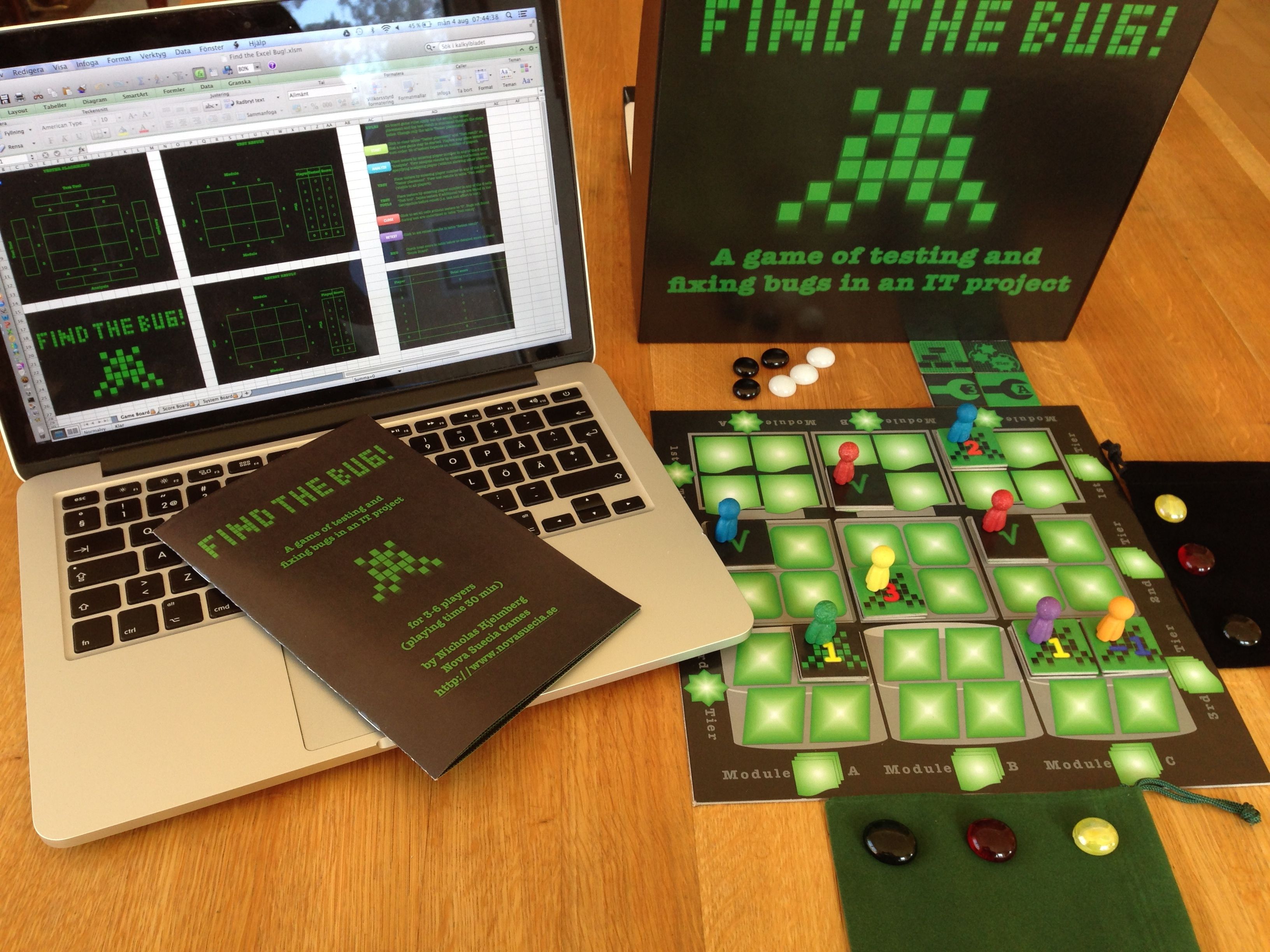
Game designThe idea to the game Find the Bug! was born when I gave test lectures to newly hired colleagues. I was a bit dissatisfied with the lack of hands-on practice and thought of alternatives. After all, testing is not very different from gaming with a hidden objective (unknown bugs) and different ways to achieve it (test strategy). The work with the Nova Suecia games helped me develop various game mechanisms and finally I had everything I needed. The main idea is to find unknown bugs and that was also the main challenge: how to simulate a test environment with random defects and still allow the players to deduce where the bugs may be? Initially, I thought of placing tiles in certain patterns but eventually I rationalized this to letting the players pick tiles from bags instead. By adding a colored gem to each bag depending on the number or severity of the bugs and then shuffle them, I also gave the players a way to make deductions about the content. The two-dimensional game board with modules and tiers, where both must have a bug tile to count as a bug, makes deductions more difficult and also simulates risk-based testing with its assessment of business criticality and technical complexity. This is enough for the basic game but I wanted to include more test concepts, such as regression test and test automation. The solution was to add fix markers. For each fixed bug, a corresponding module and tier marker are placed in a bag, out of which new bugs are drawn for the second round. The test automation was then simulated by letting the players place a tester on an entire module or tier, but not until it is mature, i.e. is free from the bugs in the first round. The rest of the game basically follows the normal test process:
Game components
|
Excel version
If you like those game mechanisms, I can also recommend:

|