
 |
The Quest for the Perfect Game - Reviews to Extract the Essence of Games by Nicholas Hjelmberg | |





|
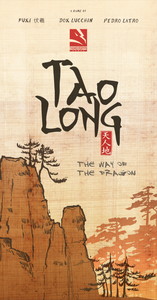
Tao Long - A Modern Game in an Ancient Robe (Published 5 February 2018)This review has also been published at Boardgamegeek. The Abstract Challenge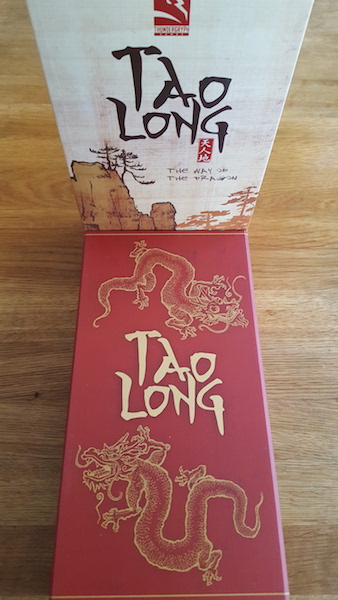
To design an abstract game is perhaps the greatest challenge a game designer can undertake. Your game will be presented naked to critical players with no "fluff" to hide any flaws. Friends of abstract games will compare the mechanics to those of ancient classics that have already done what you try to do. Others will complain about a dry experience and find it hard to relate to the purpose of the game. To succeed, a new abstract game must offer something unique and yet familiar to attract and retain players. Does Tao Long: The Way of the Dragon accomplish this? BackgroundFirst of all, Tao Long comes with an engaging background story that gives the illusion of an ancient game. Two dragons, Tianlong (Heaven) and Dilong (Earth), engage in a fight that will determine the destiny of Man. The dragons in turn obey the Ba Gua (Eight Signs), a wheel of eight elements that determines their actions. Each rule is accompanied by a thematic explanation like "The sky's movement drives the wind through the grass, as the energy of the earth breaks the thunder from the clouds to the ground". Pure poetry! 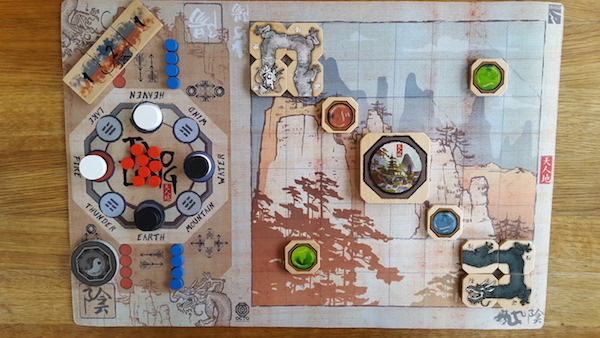
GameplayThe actual gameplay is based on two main mechanics: the maneuvering of the dragons and the manipulating of the element wheel. The dragons are said to have been inspired by the classical video game Snake, originating from a 1976 arcade game and revived in the Nokia mobile phones in the late nineties. It's amusing to see how a modern game inspires a supposedly ancient game. The idea of representing dragons with segment tiles, moved one at the time and removed in case of damage, is aesthetically pleasing and something I haven't seen before. (A dragon has three segments, excluding the head, and each segment has four life points.) It also serves as a catch-up mechanic, as smaller dragons get harder to hit. However, it's not enough to base a game on - if the dragons were allowed to move as they pleased, Tao long would be as interesting as chess played only with a pair of Queens. This is where the Ba Gua enters the game. 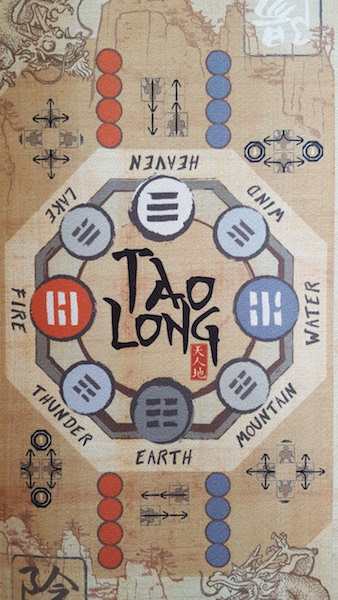
The Ba GuaThe Ba Gua is basically a rondel/mancala mechanic, where the players take turns to move and drop stones and where the element where the last stone is dropped determines the action. What this mechanic accomplishes is not only to limit the decision space of the player in turn but also to give an opportunity to leave bad options to the other player. This is common in many other games (Patchwork is one game that springs to mind), where it often works well. So is one new and one old mechanic enough to make a game interesting? To answer that question, we need to look closer at the actions you can (and cannot) take. The ActionsA turn has two phases; the Spirit phase, when you choose an action on the Ba Gua, and the Matter phase, when you execute the action with your dragon. A first key rule here is that you MUST be able to execute the action to choose it and that you lose one life point if there is no such action available. A second key rule is that all actions except one (or two depending on how you count) involves a movement of the dragon. This opens up for plenty of blocking tactics and zugzwang opportunities. Let us now proceed with the different actions. There are four pairs of actions you can choose:
Let's return to expel/absorb ability later and focus on the movement for now. One important implication is that the dragons move fairly slowly. Don't expect rapid dive bombing but rather cautious pinning maneuvers where the goal is to end a movement with your dragon's head facing any part of the opponent dragon to deliver a bite, causing the loss of one life point. If this is good or bad is a matter of taste but I feel that this game of close encounters work very well with the blocking/zugzwang opportunities of the Ba Gua. 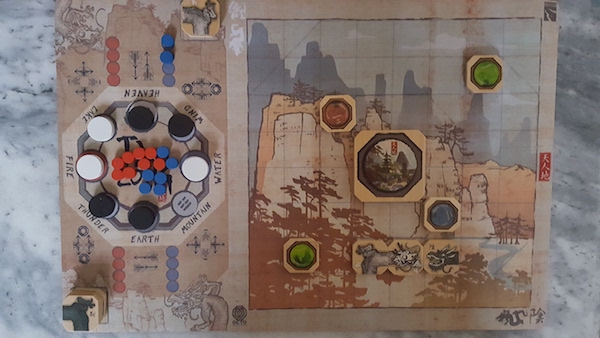
End of my first game: The White dragon launched a frontal attack to finally defeat the Black dragon. But wouldn't the loss of one point at the time turn the game into slow tug of war where it's difficult to catch up? No, this is where the Fire/Water actions add another dimension to the struggle. Absorbing gives a dragon fire/life points while Expelling allows a ranged and more powerful attack. The damage dealt is increased by the dragon's current fire for Fire attacks and by the life points currently in the pool for Water attacks, something that may add up to half of a dragon's total life points! Remember, though, that you have to use the Ba Gua wisely to absorb, maneuver and expel at the right time and place to succeed with such an attack. 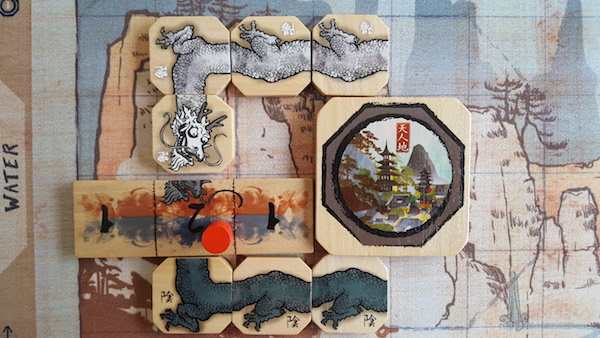
How to Use the ActionsMy initial fears that the dragon movement would be more of a gimmick were confounded once I realized that the actual game is played on the Ba Gua. It's here that a game is won or lost, not on the dragon board. When I first learned the actions, they felt unintuitive and hard to remember. However, when I started to understand that each action fills a tactical need, they all made sense and now I wouldn't want to change any of them.
I'm far from understanding all tactical possibilities offered by Tao Long but below are some images for inspiration. 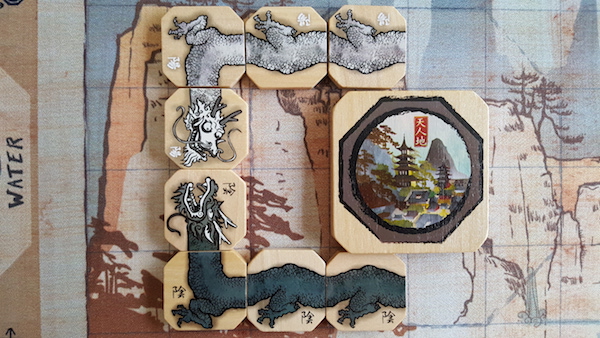
"The Kiss of Death": The White dragon ends the turn with a bite or a ranged attack. The Black dragon is unable to retaliate since she must move away first (provided that Mountain is unavailable). 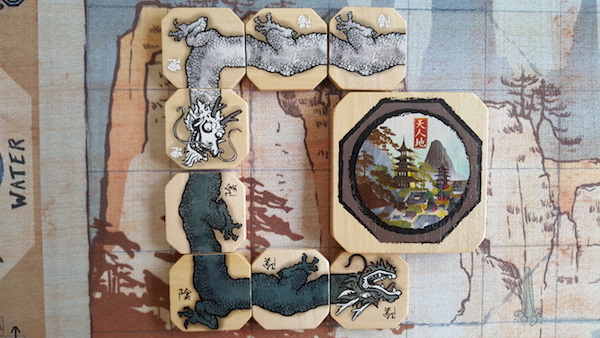
"The Tail Chase": The White dragon has an advantage, since the Black dragon cannot outrun (outfly?) it and will be exposed to several attacks before being able to turn. 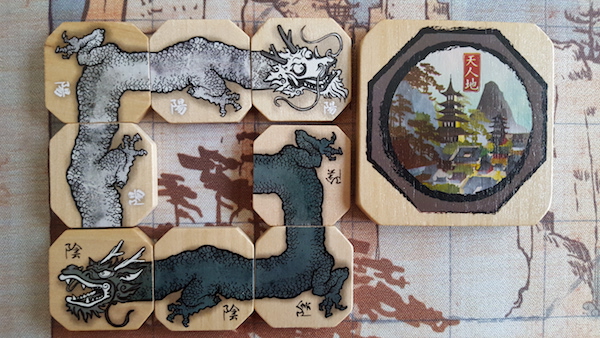
"The Lethal Embrace": The White and the Black dragons are too intertwined to attack effectively. Whoever gets loose first will have an advantage. 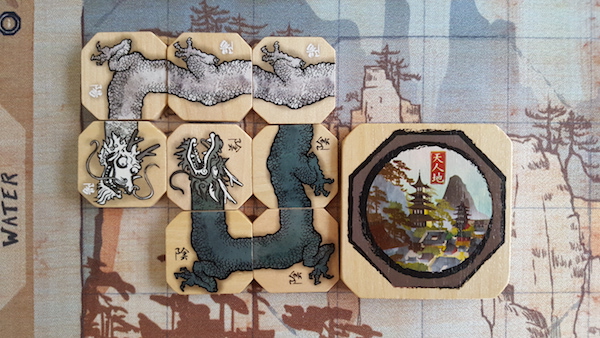
"The Python Strangle": The White dragon blocks the Black dragon and makes it difficult for it to conduct any attacks. But isn't there a risk that the players are too cautious and never approach each other, preventing the game from ending? Possibly, but the same can be said for many other two player games. If no player enters the other player's half of the board in chess or never challenges the other player's areas in go, draw will be the result. On the other hand, the first player to find an opportunity to attack will have an advantage, unlike games like Abalone, where attempts to break a stalemate are risky for the attacker. 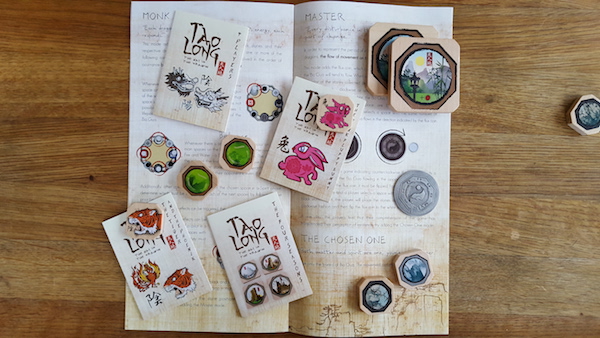
The Variants and ExpansionsFinally a few words about the many variants and expansions. I'm generally not a fan of such things. Although they do offer variability, one might wonder which of all games that is the true Tao Long. I haven't played with the Tiger or the Bunny yet, since I prefer abstract games to be symmetrical, nor have I explored the many different player modes and map variants yet. However, I do think that the Four Seasons expansion adds a third and interesting dimension to the game, since the seasons give predictable changes for the players to take into account. (Hot seasons strengthen the dragons and cold seasons weaken them.) I also found the solo variant, where the opponent dragon can get several actions at once, quite clever. Although it felt too easy, it is good for learning fundamental tactics. 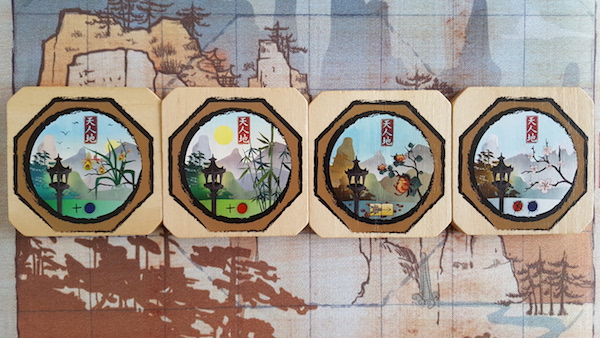
ConclusionTao Long remains an abstract game, in spite of the beautiful and intriguing theme, and may not appeal to everybody. With only one dragon to maeuver, it may also be more of a tactical than a strategic game. Nevertheless, Tao Long certainly fills a gap in the game collection of any fan of abstract games! 
|
|