 |
Home | Game | Rules | Theme | Strategy | FAQ |  |











































|
Game designDuring the design of Peoples, I got the idea of making it a double game, where the components could be used to play both the current migration game and a new civilization game. The latter game was eventually abandoned but the idea of finding the "holy grail" of a simple civilization game remained. The challenge of a civilization game is either that it gets too long (like the classic Civilization) or that it has to sacrifice elements necessary to create an epic feeling (like the card-driven games Historia and Nations). Peoples - Civilizations attempts to overcome those challenges with the following elements:
Properly implemented, those simple rules can recreate historical events, like the fall of the Roman Empire (citizens taken as slaves due to military convert their enemy citizens from within) or the colonization of the New World (cities take up all space in existing tiles but new tiles get revealed) in a limited playing time. Exactly what I'm looking for in a civilization game! I approached the design of Peoples - Civilizations a bit differently compared to previous games and made my diary public before the game was completed. The idea was to attract feedback at an early stage to help me make the right decisions during the journey. So without further ado, welcome to join me! The Quest for the Holy (Civilization) GrailWhat is a civilization game?Many gamers talk about the Holy Grail of a light civilization game, a game that will encompass the epic feeling of a timeless civilization in a limited playing time. Many games claim to have succeeded in this quest but none of them have been universally accepted as a true civilization game by the gamer community. Can such a game exist at all? In this designer diary I take on the challenge not to find such a game but even to design it myself. Why do I think I will succeed where even the best designers have failed? The simple answer is: I don't. But what I do expect is an interesting journey where I will learn a lot, both about game design and about my gaming preferences. I will do this by discussing which elements that should be part of a civilization game and which mechanisms that could support them. You are more than welcome to join me on the journey and give me advice and criticism on the way. But be warned, I have no idea when and where the way will end. Let us start by looking into the concept of civilization. According to Wikipedia, a civilization is a complex society characterized by urban development, social stratification, symbolic communication forms (typically, writing systems), and a perceived separation from and domination over the natural environment by a cultural elite. Translated into game elements, this could be covered by city building, worker placement, a technology tree and management of natural resources and calamities. I would also like to add the interaction with other civilizations, either peacefully through trade or aggressively through warfare. Not surprisingly, Francis Tresham's pioneering game Civilization has all those elements. A related game category is 4X with its elements of expand, explore, exploit, exterminate. Those elements are not enough to make a civilization game but for a civilization game they are important to provide an epic feeling. (But don't take my word for it - for some reason Civilization is not listed as a 4X game.) So is there really no other game than Civilization that has all those elements? Many other authors have examined this question, such as BlogSpot user Melissa and BGG user EndersGame. Note the many good comments, among them one by the renowned designer Lev Pulsipher, who states that he also pursued this Holy Grail but "but concluded that the people who want civ lite don't want to sacrifice any significant aspect of Civ". Here is my own short opinion on some of the candidates:
The task seems daunting so far. A civilization game will either miss critical elements or simply be too light. But what if we switch focus and look not on the elements but rather on the feeling those elements should convey. This is more in line with my favorite designer Reiner Knizia's philosophy that a game should not "try to model a specific environment, but instead try to invoke the thought and decision-making processes that are key to the theme". This is how my favorite game Tigris & Euphrates work: rather than micro managing the rise and fall of the empires of Mesopotamia, I focus on how my dynasty can influence the civilization development and benefit the most from it. Perhaps this is the way to go (so if you think that Reiner Knizia's games are too dry, this is probably the time to excuse yourself from my journey). If you're still with me, let's look into the decision-making processes of a civilization. How to grow a small tribe into an empire that stands the test of time is one. How to make use of the geographical surroundings is another. How to adapt to external forces (natural events, historical events, other civilizations etc.) is a third. A game with all of our civilization elements will provide the player those decision-making processes but are all of them necessary and to which degree? Well, the only answer to this question is to start the game design! The decisions of civilizationsIn our previous post, we decided, using Reiner Knizia's philosophy, not to try to model a specific environment, but instead try to invoke the thought and decision-making processes that are key to the theme. Our first challenge is that this perspective is anachronistic. Outside the megalomaniac dreams of mad dictators, civilizations do not follow the large scale millennia plans of one man. Instead, they are the result of the combined and often conflicting interests of many men and women over a very long time. Translating this into the game, the players should have limited decisions and merely watch how random elements determine the fate of their civilizations. This wouldn't be a very fun game, would it? But what if we would let the players represent many different interests throughout the game? In a turn, they could choose whether to take a "cultural" action, a "military" action etc. The players would still be able to choose the general characteristics of their civilization (a small peaceful one with cultural advances, a large barbarian one building an empire etc.) but no matter which they choose, they would have to prepare for and react to external forces. In game terms, they would have to play both strategically and tactically. Another benefit would be the possibility to include multiple victory conditions. Thematically it does make sense - Rome may have been military stronger than Greece but the Greek culture survived the Roman Empire. The tricky part of the design is to balance the different victory conditions so that not one civilization trait is stronger than another but that will be a later task for the game testing and tuning. Note that multiple victory conditions does not equal multiple victory point scoring (or "point salad"). If I may quote Reiner Knizia again, he stated that it is the goal that is important, not the winning. We want the players to focus on having built the greatest civilization at the end of the game (and, as a bonus, win the game), not on maximizing a civilization engine just for the sake of earning victory points. So which civilization traits should we have then? Military is an obvious one. War is not Man's greatest invention but it's hard to deny the impact wars have had in our history. Fortunately, Culture is another one with achievements that often last longer than military achievements. Science is a third one which greatly has impacted how people have interacted with the world around them and it's no surprise that the tech tree has been an indispensable part of civilization games. Economy and Religion are two other civilization traits that may be disputable. Economy has served as a strong driver for both states and individuals while Religion, for good or bad, influence our values even in our days. A sixth one could be Civics to capture how civilizations have developed from small groups of hunters and gatherers to the present super cities. Those are the six civilization traits I chose for my game Peoples - Migrations, which is why I choose them as candidates for this game as well. Whether some of them can be grouped and/or others added remain to see. The next step is to turn them into game elements and link them to meaningful player decisions. Since they all affect how civilizations interact with each other and/or their world, let us turn them into elements that affect the players' encounters with other players and/or the board. Military is a simple one. One of many examples from history is the Mongol invasion, where military superiority almost brought the civilized European nations to their knees. Using 4X terminology, a stronger military player will exterminate a weaker and lay claim to his or her land.
Economy is more tricky. Early civilizations often conducted peaceful trade with each other to get access to resources they couldn't produce themselves. But as resources became more global, different trade schools emerged. Mercantilists argued in favor of export of finished goods to obtain a positive trade balance, while free trade advocates like Adam Smith argued that nations should specialize on production where they have comparative advantages (https://en.wikipedia.org/wiki/Mercantilism). And how do we treat the Imperial powers' use of military to open foreign markets or the present outsourcing trends to take advantage of cheaper labor? Again using 4X terminology, a stronger economy player will exploit a weaker and lay claim to his or her resources. But should we turn all historical examples above into game mechanisms? No, although they all deserve to be part of purely economic games, economy is only one of many parts of a civilization game and thus must be simplified in our game. Still, even simple mechanisms may capture some of them, such as modular maps, engine building, set collection and card combinations.
Religion is another tricky civilization trait. Is religion satisfying the people's spiritual need or is it the "opium of the people" to quote Karl Marx? Christianity conquered the Roman Empire peacefully but was then used as an excuse to launch crusades. Christianity inspired cultural achievements but also suppressed science. And how to treat iconoclasms and other strives within the same religion? Religion is indeed a contradictory element to add to a game. But perhaps this characteristics can be used to create tension and unpredictability? What if a player's religious influence can extend across the military borders without actually changing them? A player could - voluntarily or involuntarily - embrace another player's religion. Events in the game could sometimes give religious advantages (e.g. Renaissance) and sometimes religious disadvantages (e.g. Fundamentalism). This could add another exciting layer to the game and also qualify as the expand part of a 4X game.
How about culture then? In a narrow sense, culture expresses itself through beautiful art, literature of wisdom, rich traditions and many other things that create a sense of belonging both in time and space. But culture also has an ability to survive long after its people has gone, such as the Ancient Greek culture, or even absorb foreign people, such as the Mongols after their invasion of China. How do we capture this in a game? Cultural influence could be one way but we've already used that mechanism for religion. How about simply allowing people units to co-exist under certain circumstances? A military player would have to share his or her conquered land with the cultural player and either co-exist in a multi-cultural but fragile empire or try to suppress the foreign culture with the risk of triggering civil wars. Mechanisms for this have to be detailed during further development but the idea is interesting. It also serves to mitigate the effects of extermination, exploiting and expansion discussed above.
So far we have turned the four civilization traits Military, Economy, Religion and Culture into game mechanisms that dictate how the players interact with each other. Military remove opponents, Economy trade with opponents, Religion convert opponents and Culture lets players co-exist. Do we need additional interaction mechanisms? Or should we focus on how the players interact with the world around them instead? In Peoples - Migrations, Science dictated the movement while Civics dictated the city sizes so why not let them do the same here? During the Age of Exploration, scientific advances helped the Europeans explore and, using the other civilization traits, expand, exploit and exterminate, thus completing our use of the 4X terminology. Urbanization has been a key to civilization advances throughout history ever since ever since the agricultural revolution produced a food surplus enough to let people gather in cities and develop other skills.
With that, the high-level framework of our game has been completed. The players will run civilizations by taking military, economy, religion, culture, science and civics decision with the ultimate goal of standing the test of time (and, at the same time, fulfill a specific victory condition). It's now time to move into the everyday work to accomplish this: the rounds and turns of the game. Turning epic time into playable turnsTurning the epic time of real civilizations into playable turns of simplified game civilizations carries many challenges and paradoxes. How can centuries be compressed into minutes? How can the stats of complex societies be managed in a manageable way? How can small civilizations survive in the shadow of large ones? From a game perspective, we need to ensure that our civilization game has a reasonable playing time, a low downtime and no runaway leader problems. The task may seem daunting but remember that we don't want to build an actual civilization, we merely want to capture aspects that are relevant for the players and remove the rest. As many other designers have put it: remove everything that can be removed without making the game worse. Take the time challenge for example. A game round that plays out exactly the same way as the previous turn isn't interesting. Instead, we should box the rounds so that each new round adds new conditions to the gameplay. The acquisition of new civilization traits is a typical such condition. A player should be able to acquire iron in one round, construct weapons in the second round and launch an attack in the third round. Playing out ten rounds for the iron acquisition and another ten for the weapon construction wouldn't be fun for that player, nor would it be fun for the other players to suffer ten rounds of iron attacks. Thus, the acquisition of civilization traits should define the rounds and the general timeline of the game (Bronze Age, Iron Age etc.). Moving on to the stats, which resources are important to keep track of when it comes to a civilization? Food is an obvious one to maintain and grow your population. Once you produce a food surplus, you can start to produce other things necessary to grow other aspects of your civilization. But which other resources do we need to keep track of for this? Sid Meier's classic civilization game uses commodities (to construct buildings and armies) and money (to allocate to maintenance, science and happiness). But this is a computer game that can keep track of different stats and building queues whereas a boardgame trying to do the same thing would be very fiddly. In our game, the purpose of non-food resources is to develop the six civilization traits discussed above so why use more than one non-food resource type? Then we would have one resource type for expanding on the board (food to get more meeples) and one resource type to develop your civilization (commodities to exchange for civilization cards). Since the civilization traits determine the various levels of your civilization, there is no need to keep track of different army units, buildings etc. Also, since each round should aim for the acquisition of cards, there is no need to store resources and keep track of building queues. You simply move meeples in the world, produce food and resource tokens, and exchange them for civilization cards that make the next round different from the previous one. Should we only have "food" and "commodities" then? No, as mentioned in the discussion about Economy above, many different resources could be used for set collection mechanisms and also encourage players to explore new parts of the world to find new resources. A player producing say 5 iron could earn 5 "commodity points" whereas a player producing 1 wood + 1 iron + 1 coal could earn 1+2+3=6 "commodity points". This leads us to the third question about the sustainability of small civilizations. A variety in production could compensate for a small production and put it on par with larger civilizations. That possibility would help mitigate some of the runaway leader problems but not all. A player moving around ten meeples will still have more actions than a player moving around one meeple. A player playing out ten civilization cards will still have stronger actions than a player playing out one civilization card. Besides the runaway problem, this would also create a downtime problem. But is this an issue for real civilizations? No, a civilization's ability to act doesn't have a linear relation to its size or advance level. Small civilizations often turn out to compensate with a greater flexibility. Let's just use that real life observation instead of artificially trying to hold back leaders.
To summarize, a round could look like this:
Simple and yet room for thematic gameplay. Next, let's look at the world the players act in. The world of the civilizations: the boardI've previously touched upon the importance of civilization board games actually being played on boards. The definition of a civilization as "domination over the natural environment" further strengthen this. Even the Pulitzer Prize winning book Guns, Germs, and Steel by Jared Diamond argues (although not without criticism) that the gaps in power and technology between human societies originate primarily in environmental differences. Since this is supposed to be a game, we can't let the players' fates be determined by their starting positions, but let's at least look into the different decisions that the environment may put before them. The first decision is how to make use of the nearby resources. This has been covered in the discussion about which resources to have in the game. A tile should have land or sea shape with a number of resources that the players can start producing with their initial units. 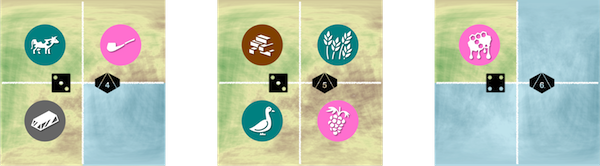
The scenario is not unlike that of the first civilizations: gather resources, learn how to gather resources more efficiently, use the surplus resources to advance the civilizations. Just like the first civilizations, the players will reach a natural stop when the nearby resources have reached their maximum utilization, and this leads to the next decision: where to find new resources? Now we have a thematic game reason to explore the world and expand the civilization but what should the board look like? A fixed board? A modular board? An unknown board? In history, and in our game, the civilizations will want to go for resources they don't already have (since sets of unique resources are worth more than sets of similar resources). But did they know where to go to find them? And did they know who to meet there? The answer to both questions is no so a board depicting an thematic world map with thematically located resources would not give thematic decisions. This rules out the fixed board. How about a modular board, where the land/sea tiles and resources are randomly located? And how about letting the tiles remain face down until discovered? Yes, this would indeed keep the players uncertain about where to go. However, they would still know who to meet there. Can that be avoided in a board game? In a computer game like Civilization, the different players can play in different spheres surrounded by void that's only gradually discovered until the whole world, and all civilizations in it, have been mapped. Wouldn't it be cool to see this happen in a board game as well? Mechanically, this is simpler than it may sound. The land and sea tiles are numbered and a die roll determines which tiles that are added to a player's continent as they explore the world. Eventually, their continents will get connected to those of other players or to the polar regions, which set the Northern and Southern limits to the world. There is also a need of size limits, forcing the players to reroll if the continents grow too large to be physically possible to connect to each other, but that's not too fiddly. If the world in a 5 player game is 10 tiles wide, one player's continent must be connected to another player's continent when exceeding a width of 2 tiles, two players' continents must be connected to a third player's continent when exceeding a width of 4 tiles and so on. A simple way to add tension and uncertainty to the game! 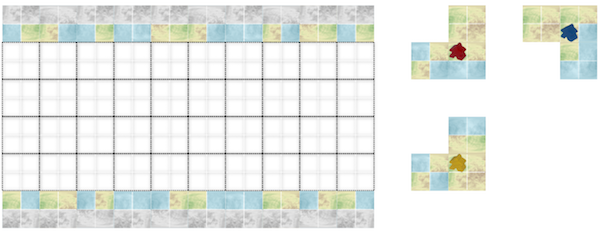
The development of the civilizations: the technology treeMost civilization games have one thing in common: the technology tree. A technology tree allows you to plan your gameplay step by step towards a preferred ability, it gives you a sense of progress as you unlock new abilities, and the many combinations of different abilities ensure replayability as each civilization gets unique. Plan, progress and replayability are all important parts of a good game. A typical gameplay scenario could be the discovery of a new continent with a numerically strong opponent. Should you rush for gunpowder for a preemptive military strike? Or perhaps art to culturally assimilate any invaders? Or simply resort to industry and reach mutually beneficial trade agreements? A good game should not have any definite answers. But that freedom is also a challenge. Do you get too many options, potentially leading to analysis paralysis? Are the many abilities compatible or are there potential role issues? Perhaps the worst, are the abilities balanced or are there game-breaking combinations? Personally and as an old chess player, I prefer transparent games where all options are restricted to the board and where detailed knowledge of large amounts of cards and combinations don't determine the outcome. The civilization cards of Civilization constitute my main issue with this otherwise great civilization game: to win you must understand how to maximize the many bonus relations between the cards, something that detracts a bit from the civilization building aspect of the game. Thus, I want to offer the players civilization cards to tailor their civilizations but they shouldn't be an end, just means to a greater strategy. The civilization cards shouldn't add new abilities, just enhance already existing abilities. Given the context of civilization traits, they should also be linked to them somehow. One idea could be to link each card to two civilization traits, for example economy level 1 and military level 1 could allow the purchase of mining, which in turn could allow production of metal resources on the board. Other civilization cards could affect other meeples (slavery, conversion etc.), movement (navigation for sea travel etc.), resources (pottery for saving food etc.), and even civilization traits (writing could allow 1 culture level to be used as 1 science level and vice versa). This system would also work like an implicit technology tree, not with specific civilization cards as prerequisites but with certain civilization trait levels. A remaining question is whether the civilization cards should be limited. From a strict game perspective a limit adds a sense of urgency but thematically it's difficult to explain why a civilization would be unable to acquire abilities known by other civilizations. No limits at all would require a lot of cards, many of which may never be used anyway. This solution is neither elegant, nor good from a production economy perspective. (As a self-publisher relying on print on demand, I'm very cost sensitive.) Also, a player may still choose not to acquire an ability and accept a "breach" in the technology tree. A simple solution would be to just have one card of each but allow other players to buy it as well. The second player could simply place a marker on it to indicate the right to use it one round and the following rounds the card could return to the "public domain" and be available for everybody for free. The implications of this would have to be tested but the idea of diminishing first-mover advantages is interesting from both a game and a theme perspective. 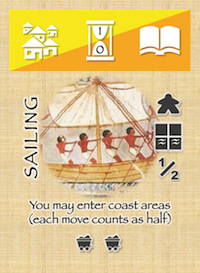
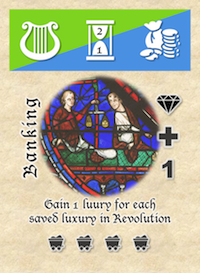
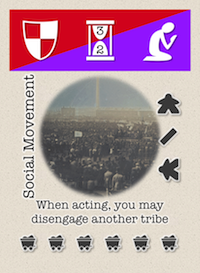
The legacy of the civilizations: the eventsSo far we have discussed how civilizations influence each other through their various civilization traits. But there are many other sources of influence. There are external forces such as natural disasters (a well-known example is the calamities of Civilization) as well as internal forces (new ideas, leading to peaceful transformations or violent revolutions). The history is full of events with a major impact on the civilizations: the agricultural revolution triggering the rise of the first civilizations, the barbarian invasions contributing to the fall of the Roman Empire, the various freedom movements shifting the power from absolute rulers to popular democracies and so on. Throughout history, civilizations have been faced with those kind of events and forced to react to them, sometimes with success to emerge as even stronger civilizations and sometimes with failure to fall into obscurity. However, although those kind of events add to the thematic feeling of a civilization game, they also add the challenge of taking away control from the players. How do we ensure that those events remain within the players' control while still providing them with changing conditions that ensure replayability and meaningful decisions? In Civilization, the dreaded calamities add both theme and control. Do I accept the fate of an Earthquake or do I trade it away? If I am the victim of a calamity, which other civilizations do I bring in my fall? Which civilization advances do I invest in to mitigate expected calamities? Also, calamities do create memorable situations that can be very fun, at least if they happen to someone else. Hence, we can't simply rule out random, tradable and shareable events as something completely bad. Instead, let's see how we can utilize random events while maintaining player control. One idea is to let them be partially known to the players, similar to how the valuable winter tiles are known by individual players from the start of the game so that they may build their strategies around them. This also promotes long-term building of a sustainable civilization instead of the short-term calamity mitigation of Civilization. (This was later fixed in Advanced Civilization, by placing the civilization acquisition AFTER the calamity resolution.) Another idea is to let the events affect all players. That removes the direct take that mechanism, where you target specific players, something that I'm not very comfortable with in Civilization. (In my games, secondary effects were either used to bash clear leaders or simply equally allocated.) It also gives a more thematic feeling, as new ideas spread all over the world. One such example could be emancipation, where slavery is being abolished all over the world. A third idea, also similar to Keyflower's winter tiles, is to give the players the power to choose which events to add to the game and which to remove from the game. Then they can choose the best (or least worst) event. That power works both ways: if I have an event like barbarian invasions, I can either choose to build up my military to be prepared or simply remove the event, knowing that I don't have to fear any barbarians. To conclude, we want to add some kind of event cards, which the players may choose to add to or remove from the game during regular intervals. They could be handed out to the players at the beginning of the game, have two events to choose from and be played at certain milestones, such as when the player enters a new age. They could also focus more on universal ideas rather than local disasters to contribute to the story told by the game. What if the religion is never separated from the state or the democratic movements are suppressed? The players will not only experience history, they will create it! Finally one word of warning. When choosing events, it is important to avoid a Eurocentric perspective and find truly global events that relate to more people than only Westerners. Having grown up in European cultural context, I may know the history of other parts of the world but I don't fully understand how important and influential various events have been in their cultural context. I'll do my best to build this understanding and any tips on "must include" events are welcome. A civilization game that stands the alpha-test of gameplay?The discussion so far has spawned many ideas about what to include in a civilization game and how to include it. The time has finally come to put it all into a playable prototype and start testing the various ideas. But testing such a long and complex game will be more challenging than any other game I've designed and tested so far. The main reason for this is the sandbox nature of the game. Where many euro games have few decisions with limited strategic paths to explore, our civilization game aimed at giving our players freedom to choose their own destinies. Yet, we must find a way to "alpha test" the game to make it playable enough to run through a "beta test" without having to stop and modify the game after each and every turn. The best way to do this is to apply common test methodology and break it down into testable units and this is how I did it. First, I ran some calculations and simulations on what I call the economy of the game. How many units are necessary to give the players enough room for a varied production but not so many that it becomes cumbersome to manage the civilization? In a simple game like Catan, a player does not have to think about more than a hand full of settlement whereas a player in the computer version of Sid Meier's Civilization have way too much to keep track of without computer help. Given that our players need to produce food, commodities and luxuries as well as use tribes for other actions, I settled with up to 3 tribes per action area or 12 tribes in total. Next, I looked into how many resources that are necessary to take those actions. To feed 12 units, you need 6 food. Later tests suggested that the 1st tribe should be "free" (otherwise a player with no food wouldn't be able to get back his or her tribes and the gameplay would come to a halt) so 5 food per player was enough. To advance your civilization traits, you need 2/3/4 luxuries so 4 luxuries per player are needed. To acquire new development cards, you need 2/3/4 commodities so 4 commodities per player are needed. However, given that there are more development cards (45) than civilization steps (6x3=18), I increased the number of resources to 30, of which 10 are available from the start and the rest get available with development. Those numbers allow a civilization to manage 12 tribes to take every action needed to feed, advance and develop the civilization. With advancements and developments, the supply and demand of resources may be modified and free tribes for other actions - the better the civilization, the more efficient its use of resources. The rest was simply a matter of scaling the numbers for different player counts.
Finally, I simulated the critical first few turns. With the six civilization traits, there are six basic starting strategic paths and it's important that they are balanced, meaning that they will provide equal conditions for the rest of the game. If not, there will either be an inferior path that only serves as a trap for beginners or a superior path that makes the first few rounds an unnecessary haul for experienced players. With "equal conditions", I simply wanted to ensure that the players had acquired asets of about the same value after the first few rounds, before their paths start crossing. This exercise helped mitigating some obvious imbalances.
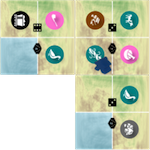
The concerns about the more aggressive civilization traits (Military to eliminate or enslave opponents, Religion to convert and replace opponents) were interesting. Initially I thought they belonged to a civilization game but to be weaker and meet such a civilization just felt boring. Either you build a similar civilization to protect yourself (with less variety between the civilizations) or you ignore the threat and get wiped out. Those concerns were aggravated as I got the opportunity to play Through the Ages and its smaller cousin The Flow of History. In both games I became weaker with no opportunity to catch up, with the result that I was constantly attacked in a downwards and most unfun spiral. This experience led to the decision not only to lessen the destructive game mechanics but also to add the specialists with the one-time civilization trait abilities. Through them, a civilization may ignore the full investment in a civilization trait while still protect itself against other civilizations buy investing in the cheaper specialists. This also became a turning point in the game development. The game took a small step away from a dudes on a map game towards an economic euro game, where a successful civilization is rewarded not with supremacy but with a more efficient production, whether it be a production of military, resources, culture, religion or anything else. Another turning point was that the game started to feel fun again. Usually in my game designs, the tedious Excel simulations turn the work into an unfun optimization exercise where everything feels too complex and complicated, but not in this case. Instead, I had began to identify myself with the Aggressive Romans, the Trading Olmecs, the City-building Sumerians and all the others and really looked forward to see the game played in my alpha-test. Lessons learned from an alpha testThe alpha test turned out to be quite slow due to the many parameters to keep track of. How many tribes and resources does each people have? Which advances and developments has each people acquired? Which tribes have acted and which have not acted? Which areas are discovered and how are they located relative to each other? An Excel sheet wasn't enough but I had to resort to draft PowerPoint maps as well. Nevertheless, those challenges helped enforcing simplifications. Ater all, if an Excel sheet can't keep track of everything, how is a player supposed to do it? The images below shows the tables and images I used to keep track of the test games. We see that a player has to keep track of tribes (and later settlements) on the map as well as the six civilization levels and the three resource types (of which each has six specific resources). Add to this all the developments acquired. Any ideas of monitoring all this with player tracks had to be abandoned in favor of individual components for each item and level. Military level 3 had to be represented by 3 physcial military tokens and 3 grain had to be represented by 3 physical grain tokens to avoid a fiddly game.
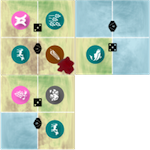
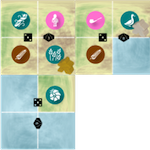
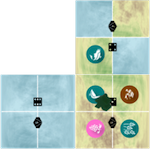
This also meant that development cards couldn't be shared among players so either there had to be a limited number of development cards or one complete set of development cards per player. The first solution was used by Civilization but abandoned in Advanced Civilization. Given that some developments felt more popular than others (e.g. Mining to get access to new commodities, although Economy could be used as an alternative to trade for those commodities), I decided in favor of development cards for everybody, although this made an already expensive game even more expensive. To manage all those items, the player board was designed with spaces for the civilization and resource tokens, which would be moved to an unavailable pool above the board when used. 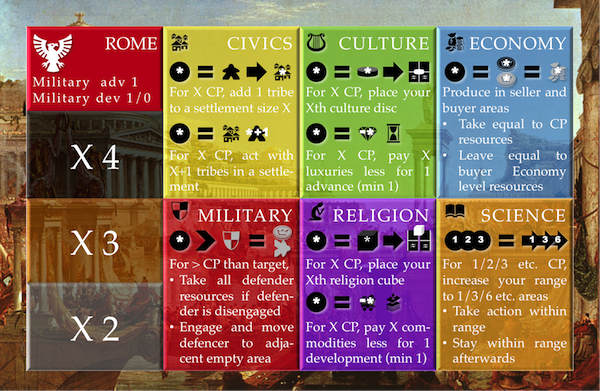
The image below shows the game state after 53 turns and 8-9 revolutions per player. Although the different peoples explored different strategic paths, none of them ran away or fell behind in the early game but they did lay the foundations of very different civilizations. The map grew at a balanced rate, giving each people enough space while still leaving unknown territories to discover in the mid-game. 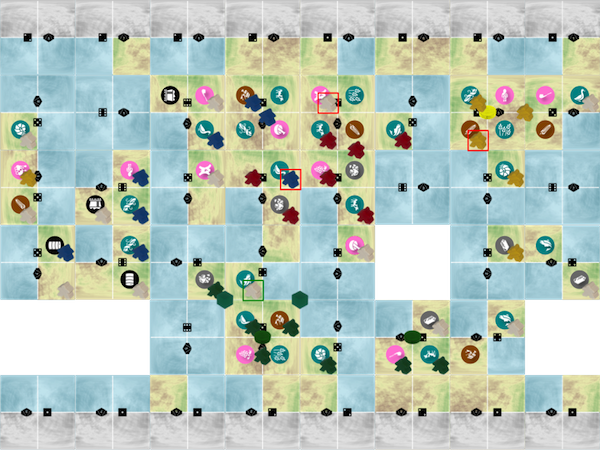
However, there were some other issues. One issue was that the game felt a bit too long. The players had only just started acquiring level 2 advances and developments, whereas they should have been close to level 3 given that a majority of the tribes have entered the game and that so few white spots remain. Another issue was that it got a bit fiddly to keep track of enslaved and converted tribes (marked with a square in the image), not to mention how complex the rules for handling them were. First, we looked at the time issue. The idea that you only act with one tribe at the time, that your people can't advance and develop until all tribes have acted (in the "Revolution") and that advances and developments are slow meant that the sense of progress was limited. One simple solution was to skip the scripted start and let the peoples start with two tribes, four region tiles and resources (or, optionally, an advance and a development specific to the people for variable powers). The one tribe action was kept to minimize downtime but the cost to advance and develop was decreased (or rather the gain from resources was increased) to allow a people to acquire several advances and developments each Revolution. This had to be balanced against the risk that a people would grow too powerful over a Revolution but in the end it managed to double the advance and development rate. Second, we looked at the fiddliness/complexity issue. Originally, enslaved tribes were marked with tokens, converted tribes were replaced and marked with tokens and both could return to the original owner through various rules. In addition, it was simply unfun to be the victim of such mechanics. (Note how the Romans have been a menace to her neighbors.). Instead, those abilities were limited to a temporary use of each others' tribes for the current Revolution cycle only (provided that the tribe hasn't acted already). Did this also remove thematic opportunities like the slave revolts and "conversion from within" that the historical Roman empire faced? Not necessarily, by letting only tribes that haven't yet acted be the victims of such actions, a tug of war was introduced where such tribes were sometimes oppressed and sometimes free. In addition, the use of others' tribes were associated with a cost, adding cost/benefit balance for both players. Hence, the rules were not only simplified but also improved! Another result of the alpha test was that the open question of events could be iterated and resolved. The initial idea to let the players choose events to "change the history" didn't quite work with specialized strategies. If you specialize in Military and can choose between and a positive and a negative military event, the choice is obvious, as is the choice if you don't specialize in Military. Thus, the events would most likely punish players doing their own ways. Instead and with the inspiration from Michael Schacht's "book" in Africana, a history book was introduced where pages could be flipped each Revolution. In this way, all the event would be cycled through but not necessarily be open long enough to impact the game. Players would no longer be able to choose the events but they would be able to prepare for those that would have an impact. In addition, the concept of a history book, presented by authentic historians, appealed to me. 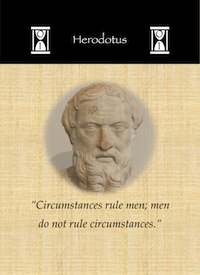
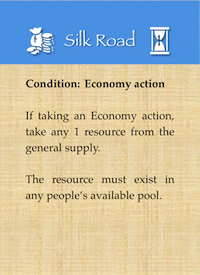
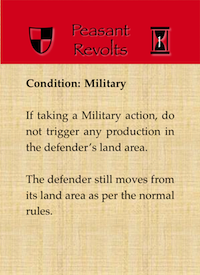
As a result of those changes (and of being tired of Excel and PowerPoint), I decided to enter beta test and order a prototype from The Game Crafter. It was expensive indeed and it's likely that most components will be redone anyway but the time saving for crafting all the components myself far outweigh the cost of letting someone else doing it. Besides, it's always fun to receive the first printed prototype and play with it! Lessons learned from prototype testingTo prototype, or not to prototype, that is the question. A prototype requires a lot of work; the components have to created, printed, cut and assembled - and most likely completely redone after the first test. I still have my very first prototype of Nova Suecia but none of the components created then are used in the current version of the game. With later games, I stayed in the alpha test much longer and didn't bother with the physical components until the game was more stable. The result was often that once crafted, the components could be used over several tests with only minor modifications. Thus I got more bold (or lazy if you prefer) and started to print my components through The Game Crafter instead of assembling them myself. Yes, it's an expensive solution but it does save time and lets me focus on what I like best with game design - the design of the actual gameplay.
However, Peoples - Civilizations is my biggest game by far, both in terms of components and strategic branches, so the alpha test became a long and cumbersome affair. How well does a certain civilization advance or development card pay off over 10-15 rounds? How do small and specialized peoples fare in comparison with larges and general ones in short and long term? Most importantly, are there any over-powered strategies or strategies that are doomed to fail? There is a limit to how much a spreadsheet can test in a game like this. To build an automated simulation that covers all branches would take too long. To manually maintain a digital record of all actions and transactions would be too cumbersome and prone to errors. And even if a spreadsheet would be able to accomplish all this, it would still fail to answer the key question: how fun is it to manage all game decision with physical components? In the end, only a prototype could move the game to the next step. 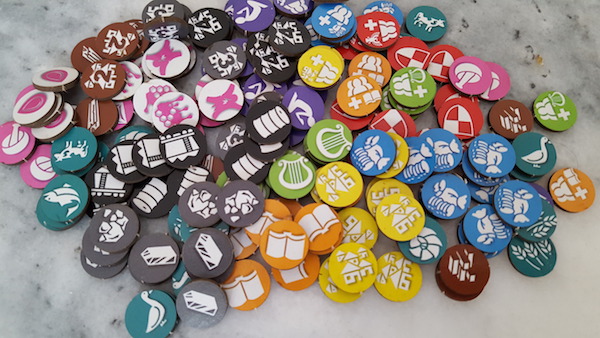
After careful proof-reading, the prototype was ordered together with some new games and some new components for old games. With the exception of the "expected" issues (the occasional spelling error, wrong icon used at one place, the purple color being slightly too dark etc.), the first impression was good. The components had the right size and were easily distinguished from each other, the setup was quick and simple (after the many chits were punched and the many cards sorted that is), and the initial game turns were short and straight-forward. So far the game played as expected. Then came the doubts. 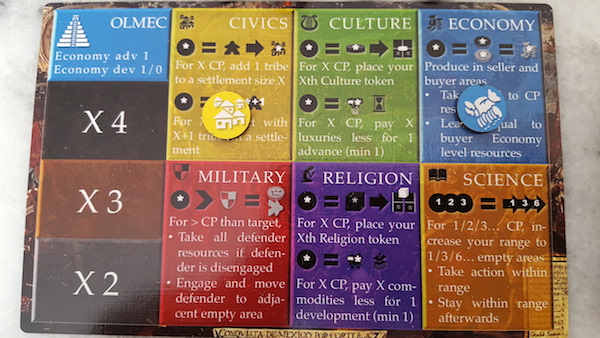
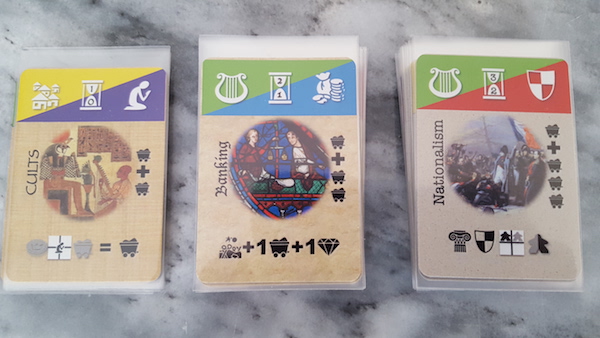
One important change from the pre-prototype testing was that the game speed had to be accelarated. This was accomplished through extra tribes and abilities from the start and lower costs and other barriers for acquiring advances and developments. While those changes looked harmless in theory, they did accelerate some strategies more than others. In particular, the rule that unique resources gave a bonus resource instead of being a prerequisite acquisitions gave some unexpected results which, in hindsight, should have been predicted.
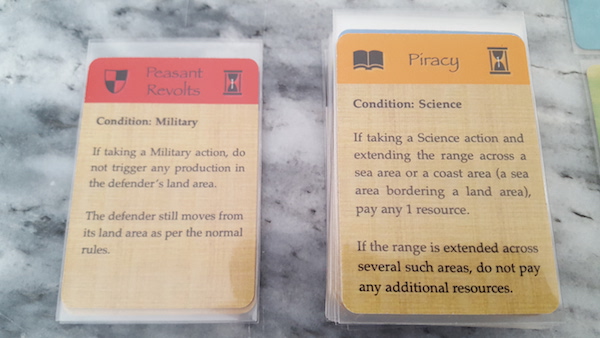
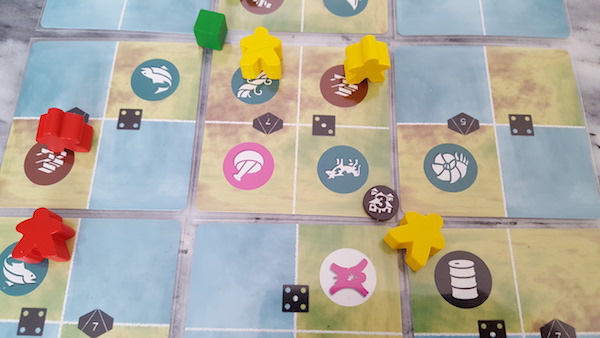
Another interesting lesson from the prototype testing was more difficult to predict and shows the importance of physical testing: production actions are fun in a spreadsheet, because they increase the number of resources, but civilization actions are fun on a physical board, because they provide tactical and strategic alternatives to the routinely "cube pushing" that is so common in modern euro games. But the old rules made civilization actions expensive and the alternative cost for them was high compared to the "accelarated" production actions that they became rare and hence the fun moments also became rare. The simple solution was to accelerate them so that they could be used more often and with greater effect. Those changes certainly didn't come without pain. The first few turns of the test game were replayed over and over again and I often feared I would have to resort to a slower gameplay or more complex rules. But as is often the case, the simple solutions turned out to be the best ones and once they felt solid and simple enough to implement, the test could proceed. The position below shows the start of a test game where all peoples have taken about 10 actions per tribe each. 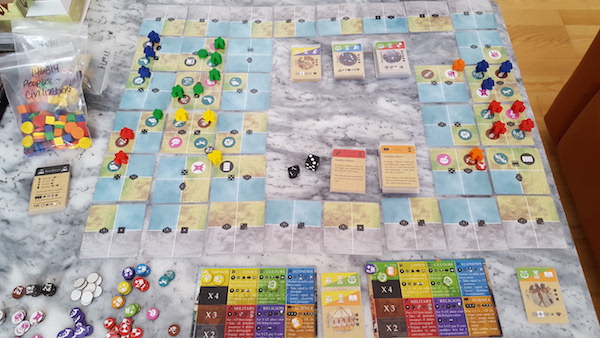
Another interesting observation is that all the four peoples ended up in the same half of the board, although with a lot of lakes separating them, while the other half of the board remains unchartered. Will the peoples move towards each other and will they come in peace or with arms? Or will they race to explore and expand in the unknown part of the world first? The answers are actually irrelevant - the fact that the questions can be asked is a good inidicator of a promising game! Lessons learned from human testingAfter a (too?) long maturity time, I finally demonstrated the core concepts of Peoples - Civilizations for an external test group and ran through the initial turns. The test gave me many valuable insights and confirmed many design decisions but also gave me many questions for the future development. A pleasant surprise was that the civilization mechanics worked relatively smoothly. The slow map revelation was perceived as a bit fiddly in the beginning but after a few rounds all civilizations had found their place on the map with plenty of unknown areas left to explore. 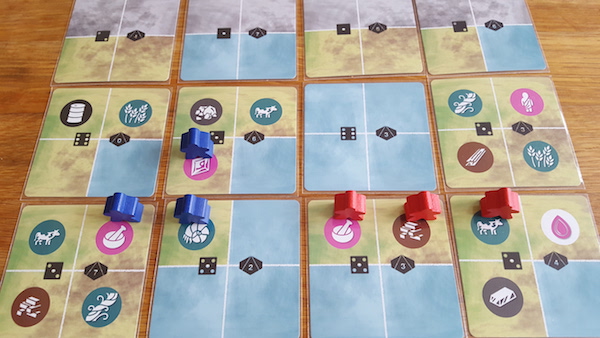
The one meeple-one action turns resulted in extremely quick turns and minimal downtime, although the production actions (lay down meeple and take resources) were perceived as less interesting. However, since the civilizations were still in their early stages, the more interesting civilization actions were still rare. The slow map and the rare civilization actions also meant that the initial interaction was low. This was by design to allow players to lay the foundations for their civilizations first, similar to games like the computer game Sid Meier's Civilization. However, some player styles may prefer early encounters. The many development cards were, as feared, overwhelming. 15 cards per era or 45 cards in total pose a huge threshold for new players. On the other hand, they also offer experienced players rich possibilities to shape and control their civilizations' destinies. 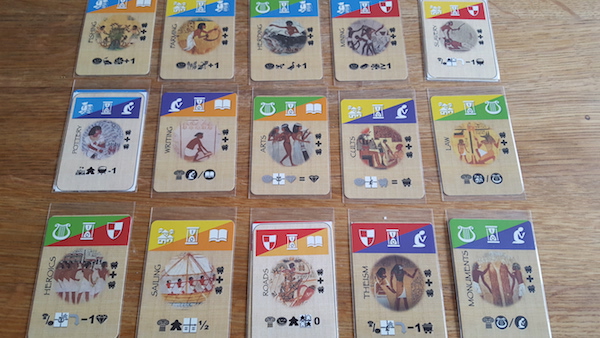
Those insights inspired several small fixes but also left me with some big design decisions. One small fix was to let land areas be connected if separated by one sea area only. This promote growth and interaction without the necessity of sailing and is also thematically correct, since water connected early civilizations rather than separating them. Another potential small fix could be to let civilizations start with level 1 in all civilization advances as well as a number of development cards to speed up the beginning. However, would need more tests with different player personalities first to assess the "fun factor" of the early civilization gameplay. 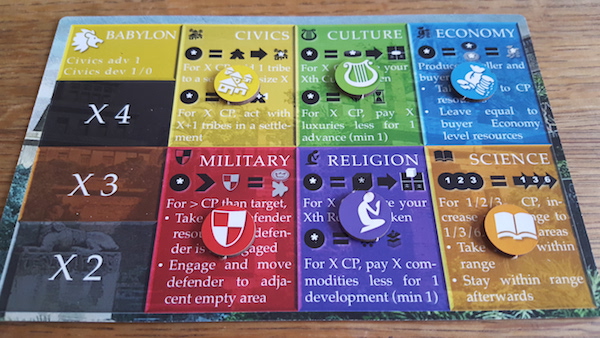
For the more radical design decisions, I have several ideas to work with. One such idea would be to scrap the civilization advances and development cards altogether and replace them with a technology board. On the board, a player could choose her own path through the six civilization areas, e.g. move from Economy 1 to Economy 2 and then on to Military 2 (skipping Military 1). Each level would give a small and easy understood bonus, such as +1 food production. This idea could be easy integrated with a round-based game instead of the current turn-based game. The production round would see production in all areas simultaneously (and let players with fewer areas produce in some areas more than once). The civilization round would also see simultaneous actions as much as possible.
Those ideas would certainly make the game quicker and more interactive. However, it would also limit the players' wiggle room. Instead of combining development cards and civilization actions, they would simply accumulate "cube pushing" bonuses and take clearly defined civiliation actions in isolation. The thematic progress from taking production actions only to increasing productivity and engaging in civilization actions instead would also be lost. The game would be a streamlined and "modern" civiliation game but would it still feel like a civilization game? Clearly the answer can only come from further testing with different player styles. From design to developmentSometimes inspiration comes from unexpected sources. One of the key elements of Peoples - Civilizations is the balance between small civilizations (less resources but more flexible) and large civilizations (more resources but less flexible). The current one turn-one resource mechanic was perceived as too slow at the human test but a one common round-all resources mechanic would let all civilizations advance and develop equally often and lose the key mechanic. Unwilling to continue the development until this issue was resolved, I started thinking about designing an economic game in the future, since I'm a fan of them but yet haven't designed any. One particular element that intrigues me is the time element, where you need to acquire not only the right resources but also at the right time. Some games like Barrage implements this through a production wheel and such a wheel could also be used to track transport time etc. But wait, wasn't a time wheel exactly what Peoples - Civilizations was missing? How about a time wheel where each player's Revolution actions would be timed based on their civilizations' sizes - the larger, the less frequent. A similar mechanic is used in games like Thebes, where players far ahead on the time track have to wait for the other players to catch up. This works well with small and simple turns and would have worked with the small production actions but would have been frustrating with the more complicated civilization actions, where a large player might have to wait for many small players. Nevertheless, I started to outline a wheel to help the thought process when I realized that I already had a wheel - on the box! That wheel, originally used in Peoples - Migrations, was intended to illustrate the progress through History, but turned out to be perfect for a time mechanic. Each section of the wheel would be associated with a civilization action but at certain sections (depending on your civilization's size) you would also get a Revolution action. Say that you take a Revolution action at one a'clock and have 3 tribes. Then your next Revolution action would take place at five a'clock (3 turns later +1 extra turn to keep the mechanic that small civilizations produce less over time). While waiting for it, you may take an Economy action at two o'clock, a Culture action at three o'clock and a Civics action at four a'clock. Whether you decide to take all of them (spreading resources on many small actions) or just some of them (saving resources for a few big actions) it's up to you - any downtime between turns is a strategic choice by yourself. 
The next question was which actions the players may take between Revolution turns. With the production actions linked to Revolution actions, only civilization actions remain. In the current version, advances and developments provided such actions while civilization tokens served as a "currency" to pay for them. Already during the design, I felt that this was cumbersome and this feeling got stronger the more I was exposed to the simple and elegant ability boards of games like Hansa Teutonica and Endeavor. It was an easy decision to kill my darlings and scrap both civilization tokens and development cards. Instead, the luxuries produced could immediately be used to advance along civilization tracks where each new level would unlock a new ability while the commodities produced could be used between revolutions to use those abilities. Instead of buying the development card "Agriculture", a player would simply unlock Economy level 1, build a Farm and get +1 production in all agricultural areas. But what to do with the actual components that you remove from your player board to unlock the ability? For Civics, Culture and Religion, the current version already had the answer: settlements (efficient production), monuments (efficient advances) and temples (efficient development, with the new idea changed to efficient building) to place on the board. Why not let all civilization traits provide buildings to place on the board? After all, I think that a map is important for a civilization game so why not use it even more? Economy buildings were simple to come up with. Farms for food bonuses, Mines for commodity bonuses and Public buildings for luxury bonuses could be placed on the specific resources to mark them for bonuses (and potentially be destroyed by opponents so that they have to be rebuilt). Military buildings were also simple: barracks or armies used for raids and conquests. Science buildings were more tricky, since the original game equaled Science with range. But how about letting Science symbolize both research (bringing inventions forward) and discoveries (bringing inventions from abroad). Science buildings could then be linked to either internal research (symbolized by bringing the next Revolution forward) or external discoveries (symbolized by resources from new regions or even advances and buildings from other peoples). 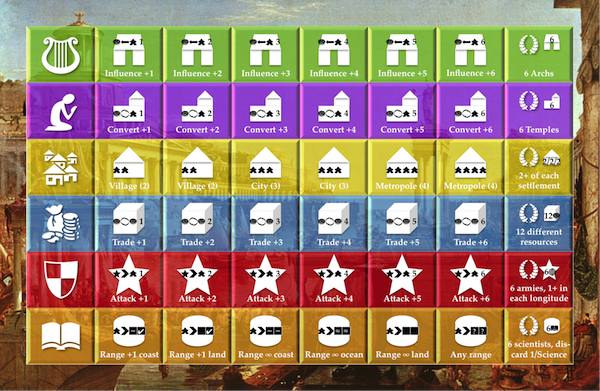
The idea of buildings gave birth to another balancing challenge, namely one of quantity and quality. Whereas the advance level improved the quality of a civilization action (the higher the Military, the stronger the army etc.), the number of buildings could determine the quantity of a civilization action (the more Military buildings, the more attacks etc.) The idea of the new civilization actions were derived from the old civilization actions ones as well as some of the old development cards.
With that, 6 currencies and 45 development cards had been simplified into 1 player board. What remained was to investigate whether the 9 different resouces could be simplified and again a player board was the solution. Instead of counting resources, taking resources and paying with resources, resources could be moved to tracks on a player board to mark production capacity and flipped to mark usage. Similar to Endeavor, a player would always have a clear overview of available resources and always be able to backtrack them by comparing with controlled areas and unlocked abilities. 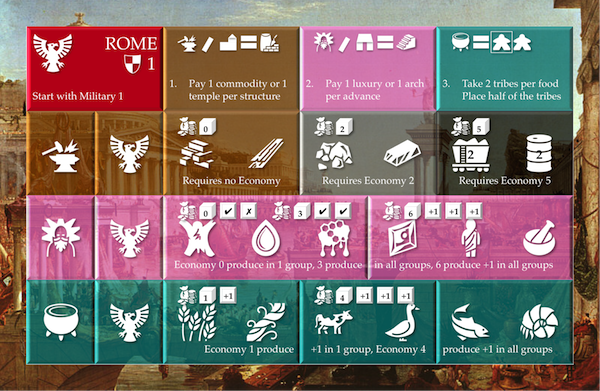
However, having reached this far I began to doubt. The first issue was that 6 buildings for each of the 6 civilization traits for each of the 6 people colors would require 216 wooden components! Considering that 6 steps on 6 traits would be too much anyway for a game where you only advance a minority of the turns, I decided to reduce the number of buildings to 4 for each civilization trait. The second issue was that not all civilization traits would have interesting civilization actions. Civics would only be interesting if you had advanced enough to expand a settlement, the production bonuses of Economy would only be interesting during Revolutions, Science would cease to be interesting once all region tiles are discovered and so on. This second issue was more critical and stopped the development completely as I tested and rejected one idea after another because they were unbalanced or too complex. I even began to doubt whether the mechanics were interesting enough compared to other "build and unlock abilities" games like Hansa Teutonica. While Hansa Teutonica features a "cube economy", where the abilities range from actions to movement and retrieval, a civilization game is more about spreading your civilization (science, military), producing many resources quickly (civics, economy) and influencing other peoples (culture, religion). Would the decisions of Peoples - Civilizations be interesting enough to pursue or would I be forced to return to the less elegant solution of many different ability cards? Finally there was a breakthrough as I decided to remove all Revolution bonuses and link each civilization trait with a civilization action bonus instead. I made sure to give each such bonus a unique ability that yet would help driving a strategy towards a goal.
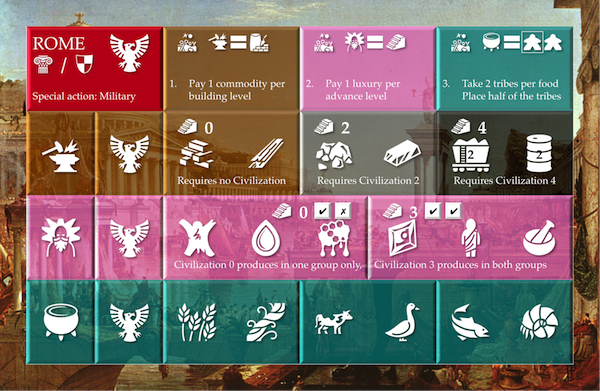
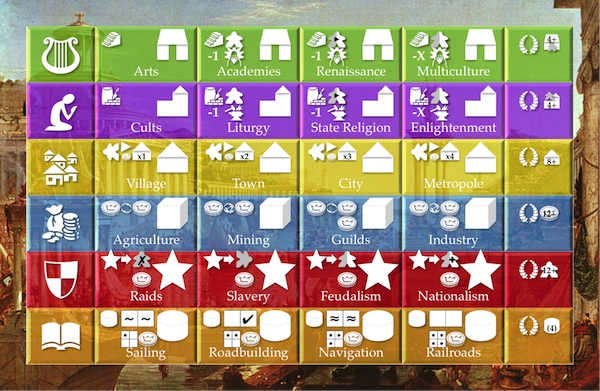
There were still some issues remaining regarding the production levels, Without the production bonuses of the Economy, there wouldn't be enough resources to trade and most of the production would have to focus on food just to maintain the population. However, two simple rules solved those issues as well. First, a specialization bonus was introduced, whereby players producing more than one of a particular resource would produce one extra of it. Second, the Economy level requirements for certain resources such as coal and oil was simple replaced by a general civilization level requirement. (Economy was compensated by getting free resources when trading at higher levels.) Peoples - Civilizations had finally overcame the obstacles for development! To sum up, the game as designed worked and was well balanced but cumbersome to play. The game as developed keeps all the core elements but simplifies and streamlines the gameplay. After a Revolution, you still have to choose which abilities to acquire, which goals to pursue up to the next Revolution and which actions to take to promote those goals. Another small but powerful idea was to make the available civilization actions random (but predictable) to enable some to appear more often than others at times, reflecting the increased importance of certain civilization traits at different Historic periods. For the first time during this process, Peoples - Civilizations began to feel like less of an experiment and more of a really interesting game! To be continued. |
Annotated gamesIf you like those game mechanisms, I can also recommend:
|