
 |
The Quest for the Perfect Game - Reviews to Extract the Essence of Games by Nicholas Hjelmberg | |










|
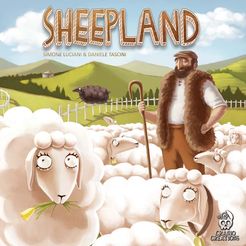
Sheepland - The Wolf in Sheep's Clothing (Published 26 February 2018)This review has also been published at Boardgamegeek. The Community VerdictWho doesn't love sheep? The designers Simone Luciani and Daniele Tascini have some well received titles on their CVs, including Tzolk'in, The Voyages of Marco Polo and Grand Austria Hotel. Sheepland, however, failed to appeal to the demanding Boardgamegeek Community and currently resides at rank 2391. Is Sheepland on a par with games like Buffy The Vampire Slayer or could the (gasp!) the community be wrong? Let us see what hides in the box of Sheepland. The First ImpressionActually, the box may provide a first clue to the low ranking of Sheepland. The cartoony cover depicting a shepherd and his sheep does not give the impression of a gamers' game but rather a children's game. The board further strenghtens this impression with its bright colors and broad brushstrokes and the sheep shaped meeples may not be something a cool gamer wants to be seen playing with. Not even the rules seem to take Sheepland seriously with sentences like "The most recent player to caress a sheep is the First Player and takes the First Player token". One of the major challenges of Sheepland is getting the game to the table! 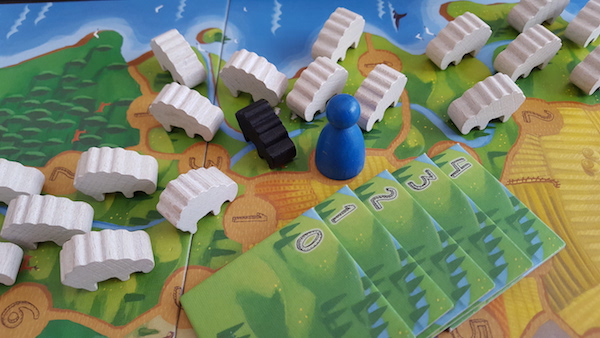
How to PlayBut what is the game about then? Herding sheep obviously. The board consists of six different terrains, each of which contains three areas. When the game starts, the sheep are spread across the board and it is your duty to bring them to your terrains. The more sheep in your areas when the game ends, the higher your score. But which are your areas, you might wonder? This is where the game gets interesting. There is no such thing as "yours" when the game starts; the sheep can be moved by any player and the terrains belong to whoever invested in them. In practice, you have three actions per turn, of which no two may be taken consecutively. 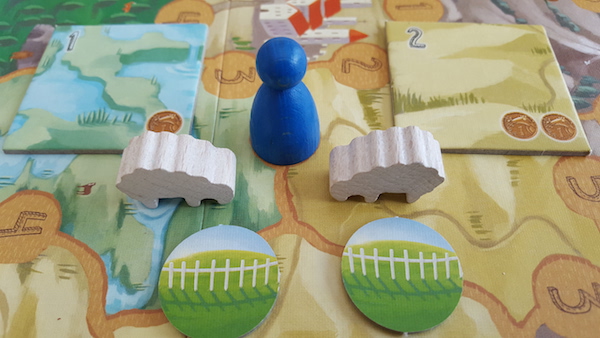
When all fences have been placed, the game ends. Your score equals your terrain tiles multiplied by all sheep that end the game there. 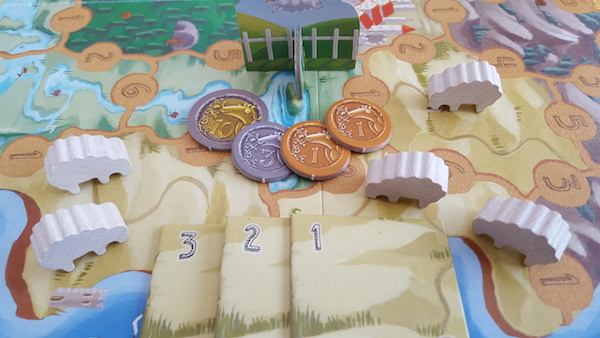
How to Play WellThose simple rules provide a gameplay far more challenging than you may think from just looking at the components. You want to invest in terrain tiles as well as bring sheep there but you will not have time to do it all yourself. If you spend too much time on terrain, the other players will steal "your" sheep, and if you spend too much time on sheep, the other players will steal "your" terrain and profit from your hard work. Or perhaps you could temporarily ally with an opponent to bring the sheep to a terrain that you have both invested in? There is also an irrational element in the game: a black sheep worth twice as much that follows not only you but also a die rolled each player turn. This little creature adds some randomness and prevents it from becoming a pure mathematical exercise. 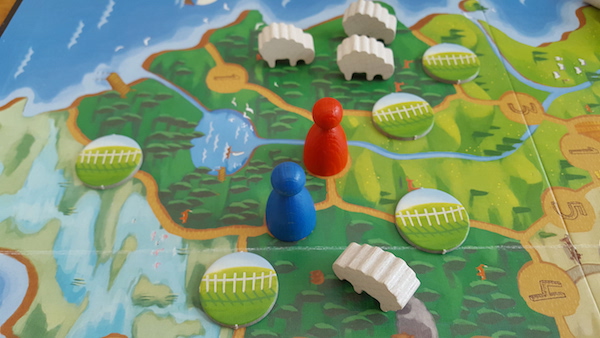
Blue could invest in forest and bring a sheep there but then Red is likely to invest in fields and steal the sheep from Blue... My VerdictSheepland is not a heavy game but you get a lot of depth in a short playing time. The interaction is stronger and the decisions more agonizing compared to many other fillers since you must constantly take into account your opponents' action. Sheepland does stand a comparison with heavy stock manipulation games like Reef Encounter (another vicious game in a friendly clothing). Children may still enjoy playing it, and should perhaps play with fixed terrain tiles in the beginning, but it is really not a children's game but rather a gateway game to heavy economic games. 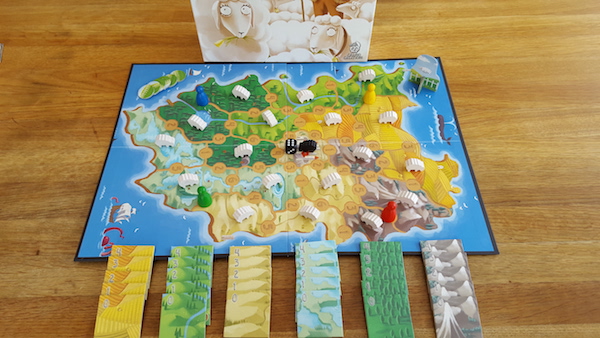
|
|