
 |
The Quest for the Perfect Game - Reviews to Extract the Essence of Games by Nicholas Hjelmberg | |

















































|
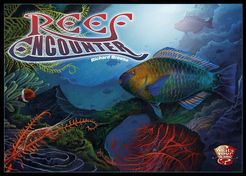
Reef Encounter - A Beautiful Depth (Published 2 July 2018)This review has also been published at Boardgamegeek. The First Impression: Deceiving CharacteristicsThere are many characteristics usually associated with bad game designs. "Too many decisions" is one, referring to games that overwhelm the players with options and lead to analysis paralysis. "Convoluted" is another, referring to games where the link between an action and an objective contains so many steps that the challenge is not to do the right things but to do things right. "Pasted theme" is a third, referring to games where the theme does not help the players understand and apply the rules but rather add to the confusion. Nobody would want to design such a game, let alone play it. Or? In Reef Encounter, you simulatenously play a coral, a parrot fish and four shrimps, which choose between ten actions (some of them in any order and any number of times) to pick, place, change strength of, change value of, capture and convert resources into victory points. Does this sound fun or even comprehensible? Probably not, but let's not dive into unknown waters straight away but rather enter the depth step by step. The Objective: "Three-dimensional" ScoringThe objective of Reef Encounter is simply to accumlate victory points. Victory points come from polyp tiles in five different colors. Polyp tiles are grouped by color to form corals, collected during up to four scoring actions and multiplied by a number between two and five in the final scoring. Does this scoring sound arbitrary? On the contrary, you as a player have control over each part of this scoring. 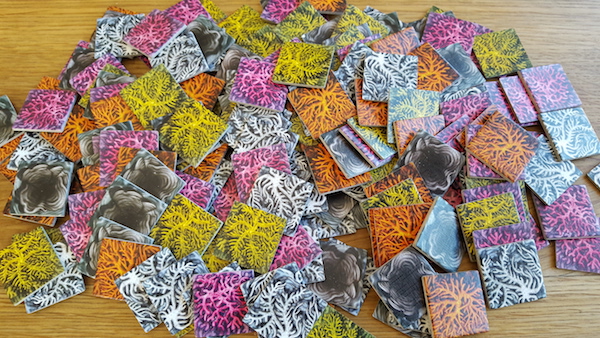
This "three-dimensional" scoring opens up many strategic and tactical opportunities. Should you focus on one color and maximize it? Should you stick to your chosen color or is it best to abandon it and focus on another color? Is it best to increase your own score or to decrease your opponents' score? There are many examples of simpler games that manage without much else and where the entire game is about knowing when to collect and when to manipulate. However, Reef Encounter has more up its sleeve, namely the "too many" and "convoluted" actions. But to understand the actions, we must first get to know the resources for accomplishing the actions so let's introduce the inhabitants of the coral reef. The Resources: The Inhabitants of the Coral ReefIn Reef Encounter, you have several resources at your disposal. First, you have one parrot fish. Actually, this is just a container used for storing your collected polyp tiles and hiding your score from the other player. 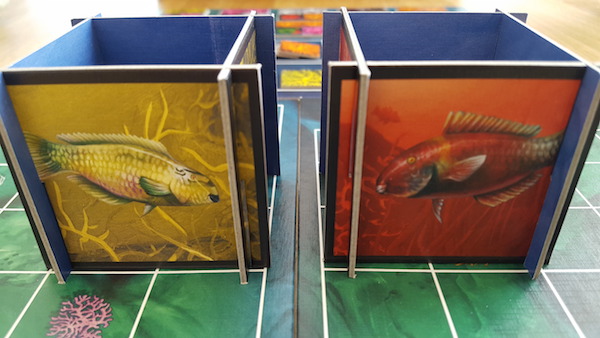
Second, you have four shrimps. They are used to mark which corals that are owned by you and there may never be more than one shrimp on the same coral. The shrimps also help defending your corals against other corals. We'll get back to how corals attack each other later. 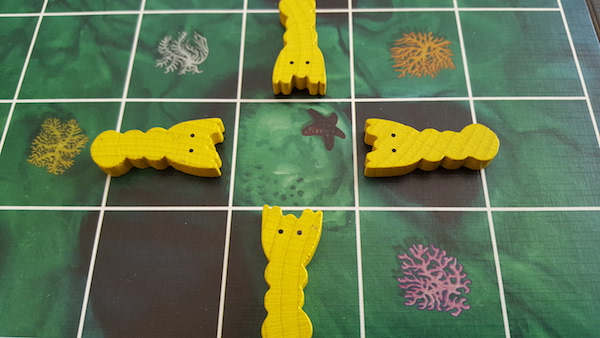
Third, you have larva cubes in the same colors as the polyp tiles. They are acquired during the game and required to build corals - play one yellow larva cube to place yellow polyp tiles etc. 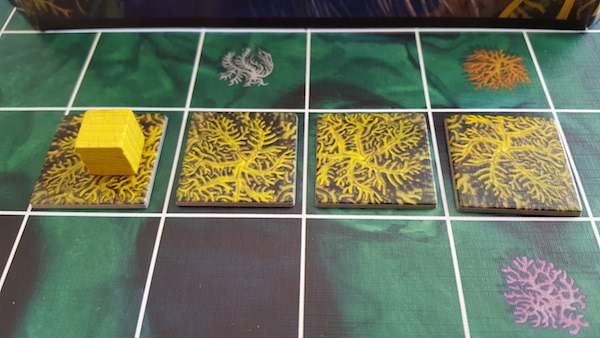
Fourth, you have alga cylinders in different colors. They are also acquired during the game and required to change the scoring values - play one red alga cylinder to change all polyp tile values marked with red etc. 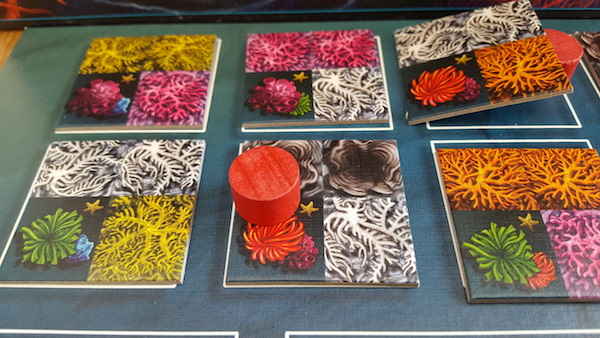
Fifth, you have the polyp tiles. Their function depends on whether they are kept hidden behind your screen or open in front of your screen. They may always be used as building material for your corals but the ones in front of your screen may also be used as a "currency" to acquire the larva cubes and alga cylinders. 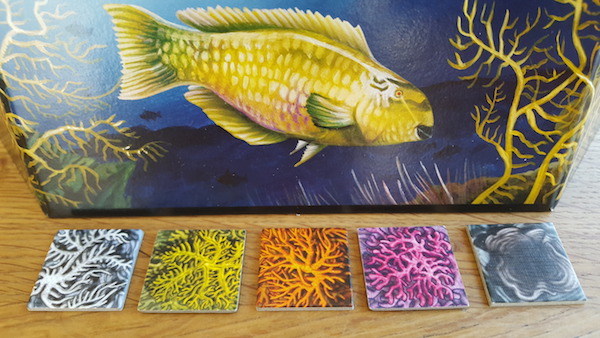
I admit that you have to be a marine biologist to appreaciate the thematic links so let's move on to the actions. Rememeber there are ten of them so take a deep breath before we dive into them. 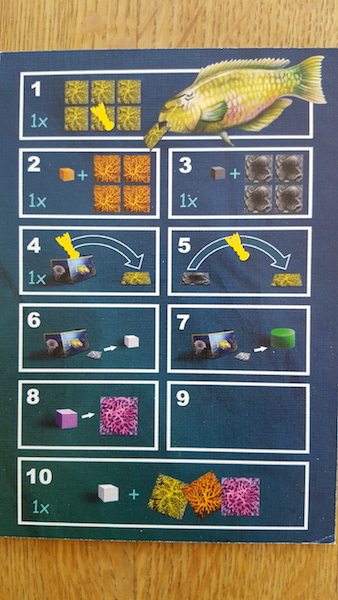
The Actions: The Building and Consumption of CoralsThe fixed actions: Score and refill polyp tilesThe first and the tenth actions are special. They must be taken as the first and the last action respectively, that is you may not take any other action before the first one, nor any more actions after the last one. The first action lets you remove one shrimp from the board together with all polyp tiles of its coral. Four of the polyp tiles are discarded but the remainder goes to your parrot fish. This is the only action that lets you place polyp tiles in your parrot fish and hence add them to your final score. It's not an easy decision, though, since your shrimp is also discarded and hence leaves you with less influence on the board. The tenth action lets you take resources from a supply that is refilled so that you always have one larva cube and one to three polyp tiles to choose from and place behind your screen. This is the only action that lets you place polyp tiles behind your screen and helps you "fuel up" your engine for the next round. Wait, wouldn't it be easier to take polyp tiles first and score polyp tiles last? Yes, but Reef Encounter is not supposed to be an easy game! The flexible actions: Acquire and use resourcesThe remaining actions are the missing links between the polyp tiles behind your screen and the polyp tiles in your parrot fish. They may be taken in any order and some of them may even be taken any number of times. Play them well and you will play Reef Encounter well. Shrimp actionsThe 4th and the 5th action are used to move the shrimps. The 4th action may only be taken once to introduce a shrimp to a board while the 5th action may be taken any number of times to move around the shrimp on or between the boards. Larva cube board actionsAction 2 and 3 may only be taken once each and lets you play a larva cube, which in turn lets you place polyp tiles to the board (from behind or in front of your screen). One reason to do so is to build large corals for your scoring action. However, there is another reason with important strategic implications: replace already placed tiles and place them in front of your screen. This is the only action that lets you place polyp tiles here but there are some preconditions for doing so.
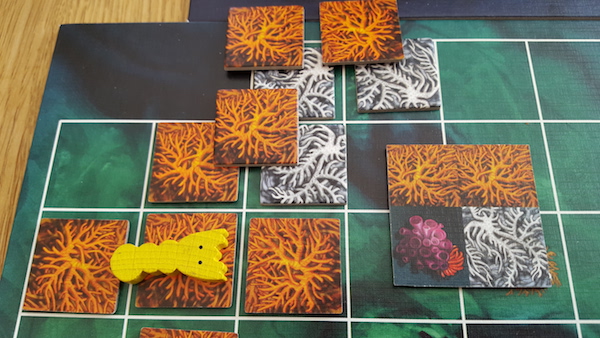
Currently, orange is stronger than white as shown by the tile with two white squres and one orange. Yellow (or any other player for that matter) may expand the orange coral at the expense of the white coral and place the white polyp tiles in front of her screen. Alga cylinder actionAction 7 lets you exchange a polyp tile in front of your screen (I told you they were powerful!) for an alga cylinder and then use it to change the previously discussed polyp tile values. Not only does this change the value of a certain polyp color but also its strength. Hence, a well timed alga cylinder can suddenly change the strength balance on the board in your favor.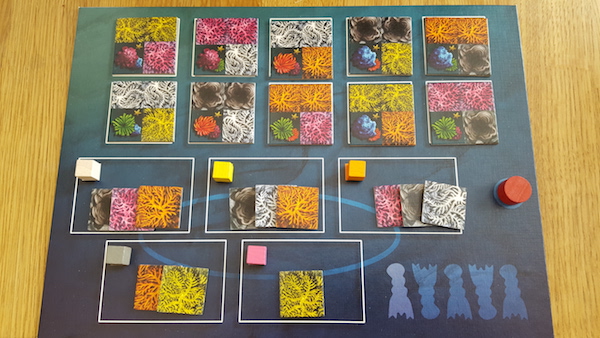
A red alga cylinder will flip the two red tiles. This will cause orange to become stronger than white and white to be stronger than gray. Larva cube exchange actionsAction 6 and 8 may be taken any number of times and let you exchange larva cubes for polyp tiles and vice versa. Those actions may be good to get that missing tile or cube to execute your grand strategy. Pass actionThere is a 9th action as well but it's simply a pass action if you don't wish to take any of actions 2-8. Are you about to drown? Grab a snorkel set and enjoy!Do you feel overwhelmed by the game so far? Let's reiterate what you have to do and you'll see that it's quite straightforward.
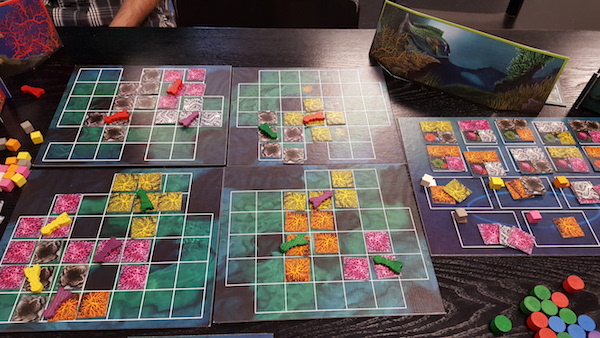
In this game, Yellow has already scored twice, proceeded to expand over her own pink and gray corals back and forth to get tiles in front of the screen, and eventually won. In this respect, Reef Encounter is much more straight-forward than your ordinary heavy euro game. This is not a game about finding the most optimal way of converting resources into victory points. Instead, you must carefully manage your shrimps, polyp tiles, larva cubes and alga cylinders to be able to accomplish your goal: a strong and valuable coral. The slow way to do so is to rely on the 10th action to collect larva cubes and polyp tiles but you'll never win in this way. Instead, you must collect and maintain a set of resources that gives you the tactical means to execute your strategy. Let's say that you have many white polyp tiles and want to build a strong white coral. Should you use your 10th action to collect a white larva cube, although that won't give you any more white polyp tiles? Not necessarily. It may be better to collet a pink larva cube, use pink polyp tiles to replace white polyp tiles, then exchange one of those tiles for a white larva cube. You will now be able to place white polyp tiles both from behind and in front of your screen AND you've made the white color more valuable. This is only one of many examples of the strategic and tactical opportunities of Reef Encounter. It's a game that gives opportunities to manage your resources and change the board conditions in your favor rarely seen in other games. The rise and fall of the corals remind about Tigris & Euphrates, the value manipulations is a common element in economic games like Imperial and the shifting power balances is not unlike the survival of the fittest in Dominant Species. The way Reef Encounter combines and simplifies those elements turns it into a unique experience. Reef Encounter may not be the easiest game to grasp but its depth certainly makes it worth exploring! 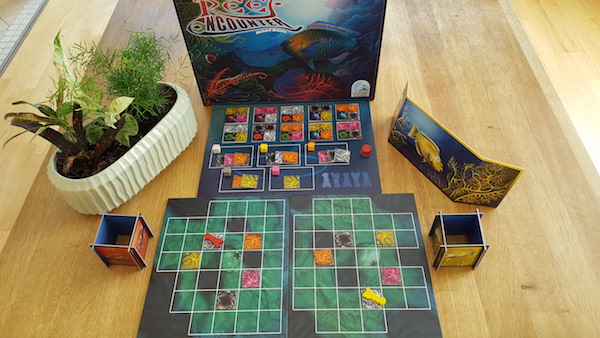
|
|