
 |
The Quest for the Perfect Game - Reviews to Extract the Essence of Games by Nicholas Hjelmberg | |







|
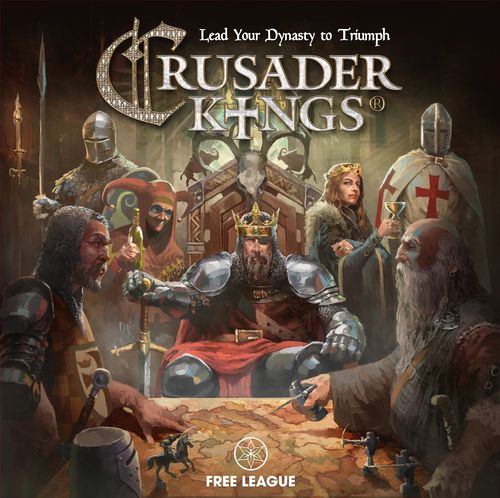
Crusader Kings - Reclaim the Holy Cardboard (Published 4 June 2018)This review has also been published at Boardgamegeek. Video Games and Board GamesTurning a video game into a board game is not easy. One might argue that all games have to fulfill certain primary criteria, of which fun is the most important one, and that the game media is only one of many secondary criteria. But while this may still be true for classic abstract games like chess and go, where the board game experience differs little from the video game experience, modern games have evolved and diverged as a result of the rich possibilities offered by the media development. The creators of modern video games have access to technological resources unimaginable to the creators of Pong while many modern board games challenge the boundaries of traditional board games by adding elements like story-telling, psychology, dexterity and automas to create a richer social experience. (Whether this makes games more fun is another question out of this review's scope.) On the other hand, the presence of multi-player modes in video games and apps in board could be considered as a sign that games are coming full circle again. Yet, there are few examples of successful video games turned into board games and vice versa. At Boardgamegeek, Sid Meier's Civilization is ranked around 200, Star Craft around 300, and Doom around 800. Will Paradox Interactive be more successful in bringing their games to cardboard? Crusader Kings is the first game to hit the table and stand the test. Crusader Kings - The Video GameWhen reviewing a board game based on a another source, it's not only the actual game that is of interest but also how true the game is to its source. Crusader Kings is a game about developing your dynasty during the Middle Ages, in competition with other dynasties. A key decision in the game is the marriage, where you have to take into account not only beneficial alliances but also heritable traits when selecting your spouse. The success is measured by prestige and piety points but there is no victory condition as such, rather a fictional prestige ranking where the success is defined solely by the player. Let's start by looking at how those concepts have been transferred to cardboard. Bear in mind that the rules are in beta mode and may be subject to change. Crusader Kings - The Board Game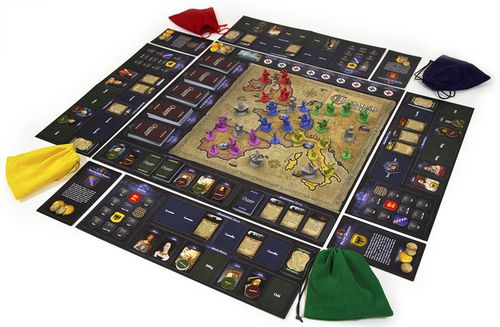
Image courtesy of BGG user nils_k The Dynasty and the TraitsEach member of your dynasty is represented by a card. The traits of your dynasty are represented by tokens, which may be either positive/green (e.g. pious) or negative/red (e.g. dimwitted). Your dynasty starts with a number of trait tokens depending on the scenario which are kept in a trait bag. The main source of new trait tokens is the marriage and the ensuing offspring. The marriage adds a member card with one known trait token, depending on whom you choose to marry, and the offspring adds a member card with one random trait. Such trait tokens remain on the cards until the member becomes a regent or a regent's spouse, in which case they are added to the trait bag. Other sources of traits are certain actions and events, such as crusades, which we will look closer into later. So far, the heritable traits of the computer game are well represented in the board game. Marry wisely and work to have your best suited heir the next regent to make your heritable traits stronger. (We'll look closer into the actions you may consider if the member next in line is not the best suited.) The trait tokens are important for the various skill checks in the game. If, for example, you want to marry, you have to draw a positive token. There are also skill checks where specific traits, whether positive or negative, count as "critical traits", which not only makes the action successful but even reward you with 1 gold if drawn. In the example of marriage, both "Attractive" (positive) and "Lustful" (negative) count as critical traits. This mechanic resembles the bag building mechanic in games like Orleans, which in turn is based on the deck building mechanic in games like Dominion. It does not eliminate the randomness but it does mitigate it. The better you build your bag or deck, the more likely it is that you draw the right token or card. In addition, you can often find alternative uses for the "wrong" token or card. However, I feel that Crusader Kings doesn't give the player all those abilities. Drawing the wrong token is always bad. Adding a negative token to the bag is often bad, since it's only good for a specific action and it's more likely that you draw it for another action. Building the bag is very difficult, since tokens are mostly added to the bag, seldom removed. You may pay gold to draw extra tokens but you have to decide how much before you start drawing and gold counts for victory points in the end so it's an expensive mitigation. The mechanic as implemented still has its merits. There is the thrill of drawing the right traits or discovering that the black sheep of the dynasty turned out to be useful but this comes with the cost of lost control and less meaningful decisions. The Actions and the EventsA game of Crusader Kings is played over three generations, each of which consists of 6 actions per player. The actions are driven by cards of different categories (Realm, Intrigue, War, Tax, and Crusade). Each player draws 8 cards in turn order, with the categories being open to the other players but the cards themselves being hidden. Each generation is then broken down somewhat confusingly into 3 turns (when 2 hidden action cards are chosen) with 2 rounds each (when the chosen action cards are played in the chosen order). This means that 2 of the original 8 action cards will never be played. Each action has a specific function, often dependent on a skill check, and an event, often negative for the player or positive for an opponent. The exception is Crusades, which is positive for the player or negative for an opponent. In addition, the player may always choose to marry or divorce prior to each action. This mechanic resembles the programmed actions in games like Shogun. The major difference is that the player does not have to choose all actions at the same time but can adjust the strategy and choose other actions depending on the outcome of the first actions. Unlike the restricted bag building mechanic discussed above, this work like a "mini deck building mechanic", where the player can freely choose cards and build a deck to be able to respond to the opponents' actions. However, there are several restrictions regarding the actions. There are limits for how many cards you may draw of each category and one (and only one) Crusade must be undertaken per generation. The purpose is probably to prevent the game from stalling (games like Excalibur, where a player benefits more from building beehives than fighting other players, come to mind) but I'm not sure that this solution is right. Such restrictions may force the players into narrow paths with few opportunities to specialize and try out different strategies. Why not allow a Richard III, who collects all the worst imaginable traits and use them for Intrigues and Wars? Fortunately, there are less restrictions when it comes to diplomacy. The players may freely and out of actions trade any items with each other and even pay to sabotage other players' actions (by paying gold to have the acting player draw less trait tokens). This is probably the area where Crusader Kings shine but only with the right group. If you shun aggressive games full of plots and backstabbing, this is not a game for you, but if you don't mind betraying your best friend, let's look closer how the actions can help you in this respect. 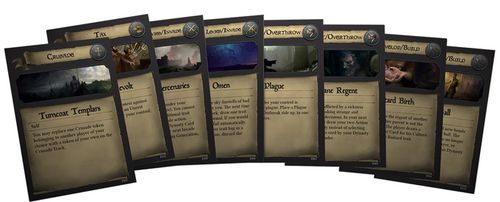
Image courtesy of BGG user nils_k Realm (Build/Develop)Build lets a player build a castle in a province, which not only improves the defence but also increases the tax value. Develop lets a player acquire a Councilor or an Invention, which gives certain benefits. One example is the Spymaster, who allows intriguing in any provinces, not only bordering ones. Intrigue (Plot/Overthrow)Plot can be used to manufacture a so called casus belli (a prerequisite to invade another player), cause unrest (a prerequisite to overthrow another player), murder a dynasty member (even your own), or bribe (steal a councilor). Overthrow can be used to cause an opponent lose control of a province. War (Raise Levies/Invade)Raise Levies mobilizes a province, something that is necessary to invade a bordering province but also costs gold in upkeep. Invade takes control of a bordering province, given that the prerequisites of casus belli and raise levies are fulfilled. The better defended the province is (through castles, pacts with other players etc.), the more difficult is the skill check. TaxTax simply earns you gold. The more provinces and castles, the more gold. The gold may be modified by certain events, such as Harvest, Crop Failure and Plague. CrusadeA successful crusade earns you a trait and a buff (a modifier for certain actions or events). An unsuccessful crusade on the other hand kills the crusader (which may or may not be what you want). The Victory PointsSo far, we've seen what you can and cannot do in the game but we haven't touched upon the key question of each game: how do you win? As we discussed, there are no victory conditions in the computer game, merely a rating. In the board game, the rating has simply been converted to the victory points we know well from many other games, and unlike the computer game, there are real opponents to compare ratings with to determine a winner. But to quote Reiner Knizia, "it is the goal that is important, not the winning". Do the victory points you earn in Crusader King reflect the fulfillment of your goal: a strong and prestigious dynasty? In the current rules, which again may be subject to change, victory points are awarded for many things: a province, 1 point, a pious trait token, 1 point, most crusaders, 1 point, and most gold, 1 point. However, all those points are awarded at the (fixed) end of the game, either after three generations or when all crusader spaces are occupied, so it doesn't matter how well you've been doing in the first generations if all other players gang up on you in the last generation. Given how few victory points there are in the game and how easy it is to track them, the game is very prone to kingmaking in the last round. Granted, this is often a problem when combining race games with "dudes on a map" games. In Diplomacy, the last man standing wins, in Civilization, the civililization accumulating the most victory points through the ages wins, in Kemet, the most powerful engine wins and so on. In those games, the victory condition is linked to how well the player performed. In Crusader Kings, it feels like all the players do some building and intriguing and fighting and then someone happens to win. But did really the best man win? Somehow it feels like reading a good book and then reach an end chapter that has nothing to do with the story told in the book. So what is the story told by the game? The Story-TellingA board game experience is not limited to a single session but also includes the memories created by the game. I still remember great stabs from old Diplomacy games, even against myself, or unexpected turning points in Civilization, where nations threatened by extinction rose again. Then there are games which try to tell a story but where you merely get annoyed by the flavor text and skim through it to the actual game decision. The crossroad cards of Dead of Winter and Scythe are examples of how games try to impose their own stories upon the players instead of letting the players create their own stories. In this respect, Crusader Kings does better. The players may sometimes be forced into the chapters of the game but within each chapter, they are more free to act, and all the actions and events make sense thematically. An attempted murder on a regent will never be met by a simple shrug, an unjust war will be remembered by generations to follow and so on. The competitive gamer may not always feel in control of his or her dynasty but the narrative gamer will definitely have feelings for his or her dynasty. I only wish that there was more congruence between the story and the end. So what's in the Mind of a Crusader King?How you approach a game of Crusader Kings probably depends on what kind of gamer you are. If you judge the game by its decisions and challenges. Questions like "Should I aim for this green token, that will always be good, or this red token, that will be extra good but only in some cases?" or "Should I tax to earn 5 gold or build a castle first so that I can tax and earn 6 gold" are not very interesting. If you judge the game by its table talk, you will struggle with questions such as "Can I really trust my neighbor?" or "How can I turn those allies against each other?" However, given how transparent victory points are, I fear that table talks will aim at identifying the player currently closest to victory. On the other hand, if you're less competitive and more into weaving an interesting story, you may simply be asking yourself which action would cause the greatest upheaval and rejoice at the surprised and upset reactions you get. And Who is Fit to be a Crusader King?Let's try to summarize Crusader Kings. Overall, it's a game true to its roots. The board game captures the core of the computer game with its simplified yet powerful trait development and there are plenty of actions to influence the power balance of Medieval Europe while still keeping the game simple and relatively short. Fans of the computer game will definitely recognize their game in this form, whether they prefer playing against human opponents or against the automa opponents planned for the board game (but not completed when this review was written). "Ameritrash" gamers who enjoy other dude on the map games based on a strong story, such as Game of Thrones, may also find Crusader Kings to their liking. In Crusader Kings, they may combine traits and actions to mitigate risks before striking. The base game can also be expanded easily to allow new scenarios with variation to setup and gameplay. "Eurogamers" on the other hand may shun the random trait draws, the strong take that elements and the limited possibilities to build something enduring. A game about wars and crusades may never appeal to them anyway but personally I had preferred more options for adapting my dynasty to the conditions and vice versa, a bit like the "war game disguised as a euro" Dominant Species. So will Crusader King be a hit or a miss? Well, with the current 500% funding the answer is already given. The strong IP of the computer game and the miniatures that so many KS backers love are not the only explanation for the success. Crusader Kings is also well timed given how popular story-telling games and expandable games are at the moment. I don't think it will become a Spiel des Jahres nominee but will it reach the Boardgamegeek top 100? My guess is yes. 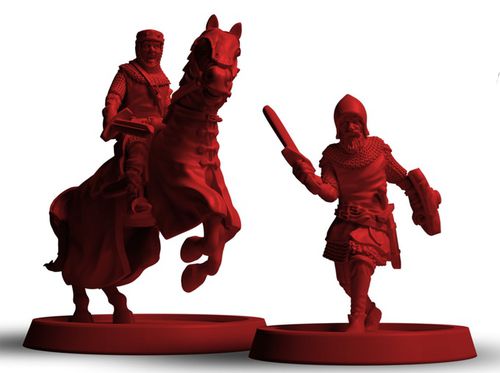
Image courtesy of BGG user nils_k |
|