
 |
The Quest for the Perfect Game - Reviews to Extract the Essence of Games by Nicholas Hjelmberg | |












|
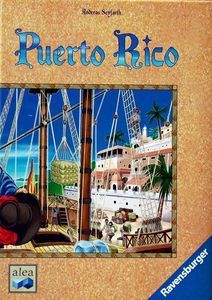
Puerto Rico - Revisiting Another Favorite Island of the Past (Published 27 August 2018)This review has also been published at Boardgamegeek. IntroductionIn Catan - Revisiting a Favorite Island of the Past, I reflected upon my first stumbling steps into the world of modern board games. Catan had showed me many of the qualities of the modern board games and left most of the old boardgames behind. But as quickly as it had come, Catan was gone, surpassed by a new and even brighter star at our game table: Puerto Rico. At first sight, Puerto Rico's core gameplay was similar to that of Catan (and, as I eventually would discover, to that of many other euro games). You produce resources and invest them in infrastructure to produce even more resources and in the end the richest player wins. However, Puerto Rico has many distinguishing characteristics that stood out then and stand out even today. Those will be the focus of this review. The Characteristics of Puerto RicoSo much to do, so little timeIn games like Catan, the gameplay is fairly straight-forward. The return on your investment comes automatically and "all" you have to decide is what to invest in. Puerto Rico on the other hand gives away nothing for free. If you want something, you have to use an action for it.
Assume that you want the resource sugar. You need to take the Settler action to place a sugar plantation, the Prospector action to get money, the Builder action to buy a sugar mill, the Mayor action to place workers on the plantation and the sugar mill, the Craftsman action to produce the sugar, and finally the Trader action or the Captain action depending on if you want to sell the sugar for money or ship the sugar for victory points. (Fortunately you don't have to take all the actions yourself, more about that later.) Each action is simple enough but together they add a challenge of planning and timing. You need to take the right action in the right time to get your economy started. The constant feeling is that you want to do everything at the same time, preferrably in your previous turn. But unlike many later games, Puerto Rico never turns into a complex puzzle of actions to accomplish a result. If you look at another "island plantation game" like Madeira, you have to choose dice at the beginning of the round, place them on actions (depending on characters rotating between islands), take a primary action immedieately (depending on if you have fulfilled the necessary preconditions), and pay to take a secondary action at the end of the round (depending on the dice placed on the characters by the other players). Both games offer interesting decisions but in my opinion, Puerto Rico keeps them simple without sacrificing depth. 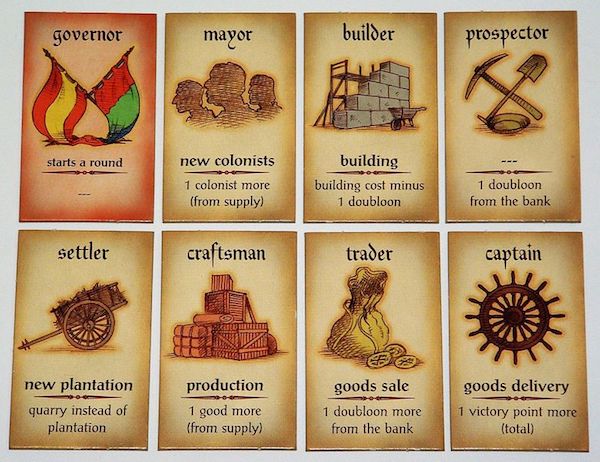
Image courtesy of BGG user EndersGame. So many nice and shining gearsIf Puerto Rico had only been a game of placing a plantation and producing on it, it would quickly have been repetitive and dull. But Puerto Rico introduced me to the concept of engine building, which today is very common and popular. The actions remain the same throughout the game but you have the ability to improve them throughout the game, adding both variability and a sense of progress. Some examples: 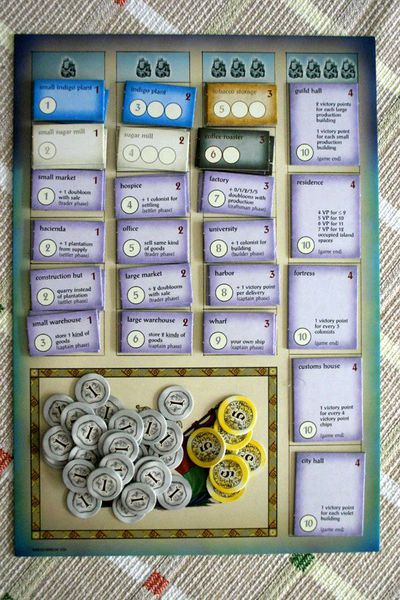
Image courtesy of BGG user Urtur.
The engine building of Puerto Rico gives you the flexibility to choose your own strategy and take the necessary actions to improve it and capitalize on it. Do you want to buy many buildings? Then you may acquire a quarry or two (which give you a discount when buying buildings), a coffee plantation (which lets you produce the most valuable resource) and an office (which lets you sell coffee, even if coffee has already been sold). Puerto Rico also avoids the many pitfalls found in later games. The "engine gears" are relatively few and can be taught to the players prior to the start of the game, unlike games which boast about hundreds of unique cards and which require knowledge of all of them to play well. Each gear provides small benefits that slowly support your strategy rather than creating crazy combinations that suddenly decide the game. Most importantly, resources remain scarce throughout the game as the increased productivity is quickly consumed by more expensive buildings, thus avoiding the inflation of many other games, where the resource piles grow absurdly large. To switch or not to switch gearPuerto Rico also introduced me to the concept of switching between resources and victory points. Many games encourage the players to play in a certain way throughout the game and the winner is the player who best did this. In Puerto Rico, however, your beautiful colony of plantations and buildings won't win you the game unless you have managed to convert them into victory points. But when should you stop focusing on infrastructure and start focusing on victory points? The answer is: it depends. Puerto Rico does not have a fixed number of rounds but can end in several different ways. A player board full of buildings, an exhausted pool of workers and an exhausted pool of victory points are all end game conditions and all of them are determined by the players themselves. To win Puerto Rico, you must not only build a good plantation but also read the game state to know when to switch focus. 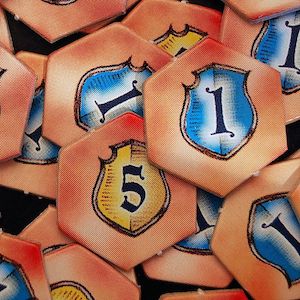
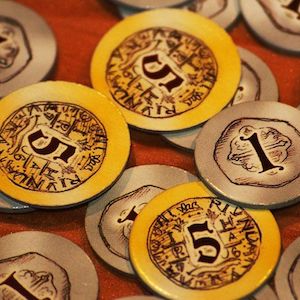
Image courtesy of BGG users tomfisher and Geosmores. The free-ridersIf you're familiar with Puerto Rico, you may wonder why I haven't mentioned its most distinguishing feature yet: the collective role selections. In your turn, you don't take an action but rather select a role. Then EVERY player gets to take the action associated with that role (although you do get a small privilege for selecting the role). The only exception is the Prospector role, where you alone takes the action of getting money. This small rule has a profound impact on the gameplay. First, you don't have to choose all the roles you need yourself. If you need money for a building, there is a chance that someone else has chosen a role that has given you money by the time it's your turn again. Second, the timing will be more challenging. A role may not be available when you want to select it. A role may be selected by another player when you don't have the means to use it yet. Or, perhaps even worse, an opponent will benefit more than yoy by a role. Third, your engine will "pay off" between turns depending on the other players' role selections. This means that your strategy must take into account the other players' strategies or else your powerful engine will idle most of the game. Interestingly enough, this feature isn't that common in today's boardgames. Some games allow opponents to follow part of your actions, either by paying something or for free, but few games let roles rotate like in Puerto Rico. 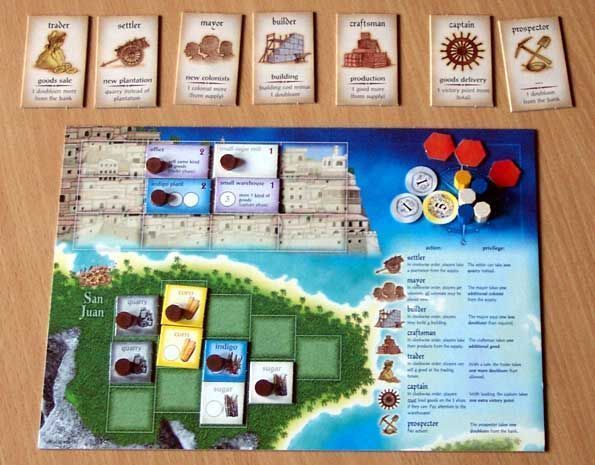
Image courtesy of BGG user BGG Admin. The few seatsDoes Puerto Rico sound like a fairly friendly game, where everybody gets to join in the actions? Forget it! Everything is limited on this island. Each role may only be selected once per round so if another player selects a role "too early", you'll have to wait until all players have selected their roles before it gets available again. The offered plantations are randomly drawn so that coffee plantation you wanted for your coffee roaster may not be available when the turn comes to you. There are less of each building than the number of players so you may never get any coffee roaster at all. The trading house, where you exchange resources for money, only accepts one resource of each kind so if another player sold coffee first, you'll have to wait until it's full and reset until you may sell your coffee (unless, of course, that other player beats you again). The ships, where you exchange resources for victory points, are also picky about the resources they accept. Once a ship has a kind of resource, it accepts only that resource until and once a ship is full, it accepts no more resources that round. The ships are actually even more evil. If the Captain role is selected, you MUST ship if you can and you MUST discard the resources you can't ship except one (unless you've built warehouses). All this makes timing crucial in Puerto Rico. Your strategy to ship corn (the cheapest resource, which requires no building) may be ruined if the player before you keeps filling the ships with corn before you. Your strategy to sell coffee (the most expensive resource, which requires an expensive building) may be ruined if the player before you keeps filling the trading house with coffee before you. Most euro games are friendly in the sense that there is always something good to do. In Puerto Rico, you're always too late. 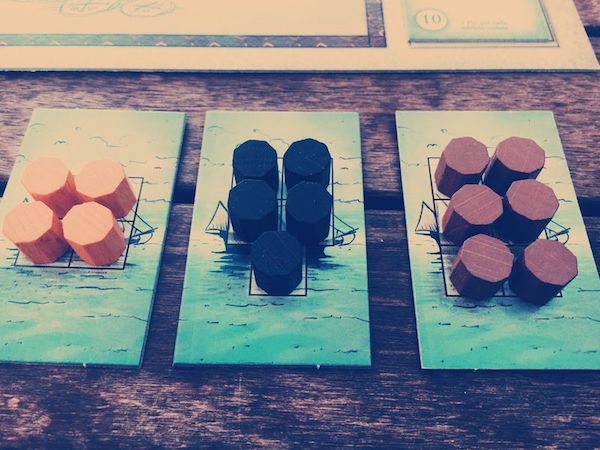
Image courtesy of BGG user sanchz. The "bugs/features" of Puerto RicoSo far, the review has highlighted the many positive aspects of Puerto Rico. Yet, something kept nagging me and it took some time to realize what it was. When I was introduced to Puerto Rico, the owner sold it to me by emphasizing the importance of predicting the other players' roles and set up yourself to benefit the most from them. In theory it sounded good but it misses some important bug/features of Puerto Rico's role selection. Choosing actionsOne bug/feature is the giving up of control. In a game of four players, only one quarter of your actions will be chosen by yourself. The remaining actions will be chosen by the other players and you'll have to make the best out of them. This has an important impact on your strategic decisions. In many games, you benefit from choosing a unique strategy. However, doing so in Puerto Rico means that you have to choose most of your actions yourself. One example is a game where you go for the "building strategy", using the Trader and Builder roles frequently, while the other players go for the "shipping strategy", using the Craftsman and Captain roles frequently. The "shipping actions" will then be selected more often than the "building actions". Value of actionsAnother bug/feature concerns the value of your action. In a game with individual actions, your optimal action is usually the action that benefits you the most in absolute values. However, in a game with "collective" actions, your optimal action is usually the action that benefits you the most in relation to the other players. This has an important impact on your tactical decisions. In many games, there is no difference between the two actions. An action that gives you two resources will always be better than an action that gives you one resource, since none of the opponents will get anything. In Puerto Rico, however, it may be better to take an action which gives you one resource compared to an action which gives you two resources and an opponent three resources. So are those characteristics bugs or features? In my opinion, it depends on the group. One game - two perspectivesLooking back at my first experience of Puerto Rico, the game often left me frustrated. The fact that I always lost contributed, I can't deny that, but I felt that Puerto Rico suffered from both alpha player problems and runaway leader problems. The alpha players would insist on the "optimal" roles for the other players and once the strategic direction was set, the roles chosen would snowball them to victory. Later, I started choosing "suboptimal roles" to annoy the alpha players. This became a fun meta game but although this strategy did win me some games, it still left me dissatisfied. But eventually I began to understand Puerto Rico and appreciate its deeper gameplay. I had to abandon my perception of Puerto Rico as a euro game of optimizing your own gameplay. Instead, I started to play it like an old-fashioned dude on a map game, carefully maneuvering around the other players and improving my relative position, until the time was ripe to reveal my true intentions. With a strong group, a game of Puerto Rico can turn into a very competitive and vicious game. But with a weak group, a game of Puerto Rico may become chaotic and even break down. One commonly perceived problem with Puerto Rico is the left/right binding, whereby a weak players' actions benefit the next player in turn. I've played that next player in turn and it sometimes felt like having two turns in a row. My comfortable victories (10+ victory points) gave me little satisfaction. Another commonly perceived problem is the idea of a dominant strategy. If the group thinks that one strategy always wins, they will pursue that strategy and attribute the victory to that strategy. Attempts by single players to pursue another strategy will likely fail since the other players inadvertently help each other, further supporting the idea of a dominant strategy. In the worst-case scenario, will turn Puerto Rico into a repetitive multi-player solitaire. 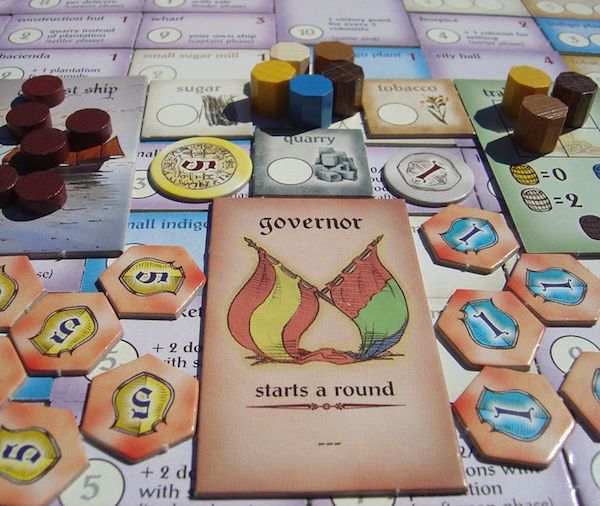
Image courtesy of BGG user OldestManOnMySpace. The ThemeI usually consider theme secondary to mechanics but it's hard to ignore it in Puerto Rico. The theme of allocating slaves to colony tasks is disturbing to say the least. (Calling the workers "colonists" doesn't help.) Once you start playing, they are reduced to wooden discs that let you execute game actions and you stop thinking about them, but why then base a game on slavery in the first place? The game creators would have saved themselves a lot of trouble by using a less controversial theme. I urge you to ignore the theme and let the game mechanics speak for themselves. 
Image courtesy of BGG user monikad. ConclusionSo is Puerto Rico a good game, because it rewards experience and repeated plays, or is it a bad game, because it can't accommodate weak players? I lean towards the former. I believe that a game must be judged by the player experience it provides but I also believe that a game should be allowed to be demanding. Thus, I do recommend Puerto Rico as the next game after gateway games, since it points out the direction to many deeper games. Whether it will continue to be played depends very much on your group but Puerto Rico is definitely a game that every boardgamer should have played. 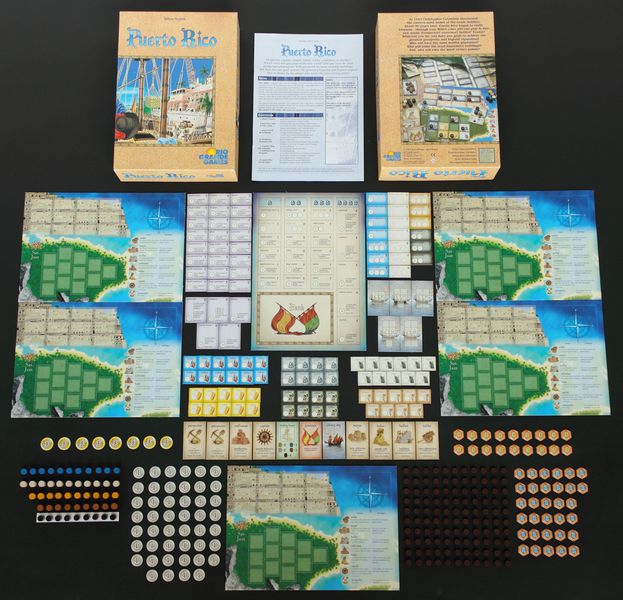
Image courtesy of BGG user FortyOne. |
|