
 |
The Quest for the Perfect Game - Reviews to Extract the Essence of Games by Nicholas Hjelmberg | |






























|
Sol: Last Days of a Star - A Challenge in Space and Time (Published 17 December 2018)This review has also been published at Boardgamegeek. IntroductionHow can you make a game where you acquire resources to build buildings to acquire more resources until it's time to switch to victory points different from the majority of eurogames out there? Today, the standard answer seems to be to add obstacles to be overcome. It's true that the definition of games as "the voluntary attempt to overcome unnecessary obstacles" was established already in 1978 by Suits in his book "The Grasshopper: Games, Life and Utopia". However, I wonder if the author had today's disjointed mini games that detract from the game objective in mind when he wrote it. How refreshing it is then to find a game like Sol: Last Days of a Star that actually manages to combine known mechanics into a coherent whole that is greater than the sum of its parts. Let's see how the designers did it. The Game around the SunThe basic idea of Sol: Last Days of a Star is that you have to transmit energy from the Sun to gain momentum to escape its pending death. Translated into game mechanics, you send out sundivers to convert into or activate four types of structures:
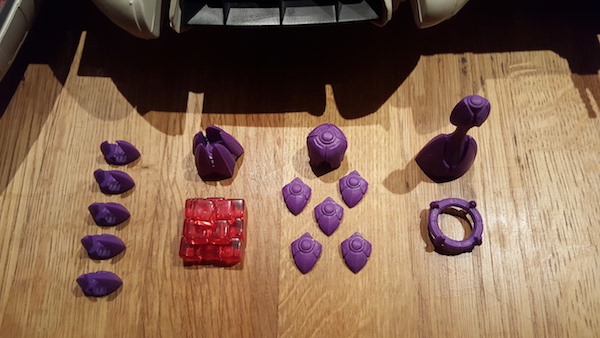
From left to right: Solar gates, energy node with energy cubes, sundiver foundry with sundivers, and transmit tower with the arch. To accomplish this, you choose one of three actions each turn:
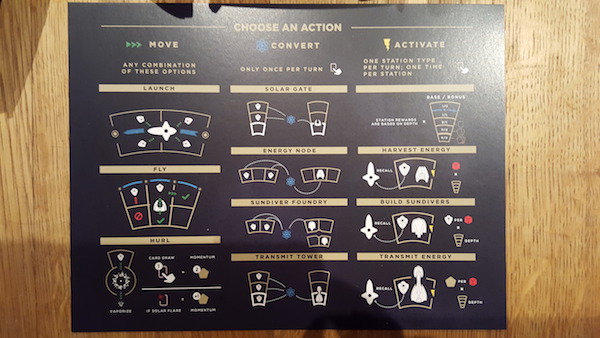
The player aide illustrating the actions. Note how certain actions require sundivers in certain patterns. The Novelties around the SunSo basically, you need to build an engine that produces enough energy/money and sundivers/workers to eventually switch to momentum/victory points production. Did I hear anyone yawn? Wait, here comes what makes Sol: Last Days of a Star different. Let's start with the mother of all ships: the Mother Ship. The Mother ShipThe Mother Ship is your starting point for all your new and returned sundivers. However, this ship does not have a fixed position but rather orbits around the sun, one space counterclockwise each round. This adds both a temporal and a spatial dimension to the game. When will your next sundivers arrive and where will your Mother Ship then be? Given this, when and where should you place your structures to reach and use them efficiently? Does this mean that your structures are useless when your Mother Ship is too far away? No, there is also the concept of shared structures 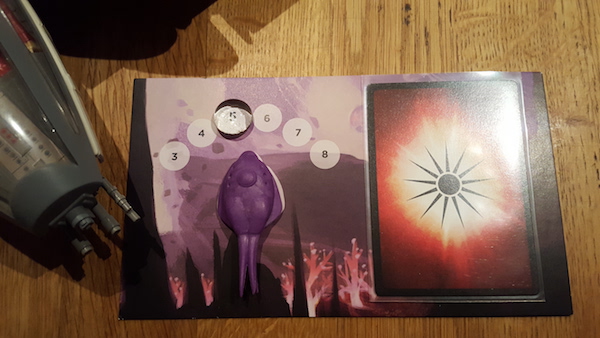
The player board with movement 5 and 1 available solar flare card available. The Shared StructuresIn spite of the fierce competition to escape the Sun, structures can be used by everybody. However, the owner gets a bonus if his or her structures are used by another player. For the solar gates, the owner simply gets 1 energy from the supply. For the other structures, the owner may take a bonus action (which is slightly worse than the base action but it's a free action not to be sneezed at). This adds a double-edged challenge to the game. Should you place structures that you know your opponents will need in the future to get as many bonuses as possible or should you do the opposite to hold them back? Another interesting aspect that if the owner declines the bonus action (beasue he or she cannot or does not want to take it), the activator may take it instead so knowing when and which shared structure to use can be very efficient. The SunAll structures are not equal. The closer to the Sun you build it, the more powerful it is. While a structure in the most outer layer returns only 1 energy/sundiver/momentum when activated, a structure in the most inner layer returns 5 in the base action and another 3 in the bonus action! This mechanic provides the familiar return on investment dilemma. Since you have to invest actions to move closer to the Sun, should you build many cheap but weak structures far away from the sun or few expensive but strong structures close to the Sun? The answer is partly given by the game: the more you spread your structure, the more movement you get. Unfortunately it does limit your strategic options (focusing only on outer or only on inner structures is likely to fail) but perhaps the designers wanted to ensure structures in all layers of the Sun? No mater what, there is another important consideration as well: The Death of the Sun 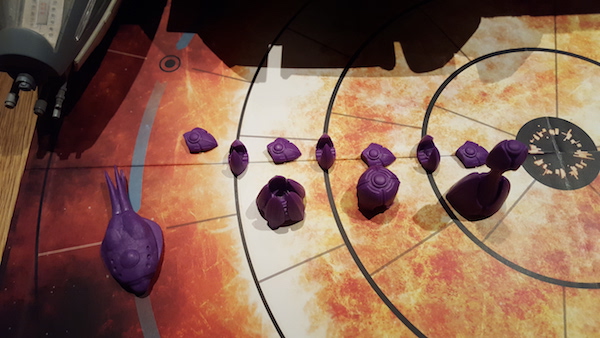
The five layers of the Sun. The Death of the SunThematically, the game ends when the Sun dies. However, the timing of this is in the hands of the players. Each time a structure is converted or activated, a number of instability cards are drawn (the closer to the Sun, the higher the number of cards). Shuffled among those cards are 13 solar flare cards that move the game clock forward. This means that those powerful actions close to the Sun do not only benefit you but it also brings the end closer for all players, leading to a frantic race towards the center before it's too late. In addition, this adds a push your luck element that affects your decision to switch from converting new structures to activating existing structures. Does this make the game too random, e.g. will the player who is lucky enough to both convert and activate structures closest to the Sun win? Not really, the end of game can be fairly well predicted and there is one more rule that lets you use those sundivers that arrived too late to the Sun to convert to a useful structure: you can hurl them into the Sun to gain momentum AND draw instability cards to trigger the game end. Selfish? Maybe. Powerful? Indeed! Is this enough to make Sol: Last Days of a Star stand out? Personally I think so but there is one more thing that adds to the game experience: the Instability Cards. 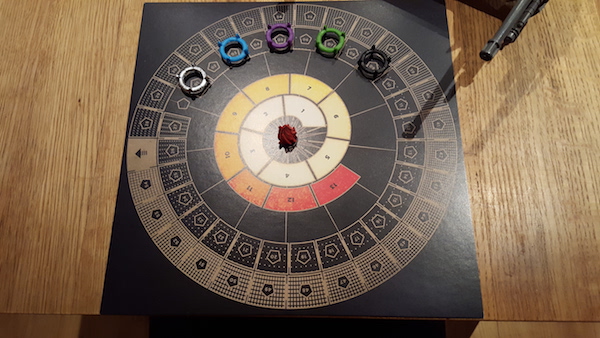
The momentum track and the time track. The Instability CardsWe talked earlier about how solar flare cards moves the game clock towards the end. However, the solar flare is only one of several suits (1+1 per player in the game) and each suit is linked to a special effect card. The effect cards range from simple (blue and green) to complex (yellow) and attack/negative (red) and it's up to you to decide which to use in the game. Personally, I think the game could have managed without them, similar to how the power cards (added against the designer Knizia's wish) in The Tower of Babel detracts from rather than adds to an elegant game, but I can also see that many players appreciate the variability and unpredictability that such cards provide. Fortunately, the cards don't make or break your game, since you may not keep more than one card and not use it until your next turn. This also means that you shouldn't except crazy card combinations, something that some players may appreciate while others may regret it. However, fans of random cards also have the Trigger Card variant at their disposal. 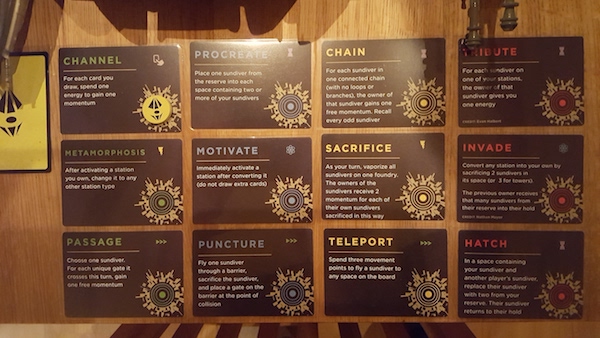
Green, blue, yellow and red instability cards. The Trigger CardsThe trigger cards are also shuffled into the instability card deck and trigger certain events when drawn. Those events may be either positive (e.g. Warp allows a free movement of a sundiver) or negative (e.g. Explode pushes all sundivers one layer away from the Sun). You will know the upcoming event but not when it takes place so they aren't completely random. 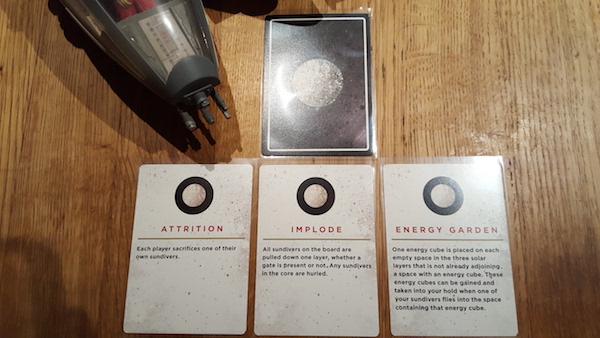
Events affecting all players. The Mythos around the SunThere is one more thing in Sol: Last of a Dying Star that tells the game apart: The Mythos. A number of short stories tell about the fate of the Sun from the perspective of the five different races of the game. This is a proof of the designers' love of the theme but it doesn't add anything to the game. Mechanically, there are no differences between the races - they have the same means and the same ends and differ only when it comes to colors and components. The theme of escaping a dying star does shine through in the game, the theme of an alien race with unique abilities and goals does not. So how to escape the Dying Star?The short answer is that although you must escape alone, you cannot prepare your escape alone. You need to consider both the resources you need and the time you have, needs that reveal themselves only gradually as the players take their actions. You will need some structures to increase your movement but which ones and when? Sundiver foundries may be needed in the opening game to get "workers", energy nodes in the middle game to get "money" for your actions, and Transmit towers in the end game to get "victory points". If there are too few at any time you'll benefit twice from building them, first from using them yourself and then from "charging" your opponents for using them. But to build them at the right place and the right time, you need to plan forward and take into account the orbiting mother ships and the placements of the solar gates. Finally you need to be prepared for the final push when you sacrifice your last resources by hurling your sundivers into the Sun to end the game in your favor. It's this temporal and spatial challenge that is the core of Sol: Last of a Dying Star. 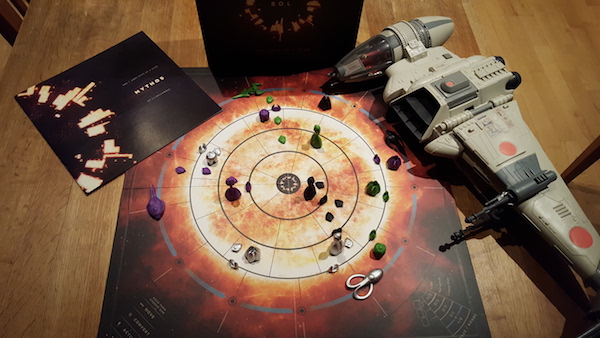
A typical mid-game with structures scattered around the Sun. |
|