 |
Home | Game | Rules | Theme | Strategy | FAQ |  |












































|
Annotated Games: 4 PlayersThis game was played during the game testing of Peoples. The tribes are denoted with colored circles; filled in the regions they stand in and hollow in the regions they moved from. The table shows which subjects and allies each player has in each age as well as the settlements and their advances each age. For teting purposes, each player employed a specific strategy:
Age 1, Round 1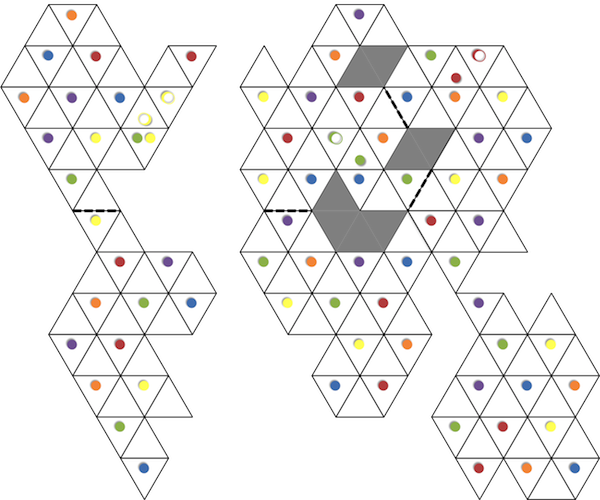
The players follow their strategies initially. Player 1 identifies the areas where the orange, green and red tribes are close to each other and groups them, starting with the ones in Northern Asia. Player 2 focuses on grouping the green tribes, starting with the ones in Europe/Asia. Player 3 sees a good opportunity to group yellow and blue tribes in North America but player 4 takes the opportunity to move the just moved yellow tribe one step closer to a yellow tribe instead. Age 1, Round 2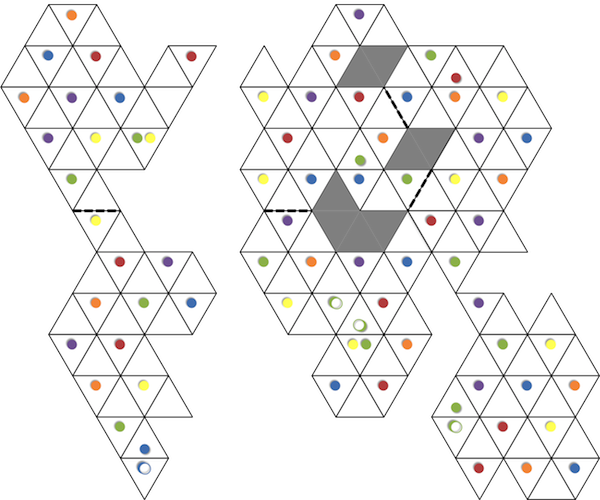
The players continue to follow their strategies. Player 1 groups orange, green and red tribes in Africa while player 2 move green tokens in Oceania closer to each other. Player 3 moves the distant blue tribe in South America closer to the center and player 4 concludes the round by thwarting player 1's plans by moving the green tribe to the yellow tribe instead. Age 1, Round 3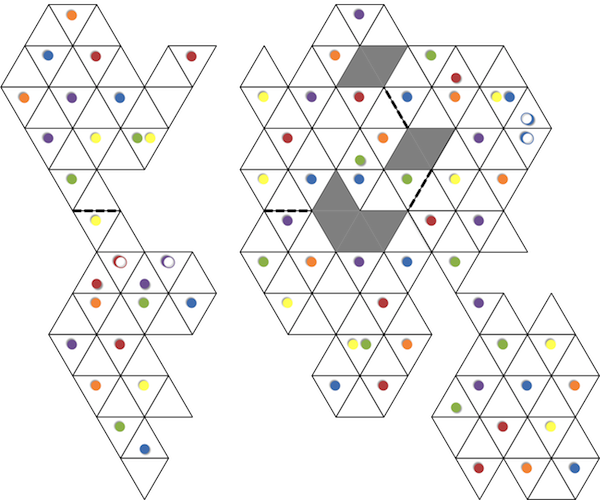
Player 1 and 2 focus on South America while player 3 and 4 focus on Asia. By moving a newly moved tribe, they not only thwart opponent plans but also gain a tempo for their own plans. Age 1, Round 4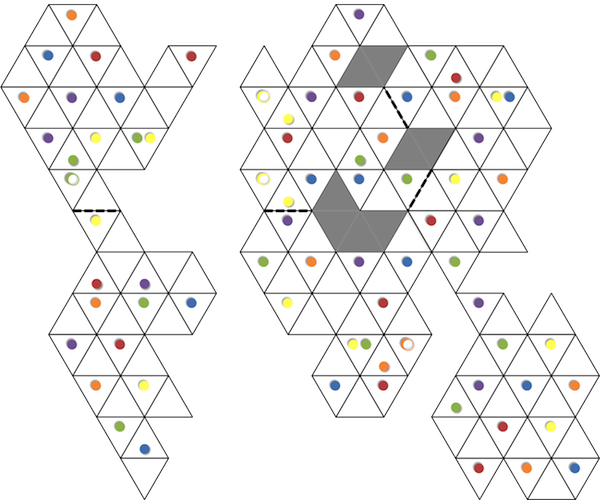
One additional advantage with player 1's long-term strategy is that her colors remain difficult to guess for the other players. Player 2, 3 and 4 play on the other hand have moved their own colors the most so far. Age 1, Round 5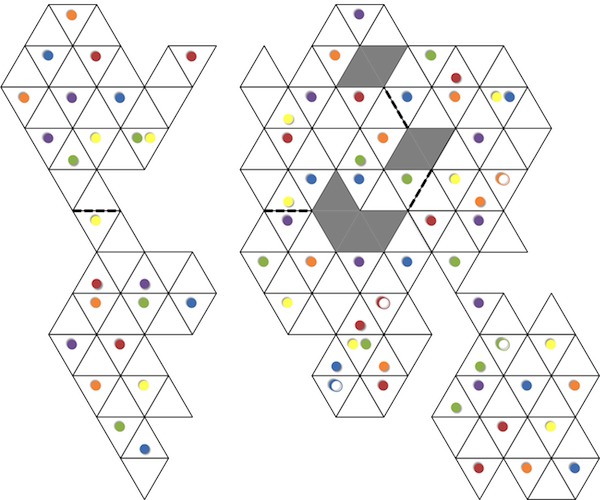
The initial movements are done and the scramble for the first settlements has begun. All players' colors compete for it in Africa. Age 1, Round 6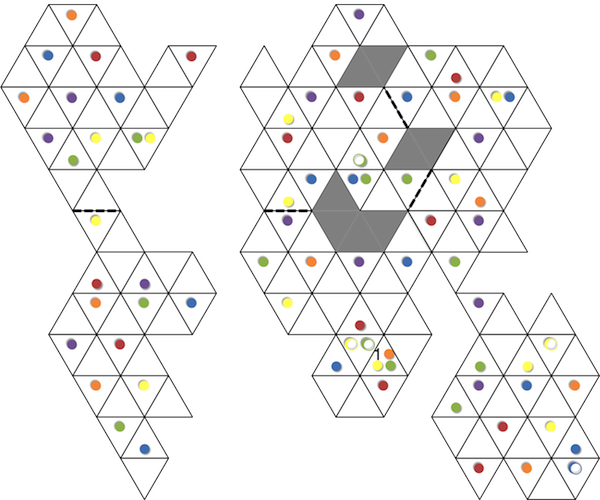
The first settlement is formed. Player 1 manages to group orange with the supporting color of green and yellow (although she'd have preferred red as the third color). The other players hurry to find other tribes to group instead. Age 1, Round 7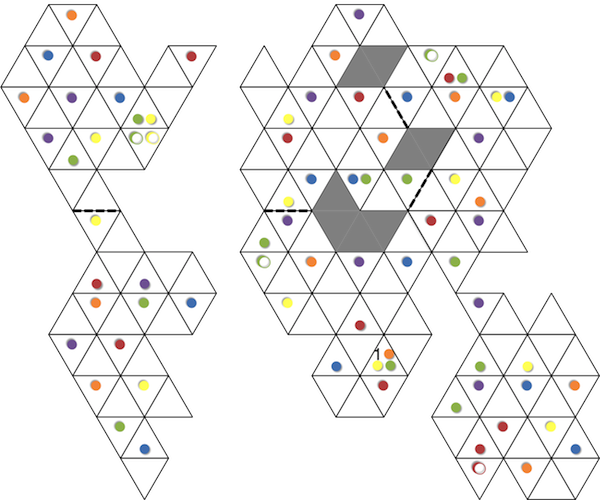
Player 1 rushes to form a second settlement continue grouping their tribes. Age 1, Round 8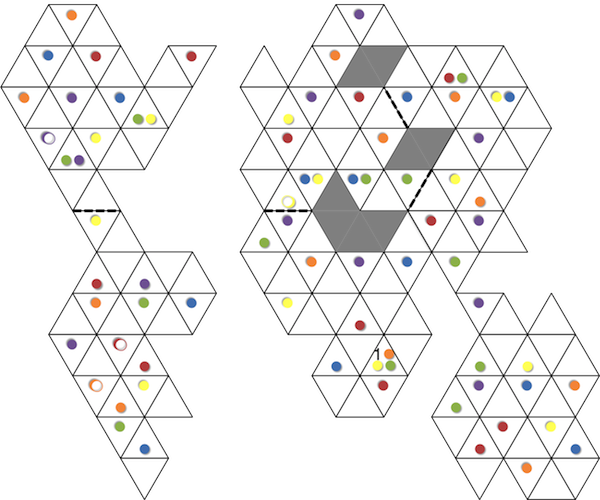
Having secured a second settlement in Asia, player 1 looks for opportunities in South America but is challenged by player 4. Player 2 and 3 consolidate their tribes in North America and Europe. Age 1, Round 9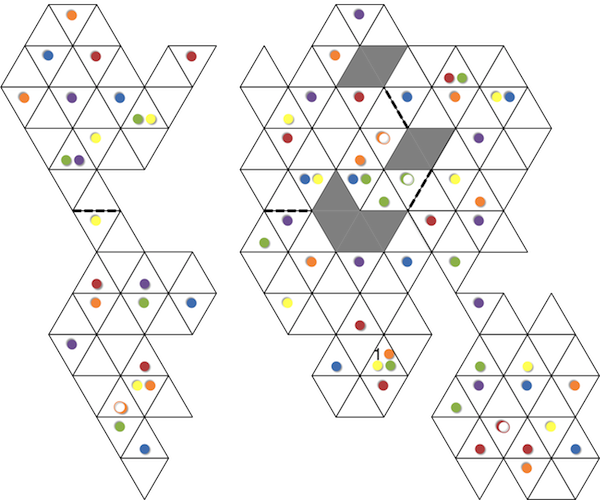
The struggle is intensified as player 1 spots an opportunity to grab a settlement in Europe. Player 2 tries to respond but is too late. Player 3 makes a vain attempt to prevent yet another orange/green settlement but isn't likely to get the blue and yellow tribes in South America together. Player 4 moves her attention to Oceania. Age 1, Round 10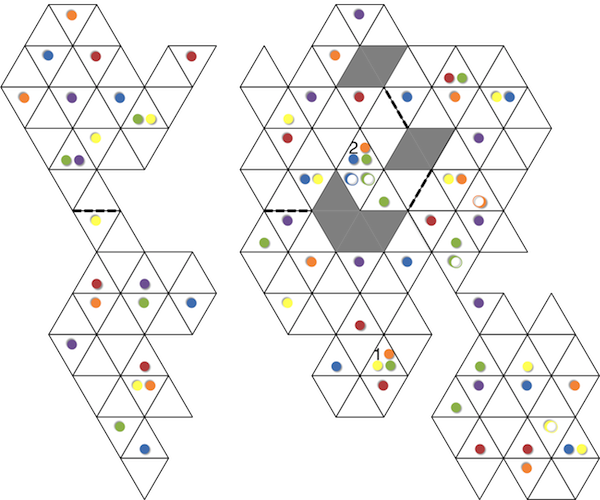
Player 1 completes her second settlement in Europe and once more, the other players must look elsewhere. However, many green/purple and blue/yellow tribes have or will meet so the distance is smaller than it may look like. Age 1, Round 11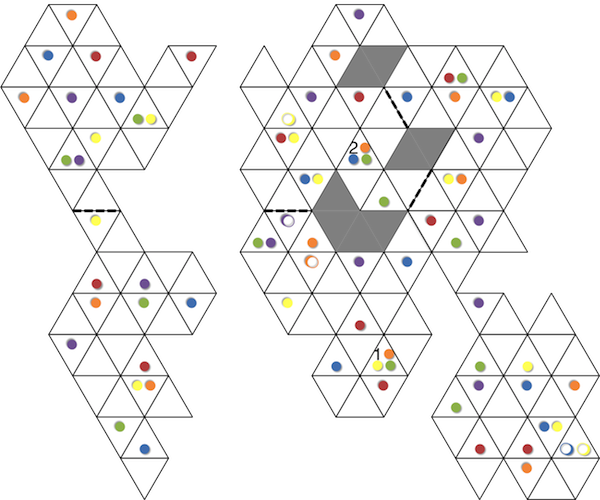
The fight for settlements move to Europe/Africa, where player 1, 2 and 4 compete. Meanwhile, player 3 has paired up many blue and yellow tribes and now move to include them in settlements. Age 1, Round 12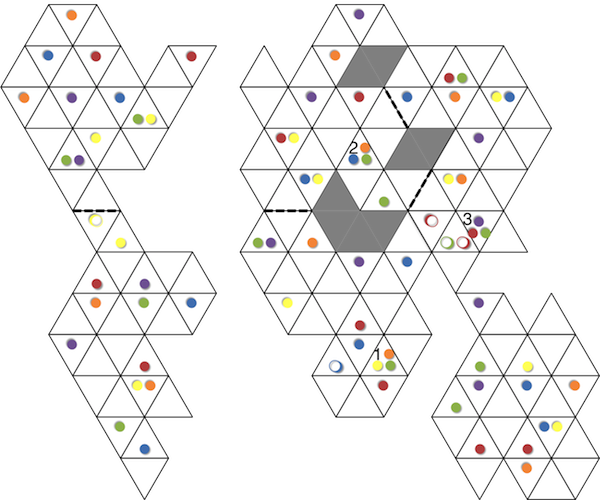
A third settlement is formed as player 2 claims the first cultural village. Player 1 could have completed a settlement in Asia before her but thinks there are better long-term advances than Culture. Player 3 and 4 still have no settlements but keep moving their tribes to good positions. Age 1, Round 13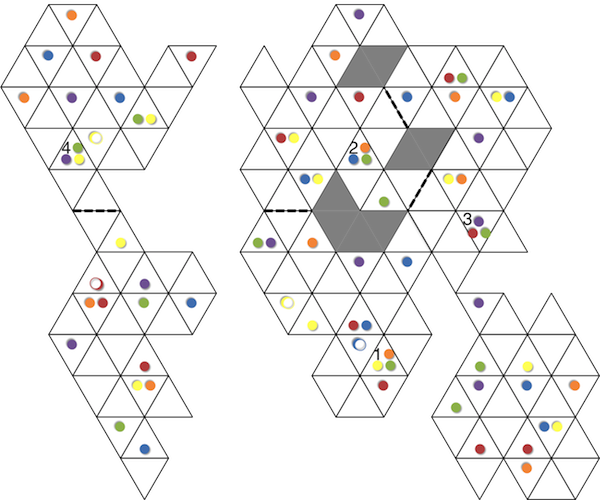
...and player 2 claims the fourth settlement as well. This is in line with her strategy to maximize the settlement score - her cultural villages are worth 3 points each this age. Eight settlements remain to be formed and the rush not to be left out has started. Age 1, Round 14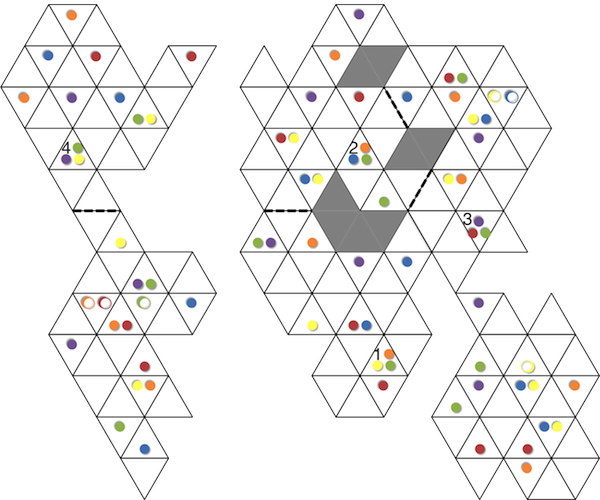
A chicken race takes place in South America as player 1's pair of orange and red and player 2's pair of purple and green both want to be the one forming the settlement (and hence choosing which color to be left out). Player 3 and player 4 keep consolidating their tribes. Age 1, Round 15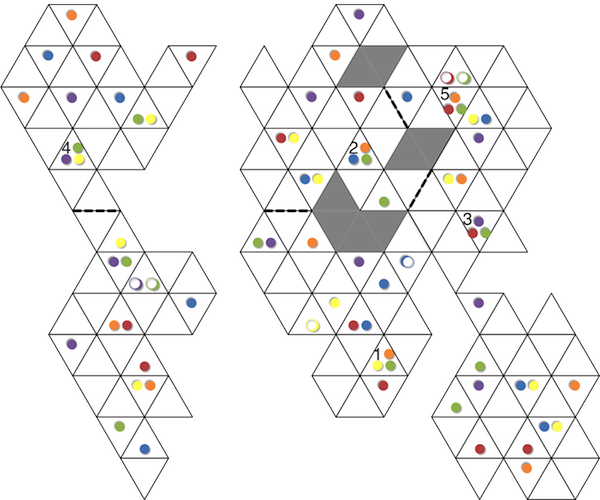
Player 1 is forced to complete her settlement in Asia, giving away the settlement in South America to player 2. Player 3 and 4 start competing for the second settlement in Africa. Age 1, Round 16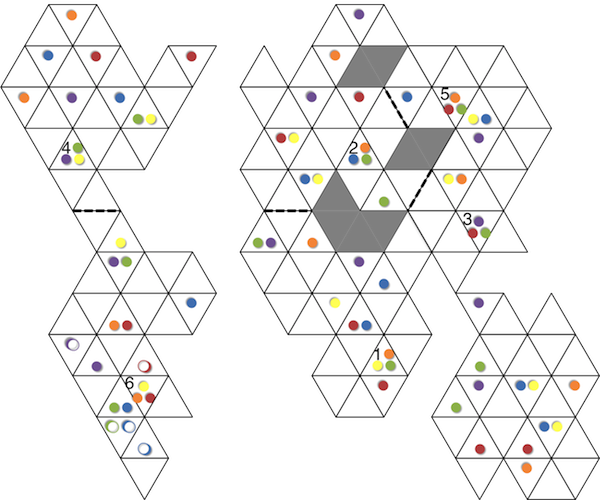
The scramble for South America ends with a victory for player 4, who manages to form her first settlement. Age 1, Round 17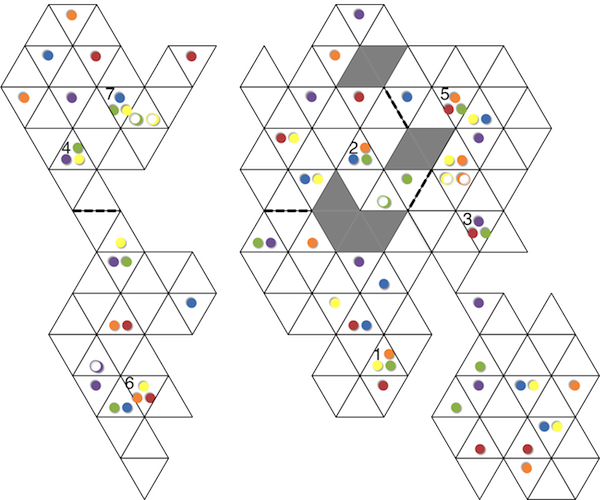
The rush for the final settlements has started. Player 1 makes an attempt to form a 4th settlement in Asia but player 4 has other plans for her yellow tribes there. Player 2 and 3 operate uninterrupted in America with player 3 getting her first settlement. Age 1, Round 18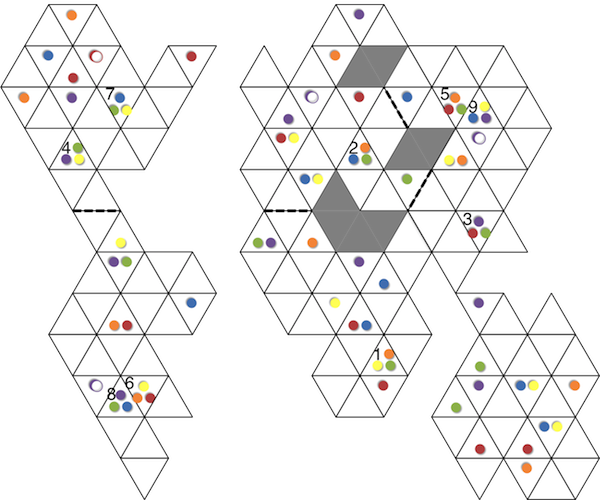
Player 1 has given up her hope of forming a fourth settlement and groups her second age tribes instead. Player 2 and player 3 continue to form settlement while player 4 is falling behind and desperately tries to find other opportunities in Europe. Age 1, Round 19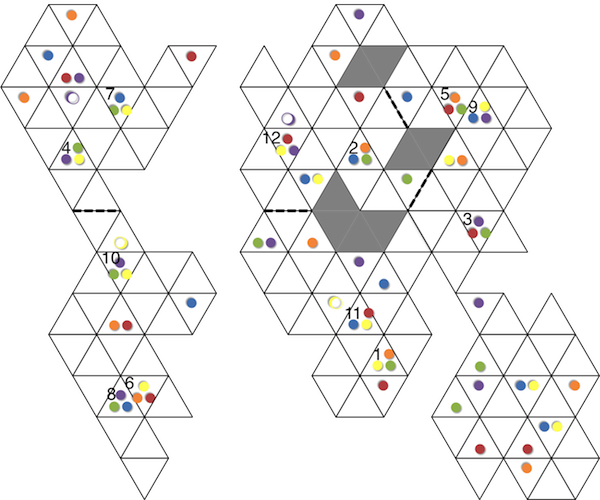
The first age ends with all players except player 1 forming settlements. Player 2 has the upper hand with 4 settlements formed, followed by player 1 and 3 with 3 each and player 4 with only 2. But the foreign relations and the scoring remains... Age 1, Civilization
When establishing relations, the players play tactically to maximize own and minimize others' points. The militaristic connect with stronger players, the religious connect with own peoples and the cultural connect with other people. Other players avoid helping them and connect with the only economic settlement (thus not adding to its points) or the civic settlements (add points to all tribes). The scientific settlements take advantage of this by connecting with them and increasing their points. Player 2 and 4 share the lead with 15 victory points each closely followed by player 3 with 14 points and player 1 with 13 points. However, player 1 has plenty of her next color red in the settlements so the next age will tell how well her long-term strategy works. When it comes to new advances, player 1 starts building an economic network, hoping to keep her settlements over the next ages. Player 2 does not expect to keep her settlements and gives them religion, which she thinks will earn little points, or civics, where she thinks she'll be able to get in her tribes. Player 3 chooses military for her settlements, hoping that stronger players will become the victim. Finally, player 4 "hedges" settlement 12 by combining religion (benefit from own color) with culture (benefit from other colors). 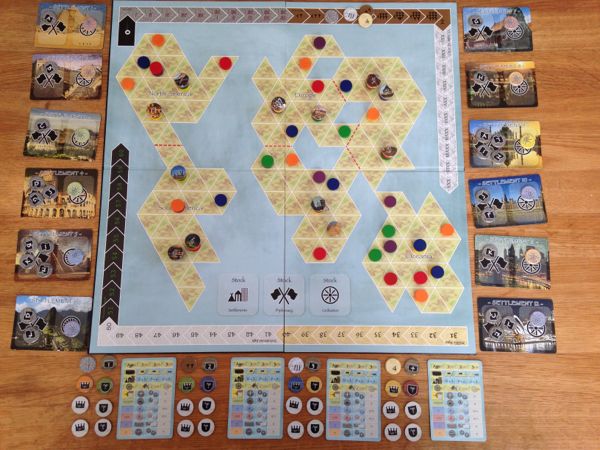
Age 2, Round 1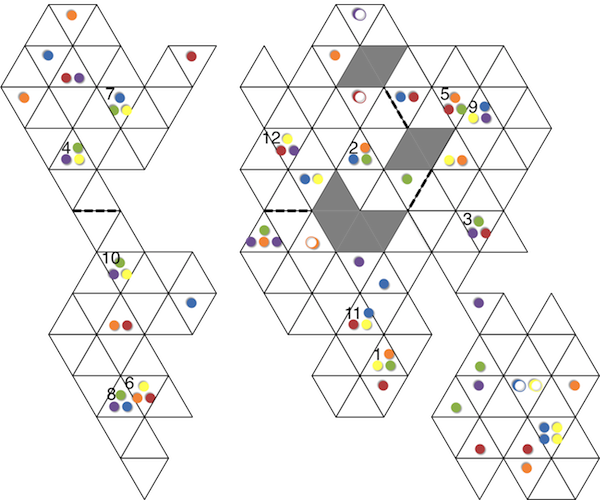
The new turn order in the second age places player 2 last. Note that none of the settlements have coast, making it more difficult for them to welcome new tribes. Will we see new settlements replacing the old ones? Player 1 starts by moving toward settlement 5 in Asia, a settlement she hopes will benefit from the economic network. Player starts grouping green and orange tribes in Africa but her plan is disturbed by player 4, who starts grouping purple tribes in the same region. Player 2 starts taking advantage of the blue and yellow tribes grouped since the first age. Age 2, Round 2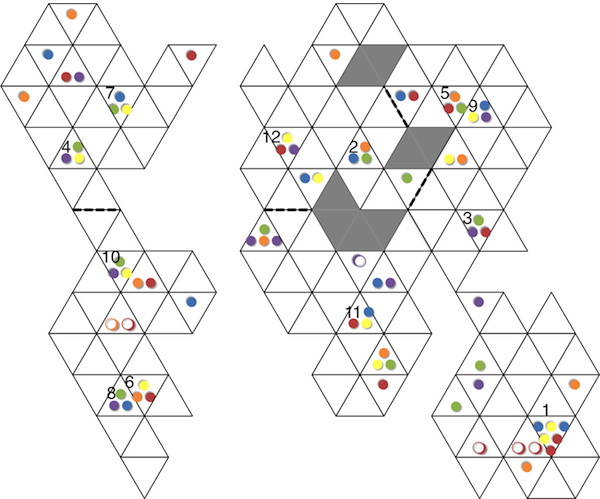
Player 1 doesn't expect to get any settlement in Oceania but can at least try to get two of her tribes into it. Player 3 turns her attention to South America and player 4 to Africa. Player 2, fearing that player 1 tries to claim the settlement in Oceania (which she can't but player 2 doesn't know this), hurries to complete the city. Since this is a new city, it takes over the settlement map and markers from the smallest village or, since all are equally slow, the one with the lowest number. Thus, village 1 ceases to exist. Age 2, Round 3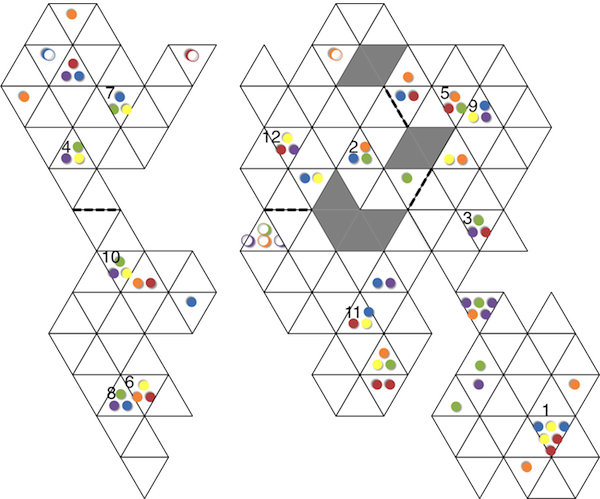
Player 1 creates another red pair in Africa. However, the real intention is to move the large group of tribes in Africa to it to form a city. This is noticed by player 4, who moves the group to the only coastal purple tribe in Oceania instead. Meanwhile, player 2 throws a tribe into the struggle for settlement 5 in Asia while player 2 looks towards North America for her next city. Age 2, Round 4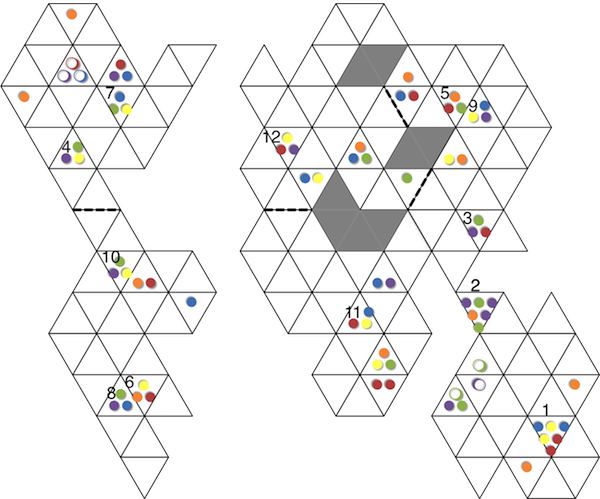
Player 1 moves the purple tribe in Oceania to a coastal region to be able to sail it later but player 3 has other plans for it and moves another green tribe to the same region. However, both their plans are thwarted by player 4, who moves the topmost green tribe and completes a city in Oceania. Player 4 attempts to group the blue and red tribes in North America. Age 2, Round 5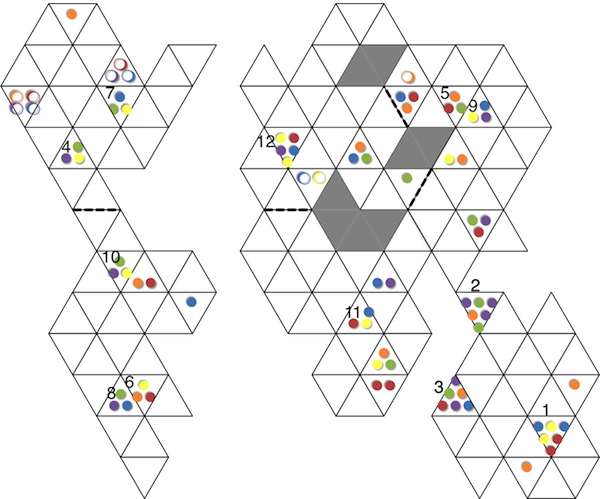
Player 1 doesn't want the red tribe to end up in a blue city and moves it to an orange tribe instead but player 4 moves it further to Oceania and completes yet another city there. Before that, player 2 takes the opportunity to add an orange tribe to the potential city in Asia. Player 2, correctly assuming that no player has yellow this age, starts grouping blue tribes in Europe. Curiously enough, Oceania had no settlements after the first age but now has three in the second age. The annotated game continues 22 June. Age 2, Round 6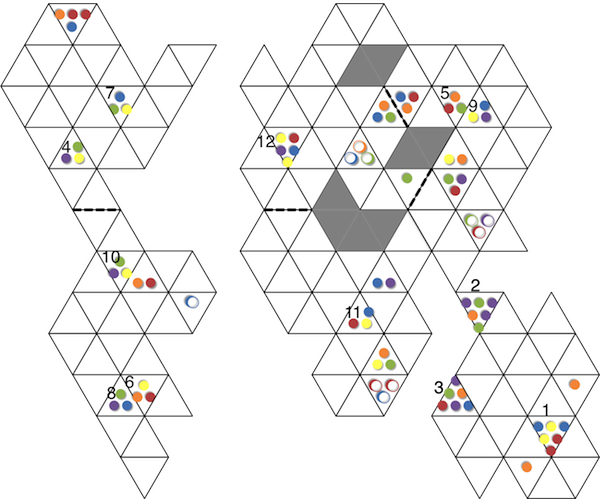
The scramble for the last cities has started. Player 1 adds a blue tribe to her red pair so that the entire group may form an African city next round but player 3 moves the entire group to the orange tribe in North America instead. Player 4 activates her purple tribe in Asia while player 2, derived of the blue tribe necessary to form a blue city in Europe 2, attempts to form a blue city along the border between Europe and Asia instead. The next round will see several new cities. Age 2, Round 7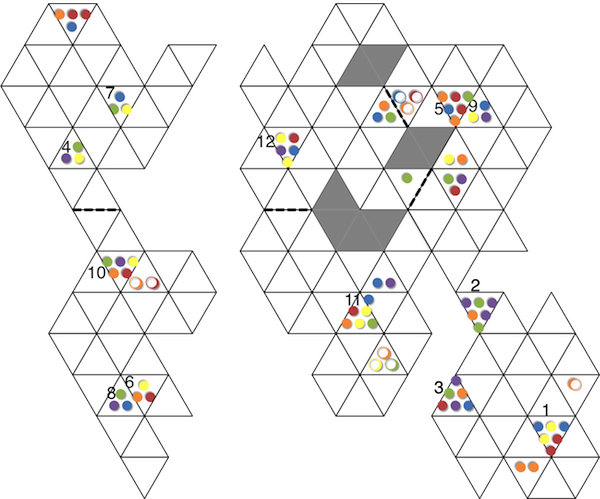
Player 1 has few good options as no red tribes are close enough to meet so she chooses to move what she can into other groups. Player 2 and 4 completes their cities in Asia and Africa respectively while player 3 groups her orange tribes in Oceania, aiming to join their friends in North America. Age 2, Round 8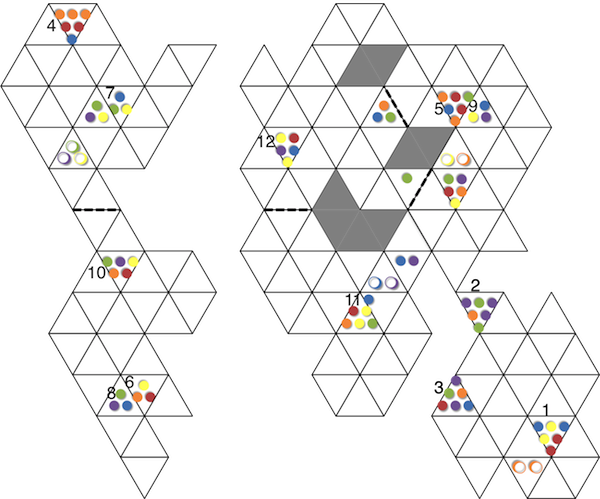
Player 1 makes a vain attempt to form a city in Asia, but that requires that nearby green tribes doesn't belong to another player (which, however, it does). The city in North America is lost to player 3 in spite of the two red tribes. This frees the tribes of the previous settlement 4 in North America so player 4 moves them towards settlement 7. Player 2 moves the remaining African tribe to a coastal region, from where they can move across the sea to another continent. Age 2, Round 9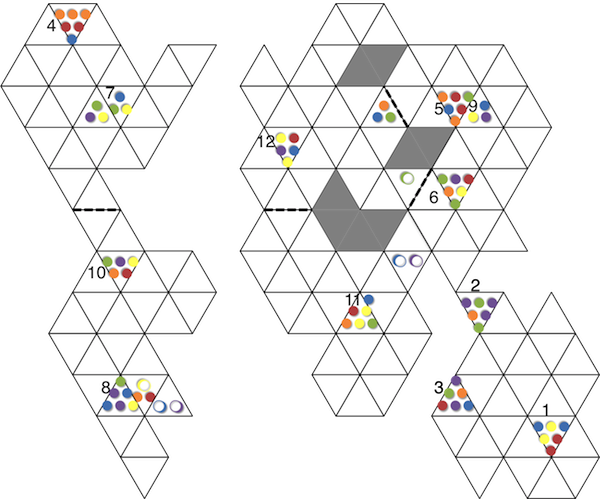
Player 1's last desperate attempt to bring red and purple tribes together in South America is thwarted by player 3, who brings them to her own settlement instead, and player 2 is forced to complete the city since she has no better moves. Meanwhile, player 3 completes her city in Asia. Age 2, Round 10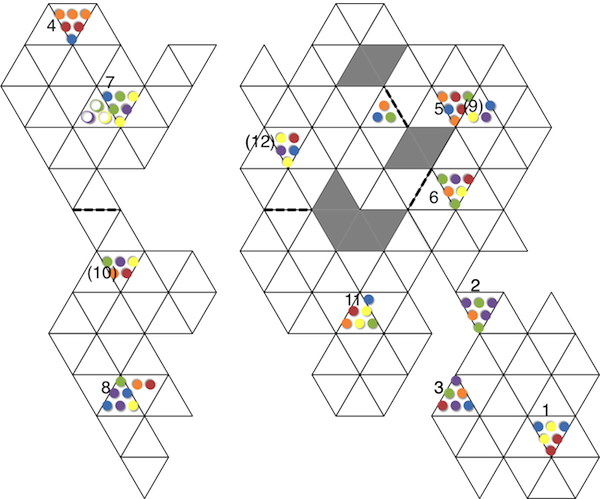
Player 1 gets the last move of the age but to no avail as she can only complete the 4th(!) city of player 4, leaving herself with no cities at all. Her long-term strategy to have villages with red tribes failed partly because the second age saw many new settlements with few red tribes and partly because the other players had more flexible tribes to move into them and beat red. All single orange tribes from the first age found new settlements in the second age under player 3's leadership while player 4 made efficient use of the purple and blue tribes that belonged to settlements in the first age that ceased to exist in the second age. Age 2, Civilization
With so few coastal cities, the connections and thus the available relations are limited. The players focus on relating their own cities first and valuable cities second. Settlement 2 (player 4) attracts both economic and scientific settlements and scores impressively 10 points. Even better is settlement 11 (player 2), where the connection with many multi-connected cities yield 8 scientific points and another 3 military points. Note that player 4 has the most cities (4) but the least tribes in them (9), which is a tribute to the efficient use of tribes. Not surprisingly, player 4 takes the lead with 43 points but in spite of only 2 cities, player 2 is not far behind with 39 points. Player 3 with 31 points may still have a chance while only a miracle can help player 1 with 21 points. In the civilization phase, the players choose which cities to abandon and which to fight for and choose advances accordingly. Thus, player 2 gives settlement 1 (no orange tribes, only one relation) culture whereas the settlement 11 gets a second science to really maximize its score. Player 3 has many red tribes and relations in her cities and put science in all of them. Player 4 is less optimistic about her green tribes and goes for civics in settlement 2 (giving her a share of the city yield) and culture in settlement 3 (giving a new owner less points given the few relations). Settlement 7 may be claimed but is weak and only slightly improved by economy while settlement 8 gets military to discourage other players from connecting to it and giving science points to the new owner. Note that player 1's yellow tribes have a good presence in some promising cities and may if not win so at least thwart many opponent plans. Age 3 may now begin. 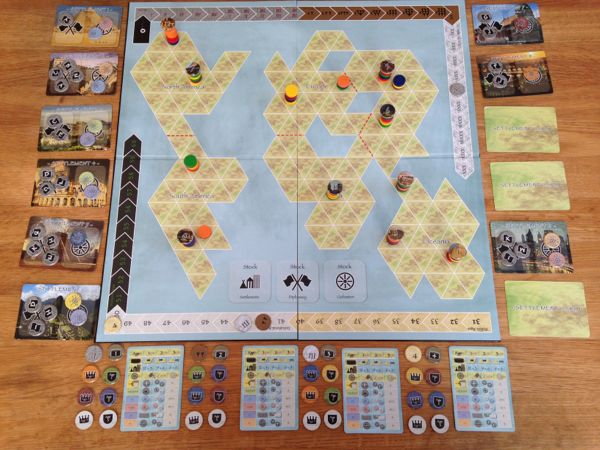
Age 3, Round 1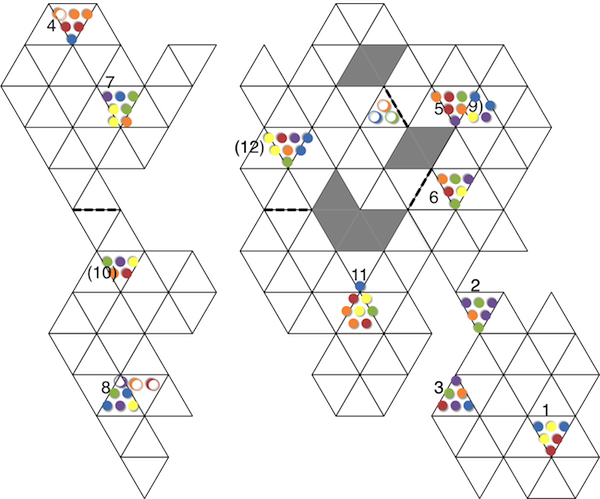
Player 1 hasn't given up yet and boldly moves the three non-yellow tribes in Europe to the non-completed city 12 in Europe, hoping to form a metropolis and disperse opponent colors at the same time. Player 3 grabs the last "free" tribes by adding another red tribe to the valuable city 11. Player 2 has no yellow supporting tribes available so she moves a purple tribe, both to decrease a city with no orange tribes and to increase a city with orange tribes. Finally player 4 picks an orange supporting tribe from the strong orange city 4 (to the dismay of player 2). The third age has started aggressively and it's difficult to predict the outcome. Age 3, Round 2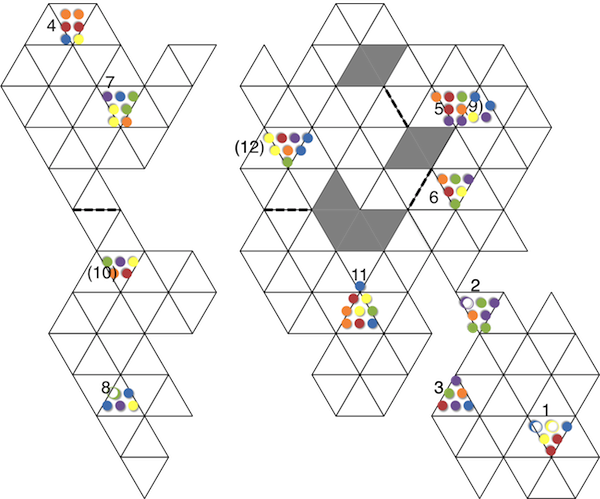
In a bold move, player 1 moves a blue tribe and claims metropolis 11 in Africa. If red had been supported by yellow or orange, she would have claimed it but 1 must gamble and in this case it paid off. Player 3 moves a purple tribe to claim the Asian city 5 instead while player 2 tries to rebuild the city in North America. Player 4 finds all her green tribes dispersed and tries to gather some of them in city 2 in Asia. With player 1 standing a good chance to claim metropolis 12 as well, the game is suddenly open again. Age 3, Round 3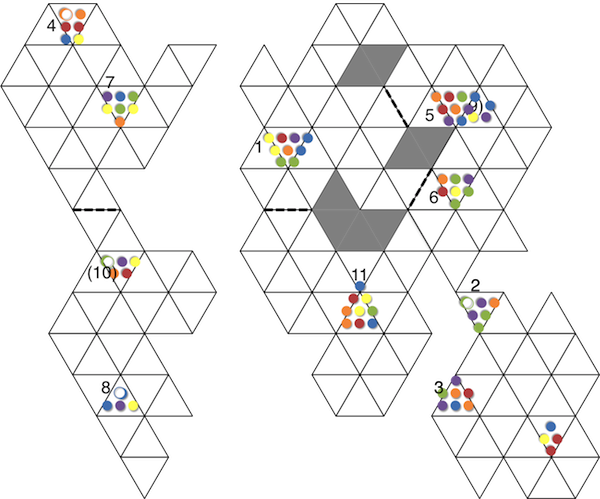
Player 1 plays safe and completes metropolis 12 in Europe while player 3 does likewise with metropolis 5 in Asia. Note that metropolis 12 was not a city in age 2 so it takes over the settlement map of city 1 and the tribes there are free to move again. Player 3 and fear this powerful stack as they don't lead any of the tribes in it so they hurry to move their available orange and green tribes to cities with as litte competition as possible. With three of six metropolises claimed by the last players after the 2nd age, the game is suddenly very open. Age 3, Round 4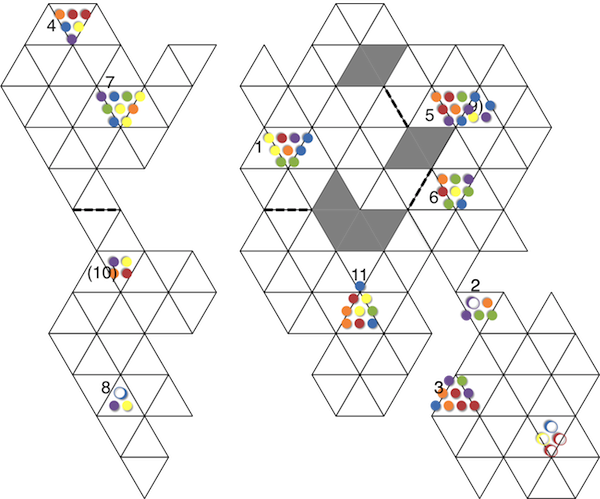
Player 1 and 3 completes a brilliantly played age by claiming metropolis 7 in North America and metropolis 3 in Oceania respectively. Player 2 has no other choice but to start moving tribes to North America and free one more orange tribe in Oceania but player 4 is one step ahead of her and will complete metropolis 6 in Asia first. Age 3, Round 5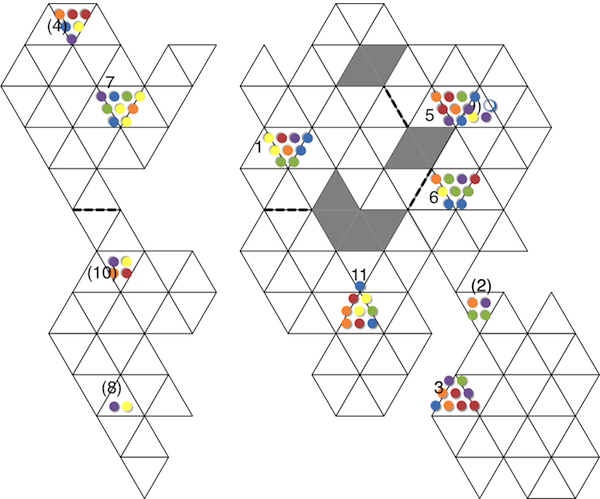
Player 1 chooses to end the game with a blue tribe that she correctly assumes doesn't add point to any other player. Now an exciting civilization phase remains before the final scoring can be calculated. Age 3, Civilization
With 3 out of 6 cities being militaristic, the choice of relations is easily as the players avoid them. Metropolis 5 with its double economy is the most popular one and reaches the maximum of 5 relations but with few economic metropolises, it "only" scores 14 points. The combination culture/religion in metropolis 3 earns it 18 points but the double science in metropolis 11 beats them both with 21 points. Player 1 makes an impressive comeback with 52 points, bringing the total to 77 but fails to reach player 3 with 86 points. Player 4 is just behind with 76 points while player 2' failure to claim a metropolis left her at 53 points. The test game may indicate that it's better to focus on the current age only (player 3) than the next as well (player 1). However, I think strategy is not only about getting your next age color into the settlements but also to keep your next age tribes flexible. Player 1 was very immobile in the second age but improved considerably in the third while player 3 managed to keep her tribes in action, particularly in the second age where there were many orange tribes roaming around alone. Playing purely tactical like player 4 did may seem sound but she was dependent on the other players playing the "right" moves for her. Focusing on the most valuable settlements in each age like player 2 is more risky as the other players are quick to grab settlements if you wait too long. The most striking with the test game is how the gameplay differ between the ages and how swingy it can be - excellent characteristics for a game! 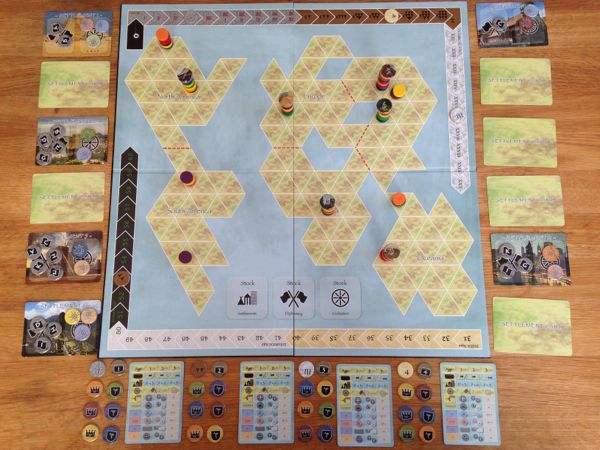
|
Annotated gamesIf you like those game mechanisms, I can also recommend:

|
|||||||||||||||||||||||||||||||||||||||||||||||||||||||||||||||||||||||||||||||||||||||||||||||||||||||||||||||||||||||||||||||||||||||||||||||||||||||||||||||||||||||||||||||||||||||||||||||||||||||||||||||||||||||||||||||||||||||||||||||||||||||||||||||||||||||||||||||||||||||||||||||||||||||||||||||||||||||||||||||||||||||||||||||||||||||||||||||||||||||||||||||||||||||||||||||||||||||||||||||||||||||||||||||||||||||||||||||||||||||||||||||||||||||||||||||||||||||||||||||||||||||||||||||||||||||||||||||||||||||||||||||||||||||||||||||||||||||||||||||||||||||||||||||||||||||||||||||||||||||||||||||||||||||||||||||||||||||||||||||||||||||||||||||||||||||||||||||||||||||||||||||||||||||||||||||||||||||||||||||||||||||||||||||||||||||||||||||||||||||||||||||||||||||||||||||||||||||||||||||||||||||||||||||||||||||||||||||||||||||||||||||||||||||||||||||||||||||||||||||||||||||||||||||||||||||||||||||||||||||||||||||||||||||||||||||||||||||||||||||||||||||||||||||||||||||||||||||||||||