
 |
Home | Game | Rules | Theme | Strategy | FAQ |  |








































|
Version History
The complete rules are available in the PDF file to the right. In the following sections, I will describe how they came to be. Implemented RulesNew citizensThe game defining concept of Demokratia is the double majority game of getting citizens for all (through citizens on Athens tiles) and getting a higher share of those citizens for yourself (through citizens in the Boule). This aspect is similar to Carolus Magnus, with its tension between controlling territories and controlling paladins. This creates a game where your actions will benefit others if you don't take control first. For better or worse, this divides Carolus Magnus into two parts; the first where you play for control of paladins and the second where you (at the exactly right moment) start playing for control of territories. In Demokratia, I had a similar phenomenon where a citizen played on an Athens tile would yield nothing as the other players would rush to the Boule to claim the new citizens generated by the Athens tile, inciting all players to play only to the Boule. Ideally, a game shouldn't force player into a given strategy so I needed to make playing an Athens tile more valuable. The solution was simple: playing a citizen to an Athens tile gives the player 1 citizen. This gives the players much more interesting decisions. Which action maximizes your return while minimizing the others? What is the expected return on a citizen played to the Boule? Should you go for a safe citizen in the short run (by playing a citizen to an Athens tile) or should you take the risk of getting more citizens in the long run (by playing a citizen to the Boule)? VotesYou cannot have a game called Demokratia without votes and the rule of secret votes was one of the first. Just like many Athens tiles contains could generate citizens of different tribes, so should votes so most vote tiles included two colors. Given all the other ways of affecting the number of new citizens (Athens tiles, Boule seats, Rhetors, Monuments), the votes may seem redundant. However, I decided to keep them for two additional reasons. First, Athens tiles provide open information for all players to act on whereas votes provide secret information that each player acts on individually. Second, votes are necessary to decrease the number of new citizens generated, as the discussion on Athens tiles below shows. Turn orderEven a simple game mechanism like the turn order can accomplish game purposes. To play citizens first also means that you show your knowledge and intentions first, allowing other players to adapt their playing. Since the player with the most citizens on the hand can be assumed to be in a good position, the rule that he or she must starts works as a catch-up mechanism. Also, since the turn order moves to the player with the most citizens left on the hand, it adds some variation and unpredictability to the turn order. Sometimes a player gets to wait before playing, sometimes a player get to play two citizens in a row. Athens tilesGiven the rule for the new citizens, I had to come up with a balanced mix of Athens tiles. Too few buildings would make Boule placements useless while too many buildings would cause inflation and end the game too early. Also, I needed to balance the colors of the buildings so that not certain combinations would make some colors better than others. First I decided on the number of tiles. 48 tiles (7x7 tiles minus the starting Agora tile) made sense, this would allow each player in a 4 player game to play 12 tiles - not too many and not too few. Second, I decided on the number of buildings on each tile. To allow for squares, crossroads, streets, turns and alleys, I could have 0-3 buildings on each tile, but how many color combinations would it require? Initially, I had 6 colors, but that would require too many tiles to cover all combinations and make matching colors more difficult so I tried out 5 colors instead. Then I would need 4+3+2+1=10 of each street and turn to cover all combinations. Crossroads only had 1 color so I added 2 of each color or 10 in total. For alleys, there were too many possible combinations so I settled with 5 tiles where each color would be represented in 3 tiles. That left 13 tiles for the squares to sum up to 48 tiles. I thought the high number of (color-less) squares were necessary to make it easier to match tiles but it turned to be too easy. Still, I couldn't add more buildings, since the ones I already had generated too many new citizens. Again, the solution was simple: black (negative) buildings. By replacing 8 squares with 2 of each tile type with black buildings, I not only made the tile matching challenging enough but also brought down the number of new citizens generated. The tile matching had to be tested to ensure that Athens tiles are difficult but not impossible to place but the number of new citizens could be calculated: The total number of citizens generated by the tiles are as follow:
The perfect balance was achieved! Each new tile gives 1 citizen directly to the player and 1 new power level to the Boule. Given that out of 15 vote tiles, each color has 6 positive votes and 9 negatives, the expected increase in power level each round is 1+6/15-9/15=0.8. This gives the following simulated figures for 1 color (assuming that a player plays half of her citizens to Athens tiles and half to the Boule):
The calculations indicated that a player should have 24 citizens after 6 rounds so a game should last 5-7 rounds - just perfect! Of course, the balance had to be tested too but it always feels good to have a mathematical balance first (and the test confirmed it!) New citizensThe rule that the player with the most citizens on a tribe in the Boule gets the first new citizen, the players with at least as many as the second most citizens get next and so on may look clunky at first glance. However, this rule creates an important incitement: players are rewarded for having the most citizens by the smallest margin. How come? Imagine a situation where player 1 has 2 citizens while player 2 has only 1 citizen. With a power level of 3, all players will receive new citizens equal to their number of citizens, and with a power level of 2, only the majority player will receive a new citizen, thus rewarding the majority. Now imagine that player 1 has 3 citizens. The majority is unnecessarily high so player 1 will still only get 2 new citizens in the first case and 1 new citizen in the second case. Rhetors and MonumentsThe double majority game was enough for a simple game where played citizens would remain forever. This works in many games and could have worked in Demokratia as well but I wanted to add some more competition by allowing the players to modify the played citizens. The solution was the addition of Rhetors and Monuments. By adding a cost to them, I added another decision to the game: by playing 1 citizen to a Rhetor or a Monument, you have 1 citizen less to play to Athens or to the Boule. The addition of the take-over rule, play 1 extra citizen to take a Rhetor or a Monument from another player, was a simple way to allow the players handle potentially over-powered tiles. RhetorsRhetors were given a simple and thematic function: change the Boule majorities by moving citizens between colors. To make them less powerful, one Rhetor of each color was introduced with abilities limited to their own colors (blue may only move to or from blue etc.). MonumentsMonuments were more tricky. I wanted to affect other parts of the game but which and how? I decided to let the Monuments affect votes and Athens tiles, either as extra information or as a modifying action, and got the following four:
For the fifth monument, I couldn't resist the thematic Stoa, to allow players to remove unwanted Rhetors (like the Old Greeks did to Socrates). This isn't purely a destructive Monument, as it can be used to threaten other players to use their Rhetors in a certain way. OstracismThe ostracism is a rule rooted in theme - I really wanted to use this Ancient concept in a game. It didn't take much thinking to realize that ostracism is a perfect catch-up mechanism, not only against the leader (who is denied a round) but also against the runner-up (who has to spend a citizen to call for ostracism). To limit the effects, I let the ostracized player still receive new citizens and also protect her from being ostracized two consecutive turns. This also creates an interesting decision, as the other players must decided when is the best opportunity to ostracize the leader. However, a catch-up mechanism must not turn into a kingmaker mechanism. Fortunately, the rule for this was given by the components - since remaining citizens are used to vote for ostracism, the vote cannot take place when there are too few citizens remaining, i.e. ostracisms cannot take place too close to the end of the game. Victory ConditionsThe main victory condition, the Democracy victory, is achieved by taking advantage of other players' actions as much as possible. Naturally, the complementary victory conditions of Oligarch victory and Tyrant victory, should be similar. Initial ideas of claiming majorities and linking citizens (the famous "longest road" mechanism) felt too individual and it also incited a behavior I didn't like: to split another player's citizens you most likely have to split your own, creating kingmaker scenarios. The current mechanisms require a power level of 10 in the Boule or 10 adjacent tiles in Athens but a player only need 5 citizens here to win. Thus, you may prevent the situation in the game or do the opposite and promote it with the intention of winning yourself! Peloponnesian WarHaving completed all the Athens tiles, vote tiles, Monument tiles and Rhetor tiles, I realized I had 1 left. (The Game Crafter's sheet ot tiles contains 77 tiles.) The early design ideas had included disastrous events so why not use this tile for the event that initiated the downfall of Athens: the Peloponnesian War. While the Monument and Rhetor effects are limited by purpose, this tile would affect all other players and could thus be more aggravated. Still, I wanted to let players use it to their own advantage as well. The solution was similar to the Long Walls, remove Athens tiles and thus affecting the Boule as well, but unlike the Long Wall, any tiles could be removed (or rather flipped, to prevent "islands" of Athens tiles with unclear positions). By delaying the effect, the players were allowed to plan how to best make use of the devastating war (or build desperately to prevent all from losing). |
Rules (Video)
Rules (PDF)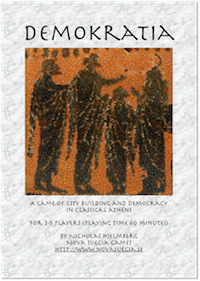
... and Rejected RulesThere are of course also ideas that will be rejected and here I will explain why. "Bumped" citizensThe ability to pay an extra citizen to replace an opponent citizen give a more dynamic gameplay to many worker placement games. However, I found it more important to reward planning and prediction by letting the first citizen on a place stay there.
|