 |
Home | Game | Rules | Theme | Strategy | FAQ |  |











































|
Game designPeoples was designed with the ambition of becoming a short civilization game with the unique twist of shifting leadership. Over the ages, the players would take turns to move and settle peoples of different colors (similar to Clans). For each age, some settlements would grow bigger and get more civilization advances (similar to Advanced Civilization) while others would decline and disappear. But over the ages, the leadership of those peoples would shift (similar to Carolous Magnus) and hence also the player scoring for a certain people. Each player would know which people he or she would lead each age and which other people to count as allies (this time I borrowed from my own game Iconoclasm) and be able to plan the migrations and advances ahead. The result would be a game not only mechanically elegant but also surprisingly thematic. It would show aspects of world history like migration and urbanization and even thematic benefits of the civilization advances. Those ideas all looked great on paper but they needed to be realized into a solid and fun game. With solid, I mean that all the mechanisms in the game, from setup to end scoring, can be executed without errors or unexpected situations. With fun, I mean that the game satisfies as many as possible of the fun criteria as possible. As with all my designed games, the ideas clashed with the reality when I tried to translate them into rules and components. The migration phase of the game was fairly easy but still had its share of questions to be answered. First, since all peoples can be moved by all players, I needed a mechanism to prevent repeating moves. Clans solves this by only allowing tribes to move to populated areas, giving them less and less options after each move. However, in my game I wanted to allow the peoples to move a bit longer before grouping into settlements and needed empty areas between them but how to prevent them from returning? I first considered a solution where (impassable) barren tokens are left behind but this didn't prevent tokens from being moved in circles. A simpler and better solution was to force the tokens to be moved closer to populated spaces. Thematically, this made sense as it represented people urbanizing. The next question to be answered was how many movement directions to have and hence what shape to have for the regions. Hexagons are popular but that would require a lot of empty spaces to keep the people separate at the setup, requiring more movement time. Squares would allow a ratio of 1:1 between populated and empty regions but I went for triangles a la Alexandros. They also allow a ratio of 1:1 and reduce the movement time further thanks to only offering 3 movement directions. In addition, they give the game board a unique look. 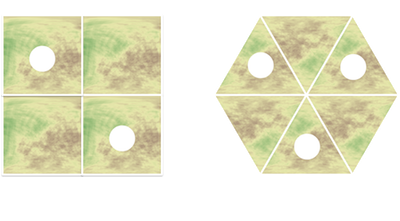
To proof this concept, I outlined a map of 6 continents, each with 24 regions and populated by 12 peoples. The figures were selected to be divided by 6 (the number of colors) and to be a good balance between options and playing time. With 2 of each people on each continent, all colors may move for own majority or seek their allies. The numbers and sizes of the settlements were selected in a similar way. 12/9/6 settlements allows all players to get at least 1 settlement in the last age. 3/6/9 in size allows majorities that may shift between the ages. (2 red in the first age may be beaten by 3 blue in the next and so on). An idea of a fourth age with metropolises of all 72 people tokens grouped in 6 settlements was considered but rejected since it would add little new compared to the first three ages. The movement restrictions added some asymmetry to the continents. In the first age, there are clusters of 1/2/3 connected continents (Europe/Asia/Africa, North/South America and Oceania). In the second age, the continents are connected by seas, and in the third age, all continents are connected. Of course, numerology is not enough as a proof but the figures are intuitive and a good starting points before giving the final word to simulating and testing. However, the migration phase relied on the idea of hidden colors. The idea is to let each player play a unique subject and a unique ally each age. Player 1 may play red and blue age 1, yellow and green age 2, and purple and orange age 3. That satisfies several fun criteria, such as surprise (who plays which color?) and equal chances (a strong color one age will belong to another player the next age). Perfect - on paper! But when I started to express this in rules format, I stumbled upon the question on how to distribute the subjects and allies so that they become not only unique but also hidden? A random distribution won't work, as a player may end up with only red subjects and allies or only subjects. The use of colored backgrounds would enable the players to draw unique colors but the risk of getting only subjects or only allies or only markers for one age. The attempt to openly create unique piles and randomly distribute them would allow players with good memory to draw conclusions about who play which as soon as the first age markers get revealed. At last I came up with an idea of a two step drawing. Sort the markers by color, and flip them to their age/subject/ally side. Then create piles with unique ages/subjects/allies and shuffle them. You will now have piles with one of each (hidden) color with one subject and one ally for each age. This shows one of several reasons why I prefer writing the rules as soon as possible in the game design process: if a mechanism cannot be expressed by a rule, it can never work. Another good reason for writing rules is to assess how complex a mechanism is and compare it to the depth it offers. The migration rules needed little rewriting. The most important rule that disappeared was the possibility for new settlements to be created in later ages (if peoples group in new regions), as this required decisions on how to handle old settlements. The migration mechanisms are enough for a basic game and also got a rule section of their own. However, to add more depth to the game, I wanted to give each settlement not only a variable score but also a score dependent on the players' own decisions. This was accomplished by the civilization advances, that are selected by the players in one age but not scored until the next (when the settlement may have a new leader). My general approach was to identify advances that scored differently for different combinations of colors, relations etc. while still being thematic and I came up with the following:
(Military was first used to attack a selected weaker neighbor but the idea was abandoned due to its kingmaking effects.) However, I struggled with the civilization rules to find a good balance between complexity and depth. Some intriguing ideas, like the merge of settlements into empires, was abandoned early. The ideas of civilization advances and relations were nearly abandoned as well, as I struggled to find a good way to visualize them. Initially I imagined a spreadsheet showing settlements and advances (but how fun are spreadsheets?) before deciding on colored and numbered markers in settlement areas. Markers could also be used to depict relations - a settlement is simply related to all settlements with which it shares a pair of diplomacy markers. So far, the rules seemed solid. Then came the simulation. While the migrations worked well, the civilizations, although individually simple, became cumbersome in volumes. Initially, I allowed each growing settlement to acquire 1/2/3 advances in each age AND each not growing settlement to keep acquired advances. The result was 36 city advances (6x6) to be resolved and potentially 15 town advances (3x5)! I quickly had to decrease the number of advances to 1/1/1 and remove not growing settlements from the game. Following that, the simulation showed that the game had a good flow and that the civilization advances were well balanced with about 2/4/6 victory points over the three ages. Some tweaking and tuning had to be done to the civilization advances to make the scoring as simple and streamlined as possible. Finally I had mechanisms that gave the players deep strategy opportunities in migrations and civilizations with the least complexity possible. Game components
|
Annotated gamesIf you like those game mechanisms, I can also recommend: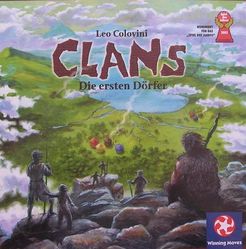

|