 |
Home | Game | Rules | Theme | Strategy | FAQ |  |




































|
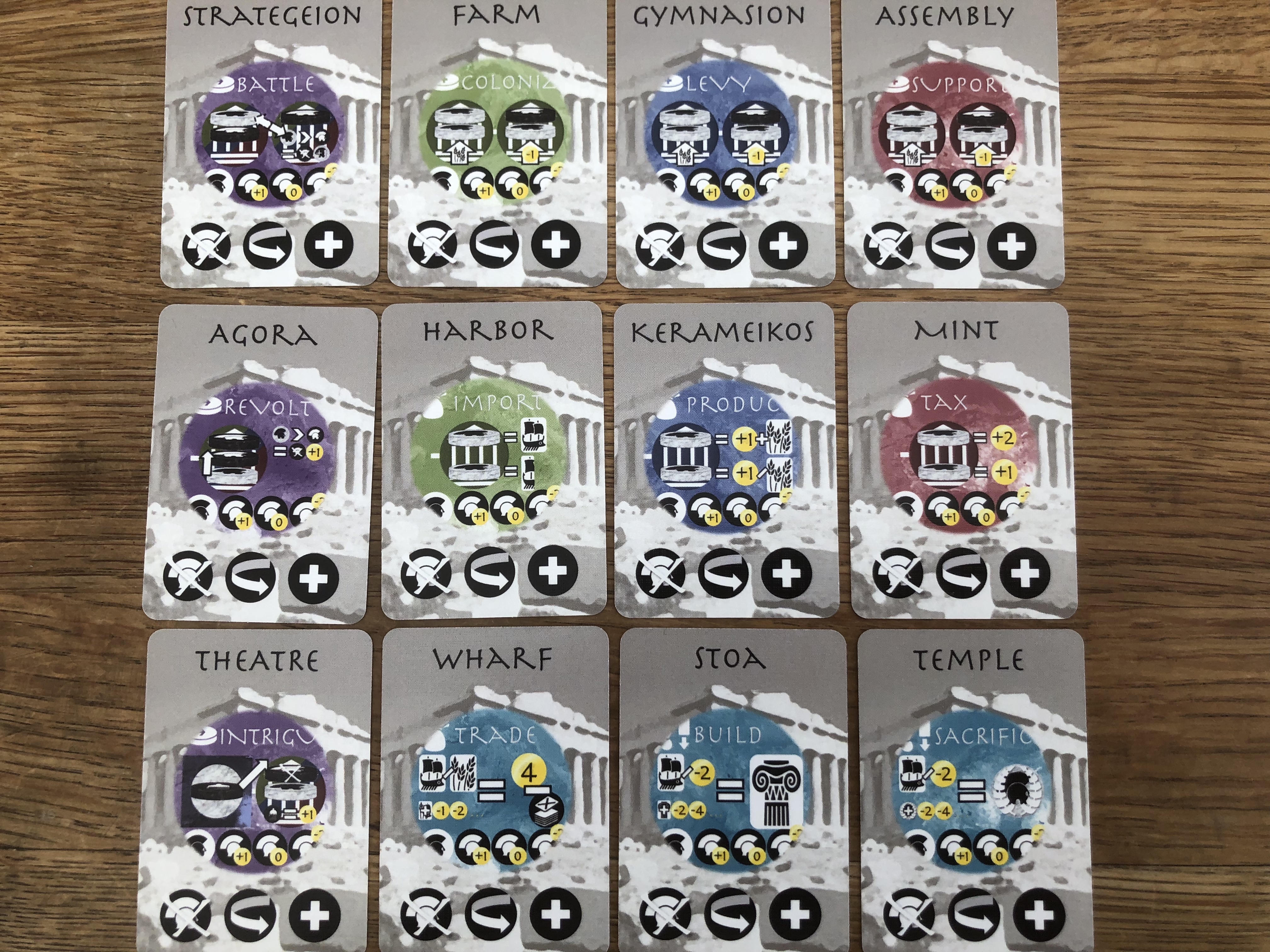
Game design 2nd editionMy successful ambition of reenginering my first boardgame Nova Suecia inspired me to revisit other old games. The decision to turn to Politeia was coincidental, since it was one that was picked by fellow designers among several presented to them during a designer meeting, but it turned out to have something special that made it worth spending more time on. What really intrigued the players was the "mancala action selection mechanic", whereby action tokens are dropped on a variable board of actions, the cost of which depends on the number of action tokens previously on the action. In this way, the players have to make efficient decisions based on both the number and the cost of actions. It was this idea that inspired me to design Politeia and clearly something to keep and strengthen in a second edition. Perhaps this mancala action selection mechanic appealed to the organizers of
However, the actual actions selected through this mechanic had a mixed reception by the testers. The concept of leader spaces and citizen spaces in some cities and merchant spaces in other cities confused some, the fact that some actions were linked to geographical areas and others not confused others, the alliance mechanic with strength and support levels was considered as one mechanic too much, and the abstract city tiles were considered too abstract compared to a real map. With this feedback, I had to reengineer the rest of the game and remove everything that distracted from the interesting action selection decision and keep the fight for hegemony in Greece in its simplest possible form. The solution was an area majority mechanic partly inspired by Cosmoclasm and Warring States.
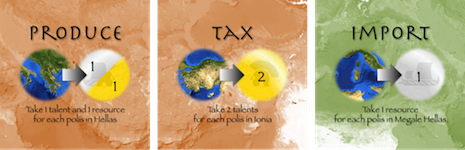
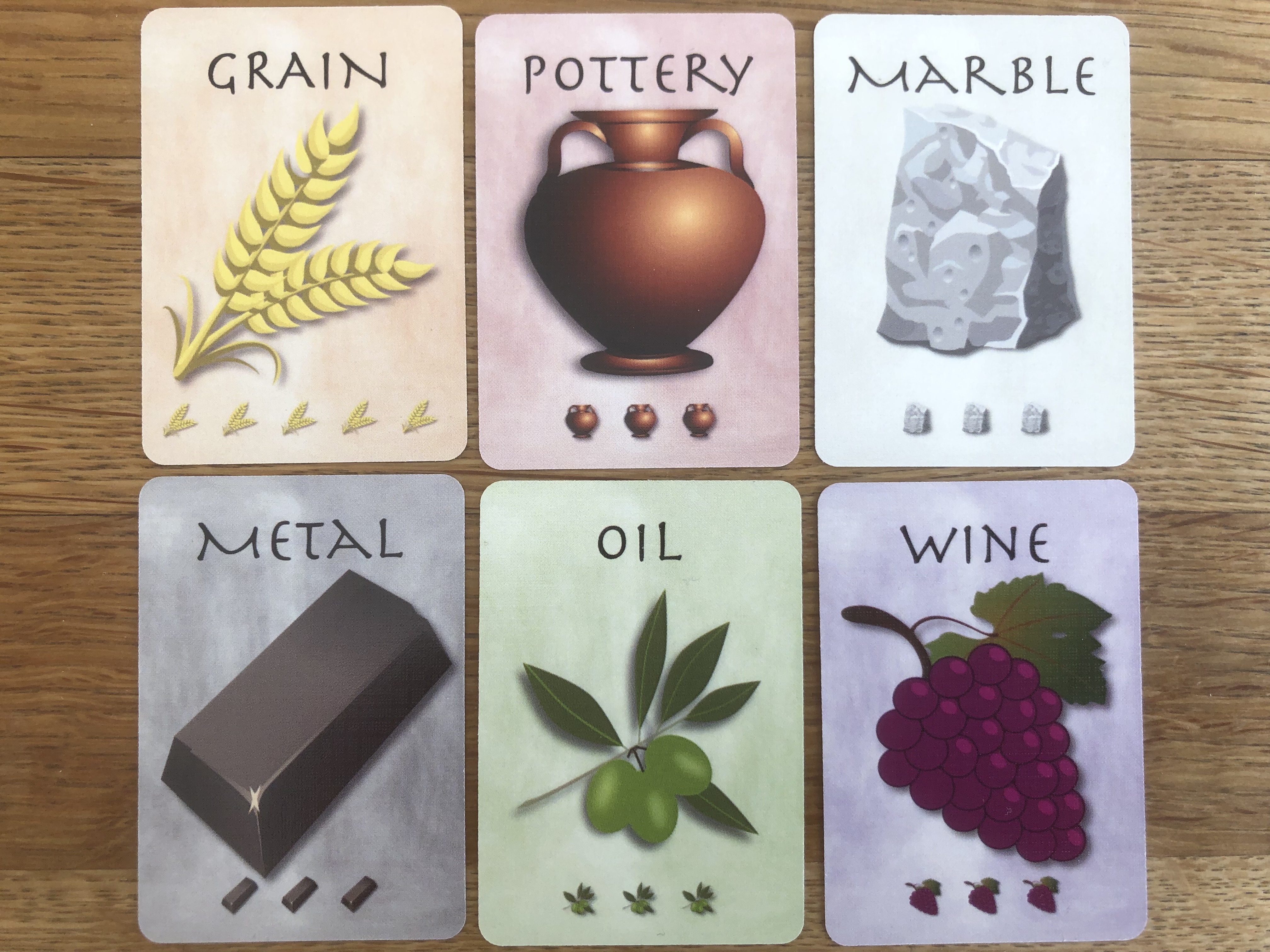
Thus, the "income actions" (Import, Produce, Tax, Export, Trade, and Build), whereby talents are moved from the supply to the hand, could remain unchanged while the "majority actions" could be executed in a much more elegant way. Some things still needed a change but this new majority mechanic provided solutions to all of them. One was the trigger for the Greco-Persian wars. Instead of the two old instability tracks based on killed Greeks and Persians, I simply added a "Hades" space where removed citizen could end up until the war threshold level is reached. Another thing was the now redundant Influence action and this was a tricky one. I tried an Ostracize action, whereby players could choose to remove leaders, and a Vassal action, whereby players could choose to add Persians and yield to them. The former was difficult to balance (the action would be too strong if free and too weak if not free) while the latter was considered too complex by the testers. The solution was a simple combination of the two: Intrigue (an old action name with a new action). It would work as Ostracize but the ostracized leader would be replaced by a Persian, thus thematically explaining why the former leader is removed but denying the Intriguer the full benefit of that removal. However, the changes didn't just remove and/or simplify mechanics but also required some new to deal with side effects. One such side effect was that the adjacencies made threats against cities more predictable (which was good, because I had missed this in the first edition) but also that it got harder for players to regain majorities if kicked out (because with less cities, you have less adjacencies and less options for majorities). A simple solution was to offer a reduced income for the second majority, something that speeded up the game and was in line with the vassal's reduced income in the advanced rules (see below). This in turn added a third side effect as the quicker game made the long term actions of Trade and Export (trade cheap resources for expensive ones and export them to make a profit in arbitrage) and Build (buy action buildings for cheaper actions). Trade was simply combined with Export to one buy/sell action, giving room for the alternative victory point action Sacrifice, whereby resources could be used to immediately get victory points instead of earning them from fighting the Persians. Build was more difficult to solved. Attempts to offer immediate bonuses or free upgrades only revealed how weak the actual buildings were. Instead, I started to look closer at the action board for other possible benefits. One idea to allow free moves to the buildings' action was rejected because it would make positioning tactics redundant for the player with buildings and less predictable for their opponents. To find the solution, I had to step back to the key issue: there is not enough time to use the same action several times, let alone take another Build action to upgrade the building. Thus, the answer was to offer a new or upgrade building immediately after its action. In this way, players may plan their way across the action board and choose their buildings based on that. An elegant solution that made the action board even more interesting! A fourth side effect was the challenge of scaling. It was no longer possible to simply remove city tiles with less players and attempts to block such cities just made the map confusing. But again, new mechanics provided solutions. Non-player citizens could simply be placed on the map as well and return to it after Greco-Persian wars. In this case, their presence (or absence) would always have an impact on the game not unlike that a real player would have had. How about the alliance system then, whereby players could "invest" in powerful opponents and take advantage of their strength. Actually, even that could survive through the new majority mechanic. In an advanced option, players may pay opponents to count their citizens as own citizens when assessing adjacencies and majorities (but not against the opponent herself of course) or get paid by the Persians to become vassals and add Persians to their own cities (for greater strength but less income and VP). Simplicity but with many interesting decisions - just what all games should offer! Game design 1st editionWith Demokratia and Apokalypsis, I started a series of games set in the Ancient Greece. However, I felt that I missed a game depicting the struggle between the city states and thought of which mechanisms that would give justice to this dynamic epoch. A light civilization game? An area control game? A war game? The answer came from another old wish to design a game with a quick and smooth action system instead of the rather downtime-prone system of rounds and phases. How about a system where the players choose only one action at the time? Perhaps a rondel mechanism like in Murano or a mancala mechanism like in Trajan? Those two fine games inspired me to a more dynamic system. Imagine only one mancala board, like in Five Tribes, where the players may open and close opportunities for each other, to determine both number and cost of actions. After some thinking a simple but brilliant system emerged. Similar to my previous games, I started trying out rule fragments (which actions, what would they cost, what would they return etc.) and then proceeded to put them all together in draft rules, partly to get them organized and partly to facilitate the process of making them intuitive and consistent. The key question was which actions to have. The actions needed to be fairly balanced (although powerful actions will be picked more often and hence be more expensive) and they needed to create a balanced economy (with surplus enough to keep the game flowing and shortage enough keep the game tense). First, I needed actions to increase the players' assets. Production, Taxation and Import are natural actions for this. They could also be linked to specific city-states (Hellas, Ionia and Megale Hellas), partly to increase the players available actions for acquiring assets and partly to decrease the outcome of each action. One alternative would be to let all city-states and players benefit, similar to Alexandros, but I preferred to keep the actions individual and quick.
The distinction between liquid assets (talents) for immediate use and non-liquid assets (resources) for set collection and delayed use was inspired by Civilization. This added a balance between tactical short-term gains and strategic long-term gains.
I did consider player trade as well but again decided to prirotize quick game turns. Instead, I added the action Trade to give the players another alternative to acquire resource they miss in their sets. Finally, I needed an action for liquidizing the resources by exporting them for talents.
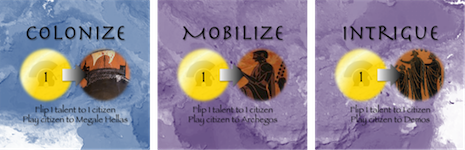
What then would the talents be used for? Assets on the board of course. Again, the actions were linked to city-states but with a slightly different perspective. Colonization is linked to Megale Hellas (and improves the value of the Import action) while the Mobilize and Intrigue actions are linked to both Hellas and Ionia. This added another dimension to the conflicts between the players: the external threats of mobilized armies and the internal threats of intriguing citizens.
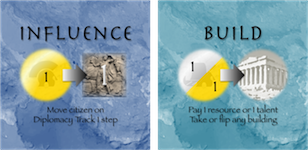
The other uses of talents were inspired by the theme. The diplomatic game between the Greek city-states, where alliances kept changing, required a diplomatic track. The still visible archeological traces of the Greek civilizations required buildings. The former could offer military advantages (more strength in conflicts) while the latter could offer economic advantages (less cost for actions).
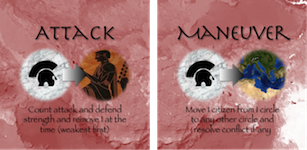
The final actions needed the direct conflicts. While a normal euro could have settled with the talents-citizens-more talents-flow, Politeia would also be about direct conflicts. The Attack action was a natural one: let the players use a surplus of citizens to attack players with less citizens. Again, Civilization served as the inspiration for the simple and predictable battle mechanism where the players take turns to remove citizens. This would also naturally make the attacker weaker, as his victorious citizens are spread out on more city-states. The twelfth and last action was a simple "adjustment" action: Maneuver to allow player to reallocate placed citizens.
How about the Persian threat then? I couldn't deny the game this epic struggle between the two civilizations. But an event that hurts all players equally wouldn't be interesting so how could I make a Greco-Persian war individual? I already had the answer from my decision to have both Hellas and Persian political levels. Players with many citizens and/or high Hellas political levels would benefit from Greek victories while players with few citizens and/or high Persian political levels would benefit (or suffer less) from Persian victories.
Game testing revealed another use of this event. In one test, the players hoarded citizens, which made internal wars too costly. By letting it trigger when the balance between Greece and Persia shifts to much, this external war not only restored the balance but also removed some of the hoarded citizens. This event became the most complex but since it's not likely to happen that many times in a game, I accepted it. With that I had a game with a unique action mechanism that would allow players both the standard euro gameplay of spending assets to build an economic engine and the more warlike gameplay of spending assets in direct conflicts. The artwork was another challenge. Most civilization games have lavish art, with 7 Wonders being only one of many fine examples. But although buildings do play an important part in the game, the main part is played using actions and geography, where art may clutter other important information.
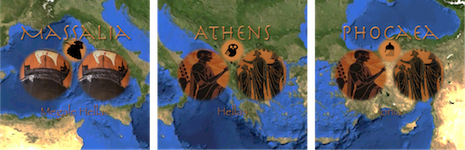
Instead, I went with simple map representation of the city states, with the additions of pottery style images for marker placeholders. Italy, Greece and Asia Minor were perfect backgrounds for the Megale Hellas, Hellas and Ionian city-states. The actions also uses geographical backgrounds (although faded out) to indicate where the actions take place but the main information conveyed by the art are the colors (to group similar actions) and the symbols (to tell how talents, resources, citizens and city-states are used in the action). Finally, the player markers were distinguished both with colors and with symbols representing the ancient city-states of Greece (as described in Theme. This also kept the art in line with the two previous games in the "Ancient Greece series", Demokratia and Apokalypsis. Game components
|
Annotated games
If you like those game mechanisms, I can also recommend: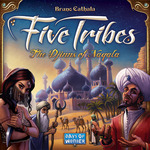

|
|||||