
 |
Home | Game | Rules | Theme | Strategy | FAQ |  |


































|
ThemeBackgroundPoliteia is perhaps even more thematic than my first "Greek" game Demokratia. Politeia covers the same time period (the Classical period) but extends the game to all Greece. Let's start by looking at the geographical parts. Geographical TilesHellasThe players represent the most influential city-states of Classical Greece. Athens is given, as is her main rival Sparta. Eventually, both Athens and Sparta fell to the hegemony of Thebes. Corinth rivalled both Athens in Thebes in wealth and joined Sparta against Athens in the Peloponnesian War. Argos challenged Sparta for dominance of the Peloponnese but was eventually eclipsed and remained neutral of an ineffective ally of Athens for the rest of the Classical period. The symbols used for the city-states are all rooted in history.





IoniaIonia refers to the Western coast of Minor Asia and was settled by the Greeks probably during the 11th century BC. Herodotus lists twelve city-states, of which Miletus was the most important while Ephesus was famed for the Temple of Artemis, one of the Seven Wonders of the Ancient World. Erythrae was the seat of the Erythraen Sybil, an oracle that among other thins prophesied Alexander the Great's divine parentage while the citizens of Phocael were the first to make long sea-voyages and among her founded colonies are Massalia, present Marseilles. Finally, Halicarnassus, although of Dorian ethnicity and not Ionian, was included because of another wonder, the Maosuleum of Mausolus. The Ionian city-states were captured by Croesus of Lydia (560-545 BC) and, following Croesus' defeat to King Cyrus the Great, by Persia. They kept their autonomy but were ruled by tyrants appointed by Persia and revolted 499-493 BC. The Ionians received support from mainland Greece and this marks the starting point of the game: the Ionian city-states controlled by Persia and the Greek city-states under the threat of invasion from Persia. Megale HellasMegale Hellas or Magna Graecia is the name of the coastal areas of Southern Italy on the Tarentine Gulf that were extensively populated by Greek settlers. Many of the city-states became rich and powerful, among them Neapolis (Naples), Syracuse, Acragas (Agrigento), Sybaris and Tarentum (Taranto). PersiaThe Persian Empire refers to many different dynasties, of which the Achaemenid Empire founded by Cyrus the Great is the one in the game. Her role in the game is limited to the role she played in Greek politics, either as an enemy during the Greco-Persian wars or as an ally during the Peloponnesian War. In the former, famous battles like Marathon,Thermopylae and Salamis, and in the latter, she supported Sparta against Athens. The empire eventually fell to Alexander the Great. Action TilesThe Ancient Greece was fragmented both figuratively speaking and literally speaking. It was a country geographically divided by mountains and rivers and politically divided into hundreds of city-states. Although the Greeks considered themselves as one people, they often competed with each other and although they could unite against external enemies (most notably Persia), they soon returned to infighting again. The competition is represented by the action mechanism, whereby one player's actions make the same actions more expensive for the next player. The actions also reflect the political and economic realities of the Ancient Greece. LevyWars were part of the daily life in the Ancient Greece and this is particularly true for Sparta, with her focus on military training. RevoltRevolts were not uncommon in the Greek city-states. During the Peloponnesian War, the Athenian democracy was overthrown in 411 BC and again in 404 BC, when the pro-Spartan oligarchy the Thirty Tyrants established a government. BuildMany Greek buildings have survived to our days. Many of the building cards have been inspired by the buildings around the agora of Athens. while the monuments have been inspired by the Athenian Acropolis and the Seven Wonders of the Ancient World. In the game like in Athens, they give both everyday benefits (cheaper actions) and eternal glory (count towards endgame socring). IntrigueSince the individual city-states were weak, alliances were important. Two of them were the Peloponnesian League, led by Sparta, and the Delian League, led by Athens. The leagues eventually clashed in the Peloponnesian War. But even Persia could serve as an ally and supported both Athens and Sparta during the wars. ColonizeThe Greek colonies were established either as trading posts or as independent city-states and the relations to their mother-cities were generally peaceful. In the game, this is represented by the letting the colonies provide resources. Import and TradeThe Greek economy was dependent on imported goods and its trading networks extended across all the Mediterranean Sea.
TaxThe members of the Delian League were obliged to pay (symmachikos phoros) or taxes to Athens to maintain a strong navy against the Persians. ProduceThe production action is simply a mix of import (resources) and tax (talents) that represent the (limited) own production of the city-states. Athens relied both on agriculture and on silver mines. BattleThe Greek city-states frequently fought each other, sometimes even with Persian support, as during the Peloponnesian War. The Persian citizens returning to emptied city-states is representing the increased Persian influence. The Greco-Persian WarHowever, the Greek city-states managed to unite against common enemies, as during the Greco-Persian Wars. The addition of all player citizens represent this effort. A loss against the Persians meant harsh retributions against the most active city-states, as shown by the Persian sack of Athens in 480 BC, while a victory allowed the same city-states to assume leadership, as shown by the transformation of the Delian League into an Athenian Empire. |
Classical Greece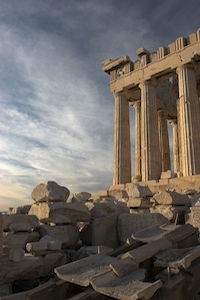
Persian Empire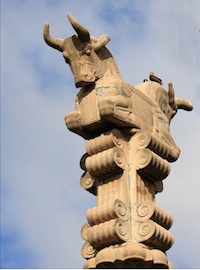
|