Home Game Rules Theme Strategy FAQ


Rule summary

The game board consists of a network of cities where citizens are placed. Whoever has a majority in a city controls it and reaps its fruits but is also the first to lose citizens if the Persians attack.

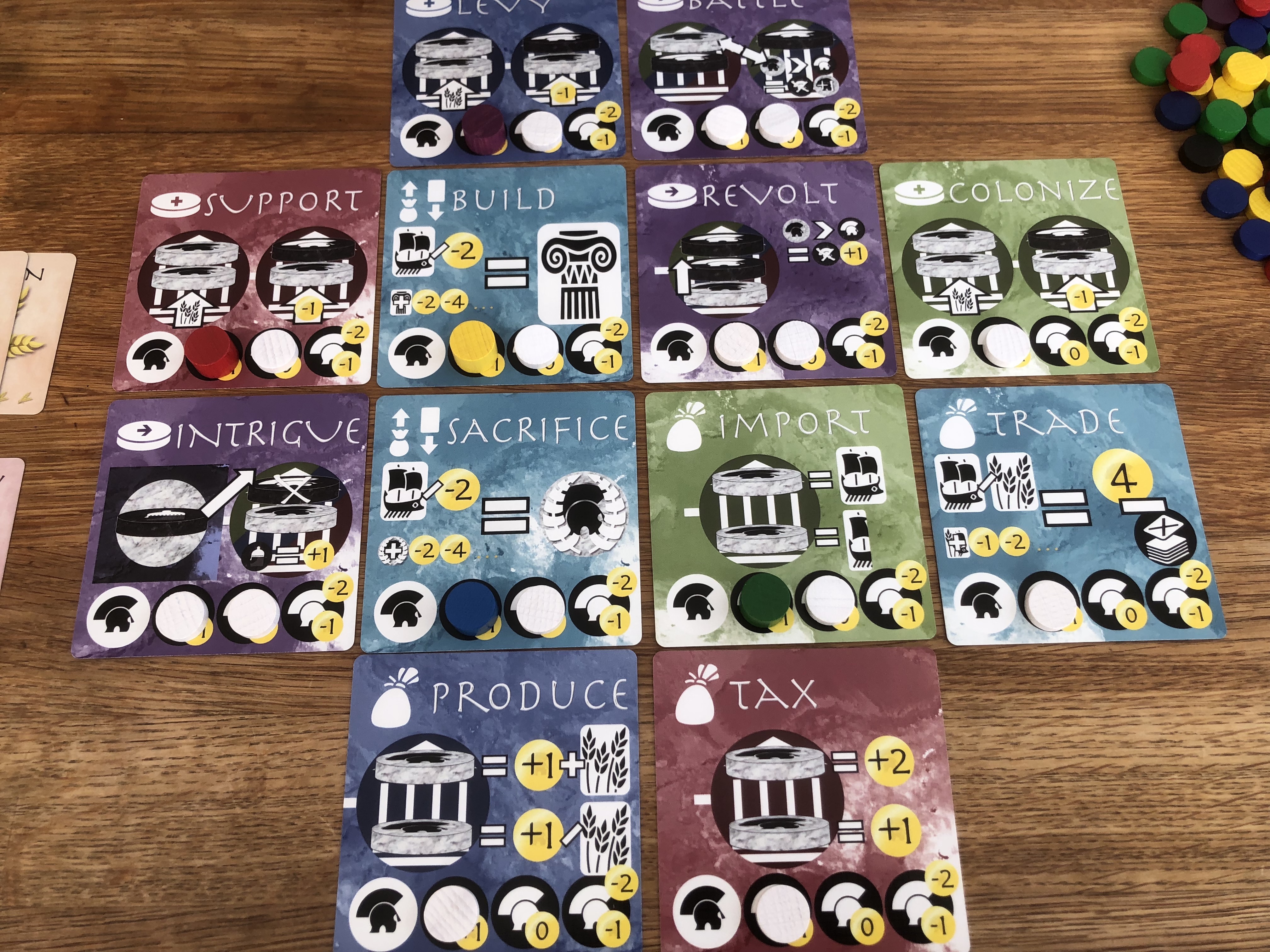
The actions are selected from a randomly set up action board. Pick up the action markers in one action space and drop them one by one in the spaces of the actions you wish to take. The more previous action markers there are in an action space, the more expensive is the action.

There are four types of actions:

  1. Receive: Acquire talents, either directly through taxes and levies or indirectly through import of resources that can be traded for talents.
  2. Pay: Spend resources to acquire talents, grow existing cities or sacrifice (for VP).
  3. Place: Turn talents into citizens to expand to new cities.
  4. Move: Use your citizens to attack or revolt or invite the Persians to fight your opponents.

The more citizens you get to the board, the more talents you may generate, but beware, when 10+ citizens (Greek or Persian) have been removed from the board, the Persians attack.

Use the different actions to add talents from the supply to the hand, turn the talents into citizens on the board, and let the citizens engage in peaceful trading or aggressive warfare. Citizens who fall in the Persian Wars earn victory points (VP), as do citizens in cities, and once a player’s supply is depleted the player with the most VP wins.

Version History

  • 3.0: Third edition
  • 2.92: Sacrifice modified to also move discs from Hades.
  • 2.91: Advanced rules removed.
  • 2.9: Pay actions streamlined and always paid from hand with Grow discs placed on top.
  • 2.8: Move actions streamlined to move to top of cities with different requirements and always paid from the hand.
  • 2.7: Adjacency requirement replaced by "uninterrupted chain" from start city.
  • 2.6: Income actions and place actions instead of six separate actions.
  • 2.5: 1 non-player citizens per city, which return to bottom after first war and move to top after second war.
  • 2.4: No rewards/punishments after wars.
  • 2.3: Two similarly colored citizens required to repel Persians during wars.
  • 2.2: 1 disc, 1 grain and 1 resource received at setup.
  • 2.2: Hellenika phase with majority checks removed.
  • 2.1: Citizens removed to Hades return to hand instead of Elysion.
  • 2.0: Second edition
  • 1.99: Build and resource cards removed, resources replaced by tokens, new action Grow (using Grain) replacing Build, fixed rates for Trade and Sacrifice, no rewards for Battle/Revolt/Intrigue
  • 1.98: Battle to bottom of city, Revolt 1 step only, purple actions 1 per area only, related Build action gives flip or exchange
  • 1.97: Grain for citizens in same cities and talents for citizens in adjacent cities, increased cost for Build, Sacrifice, and Trade, resource at start, talents after wars
  • 1.96: Wild recovery action as catch-up, no extra starting talents for later turn order
  • 1.95: City links replaced by influence, Betray/Intrigue requires presence, Sacrifice use talents instead of supply, Build unlimited and VP for monuments
  • 1.94: City links required for all actions, particularly income
  • 1.93: Exile replaced by Betray to allow Persians to reenter the board
  • 1.92: Map redesigned with arrows for Persian attacks routes and Hades and Elysion spaces removed to player aides
  • 1.91: Action tiles redesigned with action spaces and text removed to player aides
  • 1.9: Persians attack along links, VP only for removed citizens
  • 1.8: Simplified link rules (capital link not necessary), Vassal and Trade replaced by Ostracize and Sacrifice
  • 1.7: Influence tracks removed and Influence action replaced by Vassal action, advanced rule for alliances
  • 1.6: Different city spaces replaced by one city space with majority control
  • 1.5: City connections for restricted movements
  • 1.4: "Accelerated actions", possible to do more with each action, e.g. mobilize more
  • 1.3: Reward for capturing cities
  • 1.2: Board tiles replaced by game board
  • 1.1: Simplified war rules; triggered by removed citizens and resolved by removing 1 citizen per city
  • 1.0: First edition
  • 0.95: Citizen VP only for removed citizens to compensate war victims
  • 0.94: Maximum/minimum diplomacy level new war triggers, players may share the same diplomacy level
  • 0.93: Talent at start of turn to speed up game, political level starts at 0 to make Persians dangerous in the beginning, all player loss changed to last player victory
  • 0.92: All actions limited to 1 execution only, Export Action upgraded to 3-X resources. Trade action changed to 2 talents/other resources
  • 0.91: Action Maneuver replaced by Revolt, simplified Attack rules removing Demos strength
  • 0.9: No talet at start of turn to make talents more scarce, no jump over opponent citizens to make action less reachable
  • 0.8: Resource values linked to availability, resource types linked to city-states, building take-over removed
  • 0.7: "Blocking" action markers added to allow planned action paths
  • 0.6: Influence level and most buildings added to victory conditions instead of 1 per influence payment/building, war marker added to track peace
  • 0.5: Same action multiple times removed, Greco-Persian War triggered by positive or negative political levels
  • 0.4: Action Defend replaced by Maneuver, Greco-Persian War triggered by political level exceeding maximum or minimum level
  • 0.3: 1 talent+1 resource production in Hellas, 2 talents in Ionia
  • 0.2: Action board grouped like "fat cross", resources traded in unique sets only
  • 0.1: Greco-Persian War triggered by action Defend, no starting citizen in colonies, resources traded in similar or unique sets

The complete rules are available in the PDF file to the right. In the following sections, I will describe how they came to be.
Implemented Rules 2nd Edition

First single action turn

The 1st edition offered the players several actions already in the first turn. However, many testers were confused by two aspects of this rule.

  1. Placing an action disc on an action at setup without actually taking this action felt unintuitive.
  2. Planning for several actions already in the first turn felt overwhelming.

The rule that the first action space also lets the players take that action solved both those problems. Also, it didn't remove the first-mover advantage mitigation, since players later in turn may still take advantage of empty (cheaper) action spaces.

(Lack of) first-mover advantage mitigation


Similar to 1st Edition.

Last mover advantage mitigation

Similar to 1st Edition.

Talents vs Resources

While the 1st Edition relied on liquidity to balance the different regions (regions closer to Persia were more liquid but also more risky), the 2nd Edition balanced them in a different way.


  1. Ionia (high risk) offers liquid resources and action free VP, should the Persians attack.
  2. Megale Hellas (low risk) offers non-liquid resources, which requires an additional actions to turn into talents, VP or investments in future benefits.
  3. Hellas (medium risk) offers a mix of resources, where talents and grain either may be turned into citizens and offer action free VP, should the Persians reach Hellas, or turned into investments in future benefits.

The rule changes regarding actions and victory conditions (see below) also contributed to the balance by adding a timing decision regarding when to stop building a strong city-state (buildings, citizens etc.) and when to start weakening it by spending citizens for VP (sacrifices, wars).

Area majority

The area majority mechanic replaced the political levels of the 1st Edition. Instead of binary city control, where attacks and revolts required counting of both own and allied citizens, a simple and instant majority control determines both who controls a city and who receives the consoling "runner-up reward" of half income.

This rule change made Politeia not only simpler and faster but also enabled bigger moves, since the players didn't have to modify support levels every turn and since they got more resources to pay for more actions in a turn.

Victory conditions

While the 1st Edition had a more balanced VP approach, where all achievements (buildings, cities, citizens etc.) were rewarded, the 2nd Edition implemented a simpler and more to the point approach: citizens removed to Hades count the most (2 VP each), while controlled cities do count as well but less (1 VP each). This rule is not only simpler but also adds an interesting arch to the game, since a strong player one round may be weaker the next round when all his or her citizens have been turned into VP. It's also a preferable rule given the "closed VP" of the 1st edition (my gain of a city VP is another player's loss of a city VP), which may result in a tug-of-war. Finally, and perhaps most important, it offers the players a unique challenge, where a loss on the board is actually a victory in the VP count while also forcing the players to constantly rebuild their positions for the next round of VP distribution.

Actions

The actions are mainly similar to the ones in the 1st Edition but some of them needed to be modified to suit the changed gameplay of the 2nd Edition.

  • Place: Colonize, Levy and Support offer placement of citizens in each of the three regions. Those are similar to the 1st Edition.
  • Receive: Import, Produce and Tax offer income for each of the three regions and differ in terms of talents vs resources to offer different strategies. Those are also similar to the 1st Edition.
  • Move: Intrigue, Battle and Revolt offer different movements of already placed citizens (horizontal, vertical or addition of enemy Persians). Those have been changed to offer more area movement strategies.
  • Pay: Build, Sacrifice and Trade have seen the most changes.
    • Build: The faster gameplay gave buildings less action bonuses in a game but with the ability to change building after each use, they not only became more valuable but also added a spatial challenge to choose the right building for the next turn.
    • Sacrifice: The changed VP focus offered a peaceful way of earning VP and similar to VP from wars, it's way that costs resources and requires rebuilding your position afterwards.
    • Trade: Trade combines the Trade and Export actions of the 1st Edition to make market manipulations faster and make a trade strategy viable within the faster gameplay.

Implemented Rules 1st Edition

(Lack of) first-mover advantage mitigation

Many action-based games mitigate the first-mover advantage by giving the first player less starting assets or by giving all the players the same amount of turns. However, the action system of Politeia made this unnecessary. Since each action has one action marker from start, the first player can only take one action. The second player will have an opportunity to take two actions (by taking the action markers from the action taken by the first player) and/or taking one action for free (by dropping action markers on the vacated action). The third player will have even more opportunities. Any remaining advantages are likely to be mitigated by the players themselves through the many opportunities to bash the leader.

Last mover advantage mitigation

Similarly to first-mover advantage, the last player to act may have an advantage by taking the last action in the game. In a way, this is as it should be as timing of the game end is also a game skill that should be rewarded. However, this is made less powerful by the fact that the game ends when a player is unable to take any more talents rather than when a player takes the last talent. This means that the player gets a smaller advantage from her last action since the (non-available) talent is not counted. Again, a player with good timing will plan for other advantages of her last action.

Talents vs Resources

There is a trade-off between Tax (liquid talents) and Import (non-liquid resources) as well as between risk (close to Persia) and non-risk (far away from Persia). Ionian city-states offer the former while Megale Hellas city-states offer the latter with Hellas city-states inbetween. This must be balanced to make the options equally attractive. The table below compares the total talents in the hand after 1-6 turns using Tax (2 talents per turn from Ionia), Produce (1 talent+1 resource from Hellas) and Import (1 resource from Megale Hellas). Since the players start with no Tax area and only 1 Import area, it is assumed that the 1st turns are spent acquiring Tax and Import areas respectively and that one turn is spent exporting resources. (Unlike other city-states, colonies can be shared by players so 2 colonies are not uncommon.) It is also assumed that up to 2 resources can be used per turn (Export or Build), giving them a value of 1 talent each.

ActionTurn 1Turn 2Turn 3Turn 4Turn 5Turn 6Avg
Tax (2 talents)(Mobilize)(Attack)24681.33

Produce (1 talent+1 resource)124 (2 res used)568 (2 res used)1.33

Import (1 colony)(1 res)(2 res)(3 res)(4 res)(5 res)50.83
Import (2 colonies)(Colonize)(2 res)(4 res)(6 res)(8 res)81.33
Import (3 colonies)(Colonize)(Colonize)(3 res)(6 res)(9 res)91.5

It shows that liquid assets (talents) gives a steady average of 1.33 while non-liquid assets (resources) can pay off more if you can delay selling them. The safer and quicker return of the former must also be weighed against the higher risk of losing the city-state to Persia. Of course, the figures will be affected by current action costs, number of city-states acquired by the players etc. but adapting the strategy to those conditions is part of the game.

Political levels

The purpose of two political levels for the players (Hellas and Persian) is twofold. First, it allows them to compete for attack strength along two dimensions. With only one dimension, one player would always have advantage over the others. Second, it serves as a double-edged sword. The Hellas political level gives advantages against Persian citizens while the Persian political level gives advantages against Greek citizens. Which should you choose? It depends on your strategy!

How about the Hellas/Persian political levels then? Apart from the thematic purpose, they also add a disruptive element if the balance switches too much in either direction. Too much peace is likely to increase the military level and trigger a war with Greek victory while too much war is likely to decrease the political level and trigger a war with Persian victory. Both cases calls for smaller armies, the first to bring down the citizens to a level where the players dare fighting without losing too many citizens, and the second to bring down the citizens to a level where the players cannot fight. In both cases, the decreased military level (due to removed citizens) is compensated by the increased political level, bringing one of the two levels to a positive value and preventing a new war from erupting immediately.

Victory conditions

A good victory condition is something that is fulfilled by playing well, not something that is a mean in itself. A condition like depleting your talents first or build as many buildings as possible would only encourage specific actions on behalf of others. Instead, the victory condition should encourage what the game is about: develop an economy (talents) that increases your power (citizens). Talents and buildings are good stepping stones but they all serve to bring more talents and eventually citizens to the board. Thus, the game ends when all a player's citizens has come into play.

But should citizens into play also count for victory? That would aggravate the take that effect by punishing targeted players twice; first by losing productive citizens and then by losing victory points. But by letting lost citizens also count for victory, the game would suddenly turn the take mechanic into a two-edged sword, similar to how it works in games like Hansa Teutonica. Thus, a balanced approached with victory points for both achievements and citizens (whether on the board or lost) turned out to reward a balanced strategy the best.

Why not an elimination game then? Partly because I prefer avoiding elimination games and partly because the game is so balanced that elimination victories would be hard to achieve.

Rules (Video)

Politeia has been licensed so rule videos can no longer be offered.


Rules (PDF)

Politeia has been licensed so rule files can no longer be offered.


... and Rejected Rules (2nd Edition)

Late turn order mitigation

With a game that ends instantly,

... and Rejected Rules (1st Edition)

Addition of secret strength

The current battle rules are predictable - you know if you will win or lose. One option would be to allow the players to secretly spend talents to increase their strength. This was rejected partly because I wanted a predictable game and partly because it was against the fundamental game economy: acquire talents to acquire citizens.

Greco-Persian War as an action

Initally, the Greco-Persian war was triggered by a player action. The idea was that a player could choose it if he or she would be relatively better off from it. However, since this action also had a cost, it was rarely chosen so the war got another trigger instead.

Multiple actions

The idea of being able to drop more than 1 action marker on the same action for multiple (but gradually more expensive actions) sounded intriguing. However, it created a "chicken race" where a player clearing an attractive action was likely to see it full again when in turn again. No more than 1 action marker on the same action opened for more tactical action play.

Building take-over

One of the first rules simulated "building on top of others' achievements" by allowing one player's building being taken over by another player and turned into a monument. However, the kingmaker risk was deemed too high and the building action changed to a simple race.