 |
The Quest for the Perfect Game - Reviews to Extract the Essence of Games by Nicholas Hjelmberg | |
















|
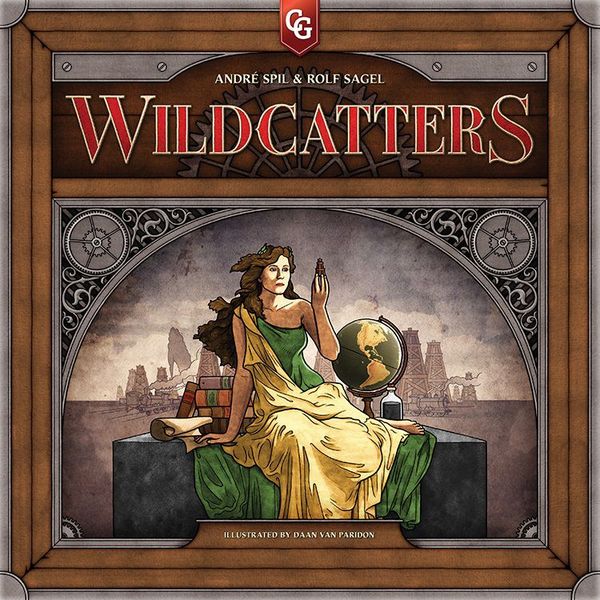
Wildcatters - An Economic Game or a Eurogame? (Published 7 February 2022)This review has also been published at Boardgamegeek. Economy vs EuroWhere do you draw the line between economic games and eurogames? Economy literally means management of resources but isn't this the challenge of most eurogames? Eurogames are characterized as games which "feature economics and the acquisition of resources... and emphasize individual development and comparative achievement" but isn't this exactly what you do in an economic game? Wildcatters has characteristics from both categories so perhaps it's no surprise that I (spoiler alert!) enjoy the game. Let's look closer at the gameplay step by step, from prospecting for oil to selling to the markets. 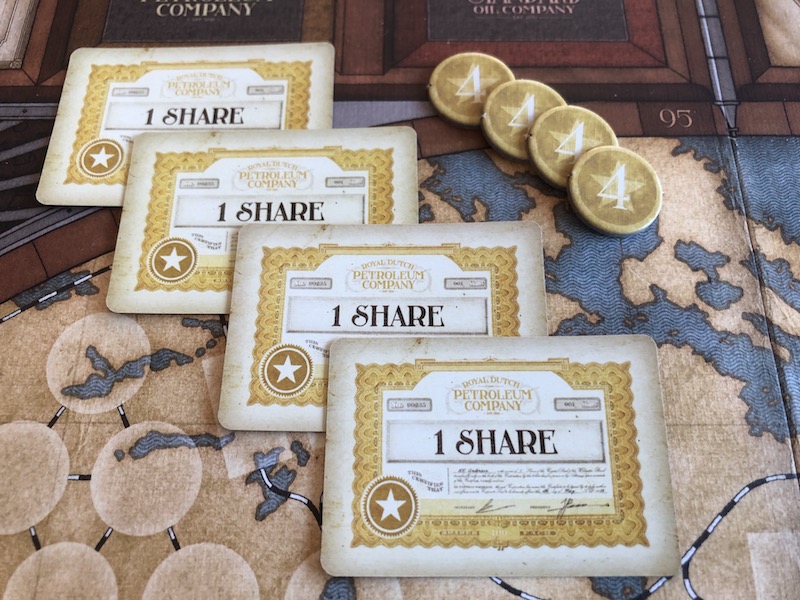
The shares - the foundation of most economic games (although they may not work as you expect them to in Wildcatters, more about that later). BackgroundWildcatters puts the players in the roles of oil barons during the 19th century, running the actual companies of Royal Dutch Petroleum Company, Standard Oil Company, Anglo-Persian Oil Company, and Pacific Coast Oil Company. Their goal is to supply oil to the 7 different markets North America, South America, Russia, Asia, Europe, Africa, and Australia. To accomplish this, they need to build infrastructure, prospect for oil, transport it to refineries, and sell it to the markets. At the same time, they must manage their scarce labor and capital as well as their stock portfolios. So far Wildcatters sounds like a heavy economic game where you have to do a SWOT analysis on each company for each market in order to... Hold on, this is not necessary in Wildcatters. The companies and markets are so abstracted that there are no differences between them except for the colors. Each company starts with an identical setup of money (referred to as workers but used like money), shares, and infrastructure. Each market is divided into 2 areas, each of which has exactly 7 oilfields, 2 pairs of rail tracks leading to 1 own harbor and 1 neighbor harbor, and 1 refinery. The exceptions are Europe, Africa, and Australia, which have no oilfields and only 2 rail tracks leading to the market's 2 ports and 2 refineries. In a true euro fashion, the map is completely empty and it's up to the players to fill it with infrastructure and resources, some as part of the setup and some during the game. As the game goes on, the players' actions will trigger oil booms across the world and it's up to them to predict and take advantage of them. Let's explore how by going through the rather long and detailed action phase that will bring oil from the ground to a market near you. 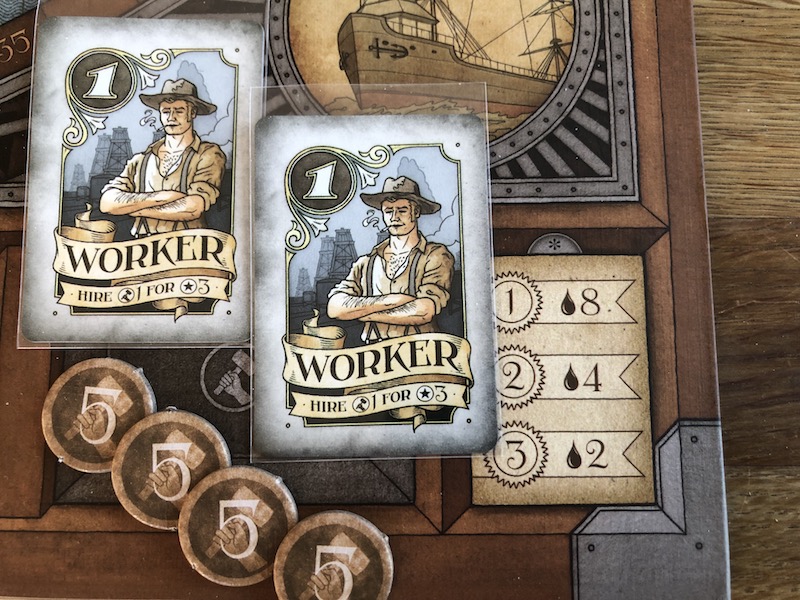
The workers - the expendable resource of Wildcatters (which you'll never have enough of, more about that later). The Economic ActionsThe action phase covers all possible company operations but although only the active player performs actions, other players may free-ride on some of them so the downtime is limited.
This adds up to no less than 35 workers (49 workers if you build all 4 rigs yourself) but you only get 10 workers per round. Although you do start with 20 workers and some infrastructure, it's easy to see that you can't do everything yourself. Instead, you have to decide where to cooperate and how. Do you go for the oil? Or do you prefer to profit from the other players' transports? Or perhaps you simply wait for them to deliver to your refinery? There are many factors to take into consideration so let's look at some of them. 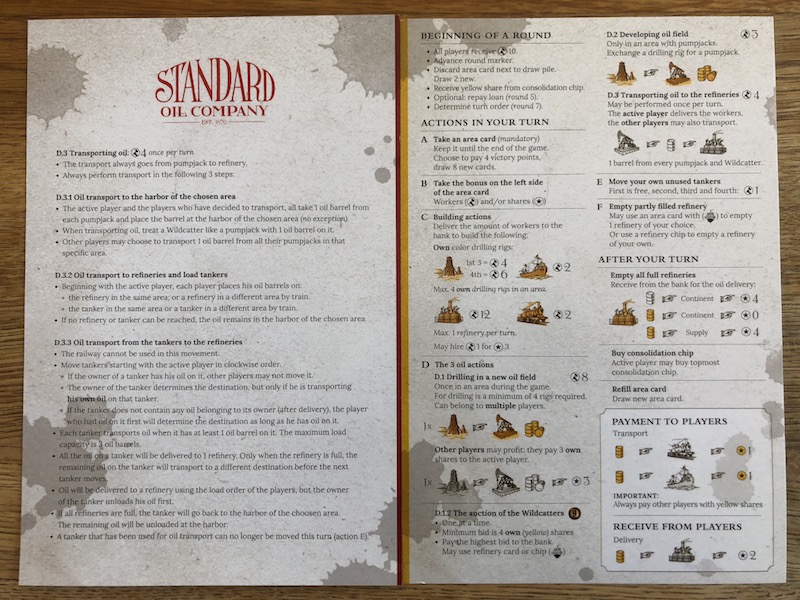
The big player aide - it is full of actions but looks more intimidating than it is. Area cardsAt the start of your turn, you take an area card from a display of 8 cards. This card provides a small bonus (workers, shares etc.) but its main purpose is to restrict your actions to this area. Isn't this restriction too euro, you may wonder. Why not let the players choose their areas freely? My answer is that this is a very elegant solution to simulate oil booms. If an area has several cards in the display, the players have an incentive to go for it, knowing that they won't have to do all the work themselves, so this area is likely to be the one where plenty of oil is prospected and extracted. At least for this round. On the other hand, if another area has seen no cards at all for some rounds and you already have presence in other areas of interest, you may want to consider this area so that you won't risk being left out when it booms and your opponents rush in for it (but not too early because there is no first mover advantage if you're alone). 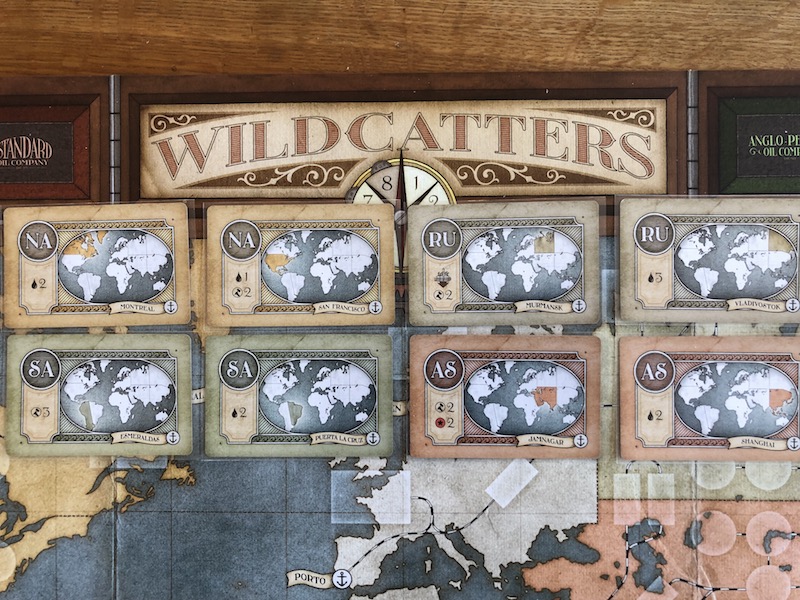
The area cards - where will the next oil boom take place? Drilling rigsDrilling rigs are required to get oil to the markets but how many are optimal? To build all 4 oil rigs required for drilling is expensive, particularly since the 4th rig costs 2 extra workers. 1 oil rig lets you pump oil from it (turning it into a pumpjack), either if you take the drill action yourself or if you free-ride when someone else takes it. A 2nd oil rig lets you take the develop action in the same turn and get a 2nd oil. A 3rd oil rig only pays off if the area is activated again later (but if it does, you don't want to be left out). So how many are optimal?. As in all good interactive games, it depends on the other players. Trains and tankersOil needs 1 train to be transported from an oil field to a refinery in the same area. An additional train can transport it to the refinery in an adjacent area while a tanker transports it to any area. If you don't own the necessary means of transport yourself, you may pay to use an opponent's. Thus, a well placed transport network that is frequently used by your opponents can earn you a lot. RefineriesThe last stop for the oil before it reaches a market is a refinery in the market's area. Similar to trains and tankers, players may use each others' refineries. However, in this case it's the owner of the refinery that has to pay the owner of the oil and it's not until the refinery is full that the oil moves to the market and the owner gets paid. One advantage with owning a refinery is that the owner sells opponents' oil to the market at a profit (twice as much as it cost), another that the owner chooses how to get paid when selling own oil: own shares or victory points. Hold on, don't I mean that the refinery owner gets money for the oil rather than own shares and victory points you might wonder. In a pure economic game, the answer would have been yes, since capital is the main resource that you use both to finance your operations and to measure your success but not so in Wildcatters. You do need money/workers to pay to the bank but all transactions between players are paid with own shares and your success is measured not by capital but by victory points earned from oil in the markets. Let's explore three important euro mechanics of Wildcatters: the area majority game, the resource management game and the set collection game. 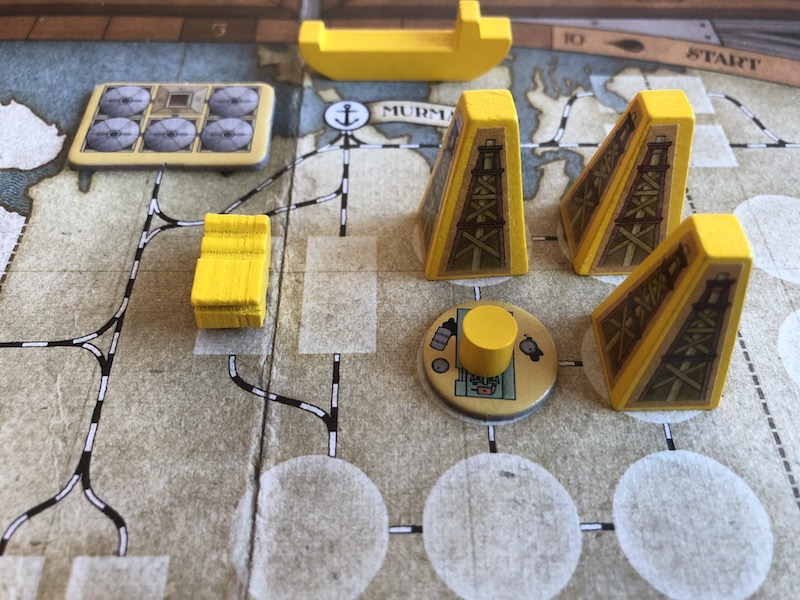
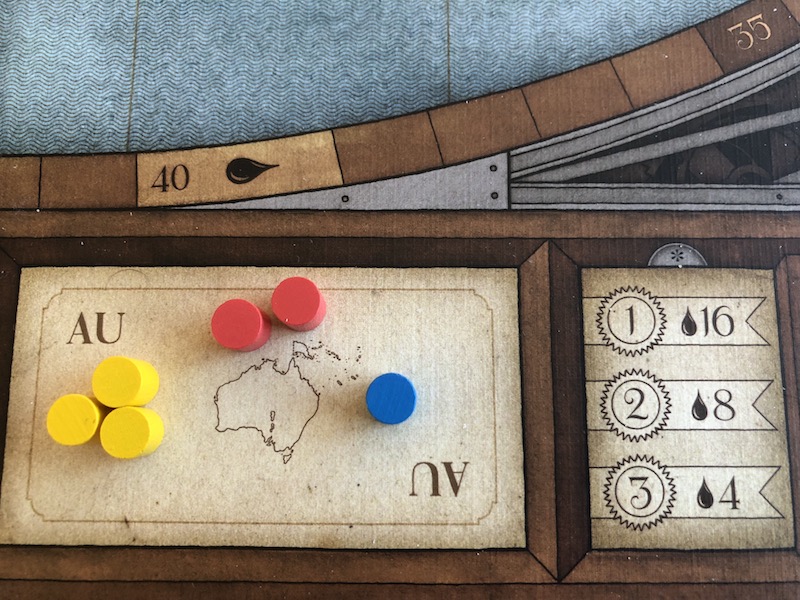
The infrastructure of Wildcatters - drilling rigs, pumpjacks, trains, tankers, and refineries. The Euro MechanicsOil - the area majority gameAs we've seen, the players invest in infrastructure and/or pay to use each others' actions and infrastructure to drill and transport oil. In an economic game, those investments (hopefully) yield a return which the players reinvest until one player emerges as the richest of them all and claims the victory. However, in Wildcatters the oil returns nothing and those arduously extracted and transported oil barrels are simply left in the market with no further function during the game. It's not until the game ends that those oil barrels become important as they will award VP through an area majority game. For each market, the player with the most barrels earns 16 VP, the player with the second most 8 VP, and the player with the third most 4 VP. This is a considerable part of the final score so in order to win, it's not enough to supply the most oil barrels but to supply just about more than the opponents in as many markets as possible. But why not simply give the players money instead of VP for their oil, perhaps through an intricate market mechanic where supply and demand dictate the prices? Well, one advantage of VP is that the players' resources remain scarce throughout the game. Wildcatters is not a snowball engine, where the challenge goes from how to GET resources to how to SPEND resources. No matter how awkward the area majority game seems, I must admit that it solves the inflation problem that some economic games may suffer from. After all, you could argue that there is a supply/demand mechanic in Wildcatters as well, since the players will aim for markets with few oil barrels, where less oil barrels are required to compete for the VP.
Australia is grateful for the oil deliveries - 16 VP to Yellow, 8 VP to Red, and 4 VP to Blue. Own shares - the resource management gameAs we've also seen, the players frequently pay each other during the oil's journey from the ground to the markets. However, the game's currency (money/workers) is only used when building own infrastructure, not when using opponents' infrastructure. Instead, each player pays with own shares to free-ride opponents' actions, use their infrastructure or receive their oil in refineries. Thus, shares don't have the function they usually have in economic games. They don't give you any dividends, nor do they let you take control over other players' companies. Instead, they act as additional resources, which must be carefully managed. You start with only 20 shares with few opportunities to get more during the game. You pay 3 own shares to drill oil during an opponent's action, 1 share to use an opponent's train or tanker, and 2 shares to receive an opponent's oil in your refinery. It's not until the oil goes to the market that you get 4 shares of any color per oil (and remember, this doesn't happen until the refinery is full). If you run out of own shares you have to take out a loan at a high interest rate to raise 10 new shares. (Such loans may either be repaid with 18 shares in the 5th round or with 25 shares at the end of the game - failure to do so cost 1 VP per missing share.) If you go for a refinery strategy, make sure that you can pay for the oil! 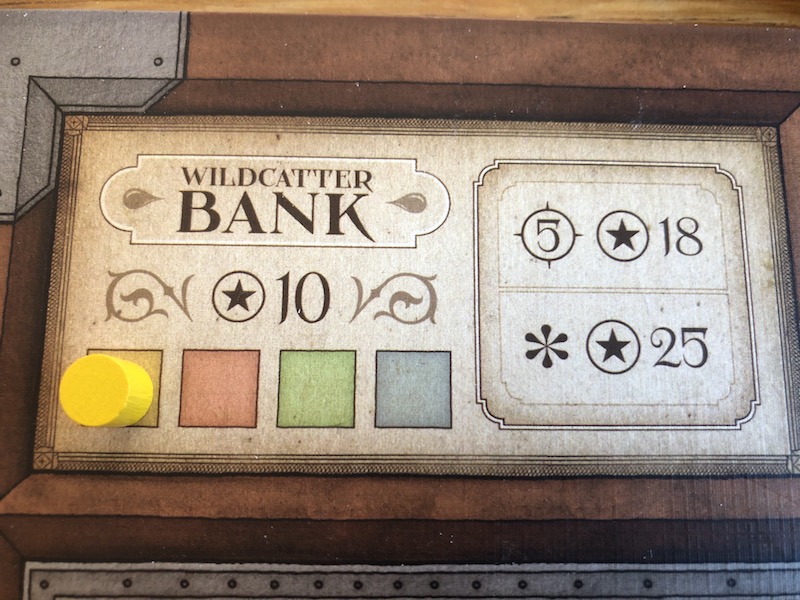
10 shares today cost 18 shares round 5 or 25 shares at the game end. Opponents' shares - the set collection gameOK, so money/workers and own shares are important but how about opponents' shares? You get them when opponents free-ride on your action, use your infrastructure, or receive your oil in their refineries but you can't use them when you want to do the same. Instead, the main use of opponents' shares is to buy so-called consolidation tokens. They cost you a number of complete sets of shares and earn you both own shares every round and VP at the end. This is quite an interesting mechanic. It's a welcome way to get own shares but certainly not an easy one. You need to spread out your infrastructure so that each opponent pays about the same number of shares to you to afford as many consolidation tokens as possible. 20 blue shares are of little use to you if you have no yellow shares. I can't help wondering if a certain Doctor influenced this "Knizian scoring". (I understand that in the first edition of Wildcatters, opponent shares were used not for consolidation tokens but for yet another majority game, where majorities in share colors earned you VP, but I do prefer this mechanic.) 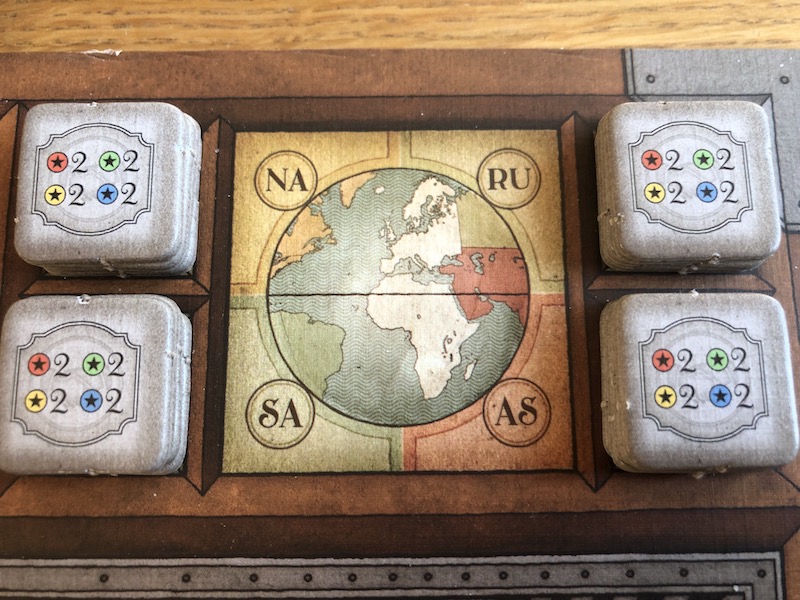
Consolidation tokens with prices starting at 2 shares of each color. Who are the wildcatters then?According to Wikipedia, wildcatters are individuals who drill for oil in areas not known to be oil fields. In the game, they are represented by tokens that are placed in the different areas (the fewer oil rigs, the more wildcatters) and auctioned for as soon as someone drills for oil there (and paid with own shares of course). True to Wildcatters' hybrid mechanics, a wildcatter token provides both an oil barrel and a number of victory points based on how many you've collected. Only the players with oil rigs in the area may participate in the auction so if nobody wanted to help you prospecting an area, you can at least console yourself with the fact that you'll be the only bidder for the wildcatter tokens. 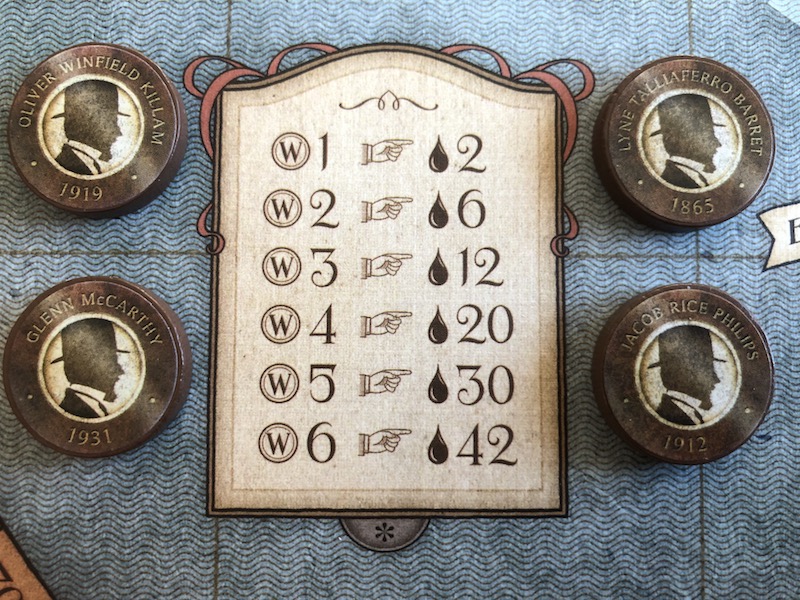
I must admit I didn't realize that each wildcatter has a unique name until I took this picture. So what does the sum of Economy and Euro equal to?I'm sure Wildcatters would work excellently without the euro mechanics but with capital as the only resource for investing in infrastructure and determining victory and with shares not as a means of payment but as a weapon of hostile take-overs and ruthless pump-and-dump transactions. Actually, there are plenty of such games and they are called 18XX. But would it be as fun? Would you get the kind of integrated economy, where every player fights to invest at the right time and the right place to make as much as possible out of an oil boom before moving on to the next? Certainly, Splotter Spellen has designed several games that accomplishes this. However, Wildcatters' hybrid is a rather unique design, the likes of which I haven't seen before (possibly with the exception of the under-rated Namibia). So is it fun then? Well, if you want an economic simulation that mirrors reality or a euro game where you have full control of your game and don't have to worry about your opponents, Wildcatters is not a game for you. However, if you want an abstraction of global oil booms that offer a highly interactive gameplay where the player who best predicts the game will win it, I strongly recommend Wildcatters. 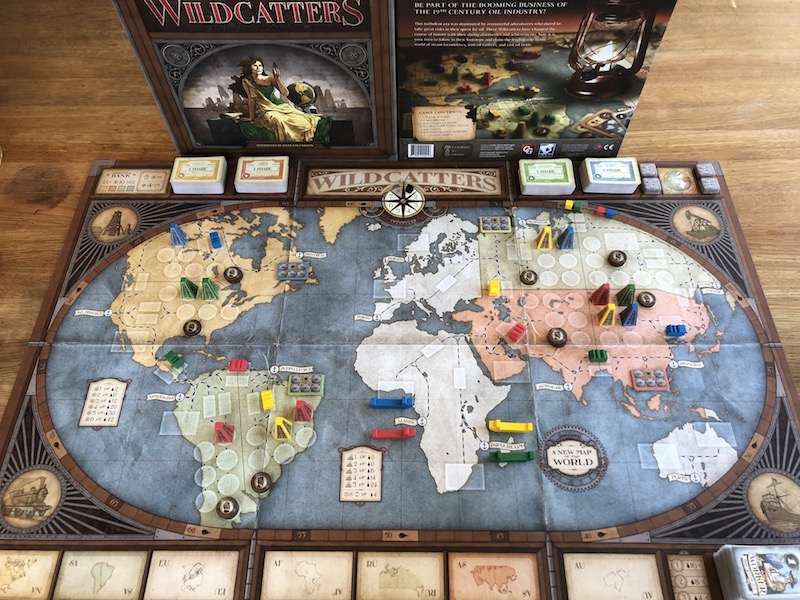
Ready to prospect for oil, perhaps in Eastern Asia? |
|