
 |
The Quest for the Perfect Game - Reviews to Extract the Essence of Games by Nicholas Hjelmberg | |


















































|
Welcome to Mars, the Planet of Opportunities (Published 27 May 2024)This review has also been published at Boardgamegeek. IntroductionThere are two kinds of eurogames, the ones where you have to specialize and do much in a few selected areas to win and the ones where you have to generalize and do a bit of everything to win. On Mars, however, you have to do much everywhere to make the planet sustainable. Fortunately, you're not alone and may stand on your opponents' shoulders to accomplish this. But Mars is an unforgiving planet and it'll take an effort to learn the game, let alone master, so some players may be better off staying on Earth. Let's start with an orbit view before we decide whether to land on the surface. 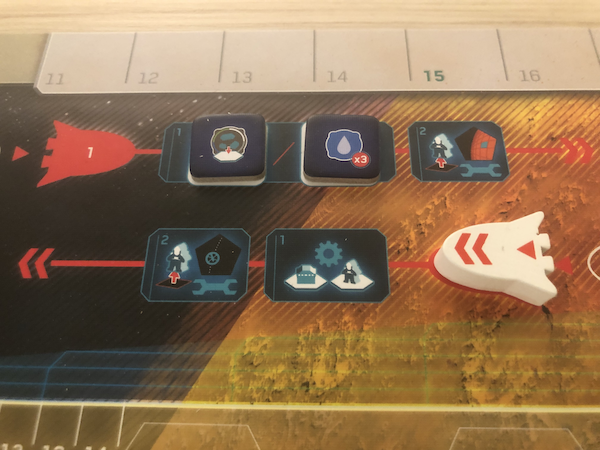
The shuttle is about to return to orbit and players joining it may 1) Retrieve colonists from orbit actions and 2) Produce resources in colony buildings. Players joining the return shuttle may 1) Place bonus tiles on Mars and 2) Retrieve colonists from colony actions. The Resources - The Circular EconomyWhat first attracted me to On Mars was the circular economy. Similar to many other euro games, On Mars is abundant with resources but producing them requires other resources: air requires plants which requires water which requires power which requires minerals which requires workers which requires... air. So how are those resources produced then? Through production buildings of course, this is a euro game after all. However, being a Lacerda game, there are more dimensions to the production buildings. A "basic" production building is merely a neutral tile placed on the game board. This tile can be "upgraded" in two ways, either by placing adjacent tiles of the same type and creating a "complex" or by placing a personal wooden building on top and creating an "advanced" building. What's the point of those building dimensions you may wonder. Well, there is a difference between them. Basic buildings provide an immediate reward in the same building action while advanced buildings provide permanent rewards but only in production actions (more about them later). Also, the bigger the complex, the bigger the reward. The first player to build, say, a plant building pays 1 water and receives 1 plant. The second player may then build another plant building and receive 2 plants (provided that she builds a complex) and the third player may build an advanced building and receive a permanent income (and opportunity points and an executive action, the bigger the complex the better, but more about them later). To do this on your own would require way too many actions and resources but together the players may generate economic growth on Mars and create a self-sustaining colony. Wait a second! This is a competitive game, not a cooperative one. Why would the players give each other opportunities like this? Well, this is where the LSS enters the game. 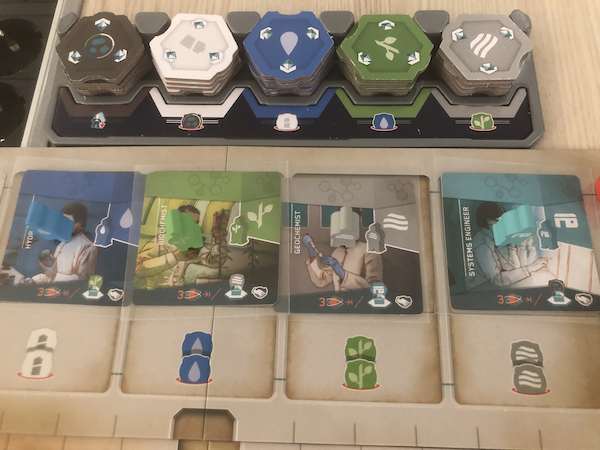
The circular economy in action: minerals can be used to get energy can be used to get water can be used to get plants can be used to get air can be used to get shelters (from the player boards) to house colonists to get minerals. Similarly, energy can be used to get a water scientist and so on. The Life Support System (LSS) - The Shared IncentivesThe players represent competing corporations with private agendas (i.e. earn victory points or opportunity points) but they also have a common interest in buildings to provide those opportunities. The game offers shared incentives for players to build those buildings through the Life Support System (LSS) tracks. The LSS represents the colony's current need for buildings. The game starts with one building of each type and the colony demands a second building of each type. Once there are two buildings of each type, the LSS level increases and the colony starts demanding a third building of each type. Each player that fulfils this demand receives valuable bonuses (which varies between games but typically include extra actions, extra resources, opportunity points etc.) so there is a race to build them, even if this creates opportunities for other players. This gives On Mars a game flow where buildings are built one at the time and where the players have to have the actions and the resources at hand to take advantage of the new buildings and the increasing LSS levels. So why not start on Mars immediately and get this building done? Well, it wouldn't be a Lacerda game if it were that simple. There are many prerequisite actions that need to be taken and there are not one but two distinctly separate action boards. 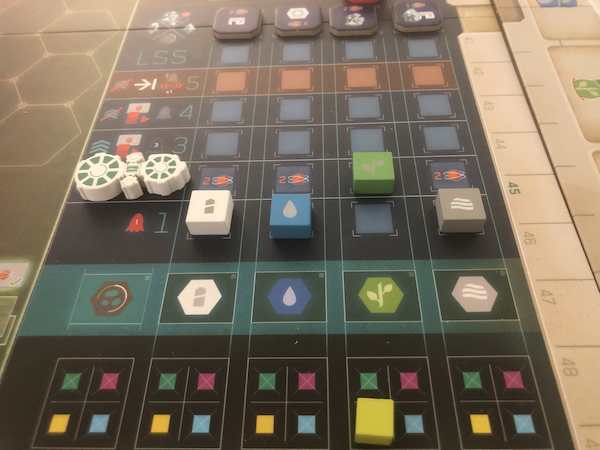
Yellow has built a plant complex as requested for the LSS and gets 1) a cube that gives OP at certain times, 2) a variable bonus, in this case 2 OP per bot and 3) a choice of 4 different bonuses. The Orbit Actions and the Colony ActionsAlready at the setup, On Mars challenges you to choose whether to start on the orbit side turn track or on the colony side turn track. Your choice determines which action board you may place your workers or colonists on and you may only switch sides at the end of the rounds (the higher the LSS level, the less frequent) so you must choose wisely. Basically, the orbit side lets you acquire various things while the colony side lets you use those things. It is possible to stay on the colony side the entire game (it's fun to try to get started with the scarce resources of Mars but I expect experienced players will punish you) but typically the players have to travel back and forth until the planet gets more sustainable. It is also the travel action (to orbit) that triggers production in your advanced buildings. The orbit side lets you take resources (required to build buildings), technology (required to build bigger complexes) and blueprints (required to build advanced buildings). The technology tiles deserves a special mention since you place them on a personal technology tree and advance them to higher levels. Your technology is available to all players to use (and you get a free advance if they do) and the more you advance them, the more bonuses and opportunity points you get so "helping" other players in this way is a viable strategy. 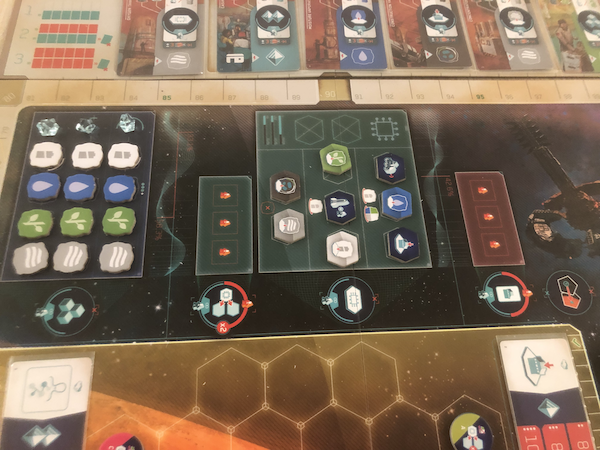
Orbit actions from left to right: 1) Take resources, 2) Advance technology, 3) Take technology, 4) Take blueprint and 5) Move to colony. The colony side lets you build the basic and advanced buildings mentioned above. It also introduces the concept of scientists, which may work in advanced buildings to unlock more executive actions (more about them below), and contracts, which may be fulfilled for opportunity points. Finally you may welcome more colonists to Mars (restricted by the current LSS level, a rule I personally often forget) to get more actions. This leads us to On Mars' twist on workers and actions. 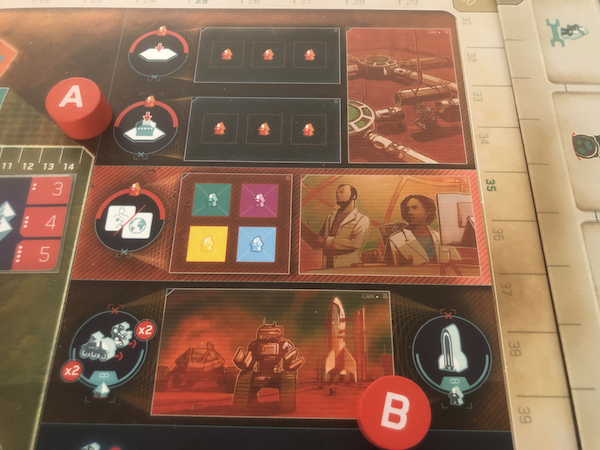
Colony actions from top to bottom: 1) Build basic buildings, 2) Build advanced buildings, 3) Get scientists or contracts, 4) Move bot and rover and 5) Welcome colonists. Teal Actions, Red Actions and Crystal ActionsOn the player board there is a living quarter (from where your colonists go to work) and a working quarter (to which your colonists go after work). However, there are several intricate rules that dictate how they are used and how they are retrieved. On top of the action space there is the basic action cost, which may be either an "X" (no colonist needed) or a red colonist icon (one colonist must be left in the action space). On the bottom of the action space there is the cost to boost the action. An "X" means that the action can't be boosted but a teal colonist icon means that colonists may be moved from the living quarter to the working quarter to repeat the action, e.g. take one more resource for each colonist moved in this way. There are also so-called executive actions on the player board and on the blueprints that may be used once per turn, before or after the main action. The more colonists you welcome to Mars and the more advanced buildings you build, the more executive actions you unlock and the cost of each action is a number of crystals. This is yet another resource in the game and it's mainly obtained from colonist buildings (similar to how other resources are obtained) or from the surface of Mars itself. Let's explore how! 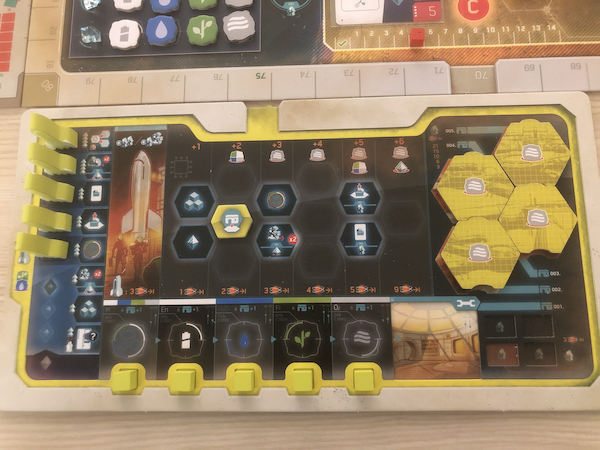
The player board with executive actions to the left, technology tree in the top middle, resources in the bottom middle and colonist quarters to the right. The Bots and the RoversIn addition to all the traditional euro challenges of getting the right resources at the right time, there is a "dudes on a map mini game" on Mars. Besides the colonists, the players have one bot and one rover to move around (with the possibility of acquiring more bots during the game). The purpose of the bot is to build buildings and you must have it on or next to the hex where you're building. The purpose of the rover is to collect crystals en route and bonus tiles where it ends its movement. Some of the bonus tiles are placed at the setup, others as players travel between the orbit and the colony. It costs a precious action to move them around but you'll curse your greed when your bot is too far away from the critical building sites (a building may only be built adjacent to or exactly one hex away from similar buildings) and leaving a player to rove around on his own means leaving a lot of riches for free. There is even a "cheat" here where you build on the bot's hex, in which case you must displace it (read: move for free) to an adjacent hex. With good planning, you can move your bot to all places you need without wasting any actions. I can't help wondering if this was designed deliberately or if it was a side effect of an attempt to avoid cluttered hexes but it's one of many examples of small tactical tricks on Mars. All in all, bots and rovers provide an additional arena for the players to compete in. Speaking of competition, although those mini games the players compete for resources and bonus actions or general improvements of their player boards may be fun on their own, the players must not forget the goal of the game: to turn all this into opportunity points. Let's look closer at where those points come from. 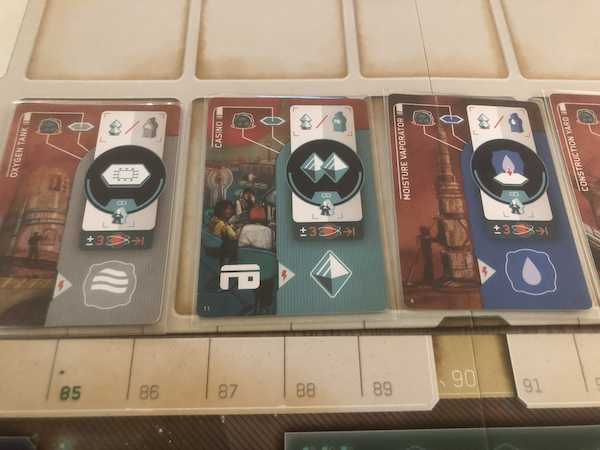
The anatomy of the blueprint: The Casino gives the owner 1 crystal when taken, costs 1 mineral to build, requires a basic building of at least size 1, unlocks an executive action that gives 2 crystals and is worth 3 OP in the end (or -3 OP if not built). The OpportunitiesA good game should reward the players for playing the game well. There should be a clear link between what you do in the game and the victory points you earn. I've played too many point salads where it's difficult to tell what the winner did well to deserve the victory. On Mars also has many victory point sources but they are all related to the goal of the game: to make the planet sustainable. The main source of victory points, or opportunity points, is building. The basic buildings award you opportunity points the first two times the LSS level increases as well as when the game ends. The more variety you have contributed with, the more opportunity points you get. The advanced buildings award you opportunity points when the game ends but also opens up two other opportunity point sources. First, you may acquire contracts that reward certain building combinations. (There are also contracts that reward resources.) Second, you may acquire scientists and place them in buildings for free executive actions, which earn you victory points for related buildings irrespective of who built them.If you're too late to the contract/scientist party, you may very well end up with less points than players who built less than you. This may distract from the sustainability goal (contracts are good for you, not for Mars) and some players think that contracts are too powerful. On the other hand, they do add yet another opportunity to the game. 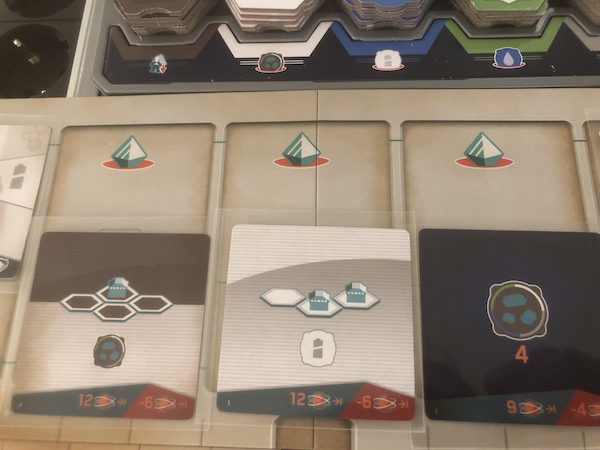
For the cost of 1 crystal you may acquire a contract to build 1 advanced mineral building on a complex of at least size 4 or 2 energy buildings on a complex of at least size 3 or simply deliver 4 minerals. Success gives your 12 OP but failure costs you 3 OP. Another important source of opportunity points is advancing technology tiles. Since your technology may be used by all players, it makes sense that you are rewarded for your effort. Finally, you receive opportunity points for populating Mars (by building ships and shelters to get colonists to your player board). With so many opportunity point sources, the weighing of them may always be questioned. How does 3 OP for a basic building compare with 12 OP for a contract? Nevertheless, the winners of my games of On Mars have not come as a surprise but rather rewarded the players who best contributed to the planet's sustainability. 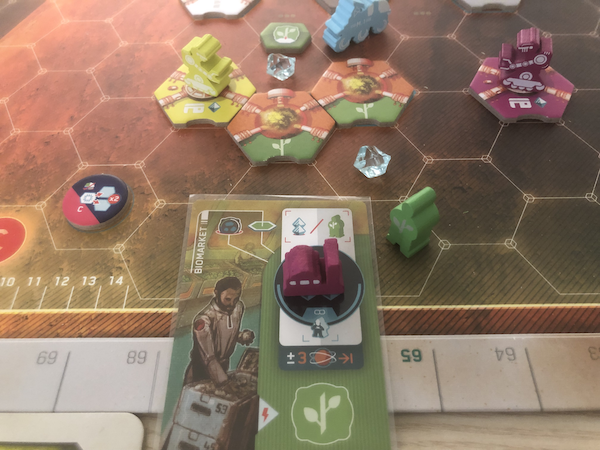
Opportunities on Mars: Yellow bot has built a basic building (using Blue's plant technology so that it was developed further and spawning crystals which the Blue rover may pick up), on which Purple may use her blueprint to build an advanced building, in which Teal player may place a plant scientist so that both Yellow and Teal may use the building's executive action for free. ConclusionOn Mars is certainly not a game for everybody. One small step for man is no step at all for mankind unless you manage to plan your actions and take them in the right place at the right time. The latter aspect may be particularly intimidating to new players: before the game has even started you have to choose between the orbit and the surface. Then you have to get the resources, blueprints and technologies you need and place your bots and rovers where they are needed to accomplish anything On Mars. Finally you need to ensure that you're rewarded for your effort. This kind of challenge is present in all Lacerda's games but perhaps more prominent here than in other games. On the other hand, the player who does take on this challenge will be rewarded. It's a great satisfaction to place that building that you planned for so many turns (or, depending on your preferences, to deny another player that opportunity). It's also satisfying to see how Mars is turned from a barren wasteland to a self-sustaining colony over the course of the game. Personally, I think On Mars is more thematic than any other space game I've played. Is On Mars even Lacerda's finest moment? I don't know. Kanban has elegant and streamlined mechanics while Lisboa is a labor of love with a strong city-building theme. On Mars has both interesting mechanics, such as the circular economy and the travel between orbit and space, as well as a strong planet colonization theme. I'll have to pass on this question but I'm happy to have all those games in my collection and only regret that I don't get to play them as often as I want. 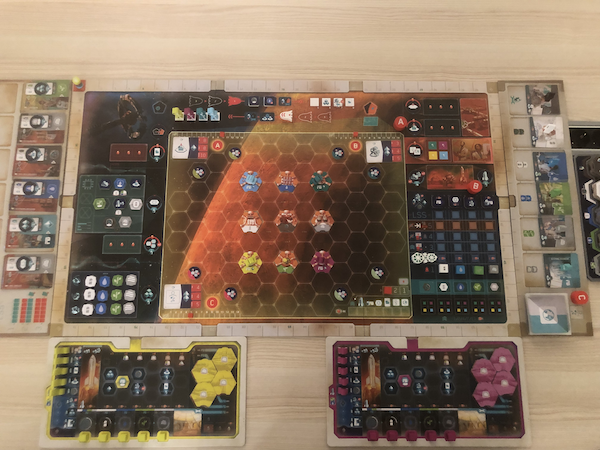
On Mars set up and ready for the players to explore the planet's virgin territory. |
|