
 |
The Quest for the Perfect Game - Reviews to Extract the Essence of Games by Nicholas Hjelmberg | |

















|
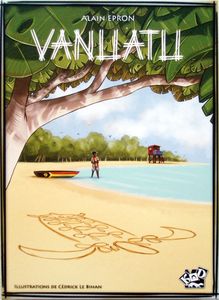
Vanuatu - A Paradise Island, on the surface... (Published 26 August 2019)This review has also been published at Boardgamegeek. IntroductionWelcome to the paradise island of Vanuatu. Here you may sail between the beaches, visit the market stalls, go for fishing and exploring in the sea, buy native goods, admire the sand drawings or simply take a rest. It's truly a paradise where everybody is friendly. At least as far as the tourists know... On the surface, Vanuatu is a simple worker placement based on an even simpler economic system. The players take actions to acquire resources and exchange them for money or victory points. If this was everything Vanuatu could offer, you might just as well stay home. However, there are three challenges that differentiate this island from many other destinations. 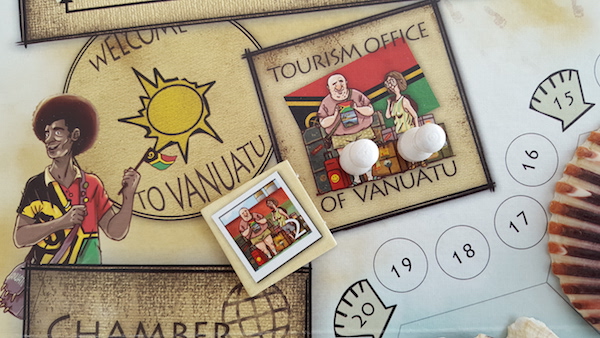
Welcome to Vanuatu! What would you like to do first? First, there is a spatial challenge of adapting to the ever changing map. Old island and sea tiles are exhausted while new ones are added each round and with them come new opportunities that you have to adapt to. Second, there is a temporal challenge due to the extremely tight economy. Forget about building an engine and simply let it run. In Vanuatu, you'll frequently find yourself struggling with the timing of your actions to get what you need when you need it. Third, there is an action selection challenge. Instead of your normal blocked action spaces, the Vanuatu action spaces are open to everybody but only the player with the most action markers there may take the action. Thus, you're never sure when or even if you get to take your carefully planned action. To better understand how those challenges are interwoven with each other, we need to understand the context they are set in so bear with me while we go through some basic island economics. The Actions - From resources to victory pointsEach player has five action markers and there are nine actions to choose from in Vanuatu.
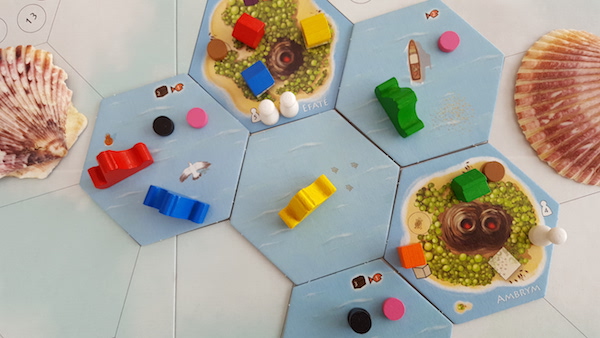
The green ship may sail to another sea tile, build a market stall on the empty square of Ambryn, fish and later sell a pink fish disc, buy the orange good of Ambryn, place a brown drawing disc on the empty circle of Ambryn, and transport tourists to any of the islands. To explore, she must first sail to a sea tile with black explore markers. In addition to selecting the actions, the players also select characters each round. A character is typically linked to an action and provides a certain bonus for taking it. One example is the Builder, who builds for less vatu, and another one is the Diver, who earns vatu in addition to victory points for exploring treasures. The Challenges - Why you can't simply amass resources and switch to victory pointsThe spatial challenge - The changing mapMost actions in the list above are linked to where your ship is and which pieces and spaces that are available on the tiles around it. Build and drawing spaces are limited, tourist pawns are limited, as is the capacity of an island to receive them, treasure and fish discs are limited and so on. The only exception concern the Buy action, where completely exhausted islands get new goods and where completely filled ships get replaced. 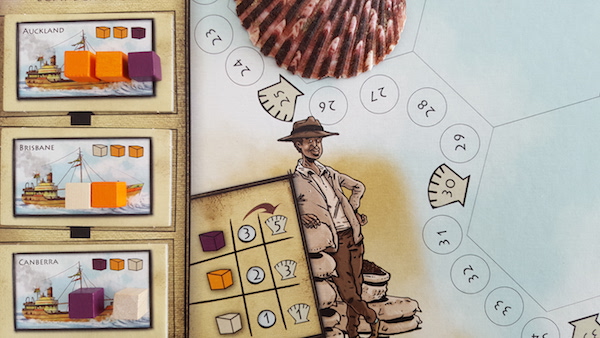
The Auckland ship is full but if you could buy an orange cube for 2 vatu, you'll earn 3 vatu for selling it to the Brisbane ship and another 2 vatu for filling it. However, each new round sees two new tiles added to the map (known at the start of the previous round and placed by the new starting player) with new pieces and spaces for whoever can get to them first. Happily staying where you are is not an option in Vanuatu. This leads us to the second challenge, namely the temporal challenge. The temporal challenge - The timing of the actionsThe list of actions above also showed the importance of timing your actions. Not only is it important to be first to get the most out of an action (the first to catch fish gets the most fish and so on) but it is also important to take the actions in the right order (before you can sell fish, you must catch the fish and before you catch the fish you must sail to the fish). In some cases, you will want to dealy your actions, such as delaying your tourist transport until market stalls have been built on an island. There is also a rule that makes your economy even tighter, namely that of forced conversion. If you reach 10 vatu, they are immediately converted to 5 victory points. Not bad for your score but disastrous if you need money to finance your actions. Thus, Vanuatu is not only a game where you never have enough time to do everything you want but also a game where you never have enough money. But surely it's an easy thing to to plan an optimal order of actions and excute them? No, we're now moving on the third challenge, namely that of the action selection. The action selection challenge - The when and if of actionsWe've finally reached the most distinguishing challenge of Vanuatu - the action selection challenge. Each player har five action markers to place on the nine action spaces. The players place them in turn order, two the first and the second turn and one the third turn, and then execute them in turn order. However, an action may only be executed if you have a simple majority there, with ties being broken in turn order. To make things worse, if you have no majority at all, you must remove all your action markers from one action space. If things go bad, your carefully planned action chain breaks and you're forced to forego some actions. If things go terrible, you don't get any actions at all! 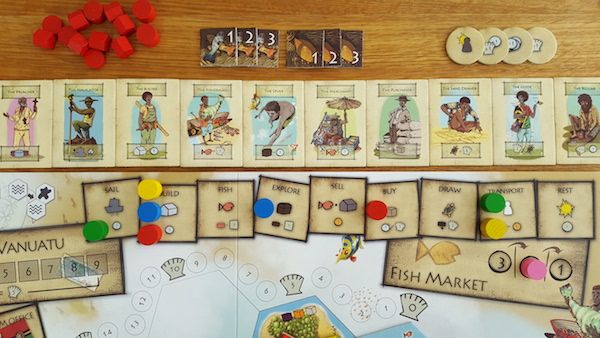
Red is last in turn order so to take the build action, she must either place a second action marker there or wait for Yellow and Blue to take their build actions first. So is there a game or just chaos in the eye of this hurricane?You may think that playing a game of Vanuatu is as futile as sailing a ship through a hurricane and that you might as well let it go and hope for the best. Indeed, if you're looking for a game where you can set up a detailed plan and see it executed the next few rounds or a game where you can build an engine and have the pleasant problem of how best to use all the resources it generates or a game where you will never curse or be cursed by your opponents, you should avoid Vanuatu at all costs. Your plans will break, your engine will constantly need more fuel and you will constantly clash with your opponents over the precious action spaces. This doesn't mean that it's impossible to play well in Vanuatu. The key to do so is to understand that the true game doesn't take place in the action execution but rather in the action selection. The current game conditions help you determine what you need to do in the round at what time and predict what your opponents need to do at what time. This in turn helps you determine where to place your action markers to accomplish this. You may think that the first player has a tremendous advantage thanks to the turn order tiebreak but going last and seeing where the competition is low is also advantageous. Once this first action selection game is completed, the second action selection game begins, namely the action execution. It's not the actual execution that's interesting, since most of the actions are executed more or less automatically, but rather the order of the execution. If you have a lonely action marker in one space and a majority in another, it's often good/evil to take the former action first and keep blocking your opponents to mess with their plans or even force them to remove action markers without actions. There may also be cases where you WANT to give actions to your opponents, for example to force a player to sail away from an island that he or she wanted to take other actions at first. (Actions are mandatory in Vanuatu - you may not pass.) Thus, Vanuatu is mainly a tactical game. There is room for long term planning, for example when it comes to where to place your ship and how best to increase the value of your market stalls, but you must be prepared to constantly adapt your strategy to the changing game conditions. As such a game, Vanuatu may feel slightly too long. Although each individual round is tense and interactive, not much changes from round to round (you take the same actions to counter the same challenges) and not much new can be explored from game to game. On the other hand, fewer rounds would make it very difficult to catch up from a "lost round" (and without lost rounds, Vanuatu wouldn't be nearly as fun). The conclusion is that Vanuatu offers a unique challenge when it comes to action selection, which players in favor of interaction may appreciate but players in favor of control may dislike. The tight economy reminds a bit about another "island game" with shared actions, namely Puerto Rico, where resources are also scarce. But instead of selectiong actions to minimize opponents' benefits, you select actions to deny your opponents actions altogether. Fun for some, too mean for others. Your game preferences determine whether you may enjoy Vanuatu or whether you should travel elsewhere. 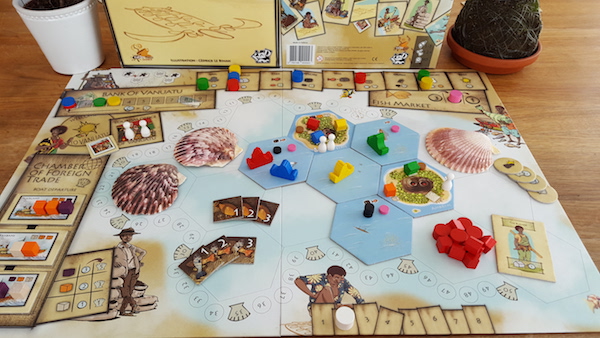
|
|