
 |
The Quest for the Perfect Game - Reviews to Extract the Essence of Games by Nicholas Hjelmberg | |



















































|
Smartphone Inc. - Well Planned is All Done (Published 7 June 2021)This review has also been published at Boardgamegeek. "I want an economy game."
OK, this is probably not how Ivan Lashin approached the design of Smartphone but he did indeed manage to transform several complex business decisions into a smooth and streamlined gameplay. Let's look closer at how each business decision is played in the game. 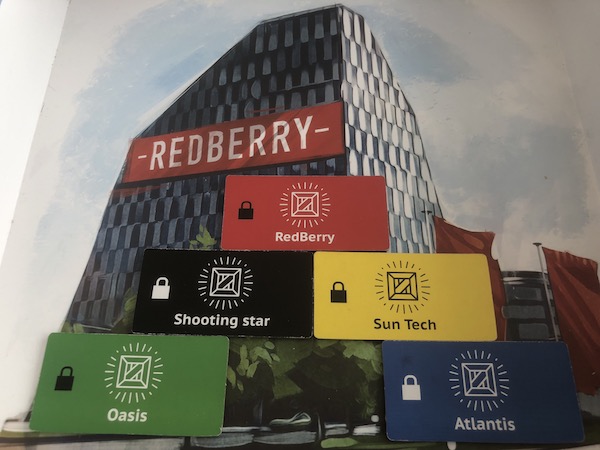
The five companies about to change everything OverviewSmartphone puts the players in charge of companies aiming at developing, manufacturing and marketing smartphones globally. The game is played over five rounds, each of which is divided into eight phases. Each phase contains a business decision that takes your company one step further towards global market domination and when the game is over it has hopefully grown from a local start-up to a multinational corporation. Victory points are awarded mainly for sales (price times volume) but also for "market dominance" (selling most on a market) and patents (first to research a technology). The player with the most victory points wins. This means that although you have forty actions at your disposal, each single business decision is taken only five times throughout the game. As in all good games this is not nearly enough for everything you want to do and every decision is critical. Let's move on and look at each phase in detail. 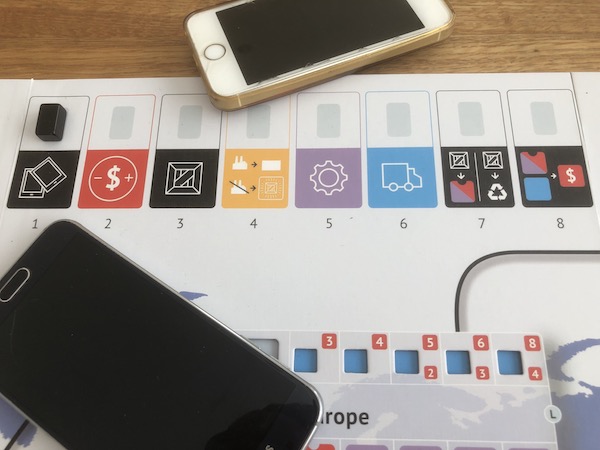
The eight decisions that will build your company PlanningThe planning phase is perhaps the most distinguishing part of Smartphone Inc. In this phase, you pre-program your actions for the round using two "pads". Each pad has six action spaces on each side (of which two are empty) which you place so that one partly overlap the other. Every visible action space gives you one action of that kind and every hidden action space gives you one extra production action. That's it - two pads to rule them all! As you might guess, this seemingly simple action is not a trivial one. For every action that you add to your plan (by making it visible) you will have to sacrifice another (by uncovering it) and this phase is the most agonizing in the game. As we will see when we move on to the other actions, one action more or less is often crucial for your business plan. 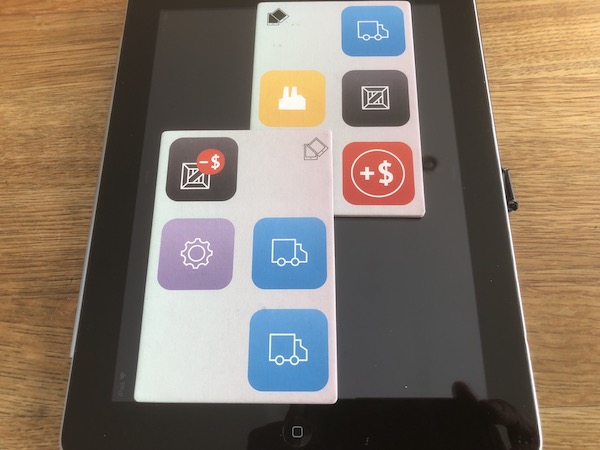
Two magical and revolutionary devices at an unbelievable price Pricing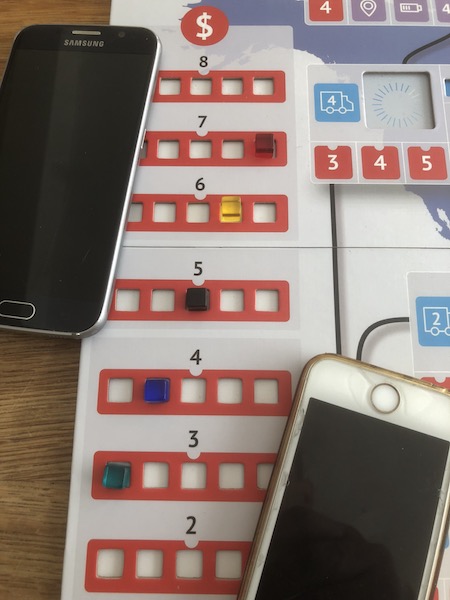
The pricing phase is a simple matter of adjusting your selling price based on the price modifier actions (plus or minus) that you chose in the planning phase. Your selling price has two important implications. First, there are twelve markets to sell to, each with its unique customer track. However, some customers will only buy your smartphone if your price is less than or equal to their pricing preference. Other customers will buy your smartphone at any price but only if you have researched a certain technology. Thus your pricing decision must take into account the number of smartphones you sell, the markets you are present in, and the number of customers you expect to sell to. Mathematically, a medium volume at a medium price is often an optimal use of actions (5x5 is more than 6x4). However, this only applies if you're alone in a market. As the second implication of your selling price shows, Smartphone is far from a multiplayer solitaire. The turn order in the round is determined by the selling price, where the lowest price goes first (or the lowest number of victory points in case of a tie). This means that a cheap company may very well clog the customer tracks and leave you with expensive but unsold smartphones. This may sound like a low price strategy is always optimal. However, as pointed out by the designer this strategic decision is a bit of a rock-paper-scissors decision where low prices generally win against medium prices but lose against high prices, since the high price company can spend actions to reach customers that the low price companies don't reach. Let's proceed to the other actions to see how they can be combined for different business strategies. ProductionThe production phase is as simple as the pricing phase where all you do is add up all your production actions and take one goods cube for each of them. As we have seen above, your production decision is strongly correlated to your pricing decision. Do you go for a low price-high volume strategy or for the opposite? Another important thing to consider is that unsold smartphones cannot be saved for later rounds. (After all, who wants last year's model?) Thus, you really want to find a balance that exactly matches your supply with the customers' demand. Unsold smartphones are actions you could have used better while empty customer spaces are lost victory points (or, even worse, victory points claimed by an opponent). So far so good, but the business decisions are not only about maximizing profits this round but also about building your company for bigger actions the next round. Thus, you must decide how much profit today you should sacrifice for profit in the future. Let's look at your various options, starting with Development. Development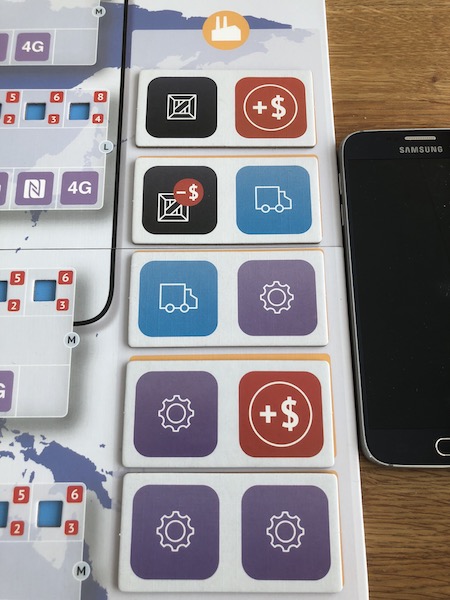
Do you think four actions per pad is too little for everything you want to do? Well, use the development actions to pick up extra action tiles. Those action tiles let you cover spaces on your pad to increase the number of actions (by covering the empty action spaces) or specialize in certain actions (by taking tiles with actions that better suit your strategy). You may also simply leave an action tile next to your pad and use it as an extra production action. This sounds like a win-win decision, doesn't it? Pay one action now and get one extra action for the rest of the game. Indeed, but there are more actions that may be even more valuable to you. ResearchGetting more actions through development is not the only way to boost your company, you can also get better actions through research. There are six different research tiles, each of which has a research cost. Each research action lets you place a token next to the tile and once the number of research tokens equals the research cost, you get the benefits. One immediate benefit is that the first player to complete a research gets a patent tile, which is worth victory points in the end. This also makes the research cheaper for the other players. More importantly, each research provides a unique ability, such as extra production with certain actions. As mentioned above, each research also lets your company sell to customers interested in the researched technology AT ANY PRICE. This means that as long as you have a technology monopoly, you can raise the prices without having to worry about your cheaper but less advanced competitors. Sadly, though, they will soon catch up and you have to find other means of competition. Perhaps a new market? 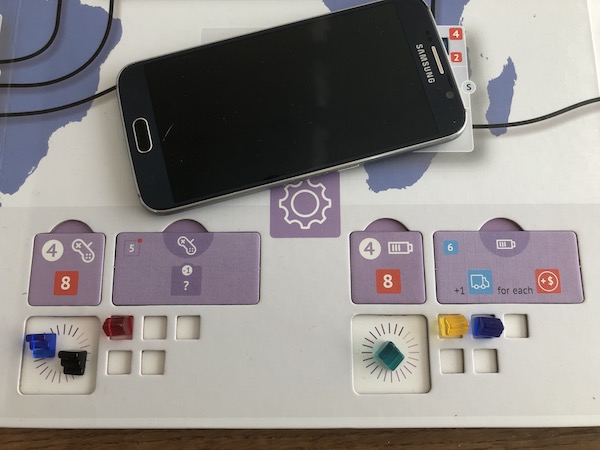
Every function your smartphone needs - except a phone ExpansionThe expansion action lets you place tokens next to markets adjacent to markets where you already have presence. Similar to research, each market has an entry cost and once the number of expansion tokens equals the entry cost, you place an office in the market and may sell at it. Also similar to research, as long as you have a market monopoly, you don't have to worry about competitors (provided that you supply prices and technology that the customers demand). 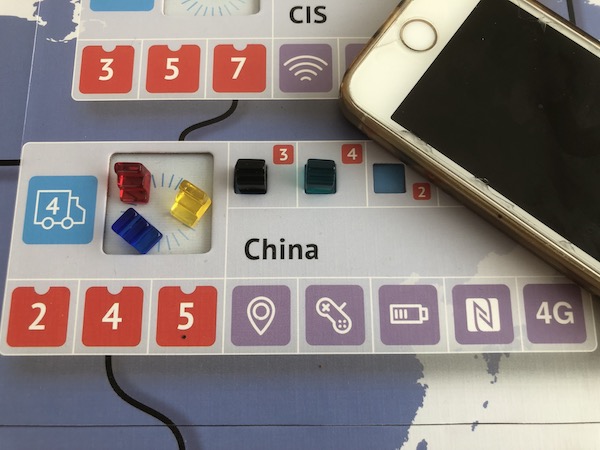
No one here has any phone, no market or huge market? SellingSo, has your company made the right business decisions? The selling phase is the moment of truth in Smartphone Inc. In turn order, you place your smartphones in the markets of your choice, filling the customer spaces from left to right and skipping those customers whose price or technology preferences you cannot match. If you have more smartphones than customers, this phase has no decisions and you simply fill all the spaces you can. However, if you have less smartphones, you have to take into account which customers you can "steal" from your competitors by selling to them first (who said this is a friendly game?) and which markets you can sell the most to to get a market dominance (which will earn you victory points based on how many offices that have been placed there). The more popular a market is, the more victory points can be earned from market dominance but of course, the more fierce is the competition. In the example below, the left-most customer is only willing to pay 3 and thus only green can sell to her whereas only red has the gamepad technology demanded by one of the right-most customers. 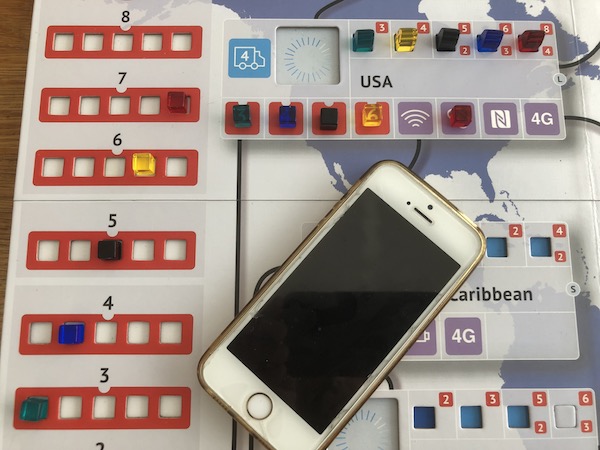
It's not about being best, it's about being first ProfitsThe final profits phase is a simple accounting phase. Multiply your price with your number of sold smartphones and add the victory points from your market dominance. Then remove all the smartphones, restore the prices to 5, and refresh the development tiles. You are now ready for the next round. 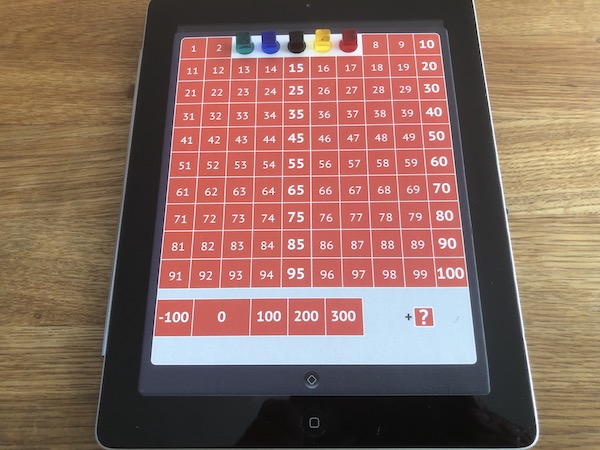
Money makes the world go round The GameplaySo how do all those streamlined actions manifest in the gameplay? A typical game starts with the players earning some easy victory points from their local markets while carefully improving their companies in areas where they will be the most competitive (i.e. areas with few other competitors). Some players focus on research or development, others on expansions to new markets. In the second round, the patterns of the future competition starts to appear and the players start specializing their companies to be prepared. The third round sees a mix of competition in existing markets as well as for the new markets (with respect to both geography and technology). In the fourth round most players are competing with each other somewhere and the main challenge is which strategy to choose to offer the best all-round competition. Finally all companies have gone global and technologically advanced and the end game is all about maximizing the profits given the worldwide competition. 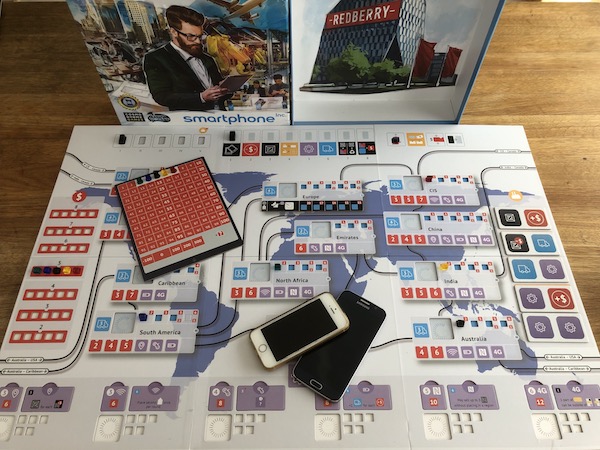
A world craving for smartphones The ThemeFor such a streamlined game, the theme remains surprisingly strong. Similar to many real companies, the players' companies start local and need to find their competitive edges to go global. Low prices and/or technologically advanced products will help on the way but the different market conditions must be taken into accounts. Some markets look mainly at prices, others at cool features. But in spite of the local differences, the players cannot sell their products as premium products in some areas and mass market products in others but have to stick to their brand image. Several important business decisions have been abstracted and included in the game to provide a holistic experience. Although Smartphone Inc. may not make you feel like Steve Jobs, it probably gets closer than any other game that plays in less than two hours. (As a personal sidenote, I have considered designing an economic game that through simple means manages to recreate the process of globalization. I guess it's too late now.) What has been rationalized away?It is self-evident that such a short game as Smartphone Inc. cannot offer the full experience of running a multinational corporation. However, there are some things which I personally feel could have been included. One is the balance between financing daily operations and future investments. As it is now, there are no running costs to take into account so a company could basically ignore sales in the opening without having to fear bankruptcy. A simple loan mechanic à la Martin Wallace might have been enough. Another is the fixed game board. The markets do not change from game to game, nor do the research options (unless you choose to play with their other sides). Although I am a strong advocate of the principle that game variety should originate from the players, not from the game, a more modular board could have been interesting to force the players to think fresh in every new game. Something that other players might miss is a stock mechanic, where the players may buy and sell shares in each others' companies, but then we are talking 18xx and a completely different game. Smartphone Inc. does not want to, and should not, be such a game. 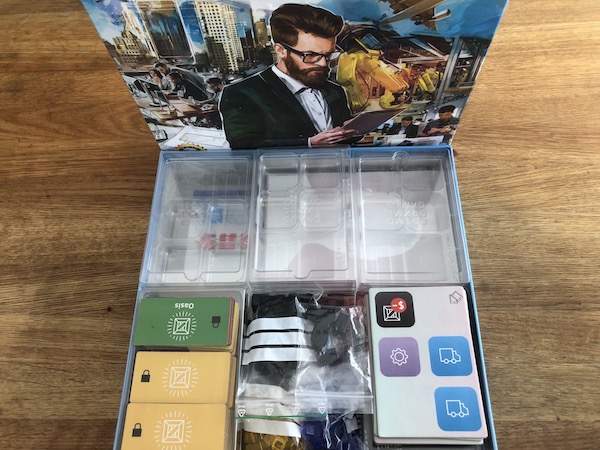
Unboxing a smartphone is easy, boxing it again is difficult ConclusionIf Reiner Knizia would have designed a business game, I imagine it would look very much like this. There are enough decisions to make the game interesting but each decision has been abstracted and streamlined so that the players may focus on playing against each other instead of playing against the game. Smartphone Inc. follows the principle of removing everything that does not make the game worse. Nevertheless, the game remains thematic and does illustrate the globalization process, from small local companies to big multinational corporations. Smartphone Inc. may very well be "The Holy Grail" for players looking for an epic economic experience in a short playing time. 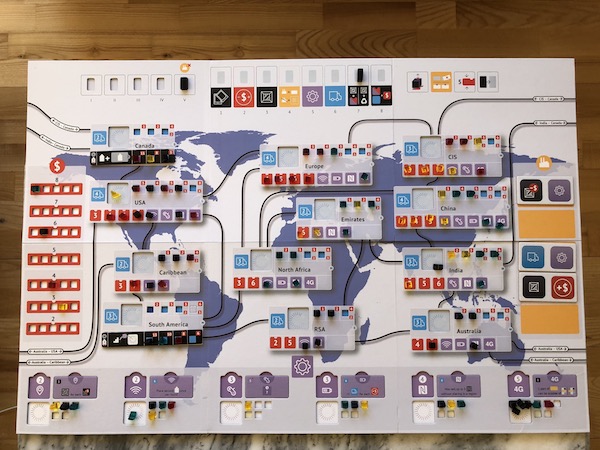
End of a game - the local start-ups have turned into multinational corporations |
|