
 |
The Quest for the Perfect Game - Reviews to Extract the Essence of Games by Nicholas Hjelmberg | |


















|
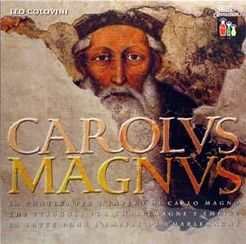
Carolus Magnus - Area Control in the Right Place at the right Time (Published 27 May 2019)This review has also been published at Boardgamegeek. The most possible depth with the least rulesLeo Colovini summarizes his design style as "the most possible depth with the least rules". He may not be among the highest ranked game designers in the community but one can usually trust his games to be unique. Whereas a designer like Reiner Knizia manages to find innovative angles of known mechanics, this clever Italian often comes up with mechanics seldom seen in other games. Granted, this may be because some of those mechanics aren't appealing enough to be copied and his games are indeed often perceived to be too abstract and thinky. One of his very first designs (second only to Inkognito and Cartagena), Carolus Magnus, is certainly no exception. 
Do you expect me to control the Franks with this? The core of Carolus Magnus is an area control game, similar to the earlier groundbreaking game El Grande. However, Leo Colovini took this idea one step further and added a double level of control. Similar to El Grande, the players move paladins (cabelleros) from a reserve to a court or to territories (regions) to take control. (The paladins of Carolus Magnus move directly from the reserve to the territories while the caballeros of El Grande stop at the court on their way but the basic idea is the same.) But unlike El Grande, the players of Carolous Magnus don't have specific colors. Instead, they may take control of any of the five colors, which in turn may take control of territories on behalf of the controlling player. To understand how this works, we need to look at five key moments of the game.
Acquiring controllersEach player starts with a number of paladins (controllers) in the reserve and replenishes them at the end of the turn. The exact numbers depend on the player count. The colors of the paladins are actually randomly determined by dice, although some die rolls serve as jokers and let the players choose color. It may seem odd in a game about controlling the controllers that you don't get to choose their colors. However, the die rolls only determine your means, what you do with them in the following moments is entirely in your hands. Would it have been better to skip the dice and let the players choose which controllers to acquire? I thought so first but this would probably lead to a game where the players focus on a primary and a secondary color and ignore the rest. Instead of "color fights" involving many colors and many players, we would get occasional color duels between players wrestling for each others' secondary colors. Perhaps the game would be more "fair" but I doubt it would be more fun. Such a rule would also increase the risk of analysis paralysis, since you would have to decide in the end of your turn which colors you'll need in your next turn. This is an example where a "healthy dose of randomness" is good for the game and this comes from someone whose vast majority of games are free from dice. 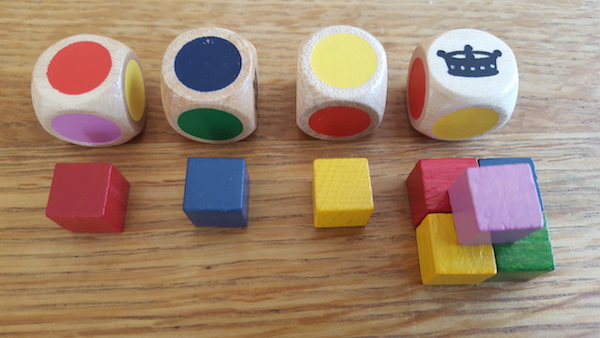
The colorful paladins of the Franks are ready to serve you. Defining controlControl of a color is determined by the number of paladins at a player's court and control of a territory is determined by the number of a paladins in it. This means that in order to take control of a territory, you need to take control of the color or colors that have a majority of the paladins in it. Ties don't change the current status and there are no rewards for the runner-up. In your turn, you simply move a number of paladins (again, the exact number depends on the player count) from your reserve either to your court or to a territory. If you end up with the most paladins of a color, you control the color and claim the corresponding clan marker. If "your" paladins are more than those of any other player in the territory, you may control the territory. Note the word may, the actual resolution takes place in a later moment discussed below. However, beware that paladins moved to a territory are only loyal to you as long as you control their color. If another player takes over the control, all paladins of that color switch side no matter who placed them there. There's no gratitude in the world, right? But wait, how am I supposed to have my paladins taking control of territories for me if I need them at my court to maintain control of them? That is actually one of the big challenges of Carolus Magnus. Ideally, you will want to move paladins to your court only, and this is also how the initial turns usually play. But as colors and territories get claimed, it may be necessary to add a loyal paladin to a territory to change the balance in your favor when the control is resolved. Just make sure that you still have the paladin's loyalty the next time the control is resolved. So when is the control resolved? That's the next key moment, to which we will proceed now. 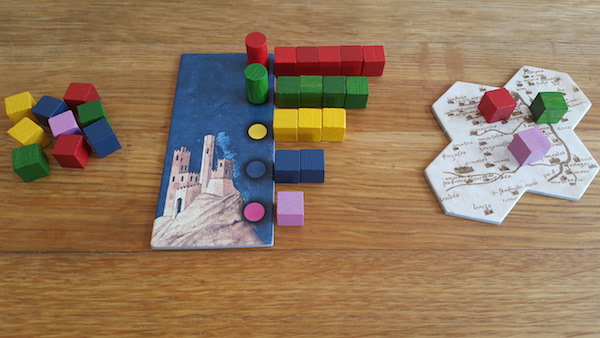
The two controlled red and green paladins outnumber the uncontrolled purple one. Resolving controlControl is not resolved immediately, nor is it resolved at certain scoring rounds. Instead, the resolution is triggered by the players through an interesting mini game linked to the turn order. Each player has turn order discs numbered 1 to 5, of which one is chosen every round. Then they take turns in the order given by the discs. However, the number also tells the maximum number of territories which the Emperor may move through. The territories are organized in a circle and wherever the Emperor stops, the control will be resolved. (Thus, he's more active than the King of El Grande, who merely blocks actions in the region he resides in.) Do you want to take control of a territory close to the Emperor? Then pick a low turn order, move paladins to take the necessary control, and move the Emperor in there. But beware that the limited movement gives you fewer territories to choose from. Do you want to take control of a territory far from the Emperor? Then pick a higher turn order to be able to reach that far. But beware that by the time the turn comes to you, the other players may have taken control of the colors you expected to control the territory with. Well played, this mini game can not only be used to resolve the "right" territories for you but also force other players to resolve the "right" ones in their turns. 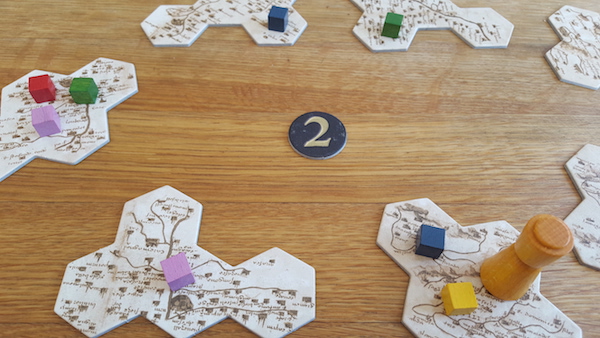
Everything is ready for the Emperor's visit and he's only two territories away. Benefitting from controlSo now you have gathered some paladins at your court and sent others to the territories just in time for the Emperor's visit. How will good old Carolus Magnus reward you for your control? Resources or victory points? No, something inbetween. Control lets you place a castle, which serves both as a resource (a paladin) and a victory point (first to build a certain number of castles wins). This means that the next time the Emperor visit the territory, your caste is also counted when resolving control. This may come very handy if some of the paladins in the territory have shifted loyalty since the last visit. However, your castle is not permanent. If your castle isn't enough to prevent another player from taking control, it'll be replaced, leaving you with neither territory nor castle! Unfair? Carolus Magnus isn't fair, get used to it. 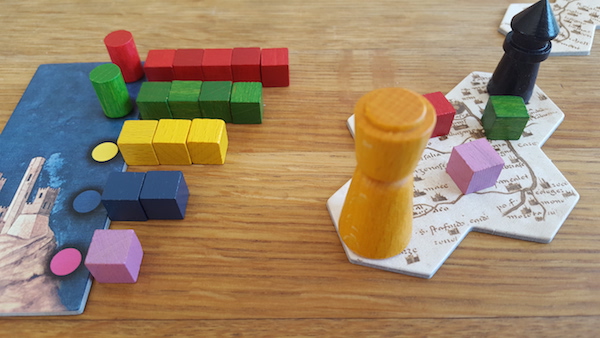
Black has been rewarded with a castle that will stand forever - or until the Emperor's next visit. Merging controlThe designer himself motivates the merging mechanic with the necessity of an element of irreversibility. Merged territories can never break apart again, thus shrinking the game board and potentially triggering an end game condition (less than four territories left). Leo Colovini has used this idea of shrinking game boards in games like The Bridges of Shangri-La (where breaking bridges give less movement options) and Clans (where tribes in completed villages can no longer move). Personally, I think the mergers are more than that, they are what makes Carolus Magnus stand out from the crowd. The later double area control game King of Siam / The King is Dead permanently locks an area once it's resolved but areas in Carolus Magnus are never locked. Instead, they can be strengthened through mergers. How it works is that if a territory resolved in your favor is adjacent to other territories under your control, they are merged into one bigger territory. All castles and paladins become part of this territory, thus making it more difficult to take over. This gives Carolus Magnus a touch of Tigris & Euphrates, where a well executed merger may completely shift the balance. But just in Reiner Knizia's masterpiece, the strength of a merged territory may be greater but so is the reward for taking it over so be sure to protect it! 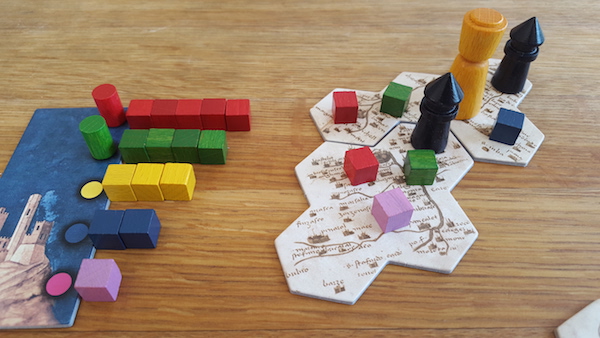
You're doing such a great job that the Emperor rewards you with a bigger territory to control. But if you fail him you'll lose it all... So what's in it for the player?The five key moments we've gone through makes Carolus Magnus an interesting game but does it make the playing experience interesting? This depends on how intertwined those moments are. A collection of mini games is seldom better than the sum of its parts. However, the "mini games" of Carolus Magnus are so closely intertwined that you can't make a decision in just one of them. To build a castle you must take into account which territory to take control of, which colors to take control of, which turn to resolve the control, which turn order to aim for, the risk that you subsequently lose the control and the prospects of merging controlled territories. And when you're done assessing your own position, repeat for every other player in the game! Let's illustrate this with an endgame example. In a three player game, me and one of my opponents were just one castle short of victory. Some territories were merged and strong but some single territories remained and it was clear that the game would be determined in one of those. My main opponent had just picked order number 3, which put him just in reach of the first of those (territory 15 in the Yucata screenshot below with only 1 brown paladin at the time). 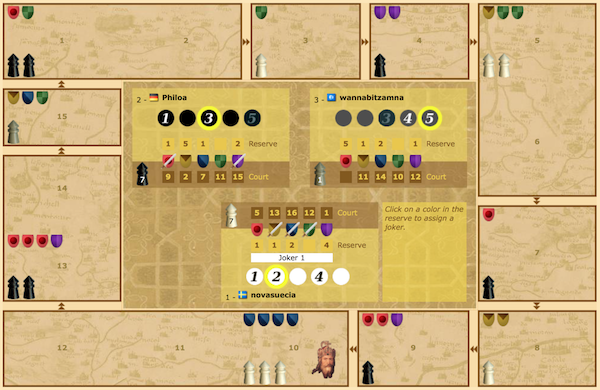
Screenshot from Yucata.de after the last turn of a round (played by White). What could I do? Picking a higher number and put me in reach of the second of the weak territories would be too late. Picking a lower number would not put me in reach of any weak territory. However, by picking order number 2, I could not only strengthen the first weak territory enough to prevent a take-over (adding 1 blue and 1 green paladin to territory 15 in the image) but also be the first to pick an order number the next round. Thus, the round passed without a game end and by picking order number 1 the next round, I could first take control of the necessary colors and then move the Emperor another weak territory and claim the victory. The example summarizes the interesting decisions of Carolus Magnus. The game is too tight to focus on colors for majority alone. Equally important is to choose the right turn order to get to use the majority at the right time and place while also preventing your opponents from doing the same. Tight, meaningful and intertwined decisions - what else could you ask of an area majority game, or of any other game for that matter? 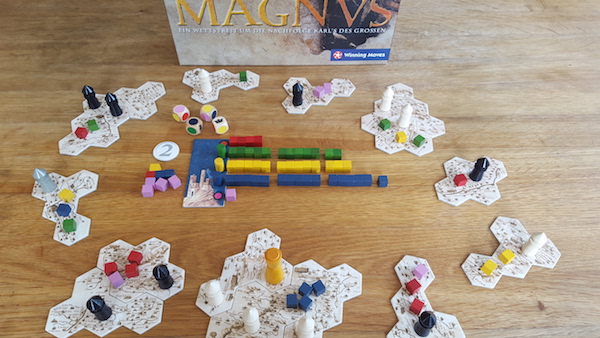
The same endgame with real components. |
|