
 |
The Quest for the Perfect Game - Reviews to Extract the Essence of Games by Nicholas Hjelmberg | |













|
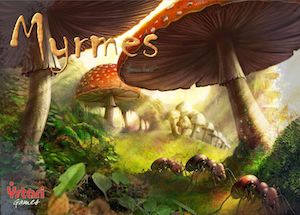
Myrmes - If you thought Ants were annoying for Humans, learn how annoying they are for other Ants (Published 30 September 2019)This review has also been published at Boardgamegeek. 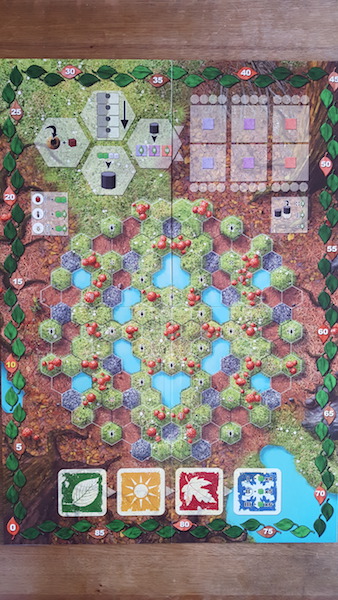
Disclaimer: I'm not a big fan of resource conversion games where the decisions are all about finding optimal conversion paths. Myrmes is basically a game about collecting resources and first use them to improve the engine, sorry colony, and later to exchange them for victory points. Nevertheless, Myrmes does deliver thanks to three challenges that prevent the game from becoming a procedural optimization exercise: long and winding conversion paths, external conditions disrupting the paths and other colonies crossing your paths. We will look closer at all those challenges but let's first look at the means at your colony's disposal. The BasicsA game of Myrmes is played over three years, each consisting of the three seasons Spring, Summer and Fall. There is also a fourth Winter season where the ant colony consumes resources gathered during the year. Victory points are awarded for claiming land, fighting preys and fulfilling objectives and the player with the most victory points at the end wins. Similar to many other euro games, you play by managing workers, action spaces, resources, and an engine to fulfil contracts - in the setting of an ant colony. The Workers - The NursesThe "workers" of Myrmes are the Nurses. They are placed on various action action spaces on your player board. They may also be consumed when fulfilling objectives. The Action Spaces - The ColonyThe "action spaces" of Myrmes are the various parts of the ant colony. Each part is associated with an action that either provide means for producing resoruces or produce resources directly.
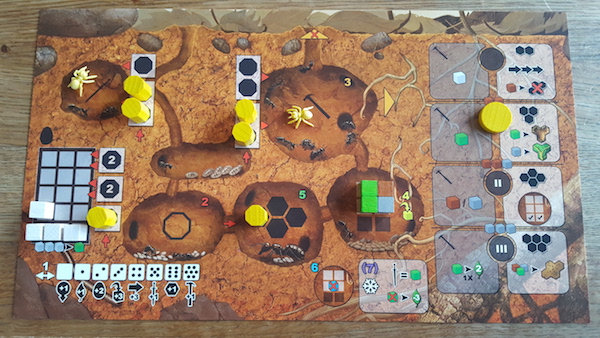
The ant colony with the Larvae room (1), the Worker and Soldier rooms (3) and the Atelier (5) as well as a storage (4) and a colony level (I-III). The Resources - Larvae, Food, Earth and StoneThe resources of Myrmes are used to maintain and develop your ant colony and, indirectly, to score victory points.
The Collection - The GardenSo far we've only covered the inside of your ant colony but to get the resources you have to send your ants out of the colony, to the garden. The garden consists of green, brown and grey hexes which correspond to the three resources. To produce the resources, you must spend an ant to place a "pheromone tile" or a production tile. For each resource hex covered by the tile, you place a resource, and by the end of the round you take 1 resource from each tile. When a tile is empty, you may remove it by spending 1 earth (and 1 soldier if it's an opponent tile). There are also hexes occupied by prey tokens that may be removed by spending 1 or 2 soldiers. Most prey tokens block the access to the abundant center of the board so there is a strong incentive to remove them. 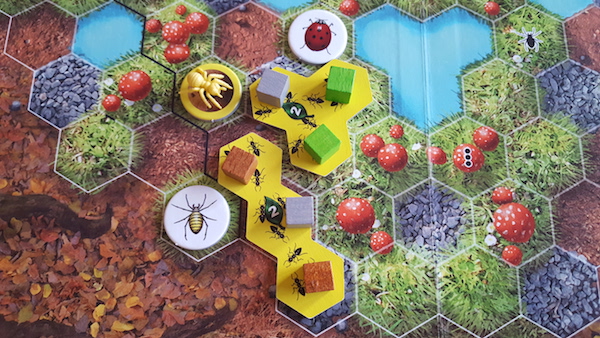
Two of each resource (green food, brown earth and gray stone) waiting to be collected. The Engine - The Ant Colony LevelThe ant colony has four levels. The higher the level, the bigger and better production tiles you may place. By covering more hexes, you will earn resources for more rounds. Bigger tiles will also earn you victory points. 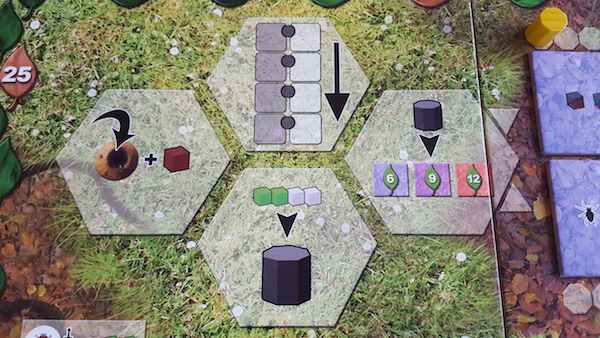
The different development options of placing a new exit, increasing the ant colony level, getting a new nurse and fulfilling objectives. The Contract Fulfilment - The AtelierAs mentioned above, the Atelier gives you development actions. However, you may also choose to permanently place your nurse on an objective and spend resources to earn victory points. This is usually a big share of your end score but the loss of resources will impede your progress so timing is critical. 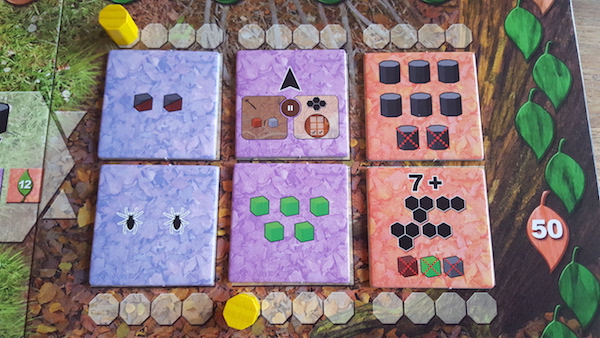
Some of the goals to complete: deliver two earth and/or stone, deliver two preys, decrease the colony level, deliver five food, discard two nurses, and connect and clear seven tiles of their resources. The External Conditions - EventsEach round is linked to an event (randomly selected each cycle of rounds) that offer bonuses for certain actions. You may for example produce an extra worker ant or move your worker ants more hexes. You may also pay larvae to alter the events. Planning for and taking advantage of events is usually important in a strategy. You may also spend larvae to modify the event. 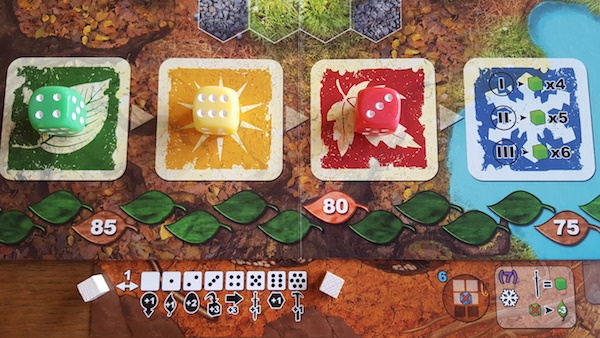
The events of Spring (extra movement), Summer (place bigger tiles) and Autumn (harvest more resources). The ChallengesThe many rules listed may seem overwhelming but thanks to a clear iconography, Myrmes' challenge is not about complexity. Instead, we will now look closer at the strategic challenges that set the game apart from the ordinary resource conversion game. Long and Winding Conversion PathsMyrmes may be an "action salad" but it's certainly not a point salad. This is not a game where you get victory points for every action you take. In fact, a poorly planned (or cunningly disrupted) action may not only leave you without the resource you had expected but also leave you without the resource you would have needed for the next action. Say that you want to collect enough food for the end of the year. First, you'll need a worker ant to place a tile. But to place that tile, you must either have an earth cube to clear an old tile or a soldier ant to remove a blocking prey token. You'll also need to increase your colony level to be able to place a tile big enough to produce the food and have a store big enough to keep the food. But to increase the colony level you need not only earth and stone but also a nurse and to get a nurse you need larvae and... food. After playing Myrmes, I can't help wondering how there can be so many ants in my garden. 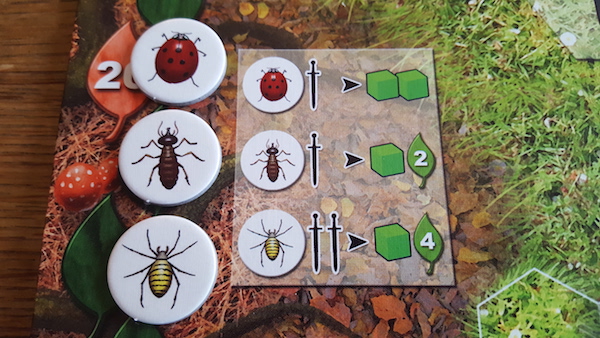
Preys, earning you food and/or victory points but costing you soldier ants. External ConditionsThe events ensure that the external conditions are different between rounds and games, preventing what could otherwise become scripted openings. Your economy is so restricted that it's crucial to take advantage of the small event benefits. Will you get an extra soldier in the next round? Then perhaps you should plan to break through to the center of the garden and be prepared to exploit such a break-through. Or perhaps it's better to spend larvae and change the event to something that fits your strategy better. Planning for events is such an important challenge that I think it's a pity that events are only rolled for at the beginning of each cycle. There's a house rule where events are rolled for continuously so that you always know the next three events. I'm usually careful not to interfere with the designer's intent but I do think this rule would result in less randomness and more strategy. Other ColoniesYour main challenge comes from the other players' ant colonies. While many resource conversion game revolves around the decision to switch from resources to victory points, a key decision of Myrmes is when to switch focus from your ant colony to the other colonies. There are two rules in particular that makes this switch critical. First, once a pheromone tile is placed, it cannot be cleared until every resource on it has been removed. This means that large tiles will remain over several seasons. Second, to clear an own tile you'll need to spend an earth cube but to spend an opponent tile you'll need to spend a soldier ant as well. Thus, it's more efficient to expand to new land but the garden is not big enough for all ants. This means that all your efforts to develop your ant colony comes to nothing if the other colonies beat you to the resources in the garden. The scramble for land is the most interesting part of Myrmes but also the most punishing. If things come to worst, your ant colony will be completely surrounded by opponent pheromone tiles, preventing you from placing your own tiles. 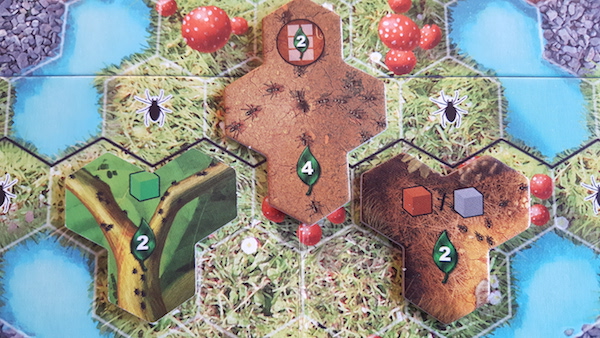
Special tiles, costing resources to place but providing permanent resources or victory points and, perhaps more important, permanent presence. So are you a Myrmecophobe or a Myrmecophil?This really depends on your player style. Players who prefer building their engines in isolation may still do so but will most likely lose to more expansive players. However, aggressive players hoping for a war game in disguise may be intimidated by the indirect warfare of Myrmes. Your ant soldiers do not fight opponent ants directly through battles, they fight them indirectly by denying them land. To enjoy Myrmes, you'll have to be a player who appreciates the balance between engine building and area control. Generate resources to build your engine to get the resources you need to continue building your engine in fierce competition with your opponents. But even then there are issues to bear in mind for the aspiring Queen ant. The restricted economy of your ant colony also means that your strategy cannot deviate too much from the golden mean. You will need some more nurses to get more action, you will need to develop your ant colony some more levels to get bigger pheromone tiles and you will need resources of all kinds. Don't expect to surprise your opponents with strategy of going all in on larvae cubes. You'll still have to adjust your strategy to the external events but with repetitive plays, the initial building game may feel scripted until the more interesting garden fight commences. Another issue is that it may be difficult to catch up if things go bad. As we've seen, a failed action may result in a failed season which may result in a failed year - and the game only lasts three years! The fact that winning players have to sacrifice some of their resources to fulfil objectives doesn't completely prevent runaway leaders. That said, I personally prefer a game where a good strategy is rewarded to a game where a poor strategy goes unpunished. If you feel the same, and if you don't have anything against ants, Myrmes could definitely fill a hole in your game collection! 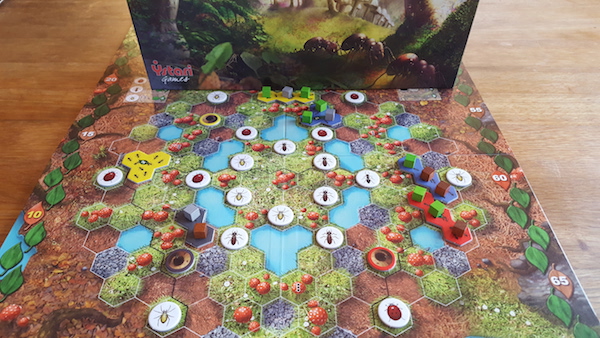
A garden waiting to be claimed. |
|