
 |
The Quest for the Perfect Game - Reviews to Extract the Essence of Games by Nicholas Hjelmberg | |



















|
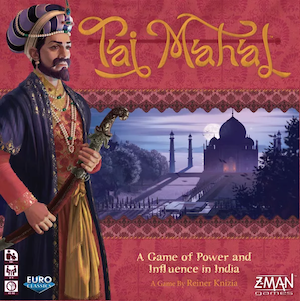
Taj Mahal - The whole is greater than the sum of its parts (Published 15 April 2024)This review has also been published at Boardgamegeek. Concerning classicsNo matter how many new games I play, I keep returning to the old classics (and for some reason, those classics are often designed by Reiner Knizia). What those classics have in common is that they rely on a few proven mechanics and add a twist to them. Some fine examples of twists are the "least money loses" rule in High Society and the discrete bidding tokens in Ra. Taj Mahal is basically an extended poker variant where you bid to collect sets (pairs, straights and flushes) with a unique passing rule as a twist. This may not sound enough for a game that lasts well over an hour but let's look closer at Taj Mahal's parts and find out whether the whole is greater than the sum. Game OverviewTaj Mahal is set in India. It is played over twelve rounds and each round corresponds to a province where the players bid for items used to collect sets. When all players have passed, they score victory points for their sets and proceed to the next region. When all twelve provinces have been scored, the game ends and the player with the most victory points wins. So far nothing new under the sun but let's look closer at the parts of the game. 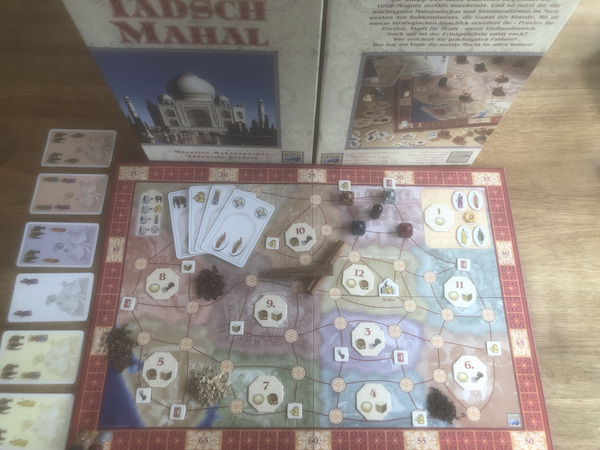
All set for a peaceful journey through India's twelve provinces. The Set CollectionEach province contains six items: generals (purple), monks (orange), princesses (yellow), viziers (green), Grand Moguls (a ring), and a province tile with one or two commodities depicted on it. If you win any of the four first, you get to place a palace in an empty spot in the province and pick up the spot's bonus tile if any. If you win the Grand Mogul, you get to place a palace with a ring in any spot in the province (but you don't get to pick up bonus tiles, nor do you block other palaces). If you win the province tile, you simply keep it. Those items score you one base victory point (one for at least one palace and one per commodity), which doesn't sound very exciting. However, they may all be used in sets that quickly increase their value.
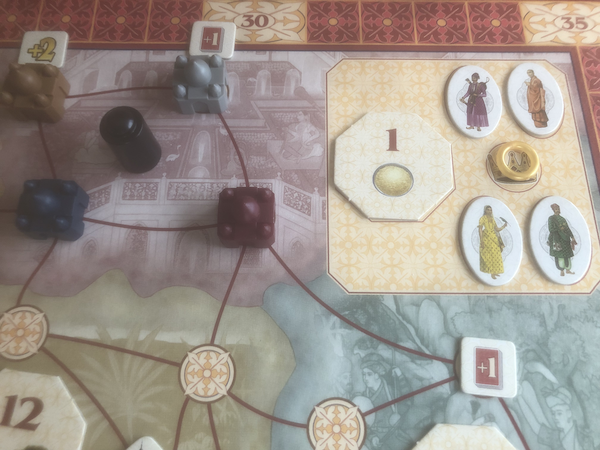
The first province offers a general, a monk, a princess, a vizier, a ring and a rice. There are also the two bonus tiles +2 victory points and +1 bid card. This makes each new province more valuable but each player will value different things. The latter part is very important for a bidding game to be interesting. Many games simply make the rewards bigger for all players in the later rounds as some kind of catch-up mechanic, but not Taj Mahal. In Taj Mahal, it is your previous actions that determine the value of your future actions. Place your bids wisely in the early game and you may get a jackpot in the end. Bid indiscriminately and you may never get more than a few victory points per province, if any. This also means that the willingness to bid will differ between provinces and players. A player who wants items in a province that no other players are interested in may get them cheaply while players with conflicting interests may find themselves in a knife fight in a phone booth. 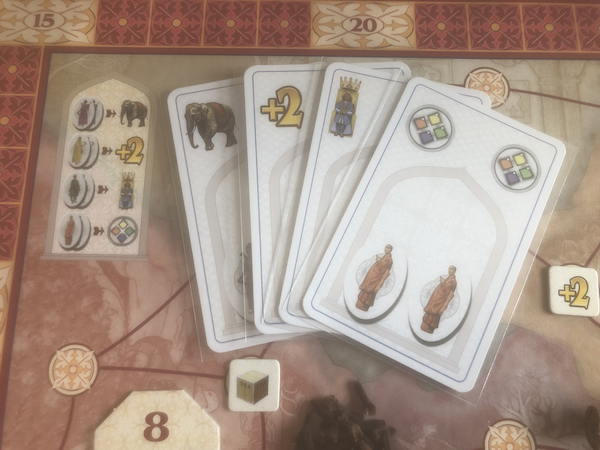
The special cards have unique bonuses: an elephant, +2 victory points, a Grand Mogul and the ability to play a card of another color. The BiddingLet's now move on to the bidding. Unlike most auction games, you don't bid with money in Taj Mahal but with cards. Each card has a color and two symbols corresponding to the six items of a region. There are also white cards with only one symbol. Each bid consists of one colored card and optionally one white card and whoever has the highest bid for an item wins it. (The special bid cards above count as white cards and provide certain benefits when played.) This creates a quick and simple bidding where the six items are auctioned in a single auction. This review could have ended here and we would have a decent but ordinary bidding game. However, Knizia added not only one but three different twists that raise the Taj Mahal from ordinary to brilliant. 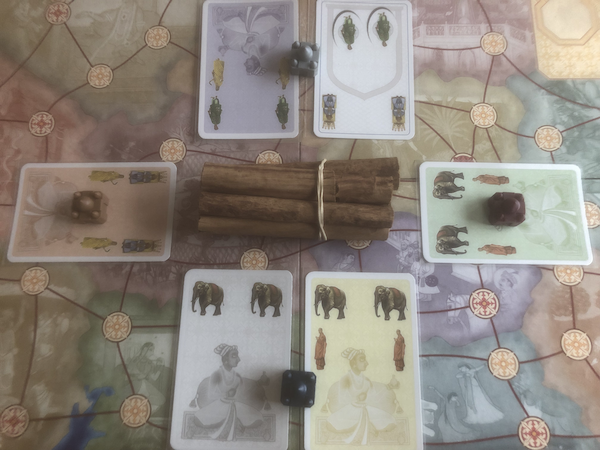
Blue may withdraw and claim majority in elephants but is tied in monks. Brown is tied with Gray in both Grand Moguls and princess and would get nothing from a withdrawal. On the other hand, if Brown does withdraw it would leave Gray with a majority in Grand Moguls, princesses and viziers. The TwistsThe first twist is that the colored cards you bid may be of one color only. This adds another dimension to your decision space. It's not enough to consider the item symbols when you build your hand of bid cards, you need to consider the color as well. The second twist is that all bid cards are lost, even if you fail to win any items. Since you only get to pick two new bid cards each round (one extra if you withdraw without any bids, only one if you're the last to withdraw), you're likely to have too few cards to compete in some of the provinces over the course of the game. Many players shudder when they hear this but the bold ones are rewarded with a fantastic tension. The third and perhaps greatest twist is the withdrawal rule. The auction is not determined at the end but rather every time a player withdraws. When you decide to withdraw, you immediately get the items where you have the highest bid, even if other players still have cards they would like to bid with. You also remove all your bid cards from the auction, which means that the remaining players may suddenly have the highest bid on some items. This twist opens up for several bidding strategies. Make a high early bid to be able to withdraw early and get the first pick of palace placement and new cards or aim at staying in the auction as long as possible until all other players have withdrawn to get all items that are left. Did I mention that Taj Mahal offers a lot of tension? 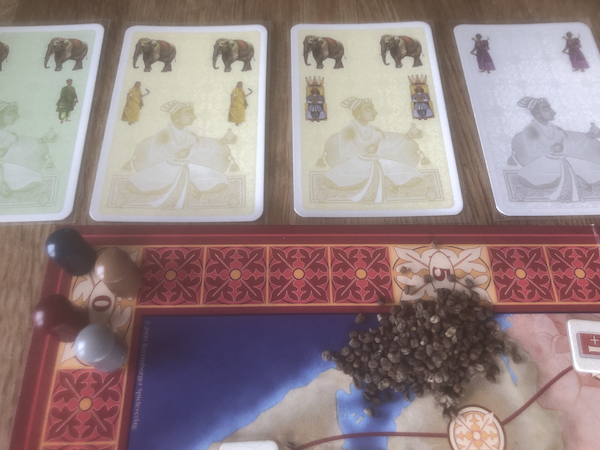
Do you need the yellow cards with elephants, princesses and Grand Moguls? Then you should consider an early withdrawal. The WholeGiven all those parts, what gameplay does Taj Mahal offer? Let's answer the question by stepping into the mind of a player at a typical decision. "OK, province 3 has no palace spots or commodities of interest to me so perhaps I should withdraw early. What does province 4 look like? Oh wait, it has rice and tea, both of which I already have. It also has a spot that connects to province 3 and 6. If I could get palaces at the right spots, I could connect provinces 3 and 4 and later 6 but is it possible?"" 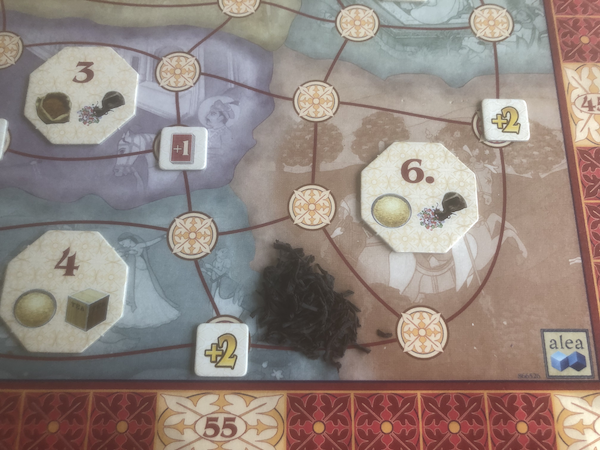
So many juicy provinces, so few bidding cards... "Let's see, if I play two red vizier cards and withdraw early, I can place a palace at the critical spot in province 3 before it gets occupied. Then I can add two yellow cards to the many yellow cards I already have on my hand. The two yellow cards in the market have Grand Moguls and elephants. Then I should be able to withdraw late to win the commodities with the elephants and still be able to place a palace anywhere in the province with the Grand Moguls. After that I can withdraw immediately in province 5 and build a new hand for the important province 6. A perfect plan!" Of course, the plan may fail already at province 3 if another player ties you for viziers but that's Taj Mahal in a nutshell... |
|