
 |
The Quest for the Perfect Game - Reviews to Extract the Essence of Games by Nicholas Hjelmberg | |

















|
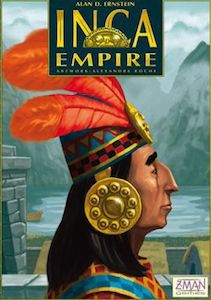
Inca Empire - The Road Goes Ever On (Published 10 August 2020)This review has also been published at Boardgamegeek. The Qhapaq Ñan"The Inca road system, known as Qhapaq Ñan meaning 'royal road' in Quechua, was the most extensive and advanced transportation system in pre-Columbian South America" according to Wikipedia. I've also been fortunate to experience some of those roads personally during a memorable visit to Peru (although my feet may not think it was so fortunate). The road network is also the theme of the game Inca Empire. Among the many route-building games, Inca Empire has managed to find its own niche. This game is not only about building routes for your own benefits but perhaps even more about building routes to parasitize your opponents. Or should you look upon them as (temporary) partners? Let’s take it from the beginning. Game overviewIn Inca Empire, you play an ”Apu”, a religious leader in the Inca Empire. Your duty is to expand and improve the empire and your tools are roads (to connect areas), workers (to conquer areas), and buildings (to develop conquered areas). Workers are earned for conquered areas at regular income phases. Victory points are awarded both immediately for conquests and builds as well as at regular scoring phases for CONNECTED buildings. This is an important distinction: the immediate victory points are awarded to the building player only but the regular victory points are awarded to ALL CONNECTED players, thus the parasite gameplay. 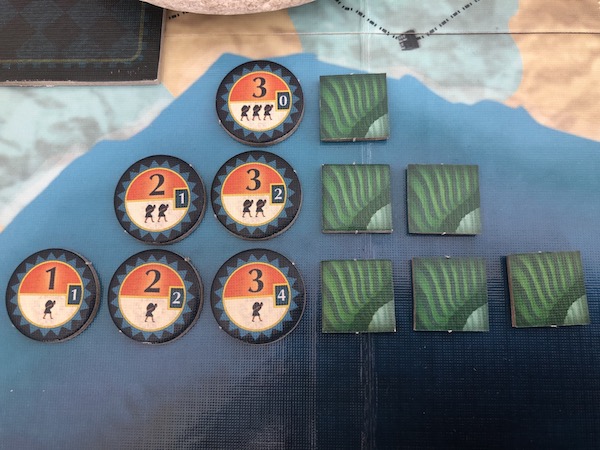
To the left, conquered territory markers, showing worker cost to conquer, regular worker income, and immediate victory points. To the right, built terrace markers, which earn regular workers and victory points. An additional challenge is that the game conditions constantly change due to event cards played by the players themselves. The player with the most victory points wins (although there is no winner thematically, since the game ends with the arrival of Pizarro and the end of the Inca Empire). So what does this mean for the player experience in a game of Inca Empire? 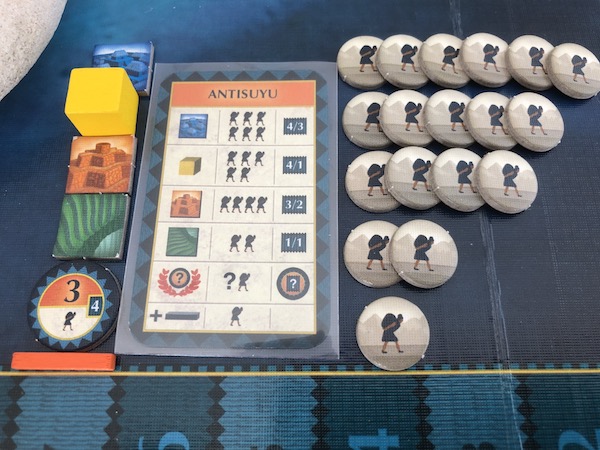
The many things in Inca Empire that require workers: cities, temples, garrisons, terraces, conquests and extra roads. The economic challenge: The worker-victory points balanceEuro games often have a money-VP ”switch” - the moment when a player should stop focusing on money and start focusing on victory points. In Inca Empire, this is defined by the moment when you have enough workers (i.e. conquered regions) to start earning victory points (i.e. build buildings). It sounds simple, since each conquered region has a fixed worker income and each building has a fixed worker cost. However, there is one more aspect to take into account. The game is divided into four eras with an increasing number of building phases. This means that a worker force that is sufficient for one era may have to be expanded the next. 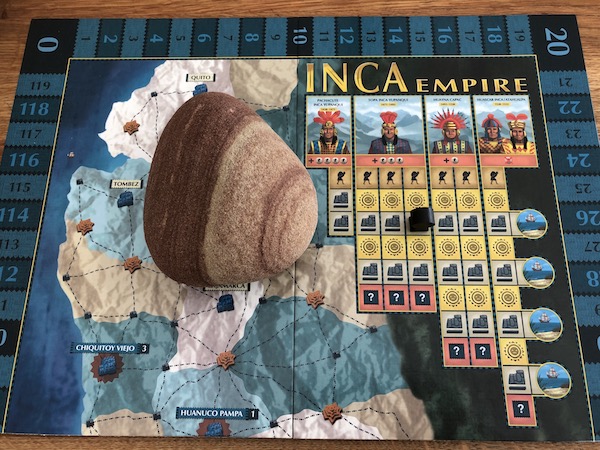
The four eras of the Inca Empire with Inca phases (income), Sun phases (events), People phases (builds) and Sapa Inca phases (scoring). The spatial challenge: The optimal networkThe network building mechanic can be characterized as a specialized kind of set collection where the goal is to place ties to connect nodes. In Inca Empire, this is translated into roads and regions. Here we have two interesting challenges compared to many other games. First, the value of the regions is determined by the buildings in them, which in turn are determined by the player actions. Thus, the players must constantly monitor each others’ actions and intentions to be present at the right place at the right time. Second, there are several criteria that must be fulfilled before a region can generate victory points:
Doing all this by yourself is not efficient. By the time you have finished, the other players are sure to go there and parasitize your effort. But waiting for others to do all the work isn’t efficient either because the less attractive a part of the map is, the less inclined are the other players to waste their precious actions there. Whether the players want it or not, their fates are linked and they have to work together to develop areas. Thus, the players must constantly decide when to cooperate and when to compete. 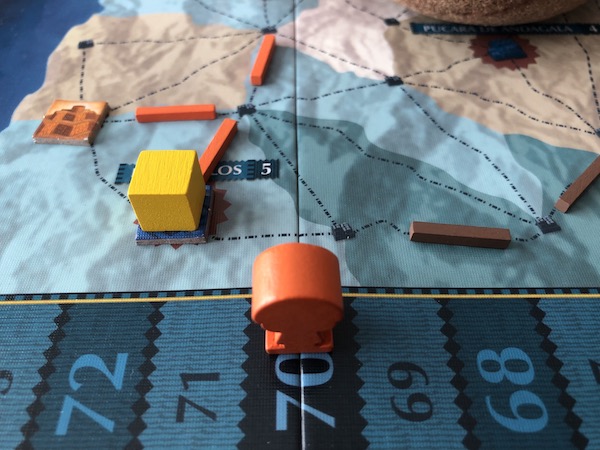
Orange has connected to Ranchilos and built a city and a temple there - but from the East a brown road is sneaking closer... The card challenge: The changing conditionsThe event cards of Inca Empire are more than simple random events or cheap take that measures.
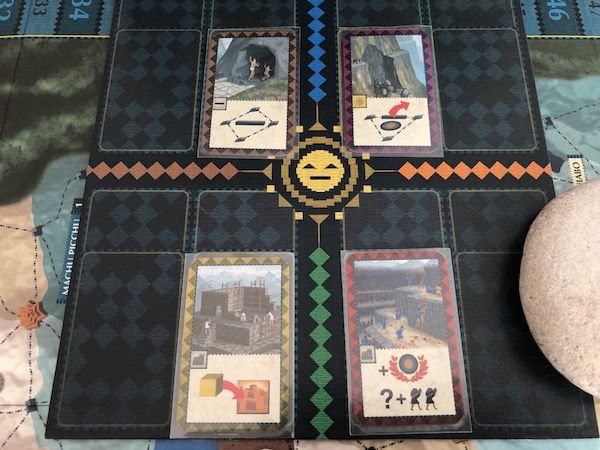
Some of the events of the Inca Empire; ability to build "wilderness roads" outside normal routes, roads destroyed through "rural unrest", ability to build temples on garrisons and ability to perform an extra conquest. The turn order challenge: When to trail and when to rushSimilar to the events, the turn order is in the hands of the players. Simply put, the player with the least victory points goes first and going first gives you many advantages. One is that the last player in turn (=the player with the most victory points) must give a worker to the first player in turn. Given that the need for workers keep increasing throughout the game, this extra worker is often welcome. Another advantage is that the first player in turn has a better chance of conquering ”worker regions” - regions that give you workers regularly - instead of ”victory point regions” - regions that give you one-time victory points. Incidentally, this helps keeping you behind in victory points and thus first in turn order. But perhaps the most important one is the the above mentioned benefit of playing event cards first. This lets you choose between playing positive cards to your slots, negative cards to opponents’ slots or simply save powerful cards and play a neutral card to block slots. In a tight game, which a game of Inca Empire usually is, the right cards in the right slots at the right time can be decisive.Note, however, that the turn order advantage isn’t that clear-cut. There are instances where you may want to go last to have time to react to the opponents’ actions. If a nearby region is conquered, you can reap the fruits of your opponent’s labor and build a city or a garrison there. If a city or a garrison is built in a nearby region, you can build roads to it and ”leech” victory points. The game of turn order is a very intricate one but whoever wins that game is likely to win the entire game. 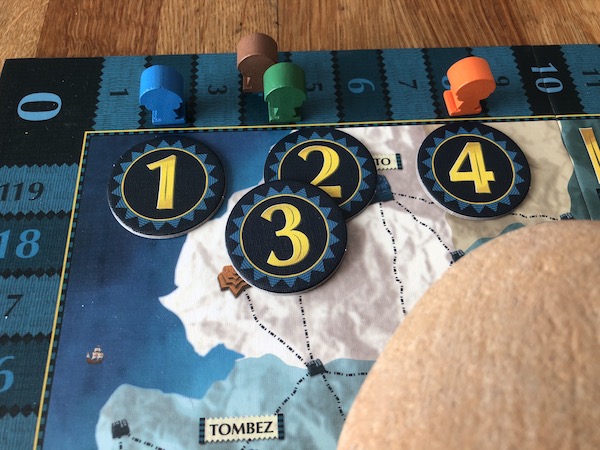
The Inca Empire scoring track; Orange has the most VP and is thus last in turn order. Green reached the 4 VP square first, as shown by the score marker's inner postion, and is thus second to last in turn order. So what’s not to like?Inca Empire is certainly not a game for everybody. The idea of having to pay workers to players with less victory points or seeing them leeching victory points from your efforts may put off many players. The high degree of balance and interaction may also make the game frail as a weak player may become a kingmaker by inadvertently helping or blockig an opponent. Inca Empire needs dedicated and equally skilled players to shine. There are also some practical issues. The victory point calculation may become a bit tedious as the number of buildings on the map increases and the road networks start stretching out and crossing each other. The game is also prone to analysis paralysis as players constantly assess the game state to find out exactly how many workers and victory points they aim for in an era. It may help to keep a running tally of the victory point levels per player but since roads keep getting added and removed, you’ll still have to re-count every scoring phase to be sure. More serious flaws are some rule ambiguities. It’s not clear if and how turn order changes if players stay at 0 victory points after the first rounds. The map, although pretty, is just plain wrong since no sites are located at the coast, making it impossible to follow the rule that so called wilderness roads ”must not run between the sea and a site”. A detailed discussion is available at Boardgamegeek but in short, you may either refer to the designer Alan D. Ernstein's map or use a simplified rule, such as BGG user clearclaw’s suggestion to require wilderness roads to be entirely surrounded by dotted lines on all sides. But if that doesn’t deter you…... then Inca Empire offers you a an exciting game on razor’s edge. You need to find a strategy that gives you the workers you need without falling behind too much in victory points over time while still letting you react tactically to map and event changes. The game starts with an empty map that it’s up to you and your opponents to fill with roads and buildings. Each new round sees new conditions, ensuring a unique experience every time, and when you’re done the map will be covered by sprawling networks in all directions. The winner is often the one who has managed to connect to the most buildings in the end but to do so is easier said than done. 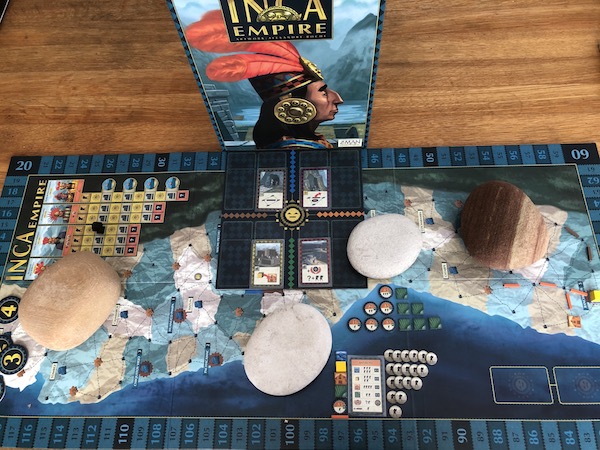
|
|