
 |
The Quest for the Perfect Game - Reviews to Extract the Essence of Games by Nicholas Hjelmberg | |



























|
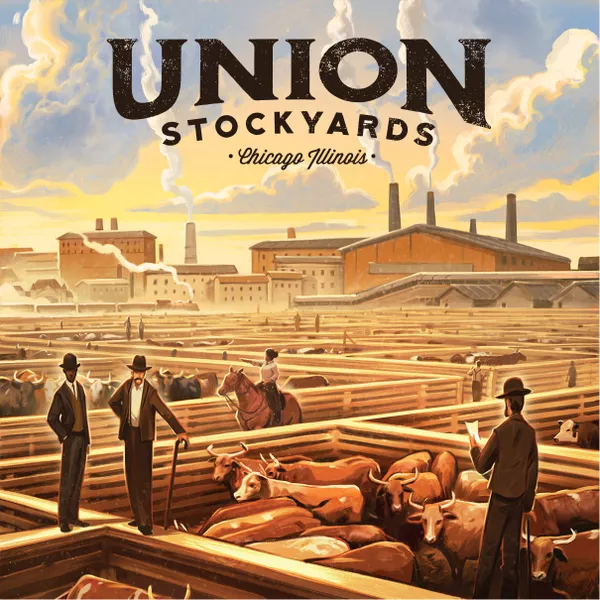
Union Stockyards - The Meat of Union Stockyards (Published 29 January 2024)This review has also been published at Boardgamegeek. The good economic gameWhat makes a good economic game? Manipulable markets? Production engines? Scarce resources? Fierce competition? In his excellent designer's diary, Duane Wulf promises all this so I had high hopes when I finally got a chance to play Union Stockyards. The setting of the game is the great Union Stock Yards of Chicago, the world's biggest meat processing area until the 1920s. The players take on the roles of the great meat packers of that time, competing to make the most money. After six phases or years, each player's money is added to his or her savings earned during the game (equivalent to victory points) and the player with the most savings wins. Mechanically, this is accomplished through worker placement, where the different worker spaces let the players slaughter animals for money, invest in buildings for higher profit margins and engage in social and political matters to change the conditions for their businesses. Each worker space is distinctly linked to a historical aspect, making the game very thematic, and you can really tell that the designer is passionate about the subject. But let's return to the beginning of this review and explore how well Union Stockyards fulfills the criteria of a good economic game. 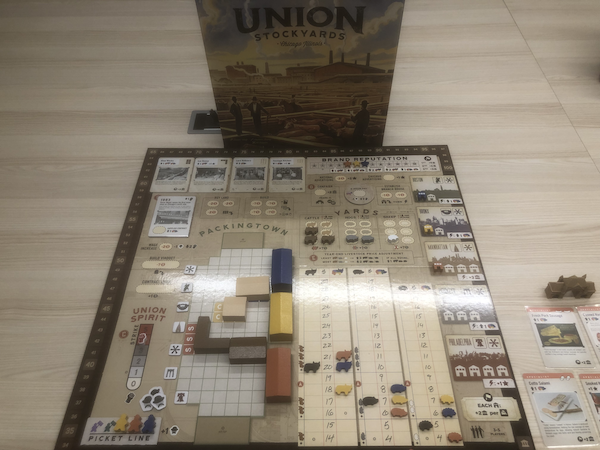
Welcome to the Union Stockyards. Manipulable marketsThe designer's diary devotes one entire chapter to the manipulable market and it is indeed the core of the game. Unlike most supply and demand driven game mechanics, where players' action determine the prices for all, Union Stockyards adds the extra dimension of profit margin, which may differ between the players. Basically, there are three livestock markets (beef, pork, lamb), each with its own price token which tells the slaughter cost. In addition, there is one meat value token per player and market which tells the slaughter revenue. When a player takes the slaughter action, he or she removes a livestock token from the supply and earns the net profit from the bank. Thus, a player may increase the profit either by decreasing the (public) cost or increasing the (private) value. 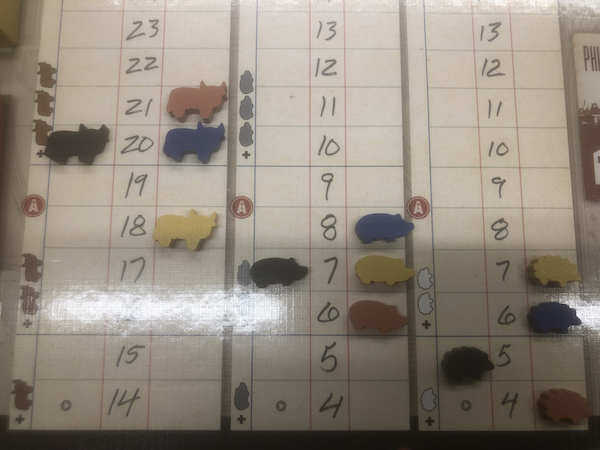
Yellow earns $2 ($7-$5) by slaughtering sheep but loses $2 ($18-$20) by slaughtering cattle. We'll get back to the latter but the former is accomplished through an interesting mechanic. If, by the end of the year, a certain livestock has the least tokens in the supply, the price increases and if it has the most tokens, the price decreases. The price level then determines the number of tokens added to the supply at the start of the next year. This gives the players, particularly the ones late in the turn order, an opportunity to set up good market conditions for the livestock where he or she has the highest profit (or to set up bad market conditions for the opponents' livestock). 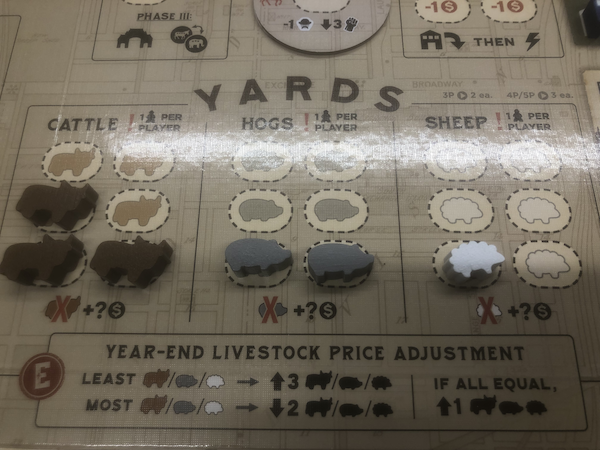
The price of cattle will fall by 2 while the price of sheep will rise by 3. Let's now look at how a player may increase the private value or, in other words, how he or she may improve the production engine. Production enginesMany euro games require the players to juggle a variety of resources but not so in Union Stockyards. Here everything is focused on the profit margins. Most actions lead to increased profit margins for the different livestocks and/or higher savings.
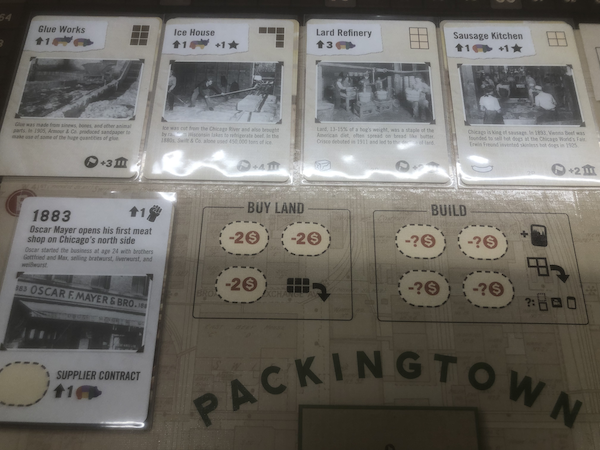
The lard refinery will increase the pork value by $3 but costs $6 to buy ($1 per square). Thus, the key challenge of Union Stockyards is not knowing which resources to have when but rather knowing which profit margins to focus on when. Will cattle buildings pay off or are the beef margins expected to fall? Can I control the hog supply enough to make pork buildings worthwhile? Having the best highest value for a livestock is pointless if the cost is also high. This leads us to the challenge of the scarce resources. Scarce resourcesThere are two main resources in Union Stockyards and both are scarce: money and actions. You start with only $1 and you have only four workers at your disposal, giving only 24 actions over the course of the six years (or less if they go on strike, more about that later). There is an interdependence between the two: you need actions to get money and you need money to make actions profitable. As an example, in the first year you may slaughter a cattle to immediately get $2. Alternatively, you may invest $2 in a building to increase your profit margin on pork and slaughter it for $3 next turn. Or you may invest $2 in brand reputation this year and next year to increase your profit margin on cattle and pork and slaughter them for $3 each. Or you may invest $2 in land to pay less for buildings there. All your decisions have to be evaluated based on their expected pay-off, which in turn have to be evaluated based on what you and your opponents will do. 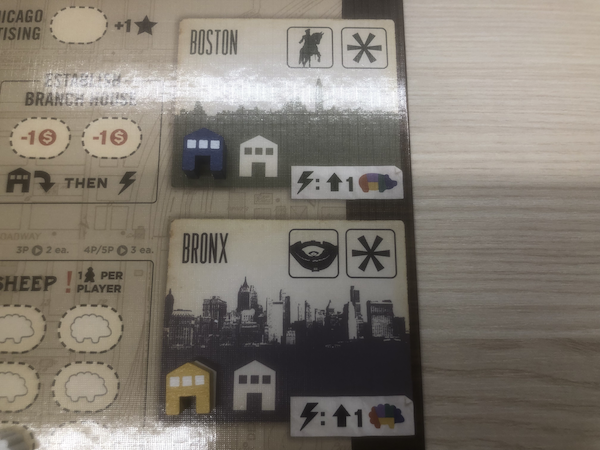
Blue's branch house in Boston increased the pork value by 1 while Yellow's branch house in Bronx increased the lamb value by 1. This leads us to the question about how fierce the competition is. Fierce competitionIn Union Stockyards, you can't play in isolation. It is not enough to know when to invest and when to slaughter since the other players' actions will affect the game state. If you improve your profit margin first, there may not be any livestock left to slaughter next turn. If you only have the second best profit margin, you may have to manipulate the market, even if it ruins your own profit margin. Although there are plenty of worker spaces to choose between, the ones that pay off best may disappear quickly. The "mini games"So far we've focused on the central mechanic of Union Stockyards but there are other games in the game. The Packing TownThe Packing Town is where the polymino buildings are placed. On one end, the players' starting pack houses are placed, and on the other end, there are railway stations. However, players expecting a puzzle-like tile placement or a fierce rush to connect to stations first may be disappointed. Once placed, buildings may be used by any players for connections, and reaching a station only results in moving it to one of the cities. Instead, the Packing Town contains the following games:
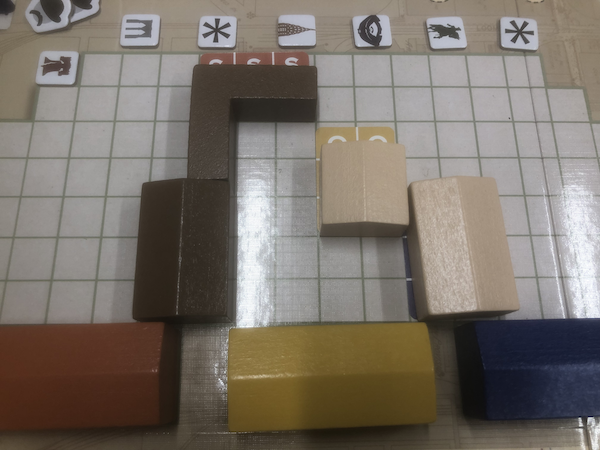
The Manhattan (church) and the joker railway stations are almost connected but the land is owned by red. All this works both mechanically and thematically but I still can't help feeling that there could have been a more interesting game here. The Union SpiritThe Union Spirit marker track may be moved up on the track by year cards and down by player actions. If it reaches above the threshold level, ALL players lose one worker to the picket line for the year and get one low morale token. Players may take actions to lower the Union Spirit and return a low morale token but ALL players benefit from getting their workers back. Some have criticized the latter part and stated that this removes the incentive to lower the Union Spirit. I beg to disagree since the low morale tokens result in an exponentially bigger reduction of the end game savings so there is certainly an incentive to act if the strikes get too frequent. Also, if you would get to return a low morale token AND get a worker back, it would be a no-brainer to place a worker there if you're first in turn order and very punishing for players later in the turn order. The main accomplishment of the Union Spirit game is to keep the players unsure about the exact number of actions in the game and this is often a good thing in my book. 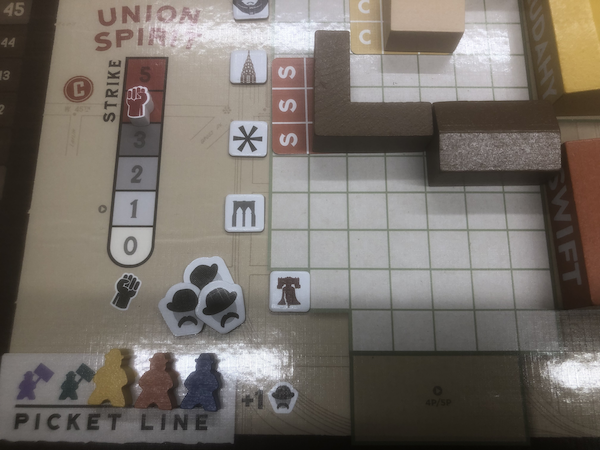
The workers are striking and the players have to make do with 3 workers each this year. The Year Cards and the ElectionEach new year a year card is drawn, which contains an event and usually adds a worker space. In addition, an election may be held (if a player placed a worker on the campaign action space) and an election token potentially flipped to reveal a worker space (representing Democrat and Republican policies). This gives both variation to the game and a colorful background to the social and political events of the era. My only wonder here is why the game has 24 random event cards but only one election token for the players to select. Wouldn't more election tokens have given the players more agency? 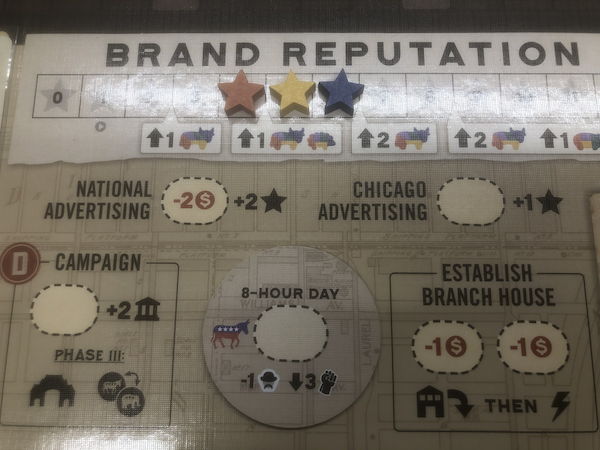
The Democrats are in power so a player may introduce the 8-hour day to lower the union spirit and return one low morale token. The SpecialistsSome buildings come with specialist icons. The first to collect two (or three in one case) similar icons immediately receives a specialist card, which increases the meat value even more. 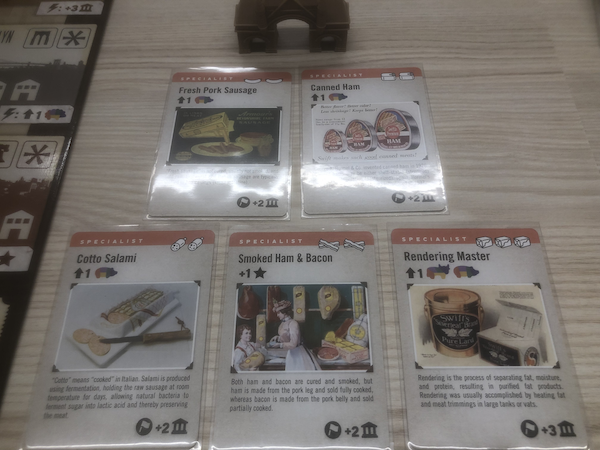
The first player to specialize in smoking ham and bacon will earn 1 brand reputation and 2 end game savings. Which other economic games are similar?The way the prices are determined by the supply reminds me about Namibia, where both prices and demand may fluctuate. The concept of player specific meat values is similar to Arkwright's appeal. However, while Namibia takes at least two hours to complete and Arkwright twice as much, Union Stockyards is a much lighter and more accessible game and may finish in a little over an hour. ConclusionUnion Stockyards manages to stand out from the crowd thanks to its profit margin mechanic. This gives the players opportunities to manipulate costs and improve profit margins while also making the best use of the limited money and actions. This is not a game for players who prefer building their engines solitarily, nor for players who want their economic games to be heavy. However, if you're looking for a mid-weight economy game as an introduction to the heavier ones or simply want to experience a fascinating part of American history, Union Stockyards is well worth playing. 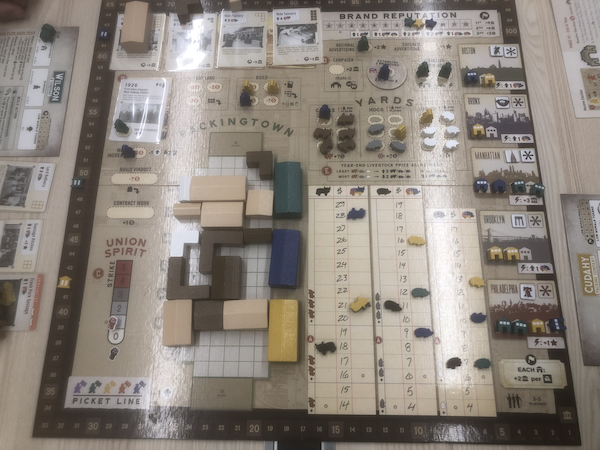
End of a 3 player game where my (Yellow) lamb strategy failed miserably. |
|