
 |
The Quest for the Perfect Game - Reviews to Extract the Essence of Games by Nicholas Hjelmberg | |













|
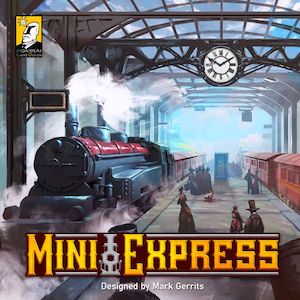
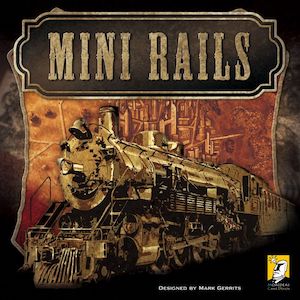
Mini Express - A worthy sibling of Mini Rails (Published 3 May 2021)This review has also been published at Boardgamegeek. IntroductionIn a recent review I characterised Mini Rails as a distillation of the stock-buying and track-laying mechanics of the heavier 18XX games. Thus, when I learned that Mini Rails would get a spiritual successor in Mini Express my curiosity was immediately piqued. Similar to Mini Rails, Mini Express features only the two choices of laying tracks and buying stocks. Laying tracks increases the value of the rail company and buying stocks increases your part of the value (and eventually your victory points). So does Mini Express simply follows in the tracks (pun intended) of Mini Rails? Let’s see if there is any difference in the gameplay between those two mini siblings. 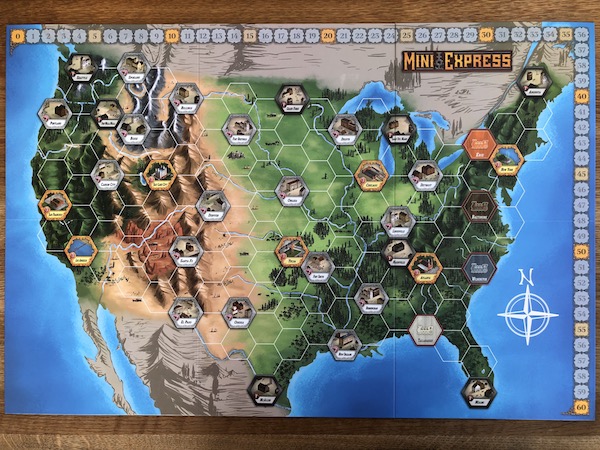
An untouched landscape, waiting to be exploited. Laying tracks, the similarities: The stock valueMini Rails featured a small abstract map where only one track was placed at the time and where the spaces could affect the stock value both positively and negatively. Mini Express on the other hand offers a more realistic map with two kind of spaces: land and cities. To lay tracks, a player chooses a city to connect to and takes as many trains from the rail company’s supply as needed for the shortest possible route. This action has two results:
The second point is a major difference from Mini Rails because it’s not enough to consider the stock value of the rail company you’re invested in, you have to take into account the influence. Let’s halt for a moment and learn more about influence. 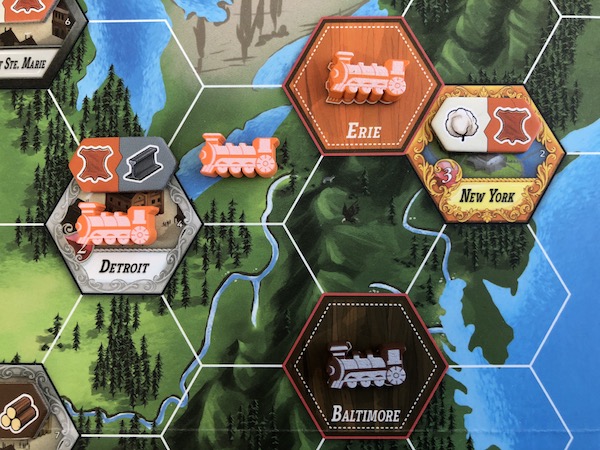
Two orange trains placed; the first increases the company's stock value by 1 and the second increases the player's influence in orange by 1 and in gray by 2. ... and the difference: The influenceBesides the stock track, there are also influence tracks for each of the four companies. While stock values reward companies for laying tracks, influence rewards you for connecting cities. Each city has two out of four possible resource demand symbols corresponding to the four companies. Whenever a player connects a rail network to a city, the player’s influence in the corresponding companies increases one step for each resource in the city. This is important because at the end of the game, the value of each stock held by a player is determined not only by the stock value of the company but also by the influence of the player. Thus, if you have played in a "greedy capitalist manner" and hoarded stocks instead of actually operating the company, you will be punished with less or even no victory points at all for your stocks. 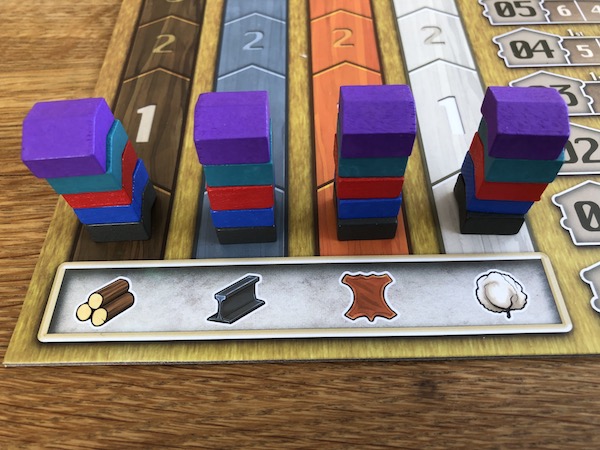
Four resources for the companies under the sky. Buying stocks, the similarities: The fluctuating valuesSimilar to Mini Rails, there is no money in the game and stocks are simply picked from the company supply. Nevertheless, both games feature market fluctuations and different end game values for the players as discussed above. However, there are two differences between Mini Rails and Mini Express. The first is that the company value never falls in the latter game, since there are no "negative" hexes and the second is that stock values are tracked on a common company board rather than on the individual player boards. This results in an important difference regarding the implicit cost of stocks. 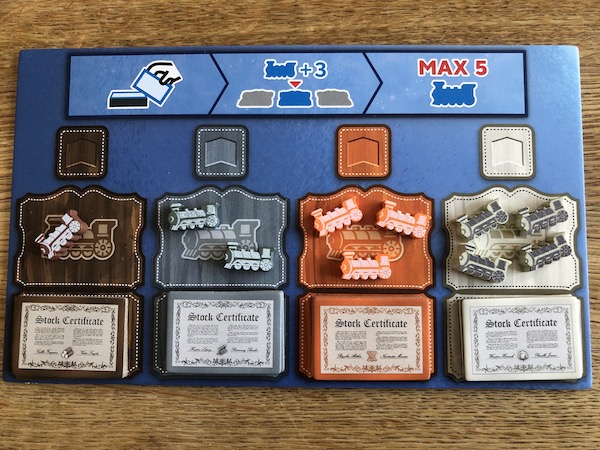
Tracks and stocks waiting to be picked by the players. ... and the difference: The implicit cost of stocksIn Mini Rails, there is a timing aspect to buying stocks, whereby a player taking a stock when the value is low will fare better than a player taking the same stock when the value is high. Basically, the higher the company value the higher the implicit cost of buying its stocks. There is an implicit cost in Mini Express as well but the way it works here is that a player taking a stock loses influence in the company equal to the number of tracks in the company’s supply. (Once a stock is taken, three more tracks are placed in the supply.) This means that the cost of a company's stock doesn't correlate to the company's value. On the contrary, the stock is "cheapest" just after it has laid tracks and increased its value, something that feels counterintuitive. Mechanically and thematically, this feels less elegant than the market fluctuations of Mini Rails. So what do we get instead? 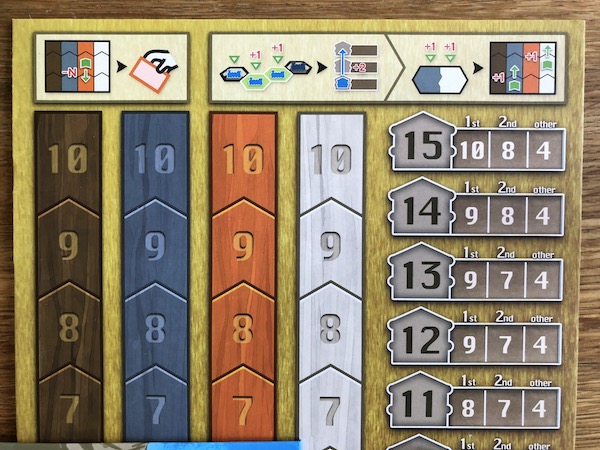
The two actions of Mini Express: take a stock (and lose influence) or place tracks (and increase value and influence). The game of opportunitiesA key aspect of the Mini Express gameplay is the game of opportunities. Laying tracks for "your" company to increase its value allows the next player in turn to acquire cheap stocks in it. Taking stocks in a company allows the next player to use the newly placed tracks to increase his or her influence in selected companies by connecting to cities. Does this mean that Mini Express is subject to turn order problems, where a weak player will give the player to her left good opportunities all the time? Not necessarily. As we’ve seen above, a player cannot focus on stocks only or influence only but must find a balance between the two. Thus, a "free" stock which costs you no influence may be tempting but if you don’t have any influence in that company, you won’t score anything for your stocks. This game of opportunities is THE game in Mini Express. Let’s look at a simple decision example, assuming that Purple one share in each company. Which action is the best for each of the four companies? 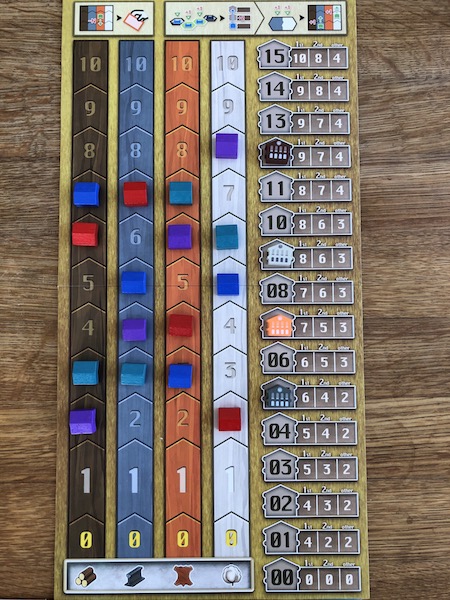
However, as we can see from this, Mini Express is not only about which opportunities your actions leave to the next player in turn but also about which effects your actions have on other players’ score. This brings us to the cooperation and competition in the game. The game of cooperation and competitionIdeally, you would like to take shares in a company AND push the company value and your company influence to the top. However, you won’t have enough actions to do all this by yourself and will rely on other players’ help. Thus, a typical game will see herd behavior and self-fulfilling prophecies as players rush to the most attractive companies and through their actions make them even more attractive. Eventually, some players will fall behind in the influence race and turn to better opportunities elsewhere, leaving only two players jockeying for the first place. If those two players play it nicely, they may cooperate for the benefit of both. (Ties are friendly so if both have the highest influence, both earn the highest VP column.) However, if one player gets greedy and tries to get the highest influence/most shares, the other player may abandon the company and spend actions elsewhere. There will also be instances where the only way to increase your influence in a critical company is to connect ANOTHER company to a city, thus increasing that company's value for the benefit of another player. Perhaps that player will do something for you in return, perhaps not... 18XX players are familiar with this kind of game arch, with the difference that actions rather than money is the main company asset of Mini Express. However, you don’t have to play for hours to experience it in Mini Express. 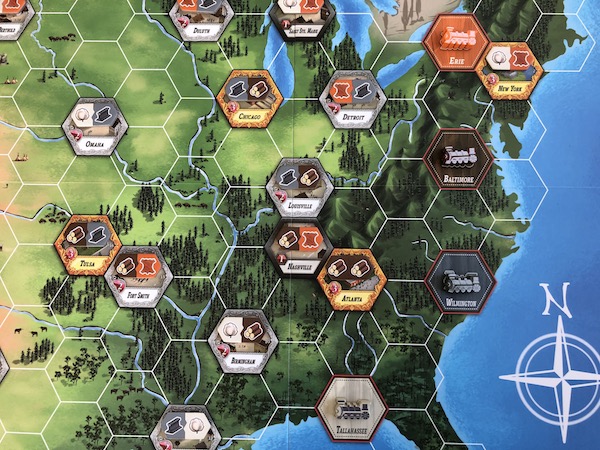
Four companies ready to go West. Conclusion: Similar but differentIn conclusion, Mini Express does manage to distill stock-buying and track-laying mechanics of the heavier 18XX games similar to its predecessor Mini Rails but through different mechanics. You will have to balance between increasing your number of shares and increasing the value of your shares. You will not have the timing dimension of Mini Rails about when to invest in a company but instead you will have an area majority dimension whereby a higher influence grants you a higher value per share than your opponents. All this turns Mini Express into a game of opportunities where you carefully have to decide what to take and what to leave to your opponents and when to cooperate and when to compete. For anyone enjoying this kind of gameplay, both Mini Rails and Mini Express deserve a place in the game collection. 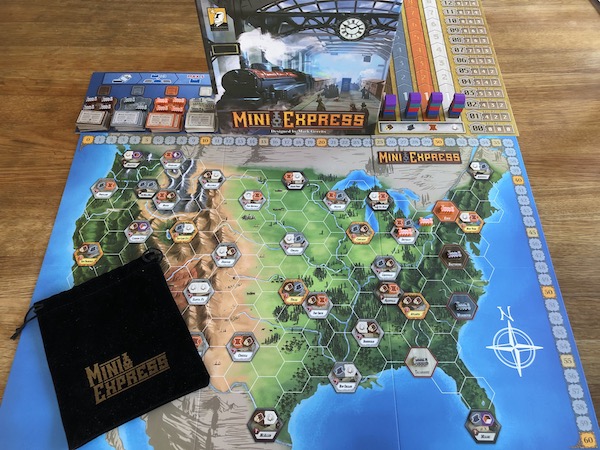
How did all this fit in the box? |
|