
 |
The Quest for the Perfect Game - Reviews to Extract the Essence of Games by Nicholas Hjelmberg | |
























|
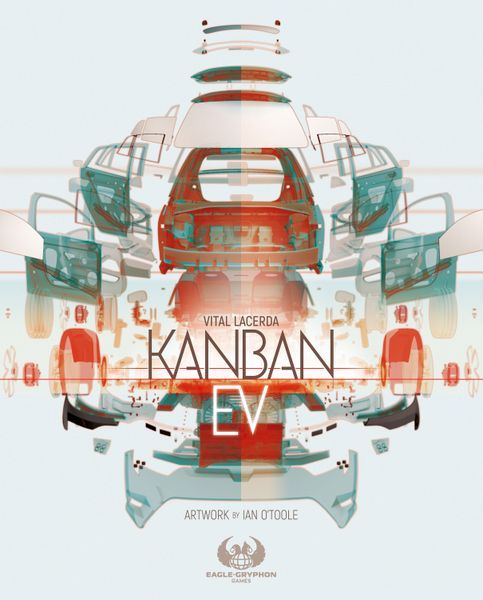
Kanban EV (Published 18 January 2021)This review has also been published at Boardgamegeek. Kanban EV: If you work and no one is around to see it, have you really worked?According to Wikipedia, Kanban is "a lean method to manage and improve work across human systems". Lacerda's games on the other hand are known for "having the most crazy interlocking mechanisms" according to the designer himself. Most of his games have a complexity rating of 4 or higher and some critics argue that they contain layers of layers of complexity just for complexity's sake. Whatever you think of his games, "lean" may not be the first word that springs to mind when someone mentions Lacerda. So how did he tackle the theme of efficient assembly lines in the automobile industry? 
Hardcore games for hardcore gamers The basics: Place Workers to convert ResourcesThe basic gameplay of Kanban EV is actually not that complex. There are only five worker spaces of the game, each of which has one or two actions. Using those actions, you acquire resources (designs and parts of different colors) and convert them to victory points (cars). This sounds even too simple, doesn't it? Well, each individual task is simple but to connect them in an efficient workflow you will need a lean mindset. Let's look at the different tasks and how they relate to each other. The Design Department: Which cars do you want to build?Car designs come in five different colors (the black concept car, the red sports car, the gray truck, the blue SUV and the green city car) are selected through simple drafting: the first two designs in each line come with a bonus, the next two come without a bonus and the designs in the draw piles require an unlocked ability. So far nothing interesting. However, if you look closer at the designs, each one is uniquely associated either with one of the six different car parts or with no car part at all, adding up to a total of 5x7 = 35 car designs. The short explanation is that this tells you which car part that may increase the value of the car and that your choice of design should be based on just in time thinking: which design should you take now to have the right resources when you need them in future departments? If this advice doesn't sound very helpful, let's move to the next department and learn more about the car parts. 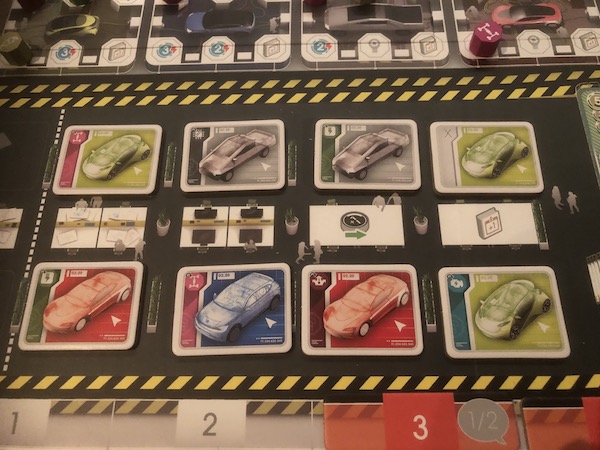
The two rightmost green cars come with a book and the black and red cars next to them come with a shift, more about them later. The Logistics Department: Which parts do you need to produce your cars?Car parts come in six different colors (teal motors, maroon autopilots, green systems, tan bodies, gray electronics and pink drivetrains). They are also selected through drafting but a more elaborate one. Here you place a kanban card with six car parts depicted so that four of them point towards three of the car part spaces on the board and the other two point towards the other three car part spaces on the board. For each match between the card and the board you place a car part and then you take all car parts in any one car part space. The point of all this is that not only can you decide to increase the number of car parts that you need but you can also decide which car parts that will be left for the other players. There is also the interesting concept of the recycling center to take into consideration. This is a space which always holds three of the six car parts and which may be used to exchange resources. Thus, if you manage to play your kanban cards well, you can take resources that the recycling center is missing and exchange one of each of them for resources that you are missing to get a variety of resources. This will give you flexibility in future departments. So is this simply a case of maximizing "your" car parts and minimizing the other players' car parts? Not necessarily, you may actually WANT the other players to get certain car parts and use them to promote your interests in future departments. If you're even more confused than after the Design Department, let's move to the next department where you actually get to produce the cars. 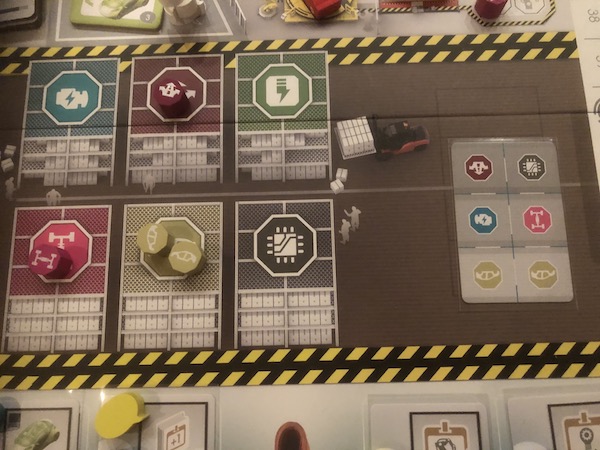
The kanban card as placed add 1 maroon part, 1 pink part and 2 tan parts. The Assembly Department: Which cars do you want to produce first?The Assembly Department is exactly this, an assembly line where you put car parts at one end and get cars at the other end. This is also a kind of drafting mechanic, where you have some influence regarding which ways the cars should take on the assembly line, which in turn determines which cars eventually get pushed out. However, there are (at least) two tactical challenges to manage at this department. First, you cannot use any kind of car part to push the car you want to push but only car parts that haven't been used for that car yet. (Obviously it wouldn't make sense to use two bodies for a car.) But more importantly, if a car has had a car part upgraded in the R&D Department, this part must be used first. Ideally, this is in your interest since it means that "your car" is worth more victory points but it also means that you should have planned for this and have the necessary car part just in time. Are you fed up with the lean management and just want to take your arduously produced car? Sorry, there is more work in the next department before you can take it. 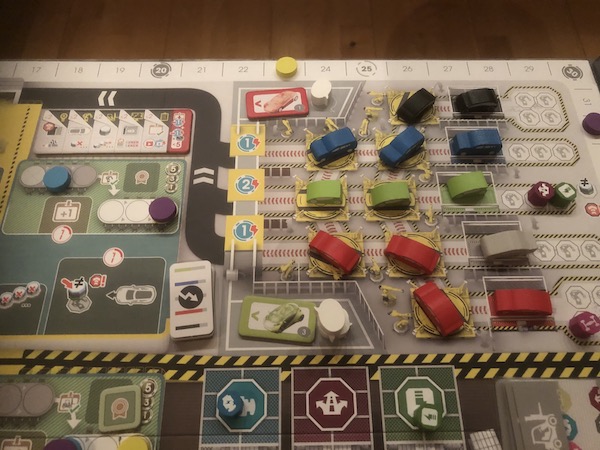
A blue, a green and a red car are in front of the assembly line, waiting to be pushed out depending on where car parts will be placed further back in the assembly line. The R&D Department: Which cars do you want to upgrade and which cars do you want to claim?The R&D Department is where you use your designs to improve and claim those cars you've worked so hard for. This department contains two important tasks. First you may use use a design to "upgrade" the car part depicted on it. Simply return the design and place the car part on the car space. Don't worry about the exact victory point calculation for now, it's suffice to know that this will earn more victory points for the players with such cars. Wait, what? Can other players take advantage of my labor? Of course, did you think you were alone at this factory? And just wait till I've described the second task. In addition to the upgrade task, you can also claim cars from the "test track". The test track is where the cars pushed out from the assembly line end up. We see the drafting mechanic here as well, where early pushed cars cost less actions to take. Thus, it does not matter who actually got the car to the test track in the first place (although they will have earned some victory points from the Assembly Department) and there will be frequent situations where a player "steals" another player's car or where a free-riding player picks up leftover cars that were pushed there to make room for other cars. 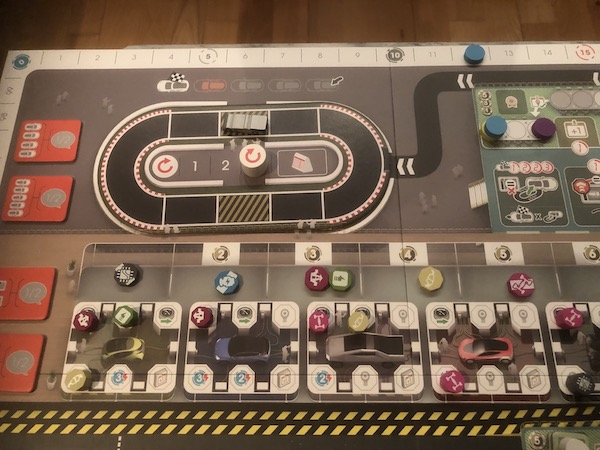
The test track is empty but for the pace car. The leftmost green car has been upgraded three times with a maroon, a green and a tan car part. The Administration Department: Which department do you need to visit an extra time?No company is complete without an Administration Department so of course there is one in Kanban EV. And as all other Administration Departments, no work is done here. Instead, a worker placed here may work at any other department. This is why Administration Departments tend to be full of workers. Well, maybe not but you may wonder why you would bother placing workers at other departments. To answer that question, we'll move on to discuss how the actions are executed in Kanban EV. "Yup, keep an eye on admim. Evil place on any company." The Action Execution: Do you want to work much or fast?As you might have guessed, there is more to the worker placement mechanic than simply selecting the best action for you. Each department has two spaces, one that lets you take two actions at the department and one that lets you take three actions. However, a worker on a two action space get to act first so if you are in a hurry you'll have to accept less actions. Do you remember the flexible Administration Department? It only has spaces with two actions and one action respectively. To make things even worse, it's the last Department to execute its actions. OK, so now you may wonder why you would ever placing workers at the Administration Department. One obvious reason is that the department you really want to work at is full. However, a more important reason is that departments are chosen and executed in department order from top to bottom. If you want to play it nice, you can use it to take two consecutive turns without having to worry about some guy coming in between and take advantage of your work. If you want to play it less nice, you can be that guy and take advantage of someone else's work. A typical example is when someone selects the Assembly Department with the intention to push out a valuable car to the test track, after which you select the Administration Department with the intention to take an R&D action and claim it for yourself before the other player has time to select the R&D Department. The Training: Do you want to be good or look good?There is one more thing you can do at each department, namely training. The training does give you immediate bonuses that help you in your work (part vouchers that act as jokers, books that provide free training and shifts that may be banked and used to take more actions in the future). The training also unlocks department specific benefits on your player board, such as more space to store the fruit of your labor. But more importantly, training is important to please the factory manager. It's now time to introduce Sandra. Sandra acts as an AI worker. Her moves are partly determined by the players as she will always move to the next available department. In her turn, she will do some clean-up and then assess the players with the LEAST training in that department. If you're assessed and can't live up to her requirements for that department you will be penalized and lose victory points. This, and the fact that her work disrupts all players' work (she blocks a worker space, she removes resources placed by players and so on) makes her the perhaps most thematic part of the game. Another interesting aspect about Sandra is that the completion of her supervision tour through the factory is one of the two game clocks (the other being the number of claimed cars) so the game length is variable and indirectly determined by the players. Oh well, at least your hard work will pay off with more victory points than you lose due to this. Not quite, although you do earn a lot of victory points from cars (for each car you earn 1 VP per upgrade + 1 VP per matching upgraded design tile), a considerable amount of victory points come from telling Sandra about your work at the Meeting and training matters here as well. 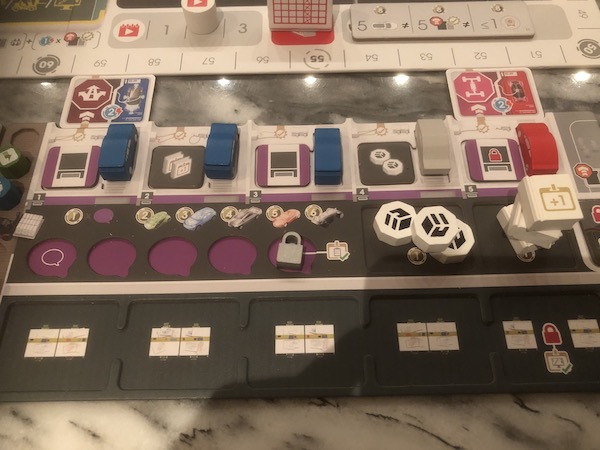
A player board with some cars, parts vouchers and books. The padlock indicates an ability that may be unlocked through a certification. The Meeting: If you work and no one is around to see it, have you really worked?At certain times (when a certain number of cars have been claimed), the game is interrupted for a meeting. In turn order determined by the training level, the players get to play speech tokens (often earned from training) on goal cards to earn victory points for work done. You may for example be rewarded for each design tile you have that has been upgraded with a certain car part. Rewards are given on first come, first served basis, meaning that the first player may be rewarded for more goal items than the second player. Thus, you will earn some victory points out in the factory but unless you brag about it at the meeting, you will miss out on the large chunk of them. Did I tell you Sandra was the perhaps most thematic part of the game? 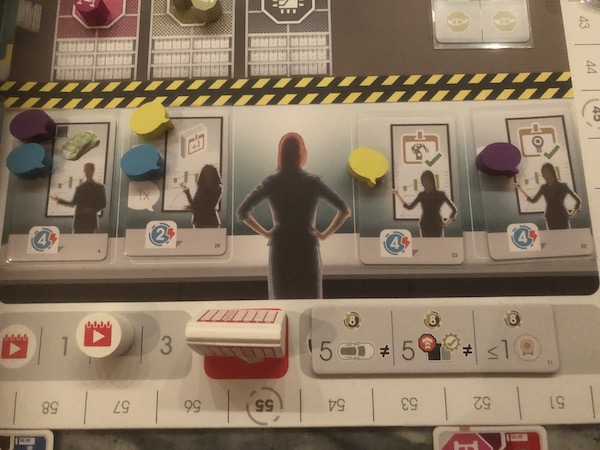
A meeting in progress. The leftmost goal, green cars in the player's garage, has been accomplished (and presented to Sandra!) by purple and blue player. The Lean Player MindSo what makes Kanban EV stand out from other games? It mixes worker placement with various drafting mechanics, turn order timing and contract completion. That doesn't sound very innovative, does it? But where Kanban EV really shines is in the way all those parts come together. This is not a point salad where you play different mini games to collect victory points. As you may have gathered from the department overview, your input at one department won't yield you anything if you don't have a plan for how to use the output at the next department, and the next and the next. Nor is this game a multiplayer solitaire, where you can hover over your little private factory and optimize your actions. Instead, you will have to sharpen your elbows and claim your place in the department and at the meetings to be successful in the eyes of the factory manager Sandra. But this doesn't mean that Kanban EV is a knife fight in phone booth, at least not always. Sometimes it makes sense to cooperate with other players. Perhaps a player is upgrading a certain car model. Why not investing in the same car model and help increasing the value of it for the benefit of both. Kanban EV is a highly interactive game where interaction can be both positive and negative. How about the complexity then? Here I would argue that the game itself is not that complex, if we accept Professor Rick Nason's distinction between complex and complicated. Complex problems involve unknowns and interrelated factors but there is very little unknown in Kanban EV. The randomly drawn reward tiles have marginal effects while the randomly drawn goal cards give you several turns to prepare for. Is Kanban EV a complicated game then, a game that is hard to solve but addressable with rules and recipes? New players may be indeed be overwhelmed, not by the many decisions (there are only five departments to choose between) but by the effort to understand how a decision now results in victory points at a meeting ten turns later. But no, the gameplay can't be reduced to simple heuristics. Understanding how all parts fit together is just the first step to mastering Kanban EV. My best advice is not to worry and simply play in your first game. In the round preceding the first meeting, grab some resources and realize that you have the wrong resources later on. In the round preceding the second meeting, grab some other resources and realize that you have the right resources later but that someone else benefitted from them. When the game is over, you will have scored miserably but you will know what to do next time and you will want to play again immediately. Once you've reached this stage, you will understand that Kanban EV's complexity comes not from a heavy ruleset but from the many interrelated factors created by other players. In this respect, Kanban EV is representative for Lacerda's designs and although the gameplay differs from that of other titles like Lisboa and On Mars, the player mindset is the same. When you start understanding how a player action now cascades into a future game state, then you will understand how to set up a strategy that gives you the necessary tactical means to react and then you will have achieved a lean player mind. "The game is that heavy because players play it only once. After 5 plays, what keeps the heaviness is the challenge and how hard the decisions are to take."
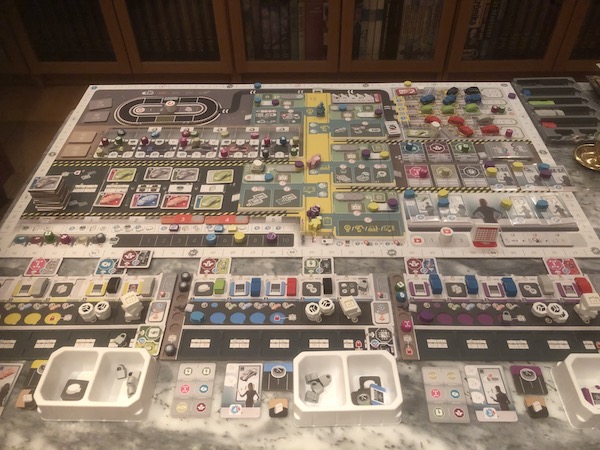
A 3 player game has ended after 2 weeks and 3 meetings. Hopefully Sandra is not too displeased. |
|