
 |
The Quest for the Perfect Game - Reviews to Extract the Essence of Games by Nicholas Hjelmberg | |




















|
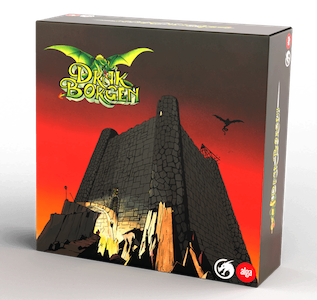
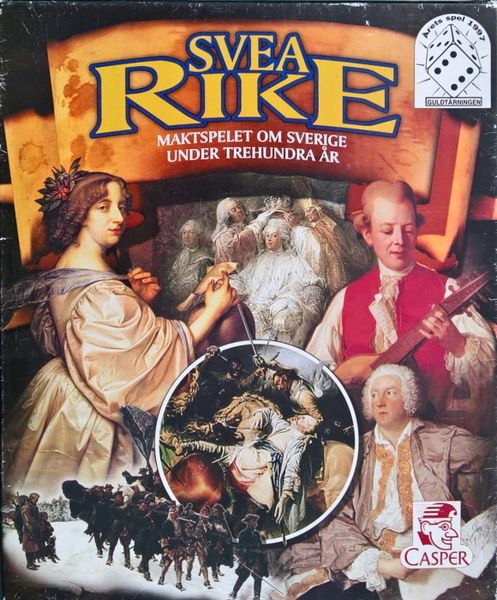
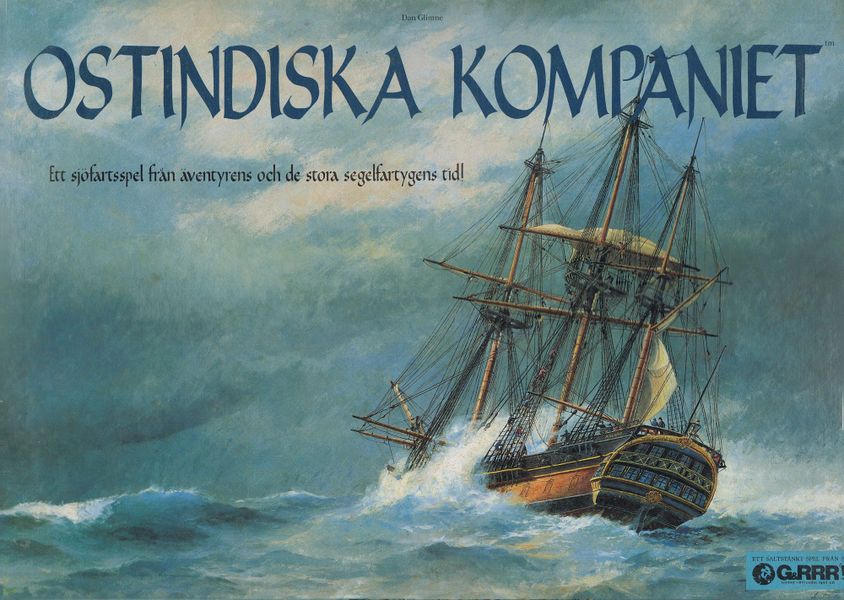
Ostindiska Kompaniet - A Wind of the Past (Published 17 January 2022)This review has also been published at Boardgamegeek. IntroductionWhy review an obscure Swedish game like Ostindiska Kompaniet (Swedish for East Indian Company) from 1991 when there are so many other and better games? Well, the main reason is that this game is from a time when there weren't so many other and better games. Back in the 80s, I had to settle with games like Monopoly (or some of its many clones) and RISK (until I discovered better war games). The Golden Age of Boardgames was still in the future and early geniuses like Sid Sackson were sadly unknown in Sweden. Then came the ground-breaking dungeon crawler Drakborgen in 1985, a game that gave the designer Dan Glimne a rock star status, at least among gamers. This success was followed by titles like Ostindiska Kompaniet and Svea Rike, historical games with more interesting decisions than gamers like myself were used to. Yet, lack of time and money prevented me from experiencing those games and when I got more of both (yes, I play more games as an adult than I did as a kid), my childhood games had been put to shame by much better ones. Nevertheless, I couldn't help wondering what I had missed so when I got an opportunity to acquire Ostindiska Kompaniet for 25 SEK (about €2.5 or $2.5), I grabbed it. According to Dan Glimne himself, Ostindiska Kompaniet was an attempt to design a good game about an interesting epoch of Swedish maritime history. In the rules, he frequently reiterates how innovative the mechanics are and how many skill moments he has built into the game. My attempt with this review is to see how well those design goals were achieved, compared both to contemporary games and to modern games. The GameThe overall goal of Ostindiska Kompaniet is to buy goods in Sweden, trade them for silver in Spain, buy Far East goods for the silver, and finally return to Sweden and turn the goods into money. Eventually you will have enough money to buy shares in the Swedish East Indian Company and the player with the most shares wins. This corresponds very well to the actual operations of the historical company but which are those innovative mechanics and skill moments and do they turn this into an interesting game? Let's start from the beginning, in the Swedish port city of Gothenburg. 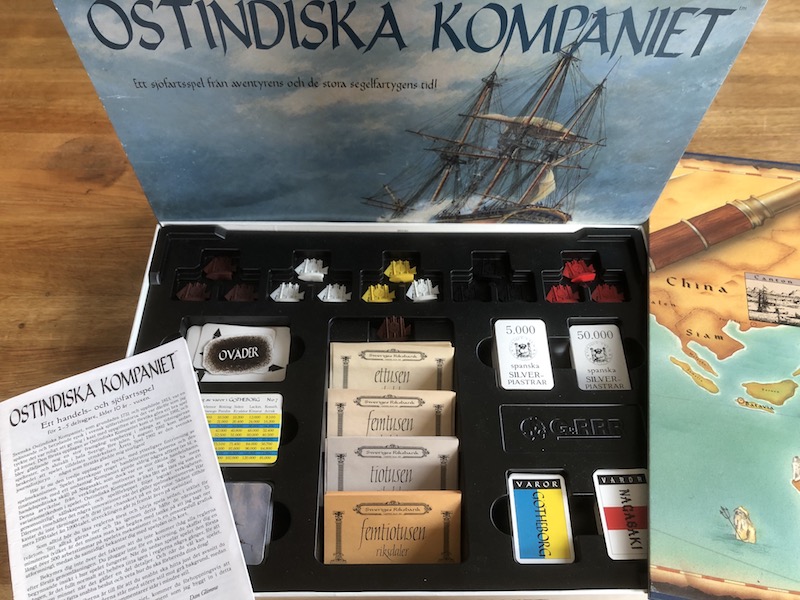
At least the insert is better compared to most modern boardgames. Buy domestic goodsYou start with a company treasury, represented by paper money, that you may dispose of to buy domestic goods. When you arrive in a port, and every turn you decide to stay there, you may draw 2 cards (sometimes more) that tell you which goods are for sale and how much they cost. Which goods will give you the best deal then? There are 6 different types of goods and the buying price for each type has a linear relation to its weight, e.g. if you buy twice as much steel, you pay twice as much riksdaler. The selling price varies more and ideally you should buy goods that can be sold expensively in Spain. However, as we will see in the section Sell goods below, you don't have enough information for such a decision. Also, waiting for better deals will not only cost you time but also save time for your opponents in the same port, since rejected cards remain up for grab for them. Thus, your only decision when buying goods is to accept or reject and not even this is much of a decision. If you can afford a good and load it into your ship, do so. But when should you stop loading and set sail? We'll find the answer in the next section about loading ships. 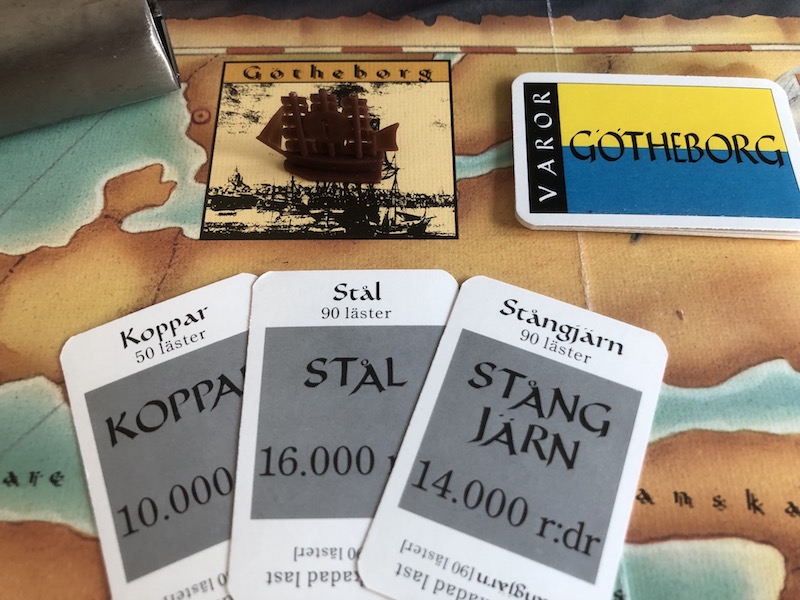
230 "läster" (old measure of weight) domestic goods for sale for 40 000 "riksdaler" (old currency). Load shipsShips are represented by a miniature on the map and a card on your hand. Each player starts with 2 ships and each ship has a loading capacity that limits the total weight of the goods you can load on it. There is also a crew and supplies for each ship. The supplies are represented by a smaller card that is tucked under the upper part of the ship card and rotated if your supplies decrease. For some reason, there is no crew card so if your crew decreases, you must place cards with this effect beneath your ship card (and hopefully remember them). How I long for the standard tracks and cubes of modern eurogames instead of this solution. Anyway, you must be careful not to let your supplies or crew fall too low as it will slow down your ship or even lose it together with all its goods. New supplies and crew members may be acquired in ports but will in most cases cost you both time and money so try to do so where it will cost you the least (in Gothenburg, combined with other actions etc.). How about the decision then? To be fair, Dan Glimne points out that there is a decision between departing before your ship is full or waiting another turn, hoping for a card that will fit the last space. With experience you may learn the card distribution and calculate the probabilities for drawing the exact weight you need. However, I don't find calculating card probabilities very fun and even if you do, spending turns to optimize your load capacity may cost too much time and time is also money. Let's instead set sail, but first we should get acquainted with the action cards. 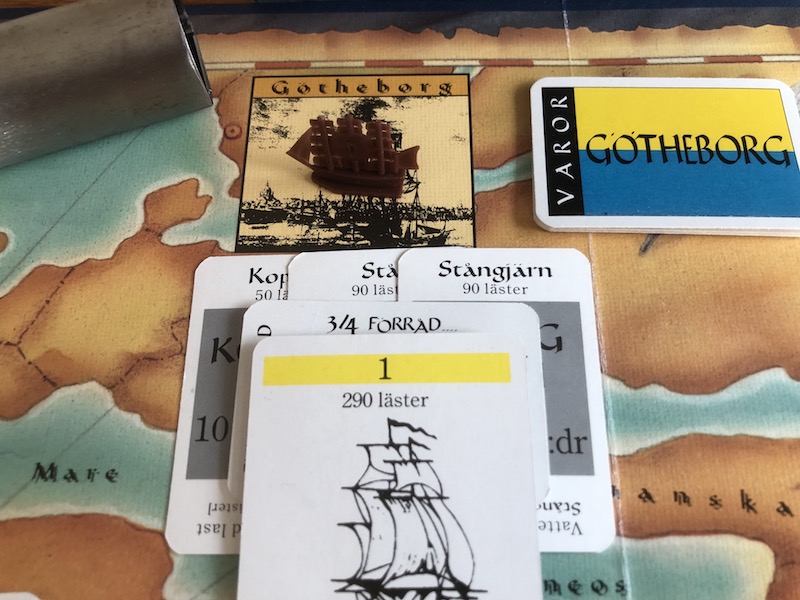
A ship is ready to sail with 230 "läster" of the full capacity of 290 "läster" filled and 3 quarters of the supplies filled. Action cardsAt the beginning of your turn you play 1 of your 3 action cards and at the end of your turn you draw a new card. Most action cards have a positive effect and lets you sail faster (see Sail ships below), draw extra goods cards at ports (see Buy goods above), or get a bonus when selling certain goods combinations (see Sell goods below). However, some cards are negative and may cause you a loss of crew, supplies, or goods. The skill moment here is to time your cards, i.e. play the positive cards when you benefit the most from them and play the negative cards when you suffer the least from them. Some of the cards also let you relocate the so-called storm card, which serves as an obstacle on the map and forces ships to take longer routes. Thus, well played cards can help you beat opponents to empty ports (which saves port fees and lets you draw additional goods cards). They also help driving your strategy by making some ports and goods more interesting than others (although once in the port, you're still depending on the luck of the draw to get the right goods). OK, let's play a sail card and learn about the Ostindiska Kompaniet's unique selling point; the innovative sail mechanic. 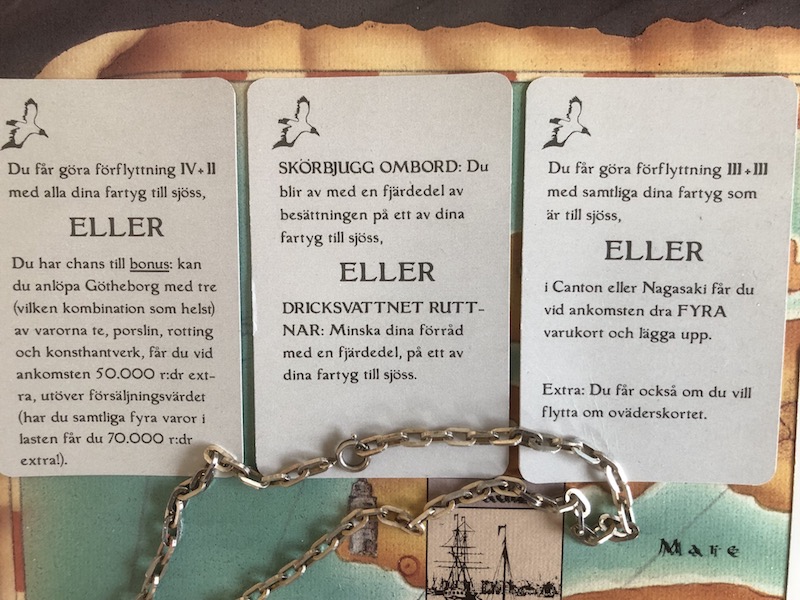
2 positive action cards (extra speed or bonus for goods combinations, extra speed or extra goods cards) and 1 negative action card (disease or spoiled supplies). Sail shipsDan Glimne prides himself in the game's sail mechanic. Instead of dice-driven movements and fixed movement tracks, the ships move freely across the oceans of the map, using a sail card which is used physically to measure distances. Normally a ship only moves the length of the short card side but some actions cards let you add the long side or a smaller sail card to your movement. Thus, the major part of your ships' movements will come from well played action cards. I must admit that I haven't seen this mechanic in any older or newer game and it's less fiddly than one might expect. Unfortunately the open seas of the map doesn't really do justice to this mechanic. There are simply no alternative routes between the ports. In an archipelago, there may be decisions between longer open sea routes (if you have a few "long moves") or shortcuts between islands (if you have many "short moves") but on an ocean, a straight line is always the quickest route. Perhaps a pirate game in the Caribbean Sea, where ship maneuvers could be used for aggressive actions as well, would be better? Anyway, now that we know how to cross the sea, let's trade our goods for silver and learn about the market mechanic of Ostindiska Kompaniet.
"Movement IV" will take the brown ship past Saint Helena. Trade goodsThe first stop on the trading route is Cadiz in Spain, where you sell your domestic goods for silver. This stop offers two decisions. First, you must decide whether to accept the prices of the current market card or draw a new one. Second, you must decide which of your goods to trade now and which to keep until your next turn, when you hopefully draw a better market card. Note that while your riksdaler are available to all your ships, your silver is only available to the ship that actually has it. This is a mechanic that rewards skills, since a skilled player will make the most out of his or her goods and time. Unfortunately and similar to loading the ship above, this skill requires that you memorize the price distributions of each of the 6 goods. Granted, many card-driven games do reward memorization but personally I had preferred a more interesting mechanic for predicting and taking advantage of price fluctuations. Actually, Dan Glimne does point out another skill: rounding. All prices are rounded so a skilled player may acquire goods so that the rounding will be in his or her favor. 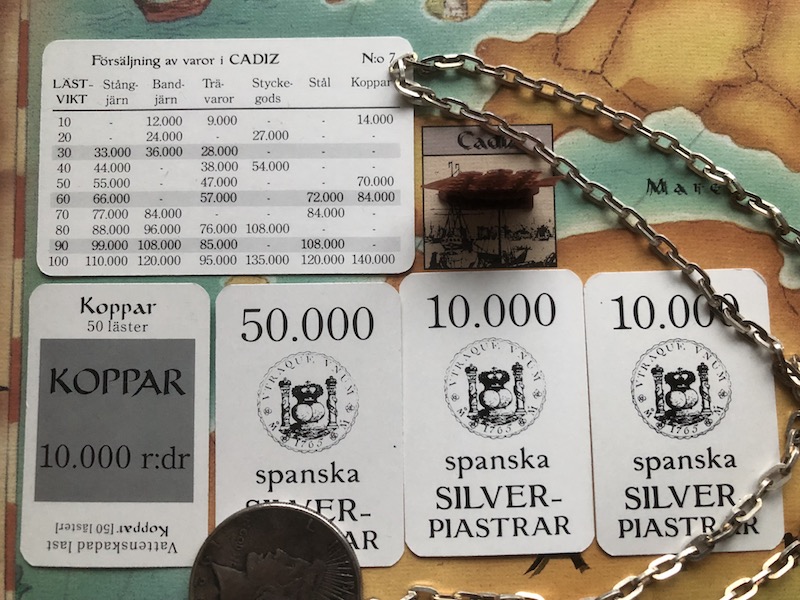
50 "läster" copper may be traded for 70 000 Spanish silver piasters. Buy overseas goodsOK, so now you have sailed around the Cape of Good Hope and have to make a decision where to proceed; India, China or even Japan. The further you go, the higher the potential profit. Your action cards may assist you in your decision if they reward certain combinations of goods, as will the storm card if it happens to block any of the ports right now. Otherwise only memorization of the goods cards in the different markets will help you assess whether a close port or a more distant port is the most profitable one over time. Once in a port, you have challenges similar to the ones in Gothenburg and Cadiz. Should you spend another turn to optimize your loading capacity and which goods will best match the market card back in Gothenburg? The first question can be answered with memorization of the 12 different goods if you enjoy that but the second question is next to impossible to answer, since several market cards may have been drawn before you return. Unless you're looking for specific goods, your best bet is probably to get as many goods that you can afford and fit and then waste no more time here. 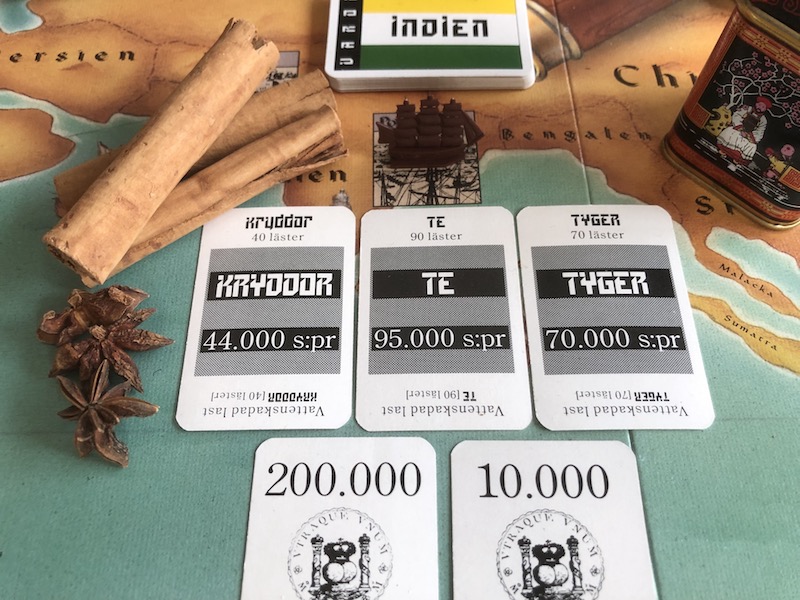
210 000 Spanish silver piasters are enough for 40 "läster" spices, 90 "läster" tea, and 70 "läster" cloth. Sell goodsFinally you're back in Gothenburg with all your overseas goods. Similar to trading goods, you decide whether and which goods to sell at the current market card prices. Here you'll find the widest price ranges of the game so use your skill (or luck) to get the best possible return on your investments. After this, it's time to repeat the cycle. Well, there are two more decisions. 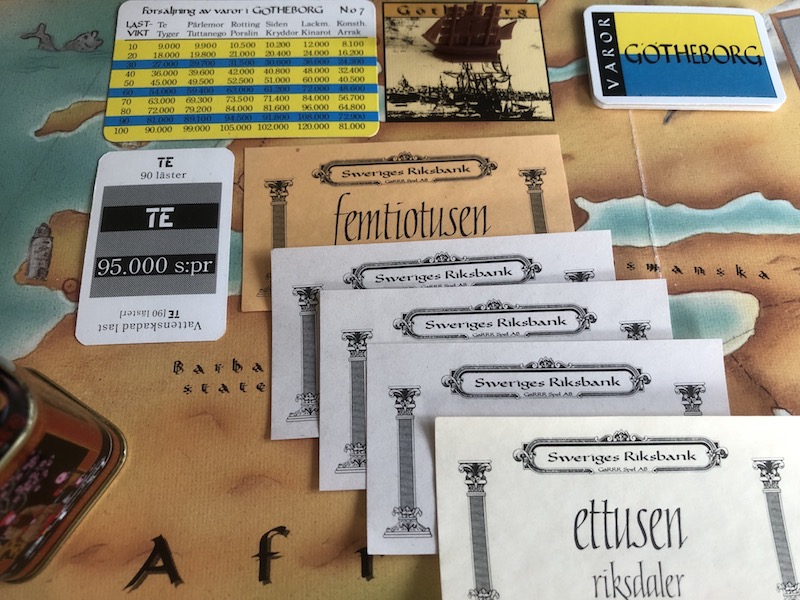
90 "läster" tea may be sold for 81 000 "riksdaler". Upgrade shipsYour first decision is whether to use some of your profit to buy a third ship. If you can afford both the ship and the domestic goods you need for the trade route, it's definitely worth it, since the 3rd ship has a better loading capacity and increases your actions per turn by 50%. 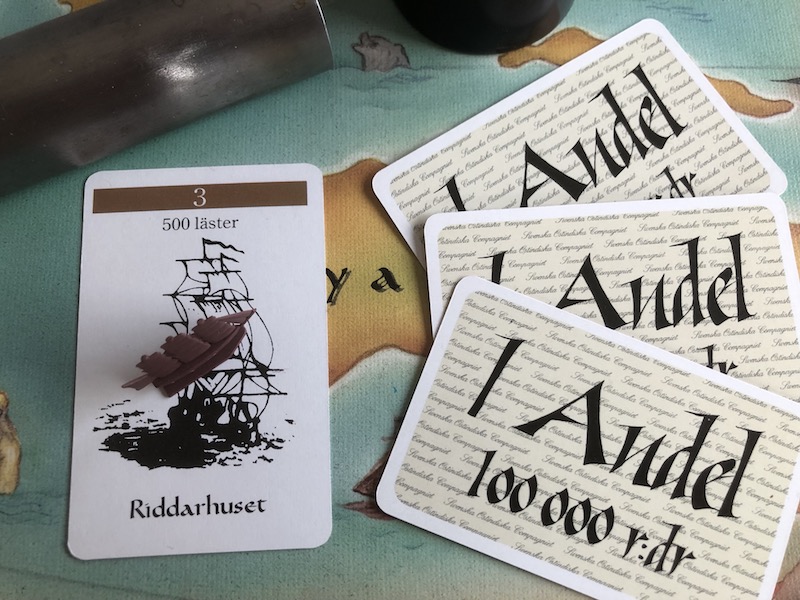
100 000 "riksdaler" will buy you 1 new ship or 1 share in the East Indian Company. Buy sharesYour second decision is whether to use some of your profit to buy a share in the East Indian Company. This will determine the winner in the end, although you're in no hurry at the beginning of the game since they offer no other benefits. Focus on money for a 3rd ship and enough goods to fill all your ships first, then on shares. When all 16 shares have been sold, the player with the most shares wins. So where is the game?Ostindiska Kompaniet was awarded the Game of the Year in 1992 (although the competition in Sweden wasn't very strong by this time) and received lavish reviews that described it as a modern classic. Yet, the game offers literally only one path to victory - from Gothenburg to the Far East and back. It feels repetitive already before you can afford your 1st share and then there remain 15 shares to be acquired before the game ends. The decisions that challenge you during a journey are either too simple (play the best action card, take advantage of roundings, block other players with the storm card etc.) or too complex (assess your trading options based on card probabilities and sailing distances). 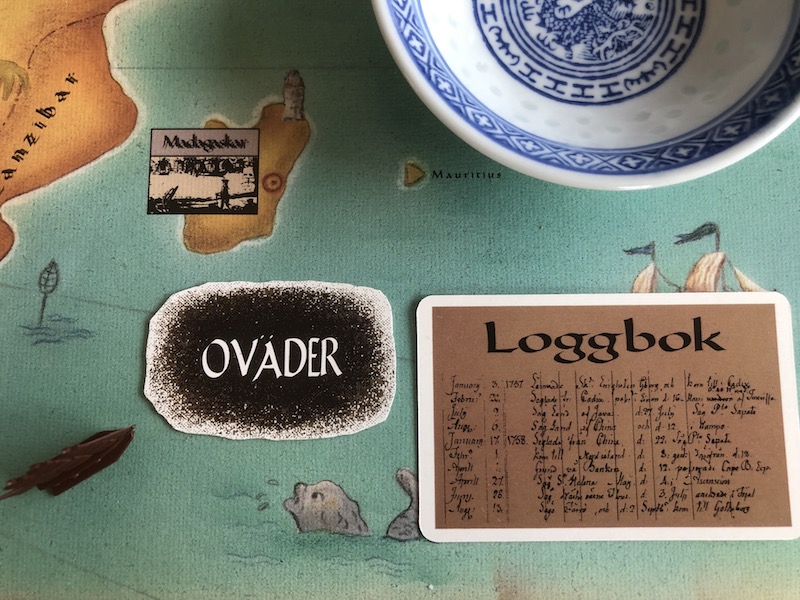
A storm and a log book cards - some of the challenges on the sea. Perhaps Ostindiska Kompaniet should be compared to its contemporary competitors instead of looked upon from a modern boardgamer's perspective. The players do have more freedom than the dice-driven round track of Monopoly and the theme is definitely stronger. I would like to have seen a more sophisticated market mechanic, where the players can make better market predictions and either race each other for the currently most valuable goods or accept that they are behind and instead go for the next good to trend. Naturally, the real merchants of Ostindiska Kompaniet didn't have this information either but surely they had some kind of idea of which goods to return home with? Ostindiska Kompaniet is probably best played in a less competitive and more relaxed mood. Don't bother calculating your optimal moves because the reward will be so marginal that it's hardly worth the effort. Instead, set sail to the Far East, grab the opportunities that the game gives you, and use the time until your next turn to discuss how games have improved and which game to play next. 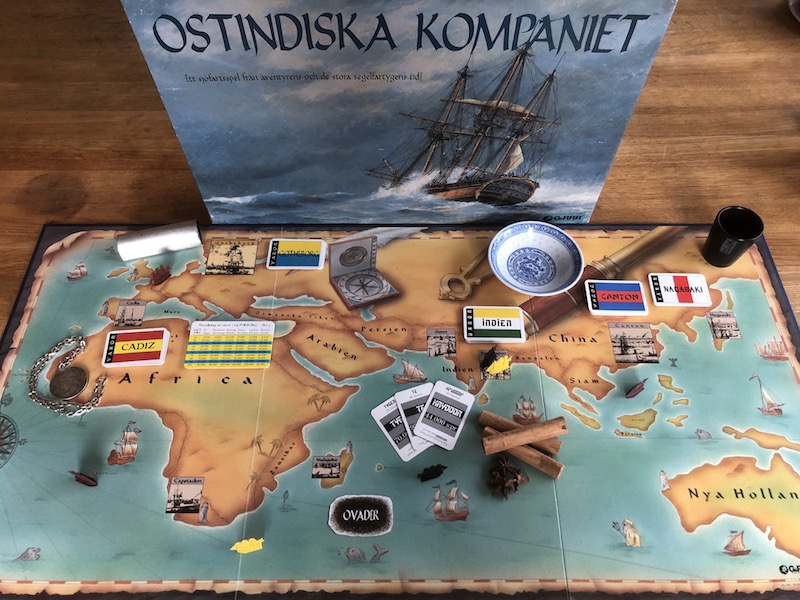
I miss the wooden components but the map and the box are beautiful. |
|