
 |
The Quest for the Perfect Game - Reviews to Extract the Essence of Games by Nicholas Hjelmberg | |





|
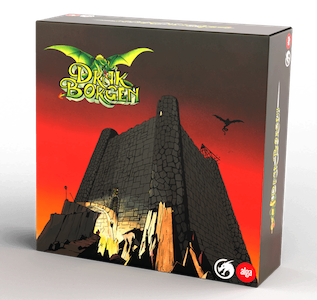
Drakborgen - A Feel Bad Experience? (Published 11 April 2022)This review has also been published at Boardgamegeek. The Beginning of DrakborgenDrakborgen used to captivate my imagination when I was a kid. In a world of predictable Monopoly and RISK games, here was finally a creation that told a different story every time. The premise was set already by the box cover: a brooding scene with a dark and sinister crumbling cliff-top castle. As a player, I expected an unknown and dangerous adventure and this is exactly what Drakborgen delivered. However, Drakborgen offered little else of what you'd expect from a game back in the eighties, let alone today. The game was mostly solitaire with every player struggling along his or her own path through the castle, the decisions were few with only two or three options per turn, and the outcome was mainly determined by the luck of dice and cards rather than the player's own skill. I did play other objectively better games at that time - I was an avid chess player and I had just discovered war games and role-playing games. So why did I keep returning to Drakborgen, not only then but even today when there are so many other games to choose from? This review is an attempt to explain that. The Gameplay of DrakborgenLet's start by exploring the gameplay of Drakborgen. Each player plays a character with unique abilities. The initial characters only differed in terms of the values of the four characteristics (strength, agility, armor, and luck) with the exception of Bardor Bågman and his special crossbow. Later expansions like Drakborgen II and the recently published reprint added additional characters with more complex abilities, such as the spells of the magician Mrishnakh or the accompanying creatures of Dzála Náryn and Thore Kopparsköld. 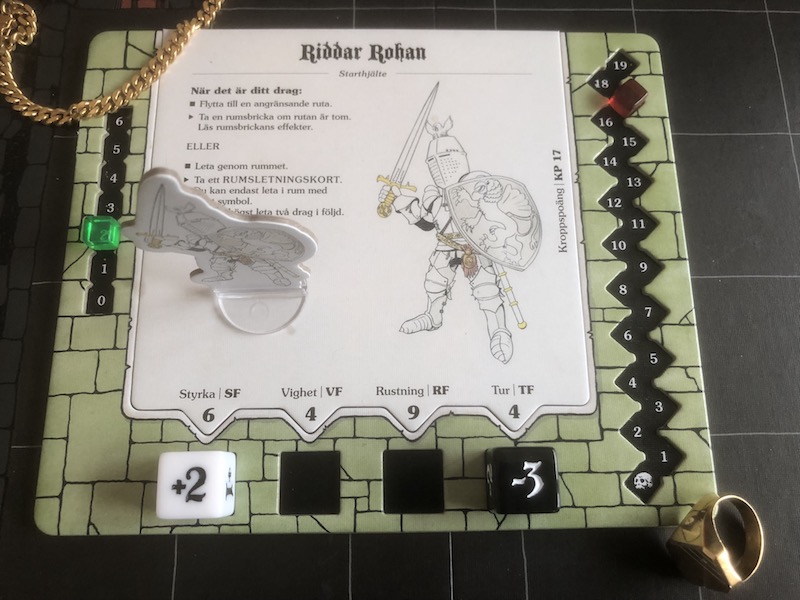
Old Riddar Rohan with a new dual layer player board to track items (green cube), health (red cube) and modifiers (white and black dice). On a turn a player moves to a square and draws first a room tile (unless there is one there already) to see what the room looks like and then a room card to see what the room contains. There are some exceptions, such as room trap tiles, for which you draw a room trap card instead, but the result is the same: every game of Drakborgen vill provide a unique game board with unique challenges. 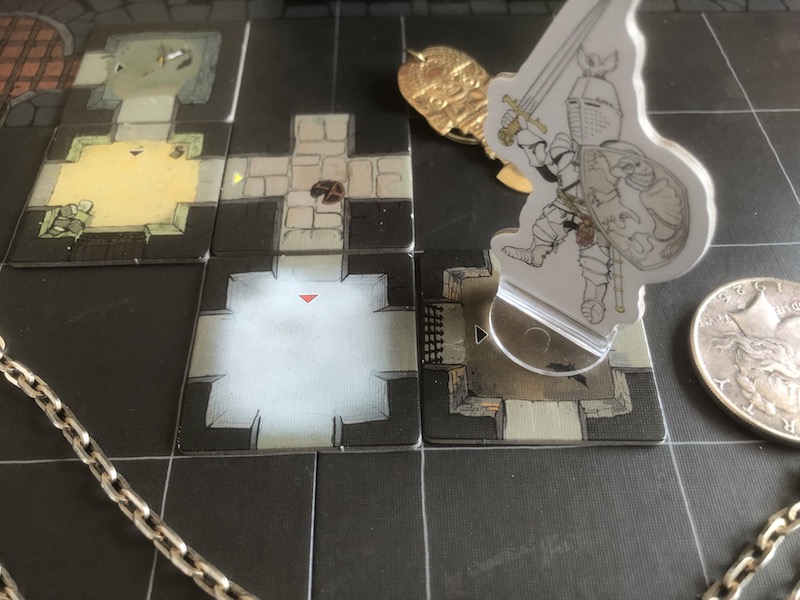
A fairly good start for Riddar Rohan where each new room tile has brought him deeper into Drakborgen. The goal of Drakborgen is to reach the treasure chamber in the middle of the board, draw as many treasure cards as you dare (but also draw a dragon card, one of which will wake up the dragon!) and leave the castle before the sun sets. Players are not allowed to share the same tile (unless you play with an optional rule introduced in the reprint) but they may reuse each others' room tiles so while the entry into Drakborgen will be a journey into the unknown, at least the exit will be slightly more informed. Unfortunately, most players won't even reach the treasury chamber... 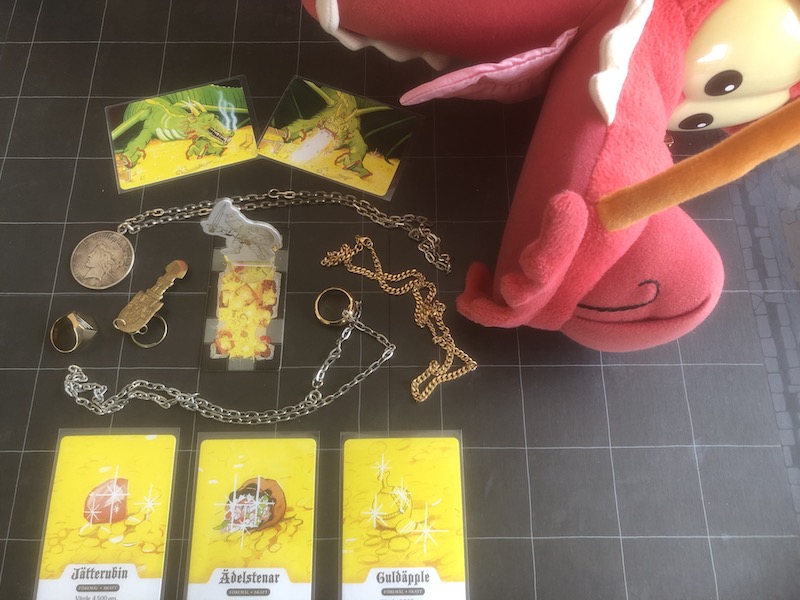
The desired goal of Drakborgen and its fearful guardian. The Challenges of DrakborgenThere are many challenges awaiting the adventurers. The already mentioned room traps will cause injuries and reduce their health points. Most of the injuries are determined by a die roll, often reduced by one of the adventurer's characteristics, but there are also traps that cause instant death if the player fails a die roll, a number guess or something equivalent. 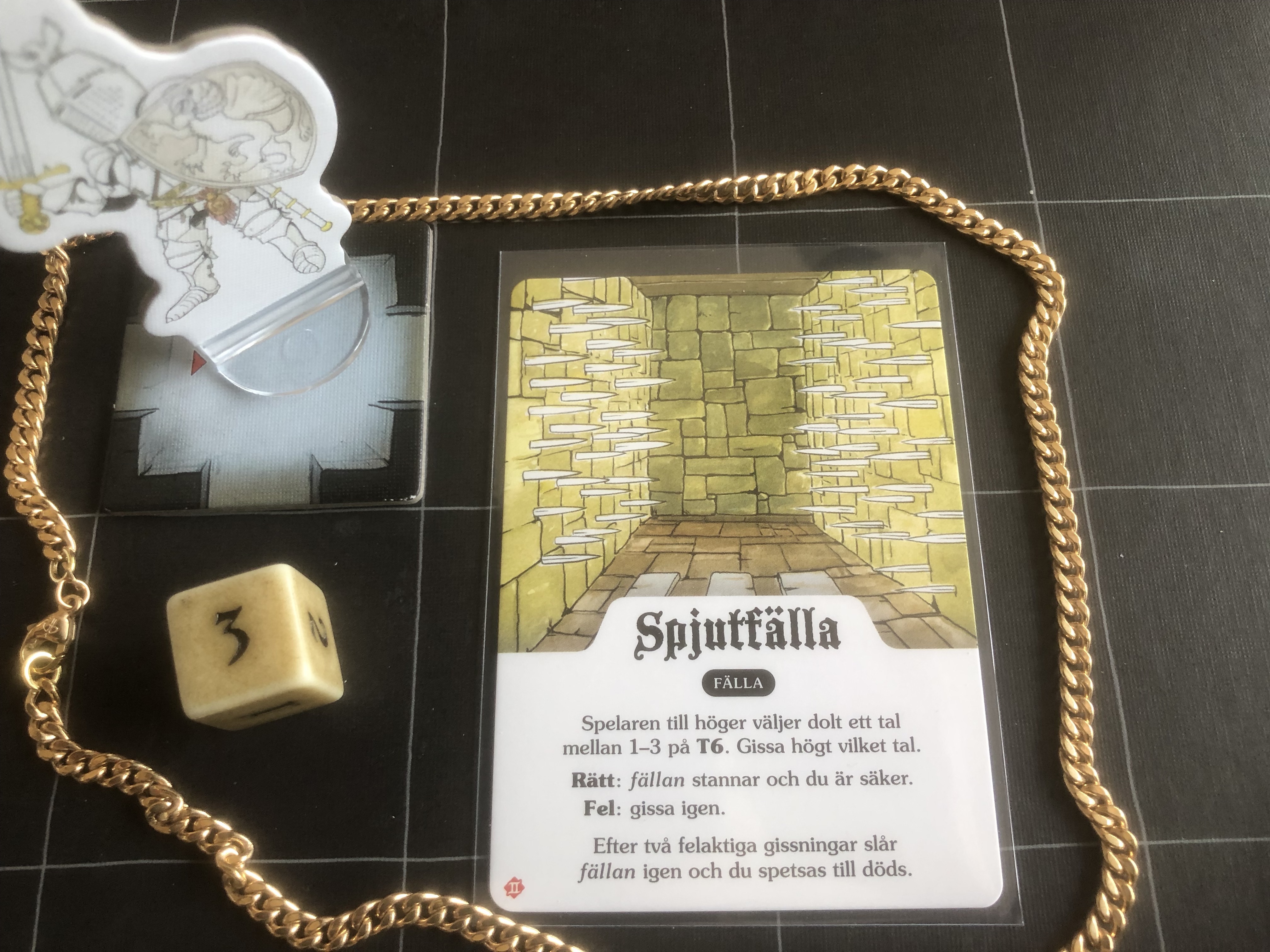
One of the more dangerous traps of Drakborgen: Spears that kill whoever fails to guess a number between 1 and 3 (two attempts). Other challenges include doors (where cards tell whether the door opens, remains closed or even has a trap), searches (where cards tell what you find in the room, in a coffin or with a fallen warrior), obstacles (that require die rolls to be forced), items (that may have a positive or negative effect depending on what the die or card says), and of course monsters. 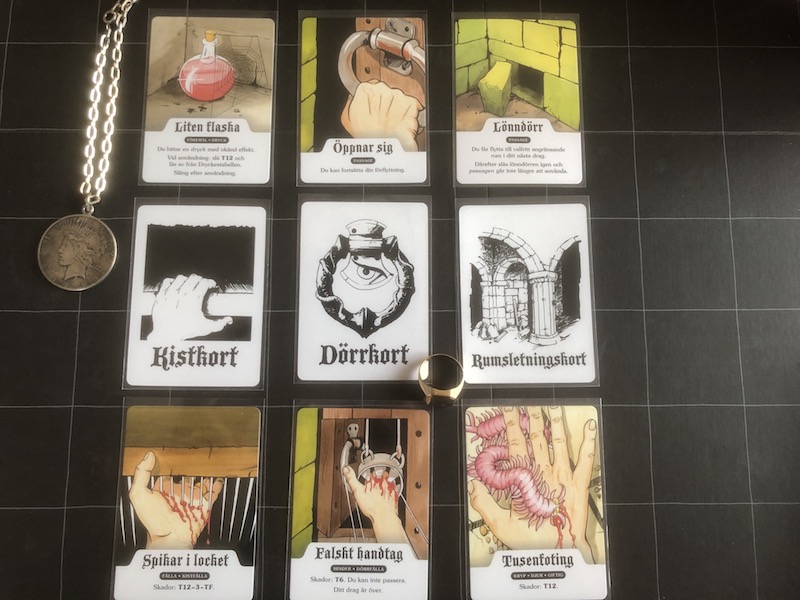
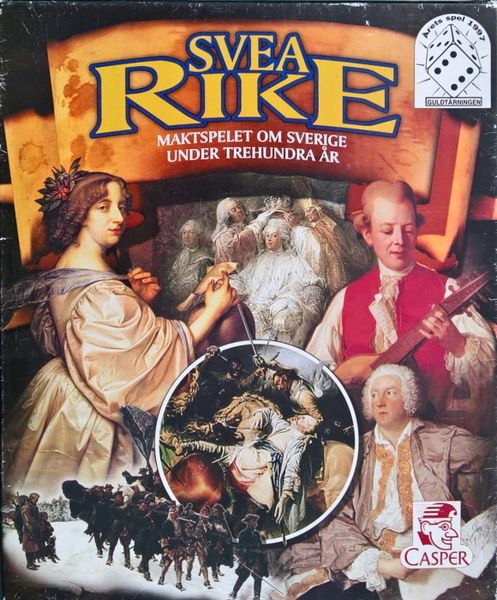
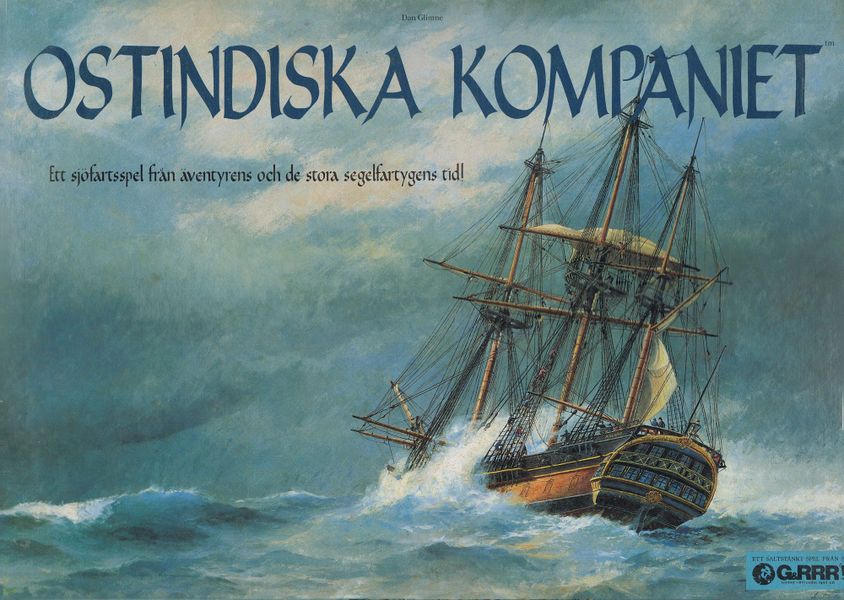
Examples of rewards and traps related to searching. Where is Riddar Rohan's gauntlet? While most of those challenges are random, the monsters do offer some decisions. First, the player must decide whether to attack, await the monster's reaction or escape. A card will then determine what the monster does and, in case of a combat, its health points. The monster's reaction does follow a pattern and once you get to know this pattern you will have a more informed decision. (For some reason, the designer liked this mechanic and used it in other games like Ostindiska Kompaniet and Svea Rike.) The combat is fought "rock-paper-scissors" style, where combat card A defeats B, B defeats C and C defeats A. Each adventurer has a card that inflicts double damage at a hit, something that provides a small but not insignificant twist to normal rock-paper-scissors. 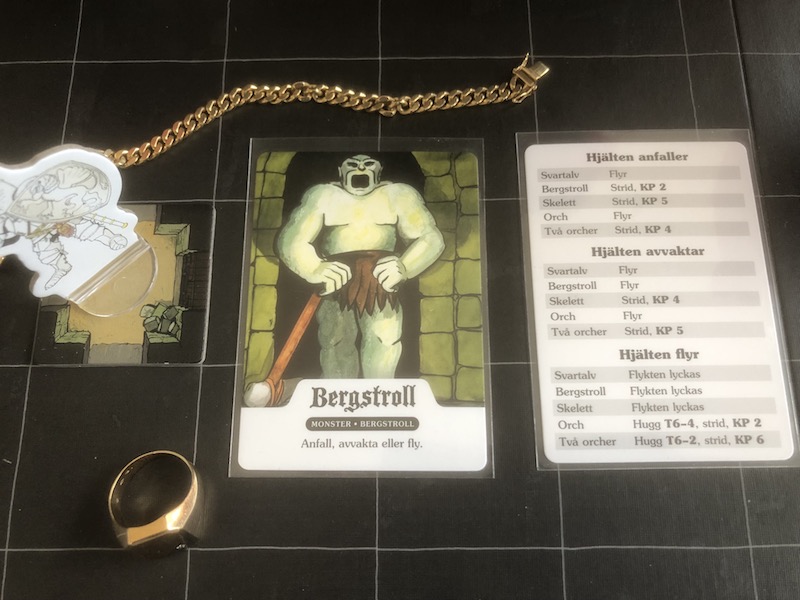
This cave troll will only attack if you attack and fight with 2 health points. There are many other rules that provide a variable experience, such as the underground, where an adventurer may choose to leave the game board and traverse through unknown caves beneath the castle by drawing underground cards each turn until (hopefully) a way up is found. The adventurer will then reemerge on the game board as many squares forward as the number of cards drawn but possibly a bit to the left or to the right depending on a die roll. 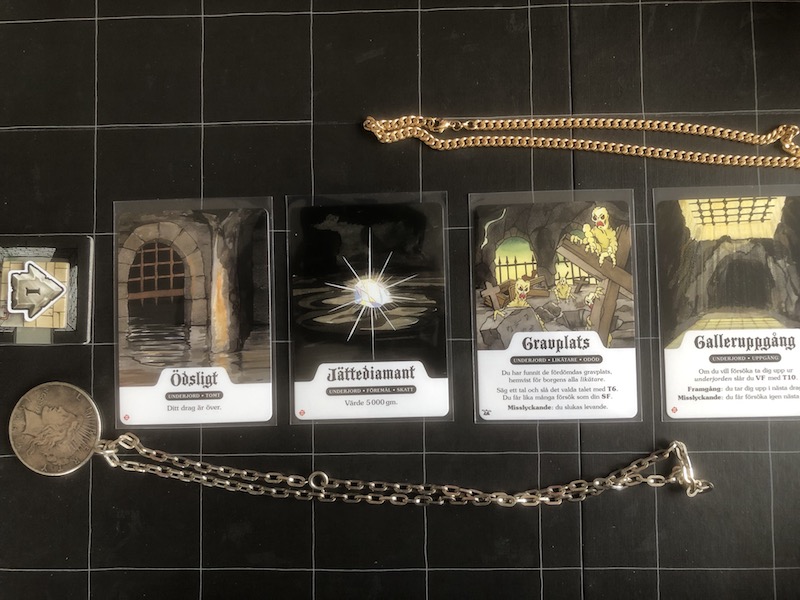
The underground contains both dangers and treasures but what you really want is a way up again. The Old and the New DrakborgenLet's pause for a moment and reflect upon the new edition (2022) of Drakborgen. Thankfully, the publishers stayed true to the original Drakborgen and Drakborgen II. The rules are the same with some welcome clarifications, such as moving rules from the old edition's rule cards to the actual components where a rule is applicable. The components have been carefully upgraded with dual layer player boards and bigger standees (thankfully no miniatures!). Perhaps the most important thing is that Anders Jeppsson's evocative illustrations of the old editions have been preserved and we've even got some new illustrations of the same style. Drakborgen I and IIThe first Drakborgen introduced the basic gameplay of room tiles and room cards and included four characters. Drakborgen II introduced eight more characters, the rules for the underground, and various other cards. Although it didn't add much to the gameplay, it did provide some more variability (the new characters have special skills, although most of them are situational so they're not necessarily better than the old ones) and options (the underground may be dangerous but at least it helps you pass a hopeless series of rooms leading nowhere). Thus, I never saw a reason not to include it in my games. Drakborgen ÅterväcktThe new edition also introduces some rules from Drakborgen "Återväckt" (Revived) of mixed quality. For example, the giant spiders sound interesting but they are only activated if 1) A spider card has been drawn, 2) A web card has been drawn and 3) A player gets stuck in the web, in which case they move towards the victim in a slightly confusing way. Nevertheless, Drakborgen Återväckt does come with more cards so if you have them you might just as well use them. Drakborgen IIIFinally there are some completely new contents labelled as Drakborgen III. Besides even more cards, Drakborgen III includes a background story, a new battle system and rules for sharing tiles. Regarding the background story, I'm generally not a fan of them and as a kid I was more than content with my own imagination as each new game of Drakborgen added a new chapter to its story. The battle system is an ambitious attempt to make battles feel less luck dependent and more about skills. Instead of choosing among three battle cards, you choose from a wheel among your four characteristics and each battle round you may only move one step on the wheel. For some reason, you lose battle points instead of health points and unless you lose them all, you will fully recover after the battle. Why the designers chose to remove the main source of lost health points is beyond me. However, if you think rock-paper-scissors is about skill, you'll find this less elegant, and if you think rock-paper-scissors is about luck, you won't like this better. Also, a battle is a duel between two players so the more complex battle rules may result in more downtime for the other players. There is no reason to prolong the battles further when there is so much else to explore. The rules for sharing tiles is an interesting attempt to answer the question why the adventurers couldn't meet in the first editions. I'm not sure this is the best answer, since the relatively smooth turn structure is fragmented into moves and events and the ability to attack each other may add to much take that into an already evil game. Here I think I prefer my old house rule that characters who meet only fight one round, after which the loser gives up an object and flees. There are also new fan-designed characters that seem to be balanced but I need more games to tell. 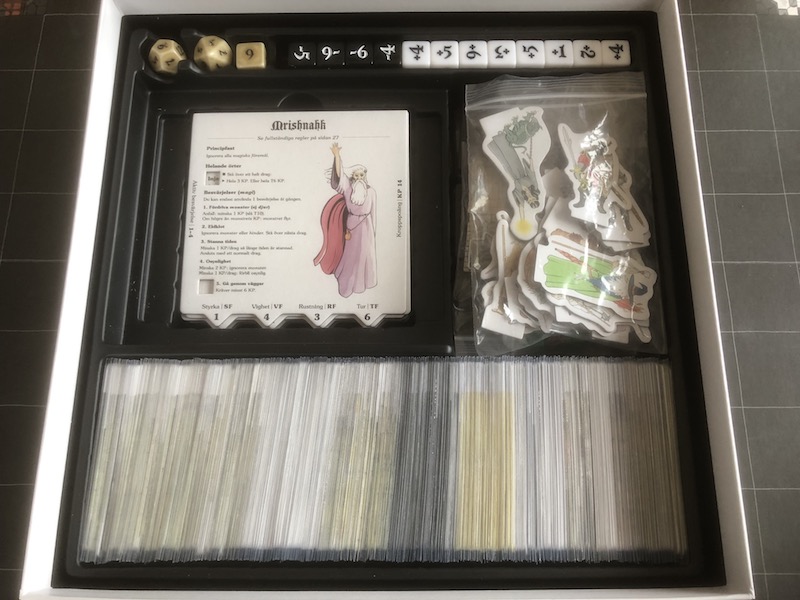
Drakborgen is like a box of chocolates, you never know what you're going to get. The Game of DrakborgenIf you have survived the review this long, you might wonder where the game is. The decisions could be summarized like this:
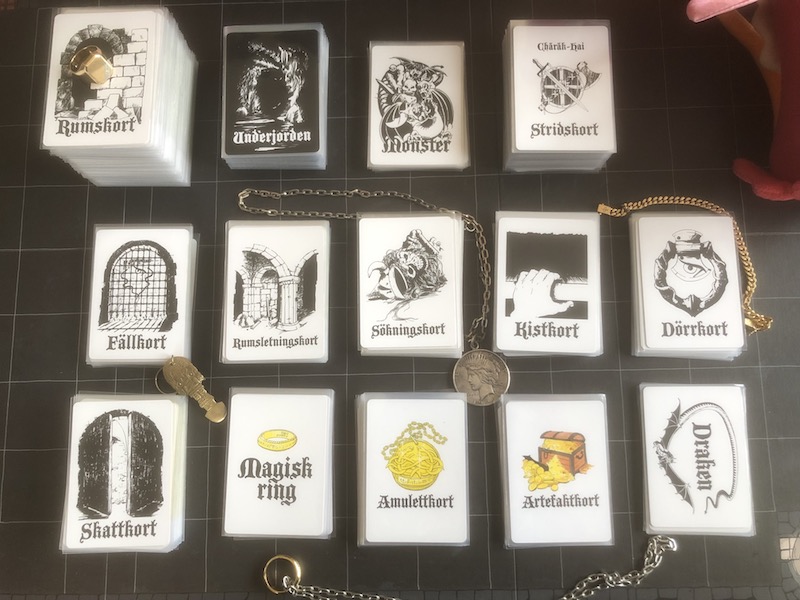
A card for every occasion: rooms, underground, monsters, battles, traps, searches, corpses, coffins, doors, treasures, rings, amuletts, artefacts, and of course the dragon. Granted, some characters have abilities that offer additional decisions and personally I think the rock-paper-scissors mechanic does reward skills (unless, which often happens to me, my opponent gives up and starts drawing combat cards randomly). 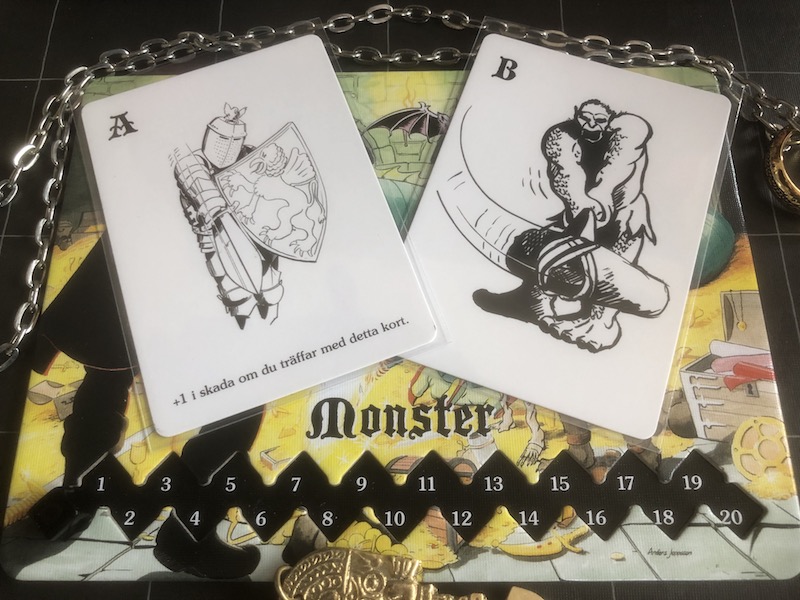
This hit will reduce the cave troll's health points from the above example by 2 and end the battle. But besides that, there is not much else you can do but to place your fate in the many cards and die rolls of the game. (You usually only roll 1 die at the time but there are no less than 458 cards in the game!) You can't do much to mitigate the randomness either. Most cards and die rolls force you to react to challenges rather than taking on challenges that fit your adventurer's particular characteristics the best. There are few opportunities to improve your adventurer during the game and most of the items you find may have both positive and negative effects, as determined by a, you guessed it, a die roll or a card draw. Drakborgen also breaks other "modern board game taboos" with mechanics like player elimination (if your adventurer dies, you're out of the game), lost turns (if your adventurer fails certain die rolls or uses certain abilities) and vicious circles (with few exceptions, your adventurer gets weaker throughout the game). In that sense, Drakborgen is not a "feel good" experience. Drakborgen does not even offer the surviving players any sense of accomplishment - you were simply lucky to get out alive. 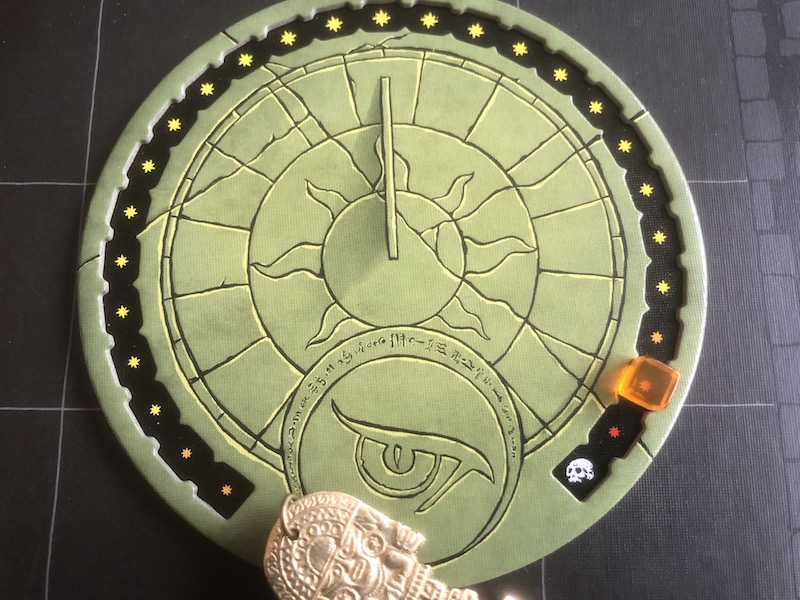
The dreaded sunset. If a day in Drakborgen hasn't killed you yet, the night will... The Fun of DrakborgenSo where is the fun in a game like Drakborgen? Why do players not only enjoy this torture chamber but even laugh at their miseries (possible more at other players' miseris but still)? I would say the answer is spelt suspense. Every single turn may be your last turn. Every decision may not be meaningful but every die roll and card draw is. It's not often in a game that you actually welcome turns where nothing happens. The randomness also means that you can never be sure about the game's outcome. Death may come suddenly but so may miracles so players are engaged until the very end. This is also the reason why I prefer Drakborgen to other dungeon crawlers that have attempted to weave in modern mechanics to the genre. If you take a game like Clank for example, the deck building mechanic does give the players more agency and rewards skills much more than Drakborgen. However, this also detracts from the dungeon crawler experience and turns the game into an optimization exercise. Nothing wrong with that, most euro games are based on this kind of challenge, but as a player I don't really care if I'm an adventurer sneaking through a dungeon or a farmer performing agricultural tasks - I simply reduce the cards to numbers and crunch them. Drakborgen may never return to my boardgame top list but for a more casual game experience where you don't feel the need of burning your brain, Drakborgen will deliver fun. After all, isn't that what all games should strive for? 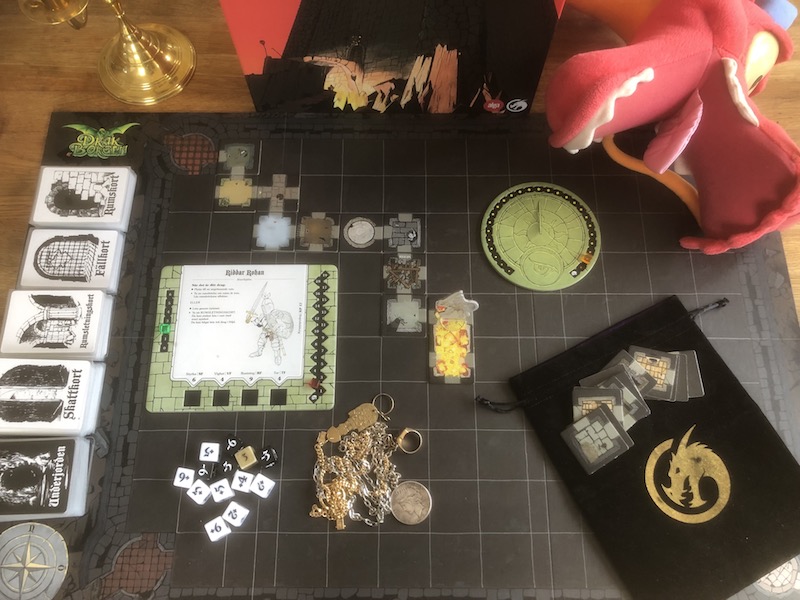
Say what you want about Drakborgen but it's certainly not desolated. |
|