
 |
The Quest for the Perfect Game - Reviews to Extract the Essence of Games by Nicholas Hjelmberg | |





|
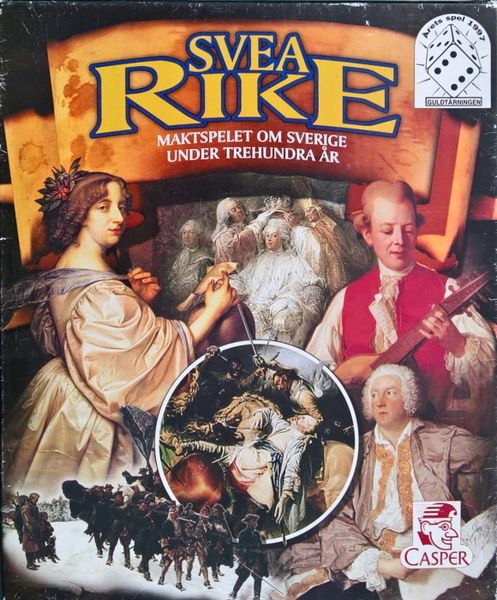
Svea Rike - Swedish History told by a Game? (Published 1 March 2022)This review has also been published at Boardgamegeek. A History Reader?Selma Lagerlöf's book The Wonderful Adventures of Nils was written as a geography reader for public schools. Perhaps Svea Rike was designed with a similar purpose, to serve as a history reader for public schools. The game takes the players on a journey through three of the perhaps most turbulent centuries of the Swedish Kingdom, from the Renaissance King Gustav Vasa via Warrior Kings like Gustavus II Adolphus and Charles XII to the loss of Finland to Russia in 1809. But while Selma Lagerlöf's masterpiece has a literary value as well, does Svea Rike have a game value? Let us embark on the game's journey and find out. The players play powerful noble families that compete for power in Sweden while also cooperating to defend the kingdom against its external enemies. They do this by drawing and playing event cards with various effects and choosing between three actions: Agriculture, Trade, and Culture & Science. Their actions are also affected by a ruler card that is drawn at the start of every round with different effects on the actions depending on which of the three eras that are played. We will look closer at all those mechanics to understand how the players influence the History and how History influences the players but let us start with the a look as Selma Lagerlöf did with a look at the Geography of where the History takes place. 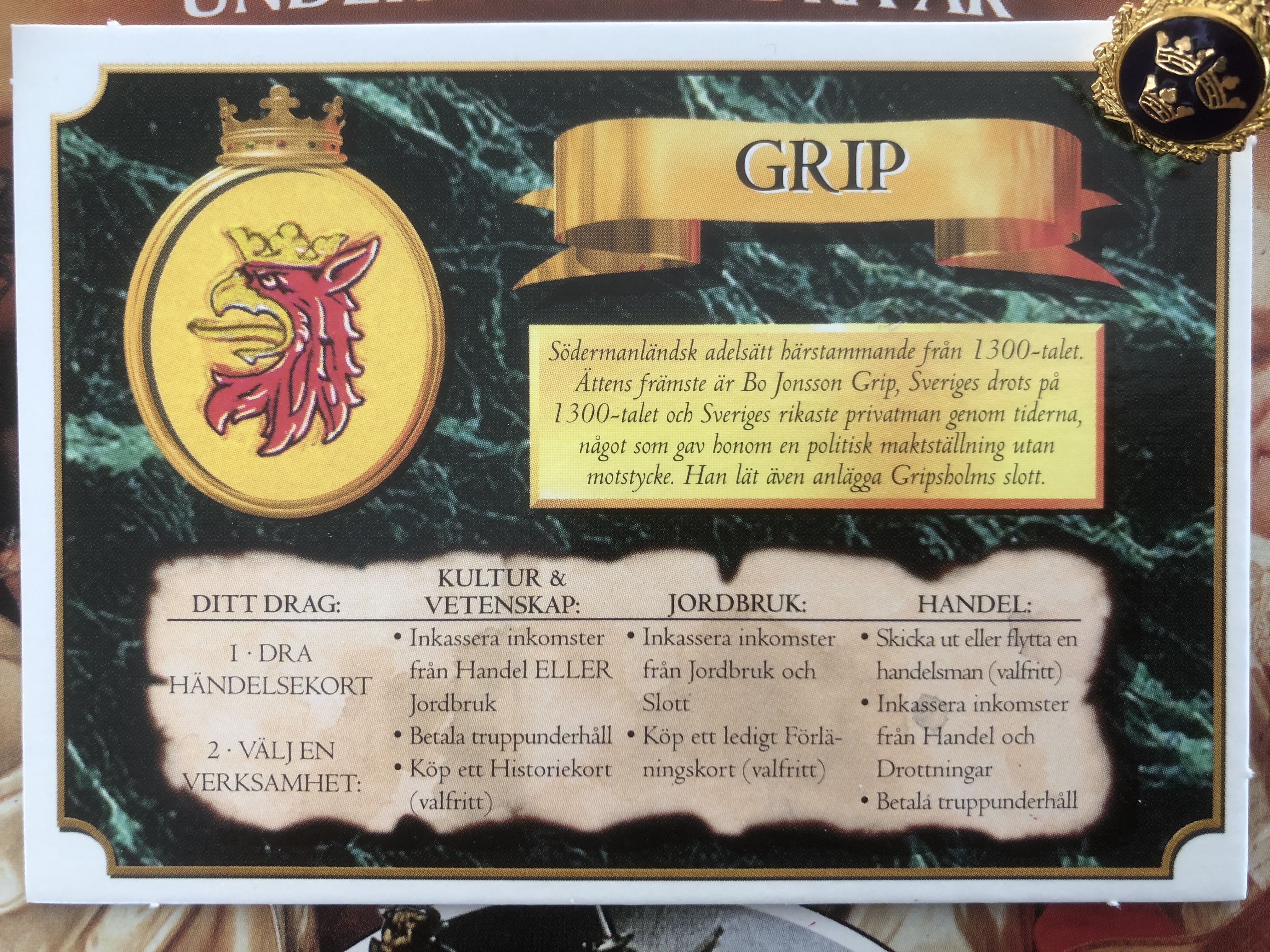
The player aide for Grip, including a short historical background. The BoardThe board depicts Sweden and her neighbors Denmark, Prussia, Poland and Russia. The kingdoms are divided into provinces, of which some belong to Sweden at the start of the game and some may be ceded to Sweden following won wars. This reflects the historical expansion of the Swedish Empire but such provinces may also be returned following lost wars. Also reflecting the actual history is that a loss against Russia in the third and last era means not only that the formerly Russian provinces are lost but also all the Finnish provinces. If you own such a province, well, you don't anymore. It should be pointed out that the map is not used much in the game. All the fancy coats of arms that are placed on it are merely used to indicate ownership but this job is better accomplished by the province cards. There are no agriculture buildings placed in provinces, nor any trade routes placed between them. There are not even any troops placed on the map, since all troops are "virtual", meaning that they have a battle value based on the province and "teleport" to the battle field. The only use of the map is when some event cards affect a chosen province and all its adjacent provinces. Shame on such a pretty map. Instead, the real game takes places in the actions taken and resources gained (or lost) during the rounds so let us proceed by looking at the round structure. 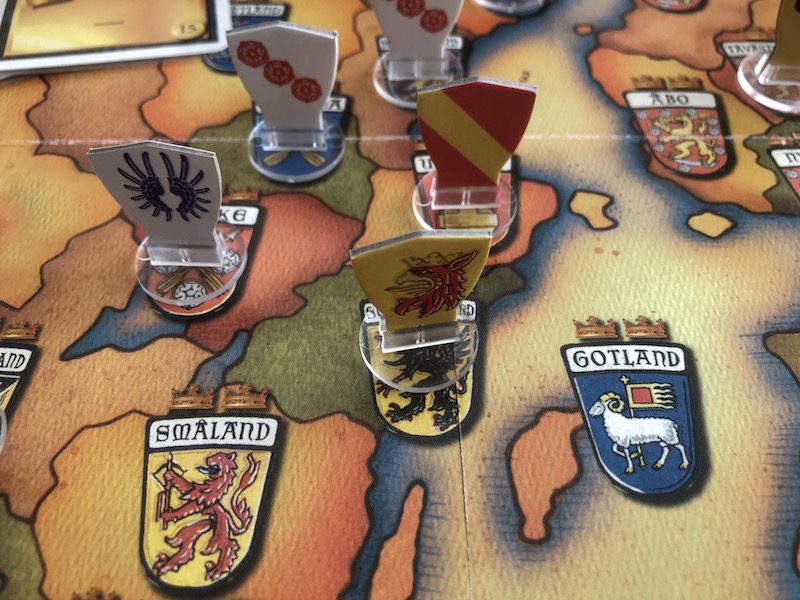
The provinces Småland, Gotland and Åbo are still up for grab. The RoundEach round starts with a ruler card that has different effects depending on the era played. If there is peace, the round will proceed with the players taking their turns in a random and hidden turn order, meaning that the next player in turn is not revealed until the previous player has finished her turn. However, if a war breaks out, the actions are replaced by a joint war effort. This combination of card and era provides variability as each new round comes with new conditions. Unfortunately, there is no way to predict those conditions (unless you memorize all the cards) so it is more about reacting to the conditions than proactively prepare for them. So which conditions do you have to react to in peace time and war time? Let us start with peace time. 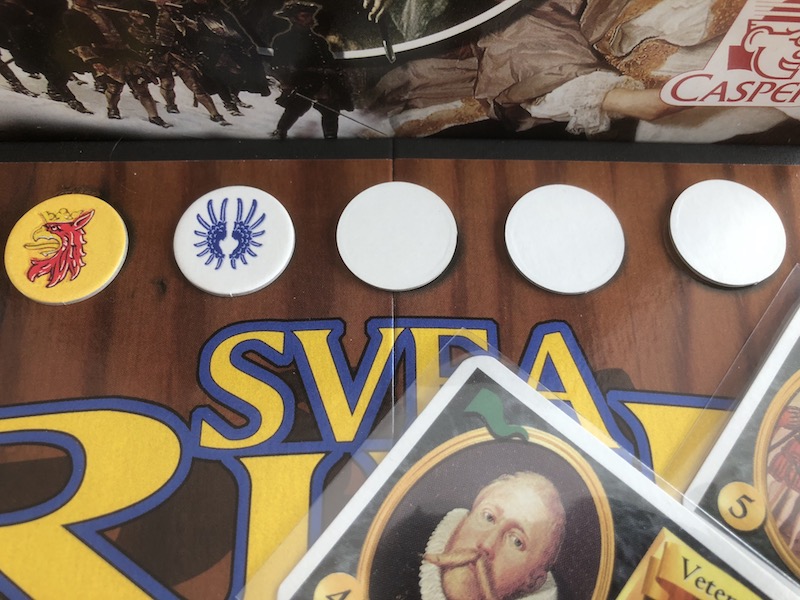
Grip has taken his turn and Brahe is next while the other players are in the dark as to their turn order. PeaceThe EventA player starts her turn by drawing an event card, which may be played immediately or saved for later. Those cards can have both positive and negative effects for some or all of the players. Some examples include extra income or discount at certain actions, others the removal of opponent cards. Thus, the cards offer plenty of opportunities to steer the game in the direction you want but their randomness and take that effects can be awkward compared to today's standards and give the feeling that the game plays you. Fortunately there are actions that give you more freedom of choice so let us move on to them. 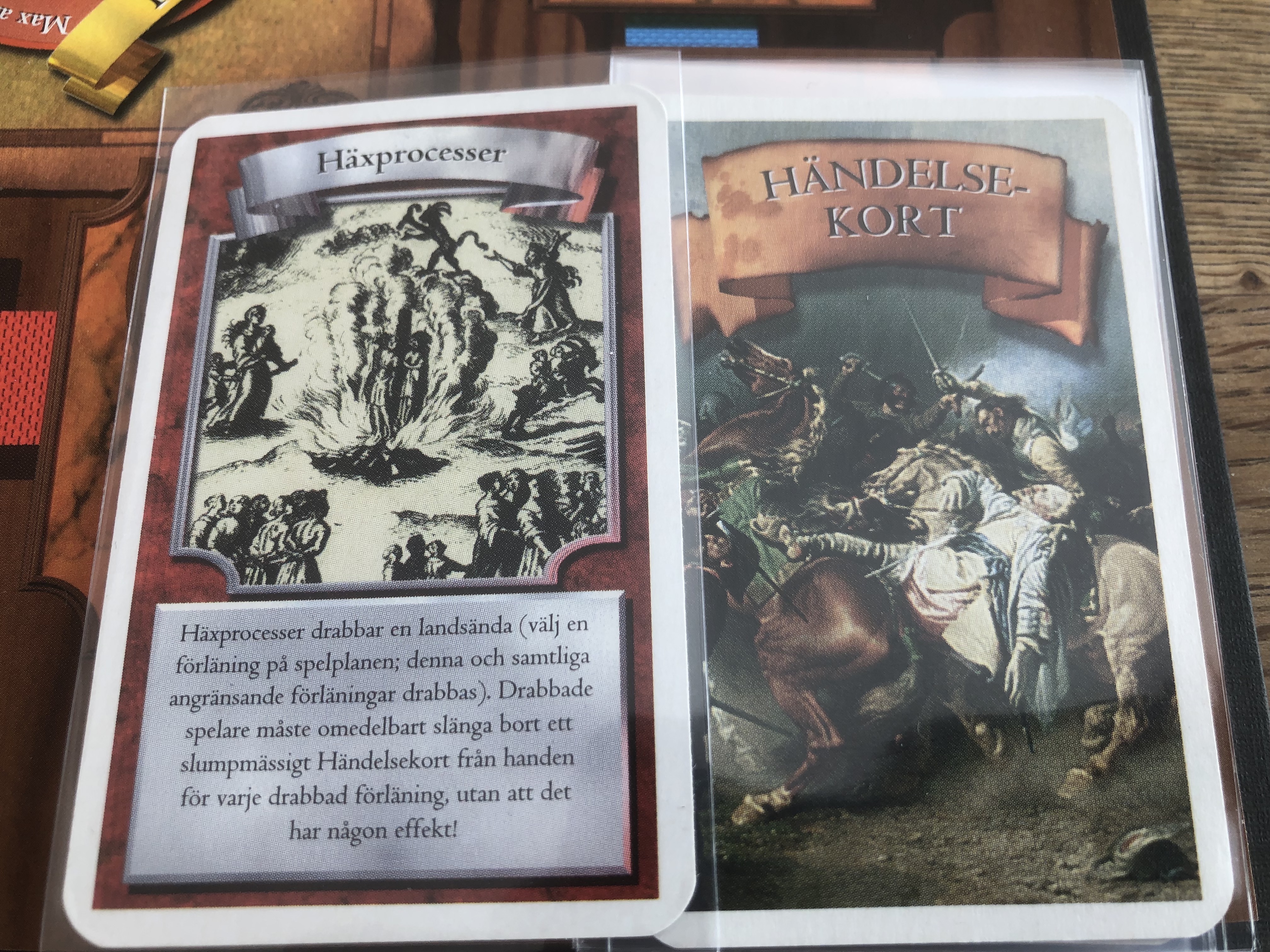
Witch processes ("häxprocesser") cause players owning a province or any of its adjacent provinces to lose an event card. The ActionsAgricultureAgriculture lets you tax your provinces and optionally buy a new one (provided that it belongs to Sweden). Besides the income (1-3 kronor per province), provinces also provide a battle value (between 1 and 3 each) during wars and victory points at the end of the game (between 1/3 and 1 each). In sum, a province strategy is a small but safe source of resources, provided that wars don't take them away from you. 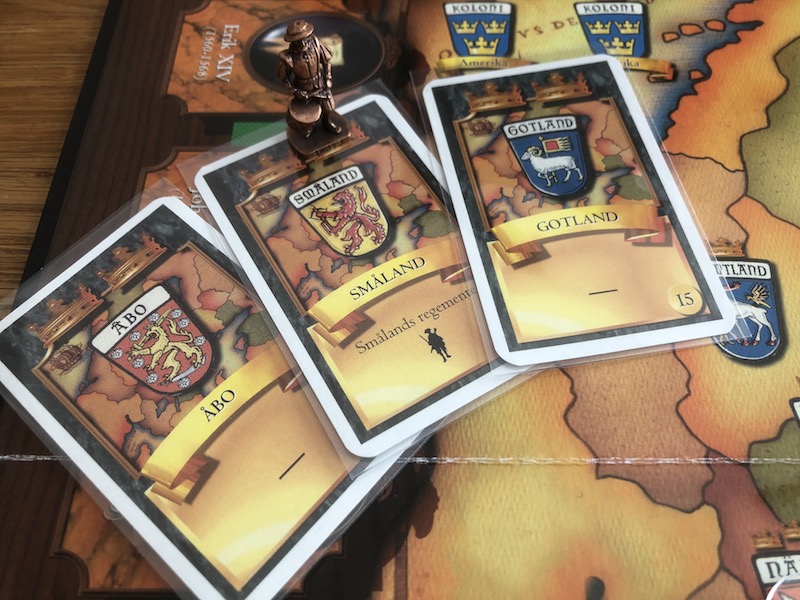
Gotland costs 15 kronor and has a value of 2 crowns (which lets you tax 2 kronor and gives you 2/3 victory points at the end of the game) but no military value. TradeTrade lets you place merchants in neighbor kingdoms and get income from them. The income increases exponentially with the number of merchants in the same kingdom, up to 21 kronor for 5+ merchants. However, you also have to pay military maintenance equal to your battle value. Similar to provinces, merchants provide victory points at the end of the game (1/3 each). So why not only go for merchants then? The answer is that a lost war against the kingdom they are based in loses ALL merchants there. Thus, the merchant strategy offers a high return at a high risk. 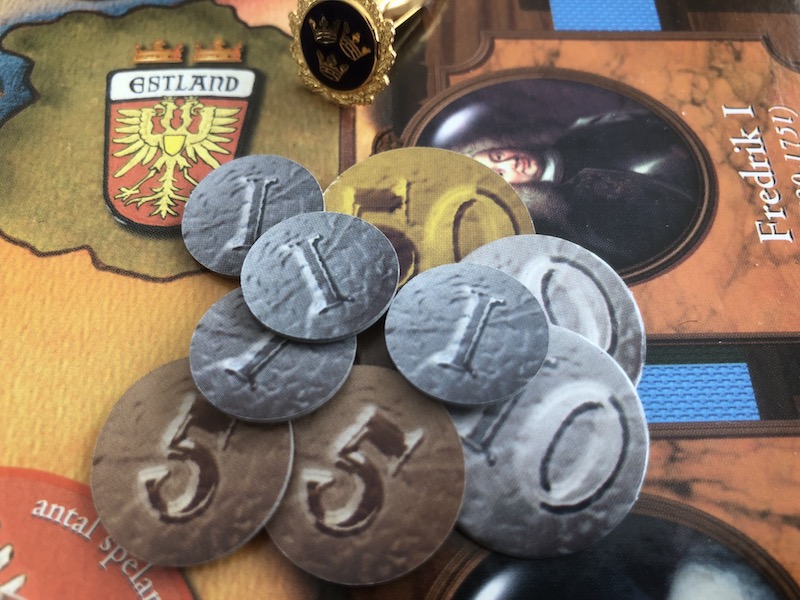
The currency of the game, "kronor", which is needed pay for troops and buy History cards. Culture & ScienceCulture & Science lets you buy History cards from a market. Some of them provide extra income, either every round or at certain actions, or extra battle strength while others may be collected for sets, where every triple provides 1 victory point. In addition, this action also gives you an income (choose between tax and trade) but you also have to pay military maintenance as above. Thus Culture & Science offers the well-known decision of when to switch from resources to victory points for the player venturing this strategy. 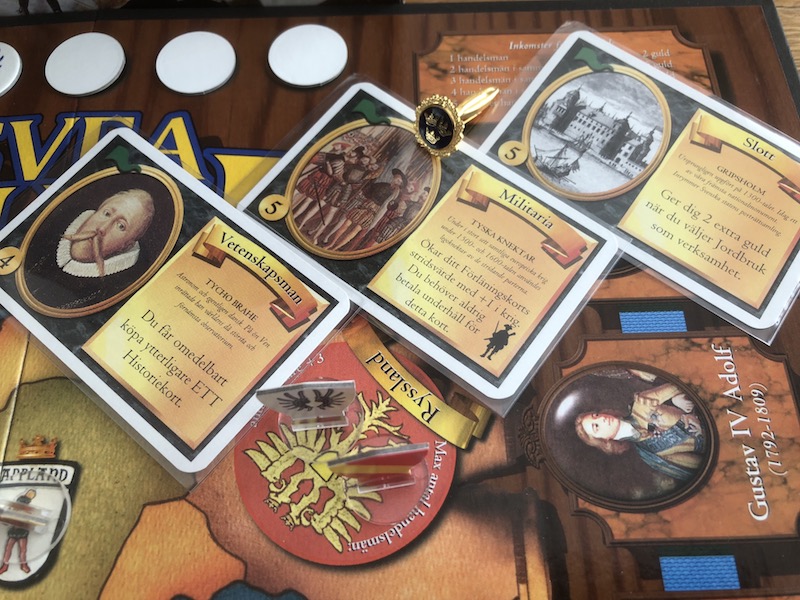
Three examples of History cards: Scientist ("vetenskapsman") for set collection, Militia ("militaria") for battle bonus and Castle ("slott") for agriculture bonus. The WarIf a war breaks out, no event cards are drawn, nor are any actions taken. Instead, the players secretly decide whether to contribute with troops or leave the opponents to battle alone. The battles are then determined by dice and a victory will reward the contributing participants while a loss will cost them provinces. This is particularly true in the last era, where a loss against the arch enemy Russia will cost Sweden all Finnish and Baltic provinces - just like in the real history. The wars are probably the most tense moments of Svea Rike since so much is at stake. However, they are also something that players will love or hate since the outcome is dependent not on individual decisions but on all the players' decisions. There is little to help you predict the other players' decisions since the game state does not make one decision more optimal than the other and even if you do predict correctly, you cannot do much about it since each player may only contribute with the battle value of one province. Compare this with a game like Amun-Re, where some players with "camel provinces" are more likely to steal from the common sacrifice but can be countered by bigger individual sacrifices. The wars, whether Sweden wins or loses, will have a dramatic effect on the game's story but you may feel more like a spectator than an actor. 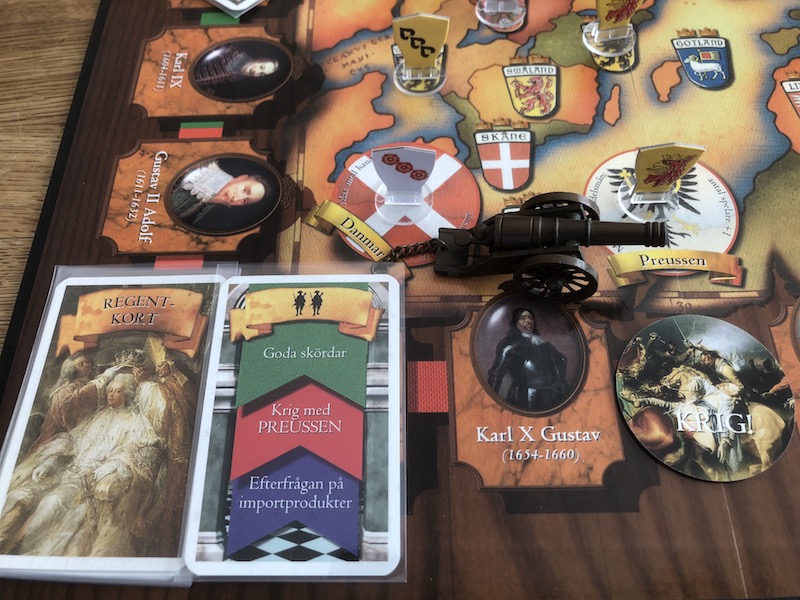
The ruler card tells that there is a bonus for the agriculture action ("goda skördar" or good harvest) in the 1st era, war with Prussia in the 2nd era ("krig med Preussen") and a bonus for the trade action in the 3rd era ("efterfrågan på importprodukter" or demand for import products). So where is the Game?At a first glance, there seems to be many interesting decisions. However, some of them seem to be either mutually exclusive or while either are either too simple or too uninformed. Take for example the decision between Agriculture and Trade. There seems to be no point in a balanced strategy between the two. The more often you take the Agriculture action, the more provinces you can buy and the stronger the action gets. Similarly, the more often you take the Trade action, the more merchants you can place and the stronger the action gets. The Culture & Science action is a bit more interesting but only a bit. Buy cards that give you resources early and cards that give you victory points later. Since there is a fixed number of rounds, the decision when to switch is less interesting compared to common euro games. The event cards do provide decisions about which to play which rounds and against which players but many of them are of a take that type and personally I am not a fan of those. The ruler cards reward the player who knows which wars that are likely to come when and who uses this knowledge when choosing provinces and/or merchants but this requires memorization of the cards. (Hint: Avoid Russia and Eastern provinces in the third era.) The wars offer a prisoners' dilemma, where the minority players will lose out. (Go to war on your own and face the losses yourself or be the only one to abstain from war and be the only one without spoils of war.) Personally I like the tension this creates but it is certainly not a mechanic for everyone. I only wish the outcome of the war would be less random. Perhaps it is in Svea Rike's ability to tell a story that we should judge the game. Svea Rike does a good job to simulate Swedish history while still giving the players plenty of opportunities to change it. The player who manages to predict the history (i.e. both card draws and player actions) and take advantage of the swings will also have a greater chance of winning. In the end, luck will probably be more important than skills to determine the winner, but those who take pleasure in seeing how the game plays out will still have a fun game. ConclusionPerhaps you have to enjoy history to fully appreciate Svea Rike but the delicate balance between cooperating and competing is intriguing and a good game is in embryo here. I'd be happy to see a developed new version, where dice and take that cards have been replaced with more skill rewarding mechanics. 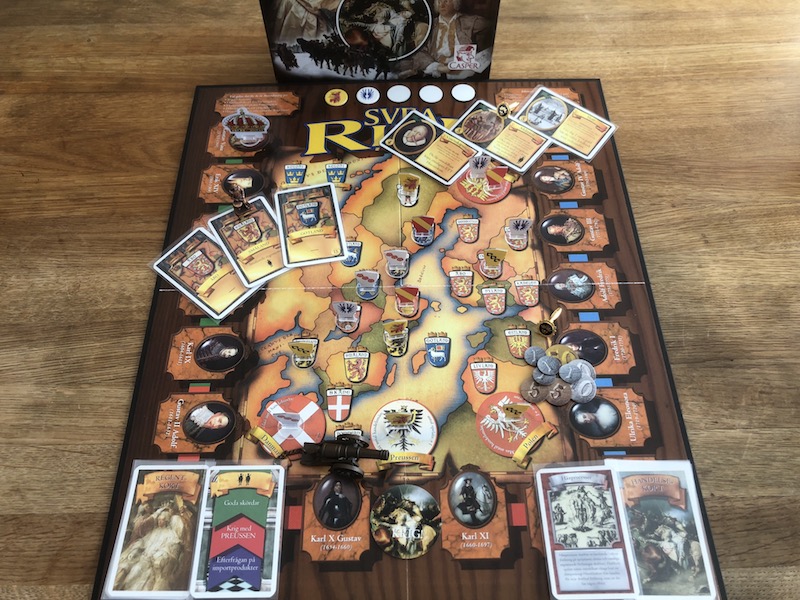
The five noble families ready to defend Sweden's interests - and their own. |
|