
 |
The Quest for the Perfect Game - Reviews to Extract the Essence of Games by Nicholas Hjelmberg | |









|
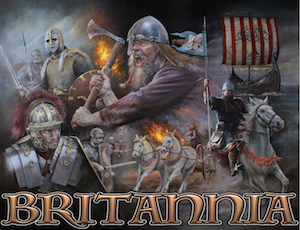
Britannia - Brentry or How Europe invaded Britain and Britannia invaded Eurogames (Published 12 November 2018)This review has also been published at Boardgamegeek. IntroductionWhy review an over 30 years old boardgame? Well, there are two main reasons. First, when Britannia first saw the light of day back in 1986, there was not yet much light to see. Boardgames were still synonymous with mass market games like Monopoly and although war games had been popular during the seventies, they were now succumbing to the competition from computer games. However, there were signs of a new dawn for boardgames thanks to innovative designers like Sid Sackson (Acquire), Alex Randolph (Twixt) and Francis Tresham (Civilization). Britannia was one of many links in this development and one of its contributions was to bridge the gap between war games and the more peaceful eurogames we know today. Second, Britannia also enlightened me and made me realize that I didn't have to choose between Monopoly and a war game with hundreds of counters. It also sowed the seeds to my History interest as I became aware of the exciting centuries that preceeded the Norman Invasion of 1066, a year that sadly was the starting point of all my history books in school. 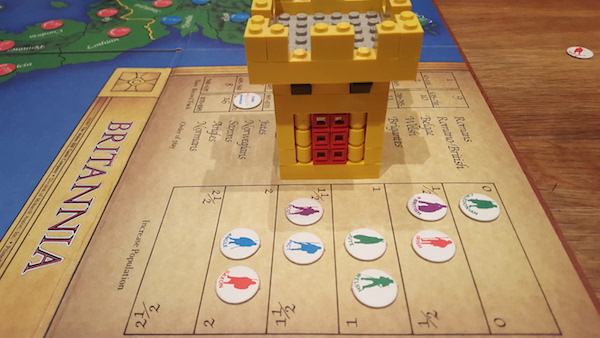
The GameplaySo how does Britannia play then? At first glance, Britannia reminds about RISK. The game depicts the invasion of Britannia from the Romans in AD 43 to the Normans in AD 1066. The players take turns to act with one of the many peoples of Britannia and a turn is divided into 5 phases:
Some exceptions apply to special units and areas, e.g. Romans eliminate opponent units at the roll of 4, 5 and 6, hill areas add only 1/2 to the population track but units there are only eliminated at the roll of 6 and so on. At certain points victory points are earned, most often for occupying certain areas in certain rounds. A typical game lasts 4 hours and the player with the most victory points in the end is the winner. 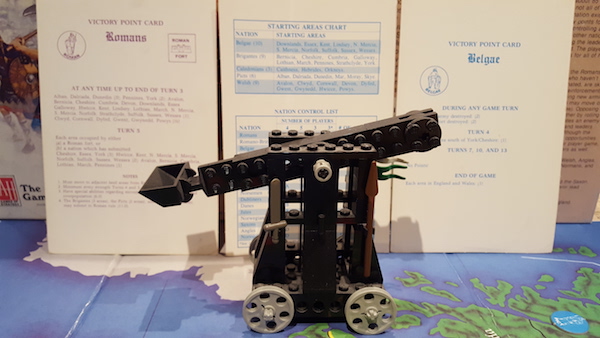
The History PlayIf this had been all there is to Britannia, the gameplay would have been underwhelming. However, what made Britannia stand out then and today still is its simulation of the historical tide. The players do not merely play one people each but rather all of the historical invaders of the island. For each player count, there is a list of peoples controlled by each player and almost each new round will see a new people arriving in Britannia. This provides a delightful challenge to both the "war" aspect and the "diplomacy" aspect of Britannia. The Military PlayerAs a military commander, you have to take into account not only your present forces but also your future forces. Should you aim at high-scoring but well defended areas or easier but less valuable targets? Should you spread thin to maximize your people's victory point this round at the risk of being eliminated or is it better to consolidate for the future? Or perhaps you should simply give up on your people and let them pave the way for the next? Granted, many war games have rules for reinforcements arriving at the battle field but the peoples in Britannia are not merely reinforcements to a people, they are completely new peoples with new objectives. The Diplomat PlayerAs a diplomatic emissary, you have to negotiate across different peoples and time periods. It's not unusual to have an agreement with another player regarding two of your peoples in Southern Britannia while at the same time having your peoples fighting ferociously for the control of Scotland. Or an agreement to give up areas to another people now for the promise of peace for your future people (which, of course, may or may not be honored when the time comes). A War Game or Not?As a matter of fact, I would argue that Britannia is not a war game at all. Britannia is not about mass armies conquering land, it's about peoples migrating and settling. It's not about maneuvering and building up to win the last battle, it's about writing chapters in the History of Britain and being rewarded with victory points throughout the game. "Wars" in Britannia are often excused, and accepted, with phrases like "I have to go here", "I have nowhere else to go" and so on. To win Britannia, you need to build and use your resources wisely and know when to focus on resources (people tokens) and victory points (areas) - not unlike many of today's modern eurogames. 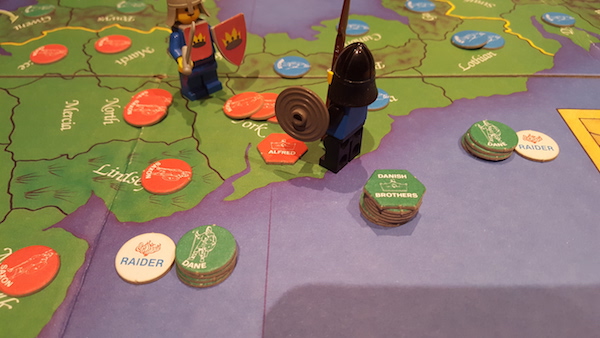
Potential IssuesBeginner Threshold?Unfortunately, Britannia's defining characteristic of History writing is also a challenge to new players. All invasions have their fixed rounds and are clearly printed on the board but it's not until you've played a couple of games that you start understanding the impact of a "major Danish invasion". It's not a flaw of the game, since it does reward repeated plays, but new players should be constantly reminded of upcoming invasions so that they may plan for them. 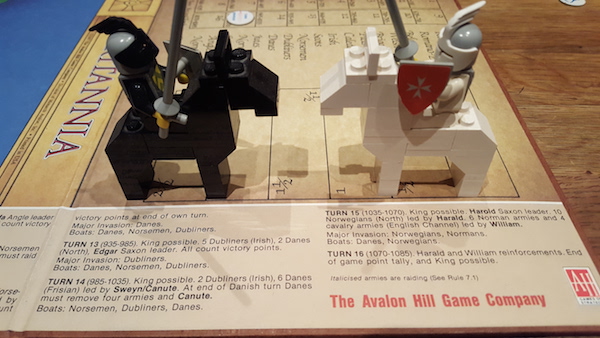
Randomness?Another issue compared to modern boardgames is the randomness of the dice. Like in war games, there are many die rolls throughout a game that "should" even out. Nevertheless, bad die rolls may ruin the future of your people, particularly if it's a small one that will need several rounds to recover (if ever). There are some tactical rules, such as the above mentioned defence bonus for hills and leaders' ability to eliminate units on one extra die result, that may be used to mitigate the die rolls. Thus, a common tactic is to use leaders to clear up strong defensive positions in the hills, but in the end of the day your people's destiny is determined by the die. 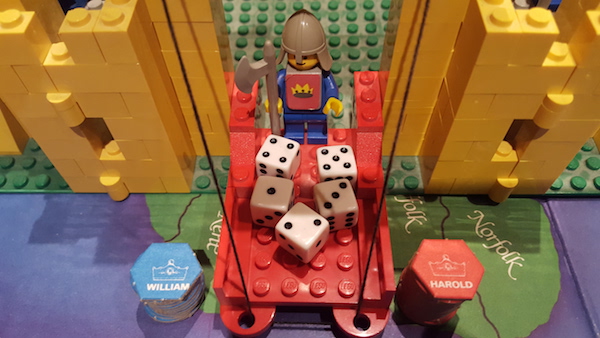
Unbalances?Finally there is the potential issue of balance. Over the course of the game, there are two peoples that can be expected to dominate Britannia for most of the rounds: the Angles and the Saxons. This means that a successful Angle or Saxon game will leverage a lot of victory points to its player (although the opposite is also true). In contrast, the Romans also score a lot of points but during a shorter time while the Welsh score points during a long time but usually limited to the Welsh areas - in both cases with less opportunity to do significantly better or worse. That doesn't mean that it's impossible to win for those players but they can't rely on the game to balance the Angles and the Saxons. Instead, they have to do it themselves to prevent any of them to get the upper hand. Is this a flaw or a feature? I lean towards the latter, since it makes each game of Britannia unique and memorable. Limited strategic choices?Modern players may also feel uncomfortable with Britannia's ambition to simulate the History of Britannia. The fixed invasions (and, in some cases, withdrawals) as well as the victory point cards, which point out specific times and areas for each people, drive the game and prevent too large deviations from History. Don't expect the Romans stay until the Vikings come or William the Conqueror conquering Scotland. This is similar to most war games out there but give less freedom than your average eurogame. Does this mean that you don't have any strategic choice in Britannia? My answer is yes, you do. Looking back at my statistics (I was geeky already back then), the success for the different player colors changed over time as new strategies were uncovered. A "green" period, where the Danes took advantage of the weakened Angles and Saxons and swept across England, was followed by "blue" period, where the Angles and the Picts helped each other to take control of Northern Britain, and then a "red" period, where Arthur seeked refuge in the Highlands, only to hand over England to the Saxons. One particularly memorable game was the first time I saw the "Brigante Gambit". A Roman failure to capture Southern England in the first round saw the Brigantes breaking into Wales and helping the later Irish to completely wipe out the Welsh, ensuring red superiority in England for the rest of the game! (I'm not sure whether this is possible in post-Avalon Hill editions.) SummaryTo sum up, Britannia is a game with its roots in the war games of its time that had the courage to explore other mechanics than conflict. The tide of the game weaves a picturesque tapestry of British History which challenges the players to manage resources of varying quantity and quality throughout the game. Both military and diplomacy skills are required and although the game does impose some restrictions on the player strategies, each game of Britannia will be unique. So does the game appear frequently on my table? Sadly no. The game is really limited to 4 players only. 3 player games often find players having to "negotiate" between their own poeples while 5 players often find players with too few/weak peoples to enjoy the game. The 4 hours' playing time was good compared to many war games of that time but too long compared to today's standard of 1-2 hours. The rules were also good compared to many war games of that time but contain many sub rules that are not always intuitive. (I'm still not sure how to handle all corner cases regarding the Brigantes' submission to the Angles.) The age and the "war game label" may also discourage new players more interested in the latest engine builder. For some reason, this doesn't prevent them from enjoying the, in my opinion, soulless replica Small World. But will Britannia leave my collection? No, I have too many good memories of the game and just like Advanced Civilization returns to my table at special occasions, I keep hoping that Britannia will one day. 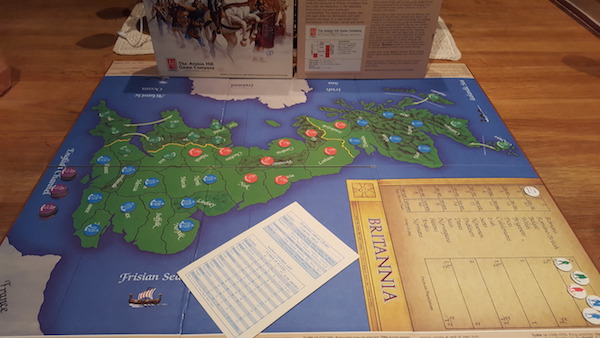
|
|