
 |
The Quest for the Perfect Game - Reviews to Extract the Essence of Games by Nicholas Hjelmberg | |








|
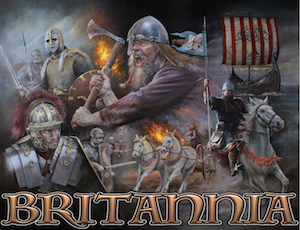
Duel Britannia - Greater than a Lesser Britannia (Published 1 July 2019)This review has also been published at Boardgamegeek. IntroductionRecently I had the honor to playtest the new 2 player variant of the classic game Britannia: Britannia Duel. Britannia is an old favorite of mine which I reviewed at Britannia - Brentry or How Europe invaded Britain and Britannia invaded Eurogames. In that review I pointed out that the game relies on checks and balances, not in the sense that it 's susceptible to breaking down but that you have to weave this into your strategy to ensure that no other player gets the upper hand. This also means that Britannia's sweet spot is 4 players, since the 3 player games often sees your nations getting in the way for each other while the 5 players games often sees your nations too scattered to cooperate. Thus, attempting to play Britannia one on one was never an option. Nevertheless, Lewis Pulsipher ventured to develop such a variant and I had the honor to test some of the many different iterations. This review is an attempt to analyze how well he succeeded and I'll walk through the game along the same steps as I did in my full game review, starting with the gameplay. Bear in mind that Britannia Duel is still subject to changes but I believe the core gameplay will remain the same. The GameplayAt first glance, seasoned Britannia players will see a compact version of their beloved game. The board is scaled down to 27 land areas surrounded by 4 sea areas and the timeline is limited to the period from the Roman departure to the Kingship of Cnut the Great. One noticable difference is that Ireland has been added to the board. 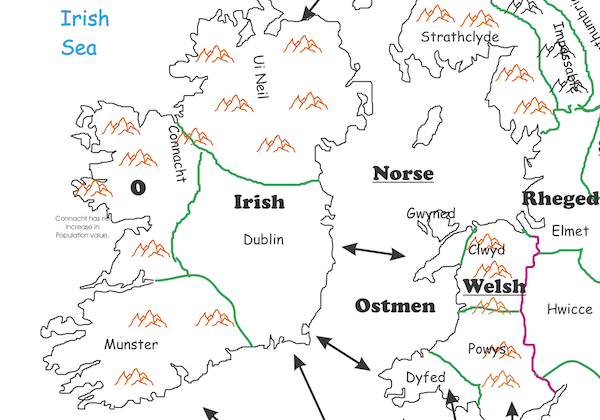
The not yet so green island of Ireland (draft print & play map used during testing) The gameplay is also similar to Classic Britannia with the well-known turn phases of Population Increase, Appearance/Reinforcement, Movement, Combat and Scoring separately for each nation. It's when we start looking closer at those phases that we realize that Duel Britannia is more than a lesser Britannia. Population IncreaseDuel Britannia uses a maintenance mechanic instead of an accumulation mechanic to increase population. With some exceptions, clear terrain is worth 2 points and difficult terrain 1 point. If the difference between your total land value and your total number of armies is -1 or greater, your population increases and if the difference is less than -1 it decreases. This means that each of your nations will see a population change each turn and thus also a change in conditions. This also means that you don't have to keep track of overpopulation. Less bookkeeping and a more dynamic gameplay that is. Appearance/ReinforcementAs in Classic Britannia, nations will arrive from the sea, either as raiders (may return and score VP), intruders (may return but not score VP) or invaders (may not return). There is also the new concept of eruption, whereby eliminated nations may still appear and rise against their oppressors. The differences between Classic and Duel Britannia is that the latter allows for some more flexibility when it comes to managing where and when your nations will leave its mark on British History. MovementThe movement rules are basically the same as in Classic Britannia. Difficult terrain stops movement, stacking limits apply (2 in difficult terrain, 3 in clear terrain), twice as large forces may overrun opponents, and straits and boats may be used to cross the sea. One new limit is that while the Irish may cross the Irish Sea to Wales, the Welsh may not do the opposite (even if it would be tempting to teach them a lesson). CombatCombat sees one of the major changes. Each army now rolls 2 dice and takes 2 hits before being eliminated. This does prolong the battles but also allows more tactical decisions during them. Should you retreat before your wounded army is killed? Should you retreat some or all of your armies? Remember one of the key questions in Britannia: when should I fight and when should I retreat to live and fight another day? Another interesting rule change is that the victorious attacker may retreat to friendly areas after the battle, allowing further tactical decisions. Besides that, the normal bonuses for difficult terrain, leaders and cavalries apply. ScoringScoring also sees a major change. Forget about the detailed scoring rules depending on nation, area and time. In Duel Britannia, all nations have 1 scoring center, which will grant them 2 VP itself AND 1 VP for each adjacent area. Some nations have 2 scoring centers, in which case they only score 1 VP each, while other nations have entire sea areas as scoring centers, in which case only adjacent land areas score VP. This minimizes the bookkeeping and lets each player focus on certain parts of Britannia rather than keeping track of exactly when and where to maximize their VP. ComponentsThe components may also be worth mentioning, since the cardboard tokens will be replaced by miniatures. Personally, I'm not a fan of miniatures and would have preferred an upgrade to wooden tokens. I'm also worried that miniatures may clutter the board and be difficult to tell apart but I haven't seen what they will look like and can't really tell. On the other hand, it will be interesting to see how the many different nations will be portrayed. 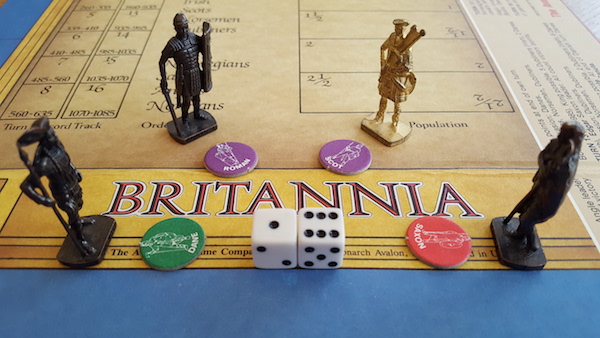
Don't bring cardboard to a metal fight The History PlaySimilar to Classic Britannia, Duel Britannia will play out a piece of European History. However, while Classic Britannia excels by giving you different nations and challenges almost every turn, Duel Britannia does the opposite and offers two distinct sides: Brythons/Vikings and Anglo-Saxons. Imagine this setup in Classic Britannia. We would get a game where players have little to do at some parts of the game and at other parts only interact at the frontiers between their big coalitions of nations. Instead of fighting each other, the Anglo-Saxons would put up frontiers against Wales and Scotland and behind them calculate to optimize each nation's VP. Such a game would be stagnant and boring. Yet, in Duel Britannia we see exactly this setup and it works! How come? There are several reasons for it.
The last point seems particularly important - having played Duel Britannia I simply can't imagine another distribution of the nations. This brings us to the next topic... The Military Player/The Diplomat PlayerIn Classic Britannia, you have to balance military and diplomacy. From a military perspective, it may be best to attack player A, but from a diplomacy perspective, it may be better to attack player B. Whatever you choose, the attacks are often skirmishes rather than grand campaigns, since you operate with isolated nations and need to take into account other frontiers and future invasions. Not so in Duel Britannia. Instead, your nations are well located both in time and space to cooperate and promote each others' goals. As the Anglo-Saxon player, you can choose to clear Brython strongholds first or invade weak points first or perhaps establish a strong bridgehead first. As the Brython player, you can coordinate Picts and Welsh to open new fronts and lure away the Anglo-Saxons from the coasts to pave the way for the Danes. During our tests, the winning strategy from one game was often refuted already in the next game. So is Duel Britannia more of a war game than its predecessor? Not quite. A War Game or Not?Although Duel Britannia offers more opportunities for amassing and maneuvering forces, the History of migrating and settling remains important. Move your nations too far from their historical habitats and you will score less. Sacrifice your nations in battles and you will lose future victory points. Based on my experience, I believe the key to winning is to keep your nations alive and have them grow by one or even two each turn. The importance of balance between building resources and using them is present in both games. Potential IssuesBeginner Threshold?Similar to Classic Britannia, knowledge of the typical gameflow (not only when and where nations arrive but also their impact) is an advantage but I believe a seasoned Britannia player will quickly get this. Randomness?The dice are still there and thus the randomness remains but it's reduced thanks to the "double dice/double hits" rule. This is an important rule, since there are no other players to restore the balance after some bad die rolls. Although the randomness isn't completely mitigated, my opinion is that it won't make or break your game. Unbalances?This is probably the greatest challenge of any 2 player game. Several iterations were tested, often with contradictory results where some groups found the Brythons overpowered and others the Anglo-Saxons overpowered. Naturally, groupthink also plays a major part and a winning strategy against one player may very well be disastrous against another. I believe the final game will be balanced but if you at any point feel otherwise, you cold always offer the losing side a unit or two to even it out in your next game. Limited Strategic Choices?Similar to Classic Britannia, the historic simulations won't dictate your strategy but merely provide a meaningful framework for it. Each of my test games saw a different strategy as we constantly searched for ways to outwit each other. One thing was common in all games: the losing player immediately wanted to play again to try out a new strategy. SummaryTo sum up, Duel Britannia is designed to be played by 2 players but is more than a 2 player variant. Instead of leading several scattered nations, you lead an entire wave of nations (all the Brythons, all the Anglo-Saxons etc.) and several rules have been adapted to suit this new setting. The "population change every turn" rule means that all your nations count at all times and can be incorporated into your strategy. The "double dice/double hits" rule make combats more tactical and less random. The scoring centers decrease the bookkeeping and helps you think of long term strategies rather than short term tactical gains. The only thing you'll miss from Classic Britannia is the diplomatic game but everything else is there, equally good or better. So who would enjoy Duel Britannia? If you're a fan of Classic Britannia but, like myself, don't get it to the table as often as you would like, the option to play against only one opponent may solve your problem. If you're a Britannia player who finds that your fate is sometimes too much in the hands of the dice and the other players, Duel Britannia is your chance to prove that you're better than Agricola (the Roman General who nearly conquered all of Britannia, not the farming boardgame). If you're happy with Britannia as is, you will still recognize your favorite game but most likely appreciate the new angles (pun not intended) offered by leading or fighting all of the Anglo-Saxons or all of the Vikings at the same time. Duel Britannia is simply a good study of what to change and what not to change when turning a multiplayer experience into a 2 player experience. 
"When will Duel Britannia arrive?" |
|