 |
Home | Game | Rules | Theme | Strategy | FAQ |  |













































|
Annotated Games: 4 players, version 0.95This game was played during the game testing of Suecia. The players tried different strategies to assess how balanced they were.
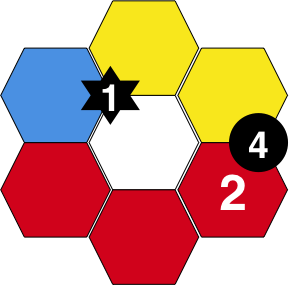
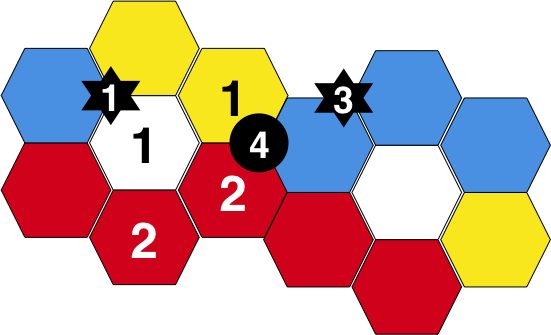
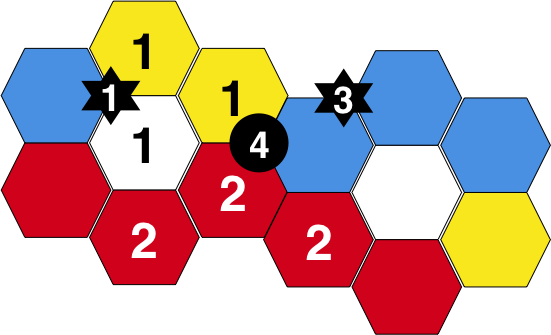
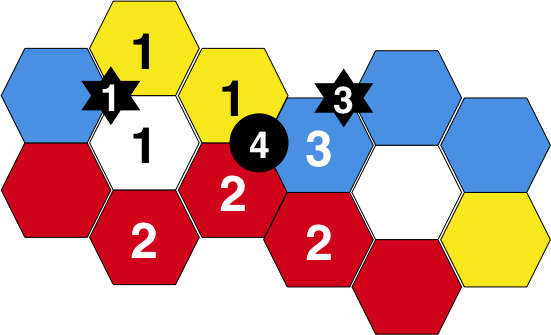
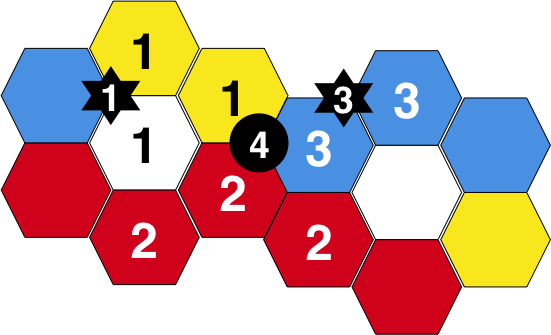
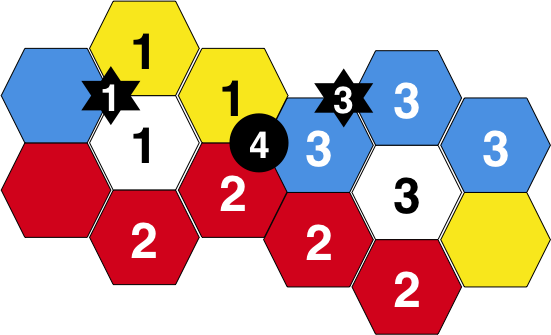
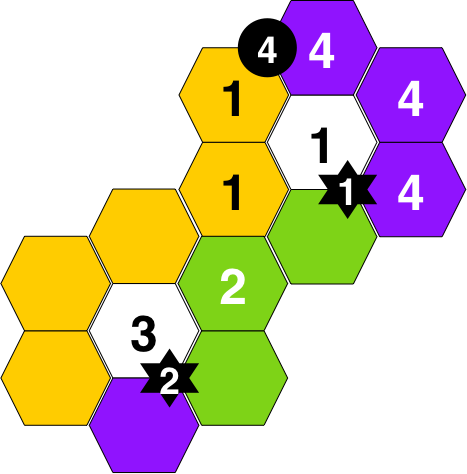
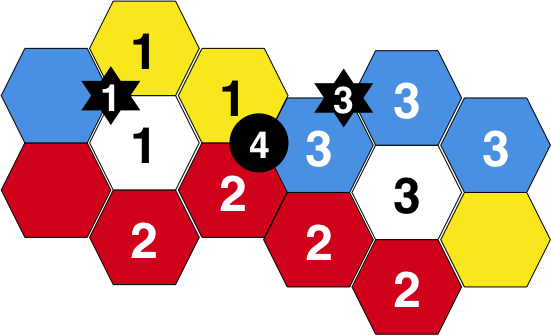
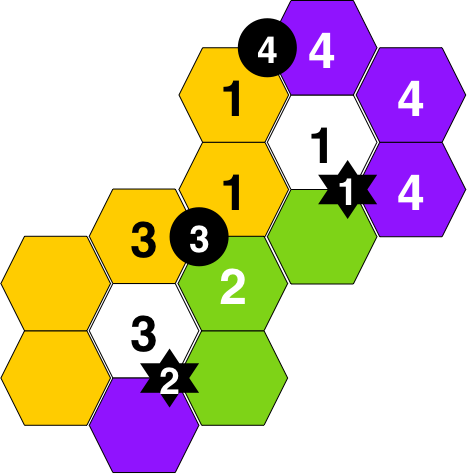
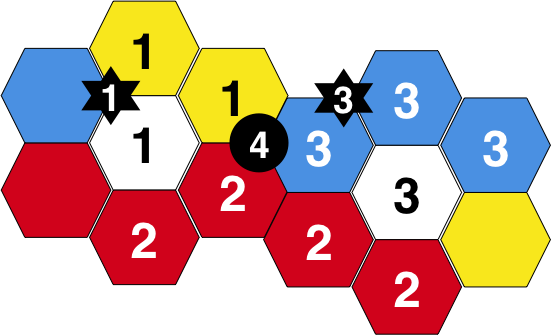
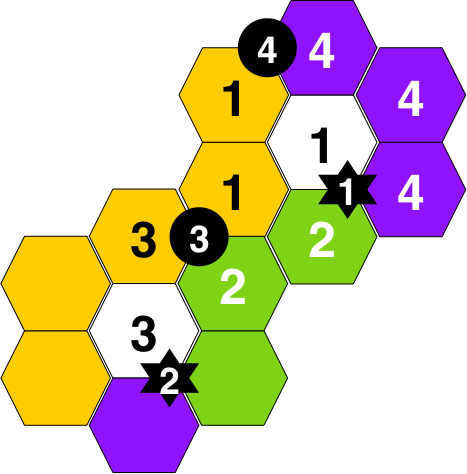
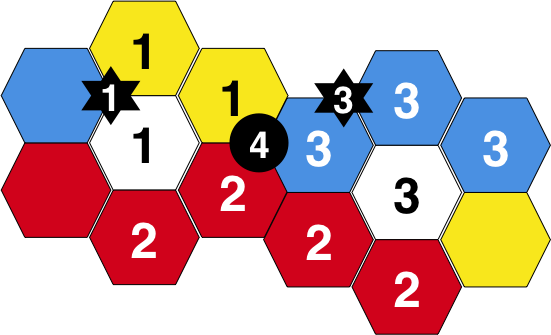
Cards are annotated with (N)obility, (C)lergy, (B)urgher, (P)easant. Resources/buildings are annotated by their colors (blue=ore, red=wood, yellow=timber, green=textile, orange=timber, purple=iron, white=economy, gray=religion, black=military) and player numbers. Buildings are annotated with the player number. Starting position
Round 1Player 1 starts with a nobility card to place a province and player 2 immediately plays a peasant card to place a wood farm there. Player 3 plays a burgher card to place a wood shop in the city, after which player 4 plays a clergy card to place a church in the province. Player 1 earns 1 wood and 1 crop from the buildings.
Round 2Player 1 boldly plays a peasant card on her nobility card to place first a crop farm and then place a castle in the province. The crop and the wood are paid to herself. Player 2 also takes a "double" action by placing a burgher card to first place a crop shop and then sell from her wood farm. Thanks to the castle and the church, she sells 3 wood, of which 2 goes to the wood shop and 1 to expand her farm. Player 1 earns 1 wood and player 4 earns 1 wood for their buildings and 1 wood is placed on player 3's shop in the city. Player 3 tries a little trick by playing a nobility on her burgher card. She uses this to pay 1 ore to place a a province with an ore area under the church, earning herself 1 ore but more importantly allowing the church to exchange resources for ore. Then she places an ore shop in the city. Player 4 predicts that ore and wood will be plentiful in the city and uses her 1 ore and 1 wood to play a burgher card and acquire an iron ship.
Round 3Player 1 decides to play a peasant card to sell 3 crop, earning 1 crop both to the castle owner (herself) and the church owner (player 4). Similar to player 2, 2 resources go to a shop and 1 to expand her farm. Player 2 realizes that all other players will benefit from her action but nevertheless plays a peasant card to produce 4 wood. The 1st wood is exchanged for 1 ore thanks to player 4's church and placed on player 3's ore shop, the 2nd wood is placed on the resource market, and the 3rd wood is used to expand her farm. The 4th wood has no demand and is lost. Player 1 and 4 earns 1 wood each for their castle and church respectively. Player 3 would like to take an iron ship but since player 4 already has one she decides to take advantage of the fact that all other players have wood and that there are 2 wood in the market to play a clergy card and take 2 wood. Finally player 4 plays a burgher card to send her iron ship to the city and demand 1 ore from player 3's shop and 1 wood from the resource market and exchange them for 1 iron - the first advanced resource in the game. Player 4 expands her ship for 1 crop and 1 wood by flipping it to its iron/timber face and player 3 pays 1 ore to expand his shop by placing a second one.
Round 4Player 1 takes advantage of the high resource prices by playing a nobility card and exchanges 3 crop, 1 ore and 1 wood for 1 iron to place the first advanced province in the game. Player 2 is worried that her crop shop hasn't had any demand yet and plays a burgher card on a burger card to acquire a textile ship. To afford the ship, she first has to exchange 1 ore and 1 wood for 1 crop and add another 1 ore to the price. Player 3 is also worried that her newly expanded ore shops haven't received any ore yet so she plays a peasant card to pay 1 ore (to herself) to place an ore farm. Player 4 sees no good trade opportunities for her ship and instead decides to play a peasant card and pay 1 iron (to player 1) to place an iron farm.
Round 5Player 1 repeats her strategy from the basic phase of the game by playing a nobility card and paying 1 iron to herself to place a castle in her advanced province. Player 2 plays a burgher card to use her ship to demand 1 crop from her own shop (and expand it) and 1 ore from the resource market. To afford to expand her ship, she exchanges the textile on the resource market for 1 crop, 1 ore and 1 wood and uses the ore and the crop to acquire a second textile ship. Player 3 expect a demand for ore and plays a peasant card to produce 2 ore; 1 to her own shop and 1 to expand her ore farm. This earns the church owning player 4 1 ore as well. Player 4 accepts the offer and plays a burgher card on her clergy card to send her ship to the city, take 1 ore from player 3's shop and 1 wood from the resource market to get 1 iron, and finally uses the iron to place a church in player 1's province (earning her 1 iron). Player 3 then exchanges all her 3 ore for 1 textile and uses it to upgrade her ore shop to the first advanced shop in the game: a textile shop.
Round 6Player 1 plays a clergy card on her peasant card and takes advantage of the high resource prices to exchange her 2 crop and 2 wood for 1 textile and 1 iron for 1 timber. Then she uses the peasant action to place a timber farm (paying the timber to herself) and the clergy action to take the first mission of the game: a textile/iron mission. Player 2 is annoyed that player 1 didn't use the peasant action to fill her crop shops so she does it herself. She plays a peasant card on a burgher card to first send one of her ships to take 1 crop from her shop and 1 ore from the market, exchanges the textile she earns for 1 timber and uses it to upgrade her crop shop to a timber shop. She also upgrades her ship to a textile/timber ship for 1 crop and 1 wood. Then she produces 5 wood (of which 1 is exchanged for 1 crop) to supply her new timber shop with 2 timber and 1 crop and uses the 3rd timber to expand her farm. That the 5th wood has no demand is lost matters less to her. Player 1 and 4 earn 1 wood each for their castle and church. Player 3 decides to take the first triple action of the game to quickly expand her shop network. She plays a peasant card on her burgher and nobility cards. For her nobility action, she exchanges her 3 wood for 1 ore and pays it to herself to place a castle in her province. For her peasant action, she produces 4 ore (earning her own castle and player 4's church 1 ore each), of which 1 is used to expand her farm and 1 is exchanged for 1 crop thanks to the church. The 2 ore and 1 crop are sold to her own textile shop. Finally, for her burgher action she exchanges 3 ore for 1 iron to upgrade her wood shop to an iron shop. Player 4 realizes that the city may quickly fill up with advanced resources and plays a nobility card on her peasant card. Then she produces 3 iron (earning her own church and player 1's castle 1 iron each) and uses 1 of them to expand her farm. The other 2 iron both go to player 3's new iron shop. Finally she exchanges 1 iron for 1 timber to buy a religion mission.
Round 7Player 1 plays a peasant card on a nobility card to produce 3 timber (of which 1 is paid to her own castle and 1 to player 4's church), of which 1 is used to expand her farm. The other 2 timber are supplied to player 2's timber shop and player 3's textile shop (supplying a second column thanks to the adjacent castle and exchanging 1 timber for 1 textile thanks to the adjacent church). Then she sends her mission to the city and takes 1 iron and and crop+ore=textile from player 3's shops. The mission earns player 1 the first mission chit of the game (religion) and she pays 1 textile and 1 timber to flip it to its religion/economy side. Player 3 uses her resources to expand her shops. Player 2 is worried that her crops shops are even less likely to attract crop now and decides to enter the advanced provinces instead. She plays a nobility card on her peasant and burgher cards. First, she sends her first ship to take 1 ore and 1 crop from player 3's shop (earning herself 1 textile) and her second ship to take 1 wood from player 3's shop and 1 crop from her own shop (earning herself 1 timber). She does use 1 wood and 1 ore (exchanged from 1 wood and 1 crop) to expand 1 of her ships but instead of using the advanced resources to expand her shop, she uses the nobility action to place an advanced province for 1 timber and the peasant action to place a textile farm for 1 textile (paid to herself). Player 3 does not want to be left out of the advanced provinces and plays a nobility card on a clergy card. This lets her take 1 timber, which she uses to place a castle in player 2's province (earning her 1 timber). Player 4 then decides to take a triple action to take advantage of the many advanced resources in the city. With the peasant action she produces 4 iron, of which 1 is used to expand her farm and 3 are sold to player 2's and 3's shops (1 of them exchanged for 1 timber thanks to the church). As usual, player 1 and 4 earn 1 iron each for their castle and church respectively. Both player 2 and player 3 use the earned resources to expand their shops. Then she plays a clergy card on her peasant and nobility cards to acquire a second mission card and send both to the city, taking 1 timber and 1 iron from player 2's and 3's shops respectively.
Round 8Player 1 plays a nobility card on a nobility card to first buy a religion/military mission (exchanging 1 timber for 1 textile to get the necessary resources) and then send both missions to the city, taking 1 timber from player 2's shop and 1 iron from player 3's shop. Both player 2 and 3 choose to keep the resources rather than expanding their shops. Player 2 plays a nobility card and pays 1 textile and 1 timber to acquire an economy mission. Player 3 plays a clergy card on a peasant card to first place a timber farm (exchanging her 1 iron for 1 timber and paying it to player 2) and then exchanging all her basic resources to place a church (paying 1 more timber to player 2). Player 4 sees that the city has no advanced resources but plenty of basic resources. To take advantage of this, and avoid setting up a good position for the other players, she plays a nobility card on a burgher card. She uses those actions to first send her ship to the city and take 1 ore and 1 crop from the market and 1 wood each from player 2's and player 3's shops. This earns her 1 iron and 1 timber and by exchanging 1 iron for 1 textile she can afford a religion mission. She also pays 1 ore and 1 wood to take another iron ship. Finally she exchanges 2 iron (2x6) for 1 textile (9), 1 crop (2), and 1 wood (1) and adds her own 1 iron, 1 timber, and 1 ore to acquire an economy mission chit.
Round 9Player 1 plays a nobility card on a nobility card and a peasant card to get more resources to the city. Since her farm cannot be expanded, she sells all 5 timber to the city (earning her castle and player 4's and 3's church 1 timber each) and they are all supplied to player 2's shops except for the 5th, which is exchanged for 1 iron and supplied to player 3's shop. Then she uses the first nobility action to acquire an economy mission (for 2 timber, of which 1 is exchanged for 1 textile) and the second nobility action to send it to the city to demand 1 timber from player 2's shop. Finally she uses 3 more timber (of which 1 is exchanged for 1 textile) to expand her economy mission with a second one. Player 2 decides to expand her shop with the timber. Player 2 realizes that she has at least two burgher actions left in the game. She takes advantage of it by playing a nobility card on a burgher card and a peasant card. First, she pays 1 crop to place a crop shop (with the intention of upgrading it to a textile shop next turn). Next, she lets her farm produce 3 textile (earning player 3 1 textile for her castle and 1 textile for her church), of which 1 is used to expand the farm (earning the province owning player 1 another 1 textile) and 2 are supplied to player 3's shop. Then she sends her economy mission to the city to pick up a timber from her own shop but does not expand it this time. Finally, she uses 1 textile and 1 timber to expand her mission with another economy mission. Player 3 had hoped to have iron in her shops but since there are none, she finds no better option but to play a nobility card on a clergy card and a pesant card. With the peasant action, she produces 3 timber thanks to her own church and castle (and also get 2 timber for owning them). 2 timber are supplied to player 2's shop and the 3rd timber is exchanged for 1 iron to supply her own shop. With the nobility action, 1 textile, and 1 iron, she acquires a religion mission. With the clergy action, she sends the mission to the city to pick up 1 iron and 1 textile from her own shops. This lets her both expand the shops for 1 iron and 1 textile and pay 4 timber (of which 3 are exchanged for 1 iron) to flip the mission to its Religion/Economy side. Player 4 now sees an excellent opportunity to fill the city with resources at her own benefit. She plays a peasant card on a clergy card and a burgher card. The peasant card lets her farm produce 5 iron (earning her own church 1 and player 1's castle 1). 4 iron fill up player 3's shops while the 5th iron is exchanged for 1 timber thanks to the church and supplied to player 2's shop. The clergy card lets her send two missions to the city for 1 iron and 1 timber from player 3's shop and player 2's shop respectively. Player 3 has no room to expand her shop but player 2 has and does so. The missions are fulfilled and expanded for the cost of 1 iron, 2 textile (exchanged for 3 iron) and 1 timber. With the burgher action she simply picks up 1 ore from player 3's shop and 1 wood from the resource market to get 1 iron (which she sells to the resource market to upgrade her ship). With 2 new military chits and 1 economy chit from before, player 4 is in a very good position.
The test was halted to test a version with a more restricted economy. |
Annotated games
If you like those game mechanisms, I can also recommend:

|