 |
Home | Game | Rules | Theme | Strategy | FAQ |  |
















|
Game designI've always been intrigued by simple and elegant abstract games like chess and go. Iconoclasm was one attempt to design such a game but the rules were not as straightforward as players expect from an abstract game. The game built on three fundamental mechanisms:
The mechanisms sounded good in theory but were hard to realize in practice. The first one was not intuitive. (Why does fire supports Earth etc.?). The second one was hard to assess. (Fire supports Earth against Water but does Fire support Earth against Fire?) The third one was not elegant. (When I get weaker, which ones do I remove?). I think the main issue was that Iconoclasm couldn't decide whether it should be a thematic game about shifting allegiances or a purely abstract game. A thematic game could move in the direction of masterpieces like Tigris & Euphrates and weave an interesting story around the struggle between the players while an abstract game could focus more on simplicity. All my attempts to move in the first direction were overshadowed by Tigris & Euphrates - why try to design a game that has already been designed to perfection? Instead, I got inspired by the recent success of abstract games like Santorini and Tak. Learning from my reengineering of my first game, Nova Suecia, I returned to the core of the game: What did I want it to be and how could I remove everything that wasn't this?
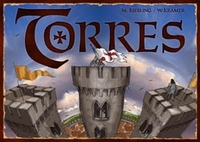
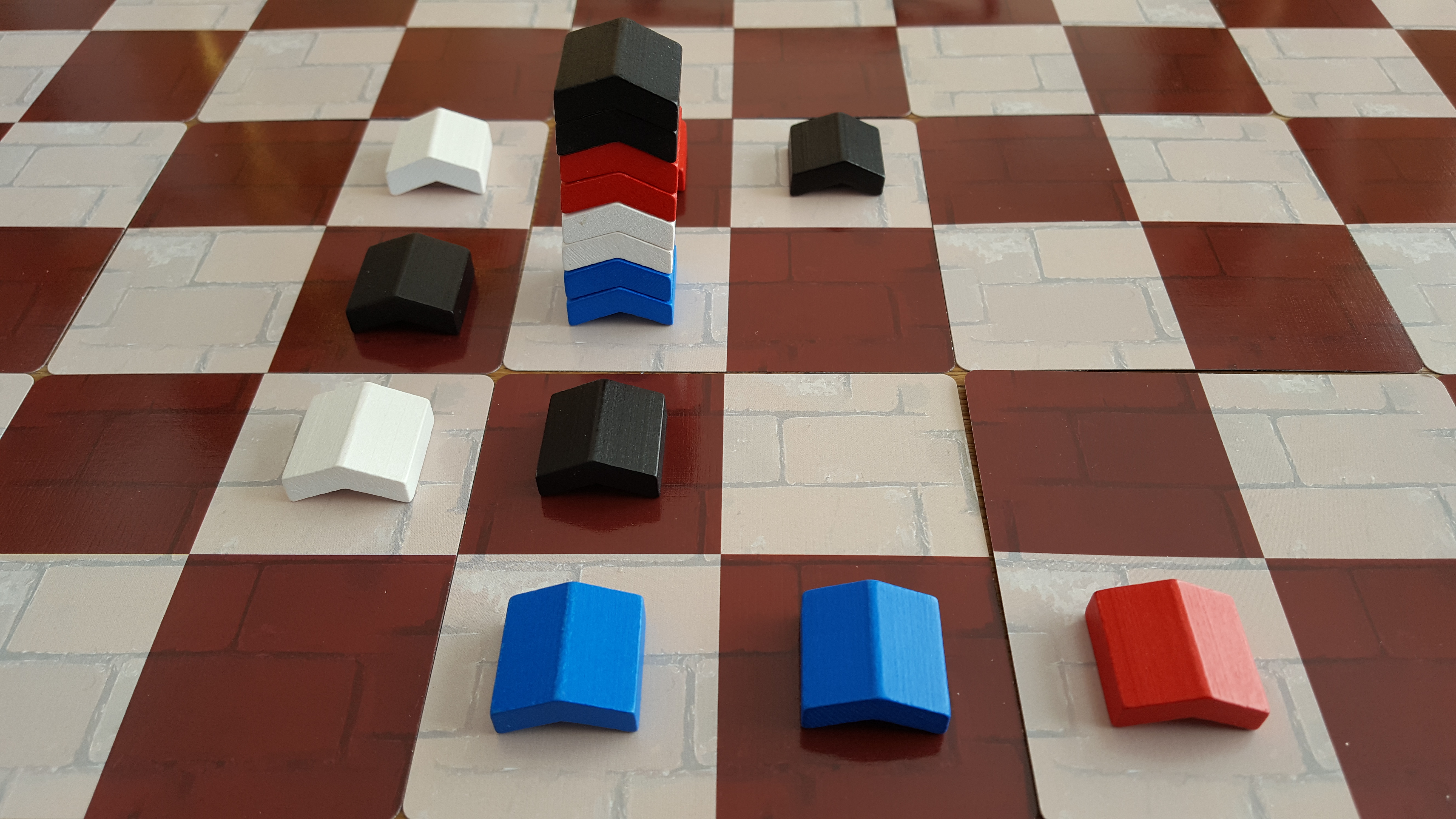
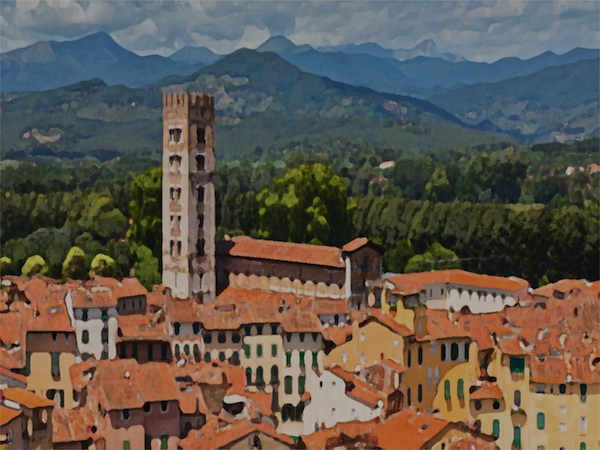
But how could I abstain from any of the three fundamental mechanisms listed above without removing the core of the game? They were all needed to design the game of ebb and flow that I wanted. Perhaps they could be combined into one visual element? It was probably Santorini and Tak that gave me the inspiration I needed. What is a symbol of power if not a tower, rising towards the sky? The "strength" would come from the height of the tower, the "support" from different colors in the tower, pushing the top tiles higher, and the "weakening" simply from the removal of the top tiles. This realization was the Eureka moment that got me started. The name of the game was perhaps the easiest. During a visit to Tuscany, I really came to like the city of Lucca with its many towers, so what else could I call a game about towers? The components were easy as well, I really didn't need anything else but a checkered board and colored tiles. The game could be expandable as well, increasing the size and the number of tiles with the requested game length, and a luxury look could easily be obtained with for example natural wooden components made of birch, ebony, oak and cherry for the different colors. Now I just needed to carve out the rules, because I was convinced that they were just waiting for me to release them.
Well, as you may expect, that wasn't entirely true. Even the simplest game require a lot of rule decisions.
Unlike earlier designs, I couldn't prepare my search for the answer through probability calculations and scenario simulations. Instead, I had to play through games over several iterations. I experienced many issues on the way, such as runaway leaders (strong towers couldn't be stopped), kingmaker effects (weaker towers could only weaken stronger towers with no chance of winning), scripted gameplay (games followed the same path) and lack of tension (towers were better off waiting than fighting). Some times I was simply stopped and forced to start over when the rules became incoherent or complex. Nevertheless, I could see a game in the fog and eventually I found it. Some critical design decisions included the following:
The real breakthrough came when I linked the color mix in the tower to the color mix in the block and forced towers to have all four colors to grow. Not only did it set the stage for the ebb and flow gameplay that I wanted but it also ensured that even weaker players remained in the game until the very end. At last, the game of Lucca had been excavated!
Game components
|
DIY+Rules (PDF, A4)
Annotated gamesIf you like those game mechanisms, I can also recommend: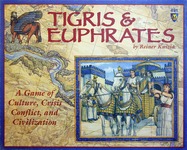
|
-->