
Home Game Rules Theme Strategy FAQ


Rule summary

Take turns to place two tiles of different colors, either in an empty square or beneath already placed tiles to build a tower.

There may only be one tower in a block and its colors must correspond to the colors of the block, i.e. two black tiles in the block allows two black tiles in the tower.

When two blocks grow together, take turns to remove one top house from one tower and one block house from the other tower (given as prisoner to the first tower). Afterwards the victorious tower is likely to have a new controlling color.

The challenge of Lucca is to time the tower building and removal so that your own color prevails in the end.

You control a block by controlling the tower of the block and you control the tower by having the top house of the tower. On a standard 8x8 board, you win if, at the start of your turn, your tower is the highest and has a height of at least 8 houses. or if you have the most prisoners and have at least 8 prisoners.

Version History

  • 1.0 First edition
  • 0.92 Victory condition board height prisoners instead of complete sets of prisoners
  • 0.91 First tower removes top color, second tower takes prisoner
  • 0.9 Tiles removed simultaneously from block and tower, tower strength limited by block size
  • 0.8 Game ends when a player can't place a tile
  • 0.7 Tiles removed first from block and then from tower
  • 0.6 1 tile at the time removed from towers and blocks by respective color
  • 0.5 Weaker tower removes houses first (block size tie-breaker)
  • 0.4 No balanced towers, victory conditions at start of turn, tower and prisoners victory conditions, neutral color may be taken over
  • 0.3 Two actions per turn (with different colors), limited tower placement, limited street fighting
  • 0.2 First stable version
  • 0.16 Balanced towers, i.e. not more than one house difference between largest and smallest color
  • 0.15 Place as many of a color in a tower as in the block, losing tower keeps bottom tile
  • 0.14 Tower height new victory condition, limit tower placement to 1 of each color and turn
  • 0.13 Remove as many tiles from winning tower as in losing tower
  • 0.12 As many tower actions as possible of any color per turn
  • 0.11 One block action and as many tower actions as possible per turn, winning and losing tower remove one tile each at the time
  • 0.10 Two actions per turn, 1 block tile and 1 tower tile
  • 0.09 Lost tiles are returned 1 per turn
  • 0.08 Both winning and losing tower loses adjacent tiles in block
  • 0.07 Any number of tiles may be placed in towers, always from bottom, pushing as many of a color as in the block
  • 0.06: Winning tower keeps tiles in block linked to tower, lost tiles are immediately replaced
  • 0.05: Only tiles of own color placed, winning tower loses tiles in block adjacent to losing tiles, block reaching edges new victory condition
  • 0.04: Winning tower loses no tiles in block
  • 0.03: Only tower blocks may expand into each other
  • 0.02 Both winning and losing tower removes tiles in block, number and level of tiles placed in towers linked to number of tiles in block
  • 0.01: Players play with any color either in block or tower, top tile in winning tower and all tiles in losing tower removed, tie breaking rules (tower height, block size, remaining tiles on hand), highest tower at end wins

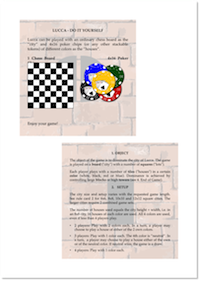
The complete rules are available in the PDF file to the right. In the following sections, I will describe how they came to be.

Implemented Rules

Brick placement

Two bricks per turn

Placing one brick per turn would make it difficult to take advantage of struggles while placing three bricks per turn would result in many placed bricks before the next turn and make it difficult to make long term plans. Two bricks is a good compromise, enabling players to trigger a struggle and take advantage of it in the same turn.

Any colors, any placements

Allowing the placement of any colors lets the players take advantage of each others' colors while forcing the placement of different colors prevents them from simply placing only their own color. Allowing the placement in either blocks or towers (rather than forcing one of each) also gives flexibility.

Tower placement

Houses in block

The 1st tower restriction is necessary to create a balance between block expansion and tower extension - you need to do both. This in combination with the "any color any placements" rule rewards player who manages to "swallow" blocks without a tower and use them to extend their own tower.

Towers in block

The 3rd tower restriction is necessary to return some control to the players. You can build up a defence against a block expanding in your direction but not against tower suddenly showing up in your own block.

Tower struggles

Immediate struggles or step-by-step struggles

There are two ways to weaken a winning tower: Remove the same amount of tiles from both towers or remove one tile at the time. Removing the same amount of tiles made the game more chaotic since it would be too difficult to predict the new top color after a struggle. Removing one tile at the time not only made it easier to predict which color would take over a tower but also made the struggles more interesting as each new top color would get to decide the outcome.

There are also two ways to remove a losing tower: remove all tiles or remove all but one tile. Initially, all tiles were removed but with the rule above, this could leave the winning tower with one tile only, i.e. no tower left. It's true that it could be rebuilt immediately but it felt better to let the winning tower stand.

Street fights

The thematic reasoning behind removing adjacent tiles of the struggling colors from the block was that the supporters of the two fighting towers would fight themselves in the streets. Mechanically, the rule was important to weaken not only the winning tower (since it would be able to rebuild immediately) but also the block (to prevent the tower from rebuilding immediately). It also adds a tactical dimension where even a lost struggle can be beneficial by breaking a strong block apart and build own towers in the remnants.

Initially, the towers took turns to remove both the top tile and a street tile from the opponent. However, this gave the stronger tower a powerful first strike advantage and the weaker tower no benefit at all (since a new color would take over the weaker tower after the first strike). An interesting solution was to let the stronger tower remove the top tile and the weaker tower a street tile (as a prisoner). This would benefit both towers and perhaps even make tower struggles a tactical option for the weaker tower.

Tower strength limit

Closely related to the step-by-step struggle rule and the street fight rule is the tower strength limit. It's hard to defeat a higher tower, since they will only lose one tile at the time and always after weaker towers have lost their tiles. However, by limiting their strength to their block size, a tactically well executed street fight may leave a strong tower in a small block and turn it into a colossus built on shaky foundations. It even makes thematic sense!

Tower mergers

It's both thematically and game technically sound to reward players who merge two of their blocks. At one point, they were even given the victory, but since this may happen due to to player mistakes, the reward was reduced to letting the towers merge. Getting such a strong tower is still a good reward without killing the game.

Three block struggles

Given the tower struggle and merger rules above, why not let more than two blocks struggle and resolve them simultaneously. The idea was intriguing but simply too chaotic. What if two towers have the same color? Wouldn't too many tiles of the struggling colors be removed, virtually restoring the board. Wouldnt' the resolution just be too complex and bringing the gameflow to a halt? There's probably a reason why similar game mechanisms, like in Tigris & Euphrates, restrict struggles to two blocks and not allow more to be connected.

Equal struggles

Weaker towers remove tiles first but what happens if the towers are equally strong? In a turn-based game, it's hard to deal with simultaneous mechanics (you want to know what your opponent remove before you decide what to remove). The simplest solution was the same as for three block struggles above and not allow equally strong towers to be connected.

Prisoners

To prevent endless games between even players, the sudden death end of permanently removing tiles from tower struggles and stop when no more tiles can be placed was introduced. It also added a timing dimension as players must plan to control the highest tower at the exact moment.

Victory conditions

With the strategic aspects of expanding blocks and extending towers, it was natural to have a victory condition related to tower height. Game tests also showed that the game could be scaled by linking tower victory height to the board size (height+width).

To further encourage tower struggles, even at the cost of losing control, set collection of prisoners was introduced as a second victory condition. This could also be linked to the board size (height).

Rules (Video)


Rules+DIY (PDF)


... and Rejected Rules

There are of course also ideas that will be rejected and here I will explain why.

Victory by block size

The "natural" victory condition of highest tower was accompanied by block size victory condition for a very long time. However, since blocks are easier to expand than towers (since towers need a block size but not vice versa), the result was a boring race between worm-like blocks.

Remove from block first, then tower

A struggling tower may remove a house so that it's no longer connected to the opponent tower to end a struggle. It seemed fair that they wouldn't be allowed to remove a floor from the opponent tower in this case. However, this led to less changes in tower control and less bricks removed from the game.