
 |
Home | Game | Rules | Theme | Strategy | FAQ |  |



































|
ThemeIconoclasm is first and foremost an abstract game where the theme mainly serves as decoration. However, the theme of the four balancing elements and the clashes of faiths fit the core of the game quite well. The four elementsThe word element was first used by Plato to describe the simplest essential parts and principles that everything are based upon. Originating from a list of Empedocles, there were four elements:
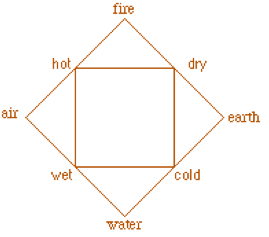
As Empedocles' diagram shows, there is a relation between the elements, where the combination of two elements result in a sensible quality. This relation goes both ways but in the game, it has been transformed into a clockwise relation where air supports fire, fire supports earth and so on. Later, Aristotle added the fifth element of aether or spirit for the unchangeable heavenly substance. This is also the role that spirit plays in the game: an undestructable substance that separates the earthly and corruptible elements. While the other elments win by destroying each other, spirit wins by maintaining the cosmic balance. For more about the four elements, I can recommend Wikipedia. The IconoclasmIconoclasm refers to "the deliberate destruction of religious icons and other symbols or monuments of one's own culture, usually for religious or political motives". Iconoclasms may take place within or between religions and historically they have been very destructive and dividing. Examples include the Byzantine iconoclasms, that split the Christian faith in Catholicism and Orthodoxy, and the Protestant reformation, that further split the Christian faith. The game originally symbolized the creation and destruction of temples by the followers of the Element Gods. Later, the theme switched to the more abstract and esoteric image of elements forming around cores, but since they were represented by icons the name Iconoclasm remained. For more about historical iconoclasms, I can recommend Wikipedia. |
Aristotle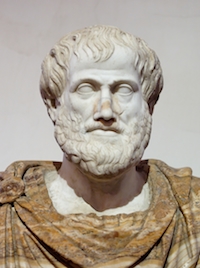
15th century icon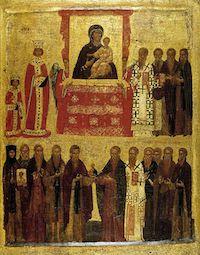
|