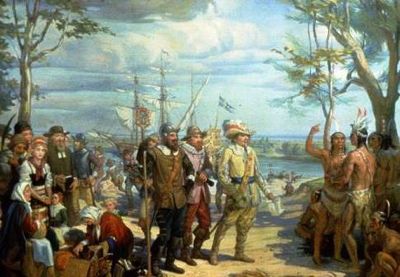
New Sweden was a Swedish colony 1638-1655. It stretched 300 kilometer along the
Delaware river and had at most 600 inhabitants, of which 400 from Sweden and Finland.
For an overview, I recommend Wikipedia and for more details the book The New Sweden in America,
edited by Rune Ruhnbro. Here I will focus on how the board game relates to the
real Nova Suecia.
The Trade Ships
Calmare Nyckel and Fogel Grip were the names of the two Swedish ships that first
arrived to what would become Nova Suecia. 12 expeditions were sent to Nova Suecia with
immigrants and tools and returned with fur and tobacco. They followed
the winds and currents past the Canary Islands and West Indies and back across the
Atlantic.
The Settlement Phase
All the districts in the game are named after forts and settlements in Nova Suecia
which themselves were named after people or places in Sweden.
The trade posts are named after the rivers that the natives travelled along to trade.
The expansion was gradual as indicated by the year on each district on the game board.
The Bidding Phase
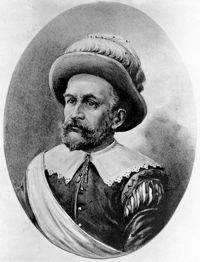
The first governor, Peter Minuit, bought land from five chieftains of the local
Lenape tribe. The natives were ignorant of the concept of owning land and often sold
the same land twice and the Swedish ambitions were disputed by the neighboring English
and Dutch colonial powers.
The Hiring Phase
Initially, the government did promote large-scale production and manufactories but the
economy gradually evolved into the smaller self-owned farms more commonly associated with
colonists in the New World.
Over 1 000 colonists immigrated to Nova Suecia, although many died at sea or returned home.
The first colonists were deserters, convicts or deported Finns and there was a constant
lack of women, as Governor Johan Pappegoya complained about in a letter home.
Production
The governor Peter Ridder reported of the good conditions for agriculture and industry.
He also sent home a shipload of beaver fur, which was in fashion in Europe at this time.
Governor Johan Printz was instructed to promote fur trade, cultivate tobacco, prospect
metals and even rear silkworm.
However, the tobacco plantations were abandoned in 1647 as tobacco could be acquired more
cheaply from the English colonies in Virginia instead. The iron industry never really
developed but so called bog ore could be extracted using lime and charcoal. In Batsto
(named by the Swedish word for sauna), there were forges that were said to have supplied
George Washington with bullets and cannons in the American War of Independence a
century later.
Overall, Nova Suecia yielded little return and requests for supplies from home were
frequent.
Trade Posts and Gold
Fur remained the most important trade good from Nova Suecia and the trade routes
with the natives were a
common source of tension between Swedes, Dutch and English. The natives could also turn
aggressive and governor Johan Printz actually
requested soldiers to break the necks of all of them. Fortunately his requests were
turned down and the governor later befriended the indians, who nick-named him Mechatz
(meaning big belly - the governor weighed 170 kilo). Unlike the English and the Dutch,
the Swedes never committed any atrocities against the natives.
Taxation
In 1641, the Dutch sold their shares in the New Sweden Company and Nova Suecia
became a matter for the Swedish government. Since the colony yielded little itself,
the governors' main concern was to acquire supplies from home to prevent the many
internal and external threats.
Prosperity and Disasters
Cultivation
The expansion of the colony was established by forts, around which settlements
arose and farms grew up. Farming was the predominant occupation in Nova Suecia but that
could not prevent cases of bad harvest and starvation. 1652 was a particularly bad year
and in 1655 only the help from Dutch merchants provided seeds to the colony.
Missionary vs Native Unrest
Native aggression was rare and only in response to poor trade or attacks from the
other Europeans. (The natives did not always make a difference between Swedes, English
and Dutch.) Nevertheless, there are records of 9 colonists killed by natives. Most
notorious is an attack in 1644 against governor Johan Printz' residence, leaving one servant
and two soldiers dead. But
not only trade but also missionary drew colonists and natives together.
Reorus Torkillus, the first Lutheran priest in America, found the natives hard to
convert but his predecessor Campanius Holm was more succesful and also compiled a dictionary of
their language.
Shipwreck and Piracy
Both tobacco and fur were in high demand in Europe but the transport was dangerous.
The ship Fogel Grip did actually sink in 1639, although not on a trade route, while her
sister Calmare Nyckel survived Nova Suecia and was later sold to the Dutch after four
trans-atlantic sails. Worth mentioning is that the ships were not only victims to pirates,
Fogel Grip added Spanish silver from the Caribbean to her load of tobacco and fur.
Supplies
The governors often requested supplies from home and often in vain. The ship Gyllene Hajen
was delayed several years until it finally departed. The ship Kattan sank outside
Puerto Rico and her crew and passengers suffered badly, first in the hand of the Spaniards and then
of the French. The ship Örnen was struck by dysentery, killing hundreds of immigrants. A second
journey for Gyllene Hajen ended in the Hudson River after a navigation error, where she was
seized by the Dutch. If just one of those ships had arrived timely and safely, Nova Suecia
might have fared better.
(Dis-)order
Dissatisfaction with governor Print'z dictatorial rule caused disorder in Nova Suecia
and 28 colonists made a petition
for governor Johan Printz' resignation. The governor had one of them executed, whereafter
fifteen colonists fled to the Dutch territories.
Dutch and English Relations
At good times, Nova Suecia lived in peace with her neighboring colonies. Tobacco was purchased
from the English in Virginia and Dutch merchants from New Amsterdam came to trade and the colony
could even attract English and Dutch immigrants. However, the Swedish colony was never really
acknowledged. The English complained about the Swedes dumping the fur price and when in 1644 the
explorer William Aspenwall travelled up the Schuylkill River, he was fired upon from the fort Älfsborg
and then invoiced for the cannon ball. In 1651, the Dutch built the fort Casimir south of fort Christina
to cut the Swedish control of the Delaware river. The fort was captured in 1654 and renamed to
Trefaldighet but lost again to the Dutch governor Stuyvesant, who then laid siege to Christina and
pillaged the colony. Governor Johan Rising had mustered a militia among the colonists but he could
still not match the 300 Dutch soldiers and artillery. After a couple of weeks, he surrendered and
Nova Suecia was lost.