
 |
Home | Game | Rules | Theme | Strategy | FAQ |  |










































|
Version History
The complete rules are available in the PDF file to the right. In the following sections, I will describe how they came to be. Implemented Rules 2nd EditionThere are many ideas that came to live in Nova Suecia - the Board Game©. On this page, I would like to present some of them and explain the reasoning behind them. ActionsShip/LetterRandom elements add uncertainty to a game but must be used with caution. Too many removes control from the players and turn the game into a luck feast while too few turn the game into calculation exercise where the players may suffer from analysis paralysis. In The Last Letter Home, you produce first and sell later, when the prices have changed. However, if the production information is open, it's possible to exactly calculate what the prices will be like when it's your turn to sell (based on what the other players have produced) and use that calculation when deciding which resources to produce. To make the production information hidden would only turn the game into a memory game and wasn't a very good option. Instead, I added a random element between the production and the sales: the ship bag that the players fill with their letters. By letting market influencing resources be hidden in a bag and drawn randomly, the players would still be able to use calculation and memory to predict the price changes but they would never be sure. Sell/BuySimilar to the ship discussion above, producing and selling the same turn would turn the decision about which resources to produce into a calcuation exercise. By simply putting the sell action before the buy (and produce) action, an uncertainty lag was added between investment and return. SettleThere are many ways to distribute districts, from random drawing to free selection. However, few are interactive as well. The use of two ships, one that enables or opens districts and one that disables or closes districts, not only added a spatial element to the game, it also gave the players the power to offer or deny other players districts. The typical example is when you open both a plantation and a spin to produce plant and get someone else to buy it from you for their spin. ResourcesGoldGiven that the players produce first and sell later, the revenue will usually be eaten up by higher costs for the higher production next turn until eventually a steady surplus will be achieved. The addition of gold (loans and deposit) added investment decisions: will the revenue I get from a loan outweigh the cost for it? What will yield the most, investment in resources or in deposits? ColonistsColonists are the key to production so why let them be free instead of having a market value as well? One reason is to minimize transactions, another that they do have a cost - an opportunity cost for delayed production by another colonist. But why getting more colonists at all then instead of just having one settling and producing over and over? Because it takes an action to get back colonists so the more colonists you have, the less often do you have to waste an action taking them back. Thus, the solution of free colonists/opportunity cost/action efficiency enables strategies like no growth (play with few colonists), slow growth (add colonists when you can afford them) and accelerated growth (take loans to add colonists early). Iron/GrainIron and grain are two similar resources. They are both bought and sold by the players. They are both needed for production (2 grain produce as much as 1 grain+1 iron). They can both be supplied to the market from the ship. To differentiate them, they got different price curves: iron has a flat curve while grain ranges from very cheap to very expensive (which is also thematic). Timber and Log CabinsWhile iron is a one-time increase of the revenue, its opposite timber is permanent decrease of the cost. Since this is typically interesting early in the game, it was necessary to let the ship demand it from the market to keep the price up and prevent it from being too weak in the late game. Likewise, it was necessary to make timber slightly cheaper than other resources (the total value of all market squares is 39 instead of 42), otherwise it would be too strong in the early game. The pay-off ratio was set to 2-3 turns to make investments profitable as long as possible (buy 1 cheap timber and sacrify a production of 2 resources turn 1 to save 1 more expensive grain every turn, including turn 1). The pay-off ratio could have been even shorter if log cabins were allowed to feed 2 colonists and save 2 grain each turn but this would more or less force the player to keep 2 colonists there all time and reduce her decision space. Plant and TobaccoPlant is the raw material necessary for tobacco. Should tobacco then be priced twice as much as plant? No, since the acquisition of plant is an investment that could have been used for iron and timber instead, the total price is higher (the total value of all market squares is 90 instead of 2x42). FurFur could have been a "neutral" resource with no relation to other resources. However, to make it more interactive, its production was linked to the number of open trade posts. This added an interesting cooperation mechanism: the more trade posts the player open, the more resources do they produce, but the more colonists they place to maximize the production, the more the prices will fall. Since a trade post can produce up to 4 fur (if all trade posts are open) while a normal district only produce 2-3 resources (since 4 resources require 1 iron), the total price is lower (the total value of all market square is 30 instead of 42). The TaxesAll engine games should stop when the engines are up and running. If all players would be able to afford increased production (with extra colonists and iron), the game would quickly turn boring. The addition of taxes, which increase the longer the game plays, will maintain the scarcity of resources throughout the game. In addition, by letting the Dutch ship charge higher taxes (thematically they raid the Swedish district), a time and space element could be introduced, where the players have to plan when and where the ships will be at their districts to avoid the higher taxes. The End GameGames with a fixed number of rounds often lead to last round optimization, which increases analysis paralysis and downtime, games with a random ending doesn't reward long term planning. Nova Suecia uses a middle way by letting the ships' opening and closing of districts also trigger the game end. Once a ship has completed its "mission", i.e. when all districts are either closed or open, the game naturally ends. To prevent never ending games, the maximum number of ship laps was introduced. Since the players collaboratively move the ships, the exact number of rounds will still be veiled. Advanced rulesAs discussed above, the ship bag introduced a random element. With experience, random elements usually become less important and appreciated, so the advanced rules gave back some control. The addition and/or removal of a resource offers a way to modify the supply and demand, while the removal of the ship bag offers almost full control of the future market. Implemented Rules 1st EditionThere are many ideas that came to live in Nova Suecia - the Board Game©. On this page, I would like to present some of them and explain the reasoning behind them. The NumbersThere is a lot of numerology in this game. 3, 4 and 5 are the number of players that may play and I have struggled to adapt the other numbers. Thus, the number of districts is 12/16/20 to ensure that there 4 districts per player and the amount of tax to the colony is modified to compensate for the fewer/more trade posts. Colonists and grain arriving each game turn equals the number of players to ensure there is one each and the same applies to the initial fur placed in the colony. Differences will remain but at least there will not be completely different games for different number of players. The BalanceOn average, a player needs 2 colonists per district, meaning that the game needs 6-10 colonists the first game turn, 12-20 the second etc. Unfortunately, only one farm comes into play each game turn, supplying only 4 colonists. That's why the players start with a log cabin. What about the next? Here the steady supply of colonists and grain equal to the number of players will help. OK, but what happens when the game runs out of farms and only non-food districts come into play? That's why there are log cabins to replace the need of colonists. Gee, this all sounds complicated. No, only to the design, in the actual game, the players only have to move colonists and grain back and forth to keep track of the balance. But it's still a fragile balance, isn't it? That's right and that's exactly what this game is all about: to maintain the balance between production types! The CooperationThe players need to trade with each others to optimize the production and manufacturing of goods and thus optimize the overall economy of the colony. But the average profit a colonist generates is 1 gold, whether it is the player's own goods or another player's goods that are manufactured. Why then should a player cooperate if he or she can both produce and refine? The answer was the ability to trade up to 3 goods from one district before the price falls, thus encouraging players to concentrate their production to few districts. Now, the player has to weigh the options of cooperating with other players and denying them trade opportunities. Cost and RevenueEach district type is supposed to have similar return on investment but different opportunities for increasing the return. Each colonist costs 1 gold and returns 2. A colonist in step 2 of the value chain returns 4 gold (average market price) but have to purchase raw material for 2 gold, thus still yielding a net return of 1 gold. Over five game turns, a province with on average 2 colonists will return 10 gold. Now to the differences.
There is also a time aspect. Farms and trade posts generally generate a stable revenue early while tobacco and metal districts may generate a high revenue late. Again, the players have to choose what fits their strategies. Stretched ResourcesInitially, the game was just about accumulating gold but I added several mechanisms where you have to decide between spending and saving, selling and storing, accumulating and investing. You may let a colonist build a log cabin for higher revenue in the future at the cost of no revenue now. You may store goods to wait for higher prices in the future or sell them for cash now. You may spend money on taxes to further your interest or save them in the hope of someone else paying for you. But you can't do all at the same time. Positive and negative taxIn real life, the problem with free-riders is outweighed by people willing to pay for the common good. However, in a game with only one winner, players may all end up like free-riders since they prefer all to lose than one to win. To add the incentive to pay taxes, the mechanism of positive and negative effects was introduced. Not only can you further your own interests but you can also damage that of others. You may still free-ride but the risk is now greater. The difference between area I-IV (affect each other) and area V-VIII (affected by the taxes or the lack of taxes in area I-IV) is due to the expected player behavior; area I-IV provide specific effects for specific district types (such as Agriculture giving farms benefits) and can be expected to get more taxes than Area V-VIII, which provide general benefits for several district types. As for the relations between the areas, there is some reasoning behind it. Metal for example provides tools to the tobacco production (positive effect on tobacco trade) but also weapons that may be used both offensive against the natives (negative effect on missionary) as defensive against the Dutch (positive effect on Dutch relations). Nevertheless, the relations are not intuitive so game aides were added so that the players may refer to the effects before allocating taxes. Semi-hidden TaxationInitially, the taxation was completely hidden. Both the total tax and the allocation to specific tax areas was hidden from the other players, creating a lot of nerve in the taxation. However, practically it was very difficult to keep track of who placed where. In a 4 player game with 8 tax areas per player, there are 32 areas to keep track of? The risk of mistakes and even cheating was just too big. Instead, I went for the semi-hidden tax allocation, where the players place gold in reversed turn order but upside down (of which some may have 0 value). In the end, I think this semi-hidden taxation creates even more nerve. The FortEconomic games usually needs limits that force the players to balance their economies. Many games rely on "economic engines", where initial cheap investments are followed by later expensive investments. However, in Nova Suecia the entire colony is an economic engine where the increased number of districts and colonists benefit all players. This resulted in early limits, as the players struggle to build an economy, but later abundance, as the colony prospers. While thematically good (the players build a strong colony together), it mechanically reduced the end game to a gold race. The solution was inspired by Istanbul: let the players "buy" victory points by building a fort but where each new fort level gets more expensive. This forces the players to balance between investing in the colony (to increase the future revenue) or investing in the fort (while the cost is low) and maintain the economic limits throughout the game! |
Rules (Video)
Rules (PDF)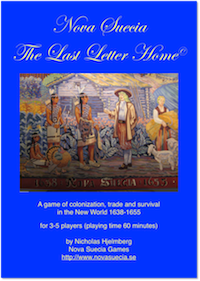
Rejected RulesThere are of course also ideas that did not make it and here I explain why. The rejected rules include all redundant mechanisms from the first edition that did not support the core interdependency mechanism: Bidding for districtsBidding may be good if the bid object has slightly different values for different players but in The Last Letter Home, there are no such differences so the bidding would be reduced to a ROI calculation. Direct tradeYou can't have much more interaction than direct trade. However, it's also a very time-consuming mechanism. It works with simple commodity trades like in Settlers and Civilization but price negotiations are less fun. TaxesThe initial idea with taxes for the common good was to add a semi-cooperative element with free-rider challenges. However, apart from being fiddly (hidden payments to different tax areas added together for all players), it's a debated mechanism, as Archipelago shows, and I'm no longer sure it makes a game funnier. Rejected RulesThere are of course also ideas that did not make it and here I explain why. Bid for foodIn the game, there is an indirect relation between food and colonists. How about if the farmers would sell food directly to the other players and if those players would be directly unable to produce without food? Imagine the chaos when every player bids for the scarce grain tokens (there can be quite a few of them). No! The current system is much more subtle. The total food affects the total colonists NEXT game turn. The players then pick colonists in turn order. The farmer still have balance power but not against individual players but against the entire game. (In spite of this, I tried the same with lumber but realized that the game does not need more player negotiations - the tobacco and metal negotiations are enough and no more, no less are needed.) Bid for colonistsThe player paying the most tax gets to start the turn first and may thus pick one more colonist than other players. Was it too much of an advantage? Should the other players be allowed to bid for the colonists? Again, no! The highest tax should give benefits and if the other players could outbid that benefit the incitement for tax is lost. Pay your tax or take the consequences! BuildingsAt one time, the players paid for and built manufactories and warehouses. However, as those buildings are more or less required to make the district pay off, the building added an unnecessary moment. Later, warehouses existed from the start while manufactories were "built" by removing a colonist from production that turn. Simple and elegant but still a "must-do" strategy with no choices or struggles. Now, the players have to pay both to build and to maintain log cabins so they need to weigh the increased productivity against the inflexibility of not being able to move the log cabin. Balancing rulesThere is a balance between too little and too much balance. My attempts to force balance upon players were met with frustration during the test and added more confusion than balance. Away went the "free" colonist (household) to allow production even in the worst of times, away went the requirement of at least 1 colonist and the specialization bonus for 3 colonists in a district, away went the set up district allocation to ensure early farms (food) and trade posts (tax). Now the players are more free to create their own balance (or throw the poor colony completely over if they fail...) Houses and shipsLumber played an important role for house and ship building in the real Nova Suecia but not so in the game. Perhaps lumber can be included in the game balance? Perhaps the lumber trader can choose whether to trade to the districts (to allow them to house colonists) or to the ships (to allow overseas trade)? Perhaps it would just add unnecessary complexity (although one aspect of lumber did make it to the advanced rules). Colonist starvationOne idea on the theme of "sabotaging" other players' game was to deny them food and thus colonists. The idea was interesting but I feared that it would make farms too strong since there wasn't any real disadvantage for the farmer to do so (unlike for raw material producers, where denying other players their goods only destroys their own business) and create too strong kingmaker scenarios. But perhaps the most important argument was that the idea interfered with the balance idea of the game, the players are supposed to cooperate for the colony's best while getting a share for themselves and sabotage is supposed to disturb the balance and everybody's game. (Nevertheless, a more subtle way of starving opponents made it to the advanced rules.) Farm and trade post warehousesShould farms and trade posts be able to store goods just as the other district types? This would give them interesting option to speculate in scarce resources. However, the effects are not as obvious as for the other district types and gave rise to analysis paralysis during testing. To avoid this, I first moved the warehouses to the advanced rules and then removed them completely. They still appear on the game board if anyone wants to include them in house rules but given the experience, I don't recommend them. |