 |
Home | Game | Rules | Theme | Strategy | FAQ |  |











































|
Version History
The complete rules are available in the PDF file to the right. In the following sections, I will describe how they came to be. Implemented RulesThe "Game Board"The purpose of a game board is to have an area where players can move around meeples and collect item cards. However, in Mingle and Murder, the game board is really nothing else but a grid holding the cards to be collected. Since each item card is linked to a specific room and replaced by a mingle card when taken, why not simply replace the item cards with room cards representing the grid? In that way, the game would save the cost of a game board. Why only one room card at the time then? This is simply to make it more difficult for a guest to find all the room cards he or she needs in the first round. The Room SymbolsWith each room being represented by a room card, there is really no need for any other component to tell which room it is. Still, I decided to accept the cost of adding miniatures for room symbols. Why? The rule states that a room symbol indicates whether the room has items or not but this could equally well be accomplished with room cards face up for non-empty rooms and mingle cards face down for empty rooms. One could argue that it give one less flipping moment in the end of each round but it's not a very strong argument. Instead, I added them to give a 3D feeling to the mansion that the cards are representing. Still, it does add a cost and I may have to consider a cheaper version in the future (but they do look nice, don't they?). The Character CardsThe only game purpose of the action cards is to tell who plays which meeple. They also contain flavor text for the roleplaying part of the game. (Just like in Clue, it's funnier to play "Colonel Mustard" than "yellow".) Given that The Game Crafter charges cards by the sheet, the 8 extra cards did not add to the cost, so I decided to add them as well. The Action Cards
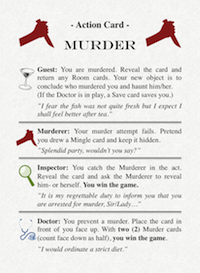
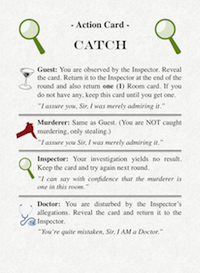
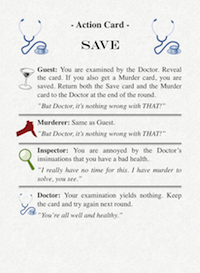
How about the important cards then? They are all natural in a murder mystery game (murder victims, catch the murderer, save the victims) but serves game purposes as well. The murder cards are the core of the game - without them, no murder. But the way they are best played also fits the theme. The murderer will want to leave them in rooms where many guests have passed to make them more difficult to trace. The guests, on the other hand, will want to avoid rooms where many guests have passed to increase their odds of finding a room card. This gives a scenario where guests sneak around to be alone, shadowed by a murderer waiting for the best opportunity to strike. The catch cards are NOT used to catch the murderer. The simple reason is that this would create a cheating opportunity as the murderer drawing a catch card may refrain from telling that he or she is the murderer. The opposite way of letting the inspector tell whether he or she drew a murder card or not is safer - the inspector will want to tell since this give him or her the victory. So the catch cards are unnecessary then? No, they serve two purposes. First, they add catch-up mechanism as guests run a risk of losing cards. Second, they give all players, not only the murderer, a reason to stay away from the inspector, making his or her deduction more challenging. This also fits the theme with an inspector being hindered rather than helped by the witnesses due to their secret objectives. The save cards also serve a dual purpose. The guests will want to stay away from the doctor to increase the chance of finding room cards but so will the murderer to decrease the risk of the doctor drawing a murder card. Again, this fits the theme of a doctor wanting to help unwilling patients.
The Object CardsThe objects of Mingle & Murder were the most challenging to come up with. They need to be well balanced to give all players an equally fair chance to win the game. After a lot of probability calculations, I came up with the levels of 2 murders for the murderer, 1 arrest for the inspector, 2 saves for the doctor and 3 room cards for the guests. Later on, the guests were given the additional objective of collecting 3 mingle cards from the other guests. With 2 cards per room and 2 mingle cards per guest, the two objectives are fairly equal and the addition prevent the risk that players not finding any room cards in the first round fall behind. Let's start with the guests probabilities. Since 1 guest will be murdered shortly, I calculated with 1 room per player and an average of 3 action cards being placed in each room. This gives 75% probability that the room card gets drawn. The more rounds that are played, the greater the chance of both room cards getting drawn.
Given a normal distribution of cards, 1 guest may have 3 cards from round 3 and onwards. This gives the other players 3 rounds to attain their objects. Let's move on to the murder object. Given the assumptions of above with 4 cards in each room, there is a 25% chance that the murder card is drawn by the murderer him- or herself and another 25% chance that it's left undrawn. Assuming 1 placed murder card per round (to minimize the risk of getting traced back to the murderer) I came up with the following probabilities for 2 murders (with the victory divided between the murderer and the victims based on the how many survivors there are to choose from for the victims): 5-6 players (average 5.5)
Adding the inspector object at 7-8 players, I used the probability for a successful murder divided by the number of players excluding the murderer and reduced the murder victory probability accordingly. 7-8 players (average 7.5)
Finally adding the doctor object at 9-10 players, I had to add probabilities for the doctor drawing a murder card, for a guest to draw a murder card together with a save card and for the murder card to be left in the mansion. 9-10 players (average 9.5)
I can't claim that the assumptions and calculations are perfect (please feel free to check them here) but as they are, they indicate that the game has a good balance. In the 5-6 player variant after round 3, the murderer should win 1 of 3 games and any of the guests 1 of 2 games. Adding the inspector in the 7-8 player variant, the murderer and the inspector have about equal victory opportunities. The doctor's victory opportunity in the 9-10 player variant is smaller but increases the longer the game lasts. (This is also why he was given an additional 1/2 point for murder cards left in the mansion.) The victim victory is small but should, otherwise players would prefer being murdered (!). Of course, those probabilities are only indicative as the players' strategies may increase or decrease their odds. More about that in Strategy. The important conclusion is that no object seems to be over-powered, something that the tests also confirmed. |
Rules (Video)
Rules (PDF)
... and Rejected RulesThere are of course also ideas that will be rejected and here I will explain why. Steal from guestsTo give players not finding a room card in a room a chance to get it anyway, a possibility to steal from guests was introduced. However, by introducing the object of mingle cards, players not finding room cards got a second chance and the stealing rule became redundant. Move in mansionAs the stealing rule became redundant, so did the movement rule. The new place/displace rule kept the tension of observing which rooms the other players target and made the whole card acquisition part more streamlined, giving more focus to the core deduction part. Scaled mansionWith few players and many rooms, there was a risk that the mingle cards would be so spread out that the murder cards would be easy to trace back to the murderer. This was solved by scaling the mansion to the number of players. However, this introduced the problem to match object cards to rooms in play. Eventually it became clear that the risk didn't exist, since the players would only visit rooms on their object cards and leave other rooms empty, so the scaling rule could be removed. |
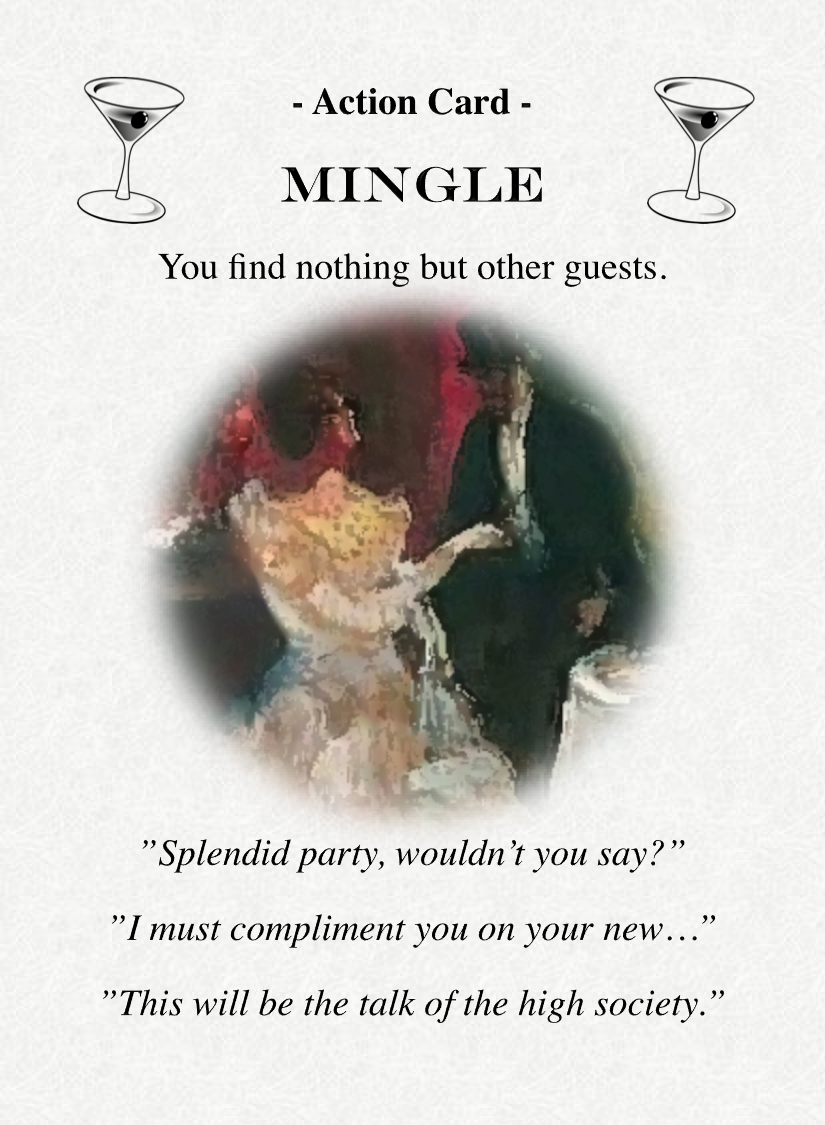 Most action cards are mingle cards of no importance. Does this mean that they are redundant? No, the number of cards is necessary to create a "mystery fog" that hides the important murder, catch and save cards. One alternative would be turn them into different items of different value to different players to allow them to build hands or even engines for victory point scoring like in other card games. But this game is not about building engines, it's about searching and deducing, and just because a mechanism works in one game, it shouldn't automatically be added in all games.